Loading page, please wait…
Vaidra Logo
Vaidra

Top 4 items + smart groups

UPSC GPT
New
Current Affairs
Daily Solutions
Daily Puzzle
Mains Evaluator

Version 2.0.0 • Built with ❤️ for UPSC aspirants

Loading...
Loading...
Loading...
Loading...
Loading...
Loading...
Loading...
Loading...
Loading...
Loading...
Loading...
Loading...
Loading...
The State of Food Security and Nutrition in the World 2024 - UPSC Social Issues
Back
All Subjects

Topics

0 topics • 0 completed

Loading topics...
Loading...
Loading...
Loading...
Loading...
Loading...
Overall Progress0%

The State of Food Security and Nutrition in the World 2024 - UPSC Social Issues

What is The State of Food Security and Nutrition in the World 2024 in UPSC Social Issues?

The State of Food Security and Nutrition in the World 2024 is a key topic under Social Issues for UPSC Civil Services Examination. Key points include: SOFI 2024 report by FAO, IFAD, UNICEF, WFP, WHO highlights global food security and nutrition trends.. India has the highest number of undernourished individuals globally (194.6 million), though numbers have decreased since 2004-06.. Over half of India's population (55.6%) cannot afford a healthy diet, impacting 790 million people.. Understanding this topic is essential for both UPSC Prelims and Mains preparation.

Why is The State of Food Security and Nutrition in the World 2024 important for UPSC exam?

The State of Food Security and Nutrition in the World 2024 is a Medium-level topic in UPSC Social Issues. It is tested in both Prelims (factual MCQs) and Mains (analytical answer writing). Previous year UPSC questions have frequently covered aspects of The State of Food Security and Nutrition in the World 2024, making it essential for comprehensive IAS preparation.

How to prepare The State of Food Security and Nutrition in the World 2024 for UPSC?

To prepare The State of Food Security and Nutrition in the World 2024 for UPSC: (1) Study the comprehensive notes covering all key concepts on Vaidra. (2) Practice previous year questions on this topic. (3) Connect it with current affairs using daily updates. (4) Revise using key takeaways and mind maps available for Social Issues. (5) Write practice answers linking The State of Food Security and Nutrition in the World 2024 to related GS Paper topics.

Key takeaways of The State of Food Security and Nutrition in the World 2024 for UPSC

  • SOFI 2024 report by FAO, IFAD, UNICEF, WFP, WHO highlights global food security and nutrition trends.
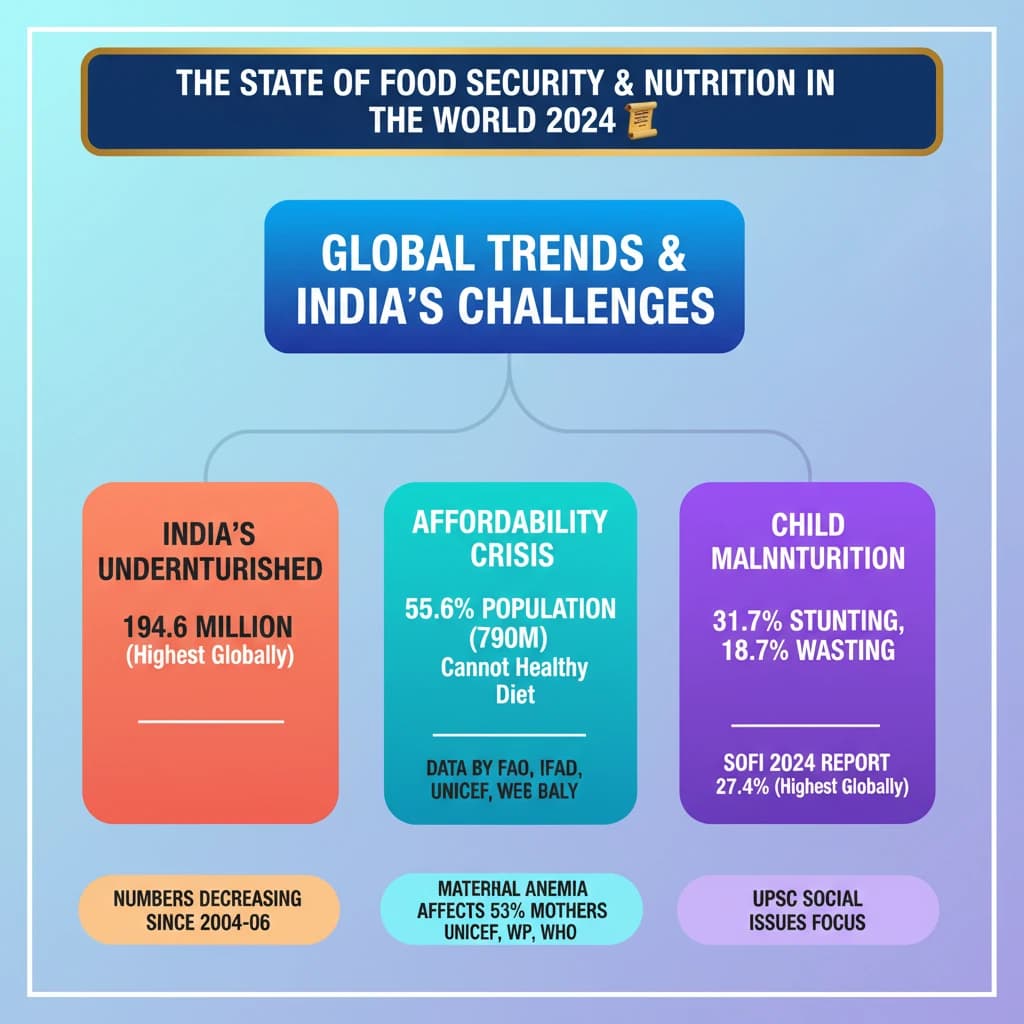
  • India has the highest number of undernourished individuals globally (194.6 million), though numbers have decreased since 2004-06.
  • Over half of India's population (55.6%) cannot afford a healthy diet, impacting 790 million people.
  • India faces a significant burden of child malnutrition (18.7% wasting, 31.7% stunting) and maternal anemia (53%).
  • Low birth weight (27.4%) is highest globally in India, indicating severe maternal malnutrition.
  • Rising obesity (7.3% adults) alongside undernutrition presents a 'double burden of malnutrition' challenge.
  • The report calls for increased financing to end hunger and malnutrition, emphasizing the urgency for SDG 2.
The State of Food Security and Nutrition in the World 2024

The State of Food Security and Nutrition in the World 2024

Medium⏱️ 8 min read✓ 95% Verified
social issues

📖 Introduction

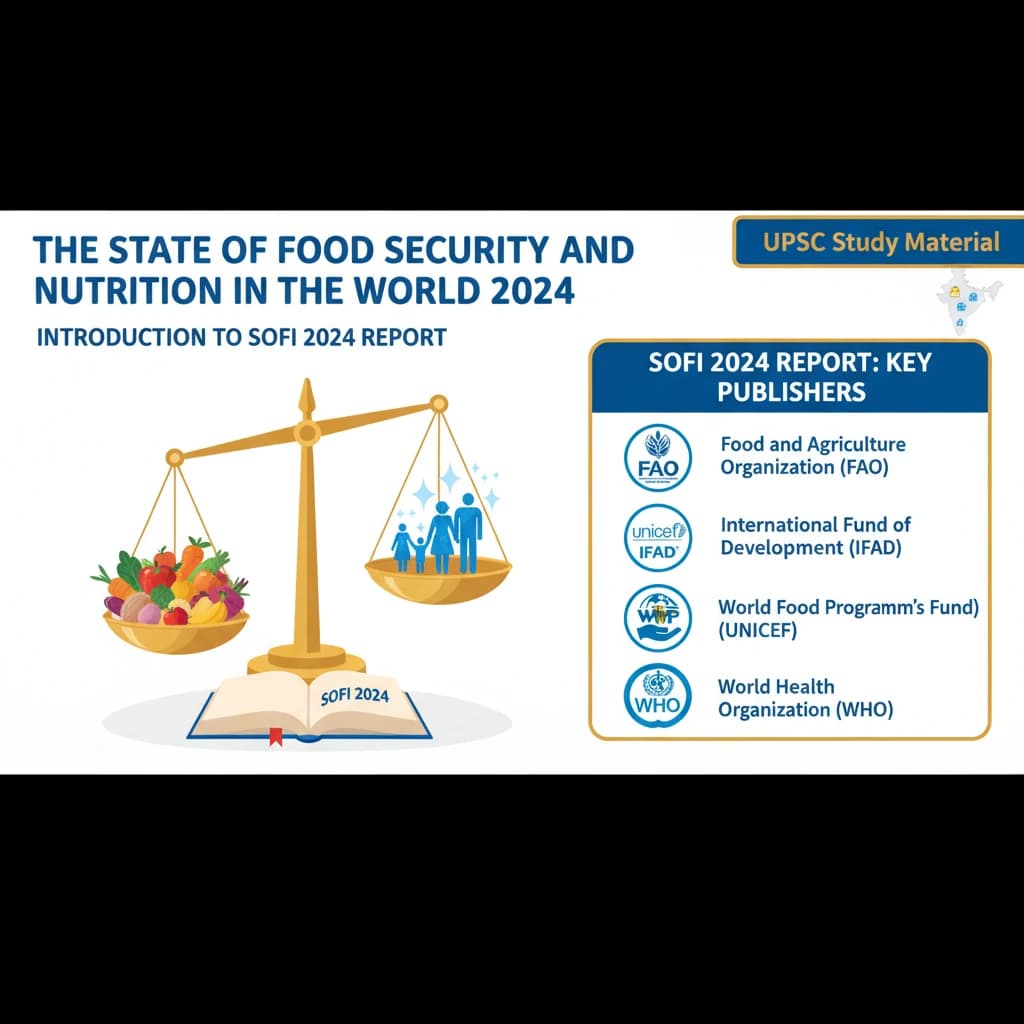
<h4>Introduction to SOFI 2024 Report</h4><p>The <strong>“State of Food Security and Nutrition in the World 2024”</strong> (SOFI 2024) report is a crucial annual publication. It provides a comprehensive analysis of the global status of <strong>food security</strong> and <strong>nutrition</strong>.</p><div class='info-box'><p>The <strong>SOFI 2024 report</strong> is jointly published by five leading international organizations:</p><ul><li><strong>Food and Agriculture Organization</strong> (FAO)</li><li><strong>International Fund for Agricultural Development</strong> (IFAD)</li><li><strong>United Nations Children's Fund</strong> (UNICEF)</li><li><strong>World Food Programme</strong> (WFP)</li><li><strong>World Health Organization</strong> (WHO)</li></ul></div><div class='key-point-box'><p>A central theme of the <strong>SOFI 2024 report</strong> is the urgent requirement for <strong>increased financing</strong>. This is essential to effectively combat <strong>hunger</strong>, <strong>food insecurity</strong>, and all forms of <strong>malnutrition</strong> globally.</p></div><h4>Key Findings Related to India</h4><p>The <strong>SOFI 2024 report</strong> highlights several critical aspects concerning <strong>India's food security and nutrition landscape</strong>. These findings underscore persistent challenges despite some areas of improvement.</p><div class='info-box'><p><strong>Undernourishment in India:</strong></p><ul><li>India is home to <strong>194.6 million undernourished individuals</strong>, which is the <strong>highest number globally</strong>.</li><li>Despite this, the number has decreased from <strong>240 million</strong> in the <strong>2004-06 period</strong>, indicating some progress.</li><li>Approximately <strong>13% of India's population</strong> suffers from <strong>chronic undernourishment</strong>, pointing to long-term food insecurity issues.</li></ul></div><p>The report also points out significant challenges in access to <strong>healthy diets</strong>. A large proportion of the Indian population struggles to afford nutritious food.</p><div class='info-box'><p><strong>Affordability of Healthy Diets:</strong></p><ul><li><strong>55.6% of Indians</strong>, translating to about <strong>790 million people</strong>, cannot afford a <strong>healthy diet</strong>.</li><li>This proportion shows a slight improvement of about <strong>3 percentage points</strong> compared to <strong>2022</strong> figures.</li></ul></div><div class='exam-tip-box'><p>India's performance in the <strong>Global Hunger Index (GHI) 2023</strong> is also relevant. The country ranked <strong>111th</strong>, which further emphasizes the significant issues in achieving comprehensive <strong>food security</strong> and <strong>nutrition goals</strong>.</p></div><p>Child and maternal health indicators remain a major concern. India faces high rates of various forms of <strong>malnutrition</strong> among vulnerable groups.</p><div class='info-box'><p><strong>Child and Maternal Malnutrition:</strong></p><ul><li>India has the <strong>highest prevalence of wasting (18.7%)</strong> in <strong>South Asia</strong> among children under five years.</li><li>The prevalence of <strong>stunting</strong> in children under five is also high at <strong>31.7%</strong>.</li><li><strong>27.4% of babies born in India</strong> have <strong>low birth weight</strong>, the <strong>highest globally</strong>, reflecting widespread <strong>maternal malnutrition</strong>.</li><li><strong>53% of women in India</strong> are <strong>anaemic</strong>, which is the <strong>highest in South Asia</strong>.</li><li>The report projects that the <strong>global prevalence of anaemia in women aged 15–49</strong> is expected to increase, significantly driven by trends in <strong>South Asia</strong>.</li></ul></div><p>While addressing undernutrition, the report also highlights the rising concern of <strong>obesity</strong> in India, indicating a <strong>double burden of malnutrition</strong>.</p><div class='info-box'><p><strong>Obesity Trends:</strong></p><ul><li>The prevalence of <strong>obesity in children under five years</strong> is <strong>2.8%</strong>.</li><li>In adults, the prevalence of <strong>obesity</strong> has risen to <strong>7.3%</strong>.</li><li>A significant portion of the <strong>Indian population</strong> is <strong>physically inactive</strong>, which is a contributing factor to the observed rise in <strong>obesity rates</strong>.</li></ul></div>
Concept Diagram

💡 Key Takeaways

  • •SOFI 2024 report by FAO, IFAD, UNICEF, WFP, WHO highlights global food security and nutrition trends.
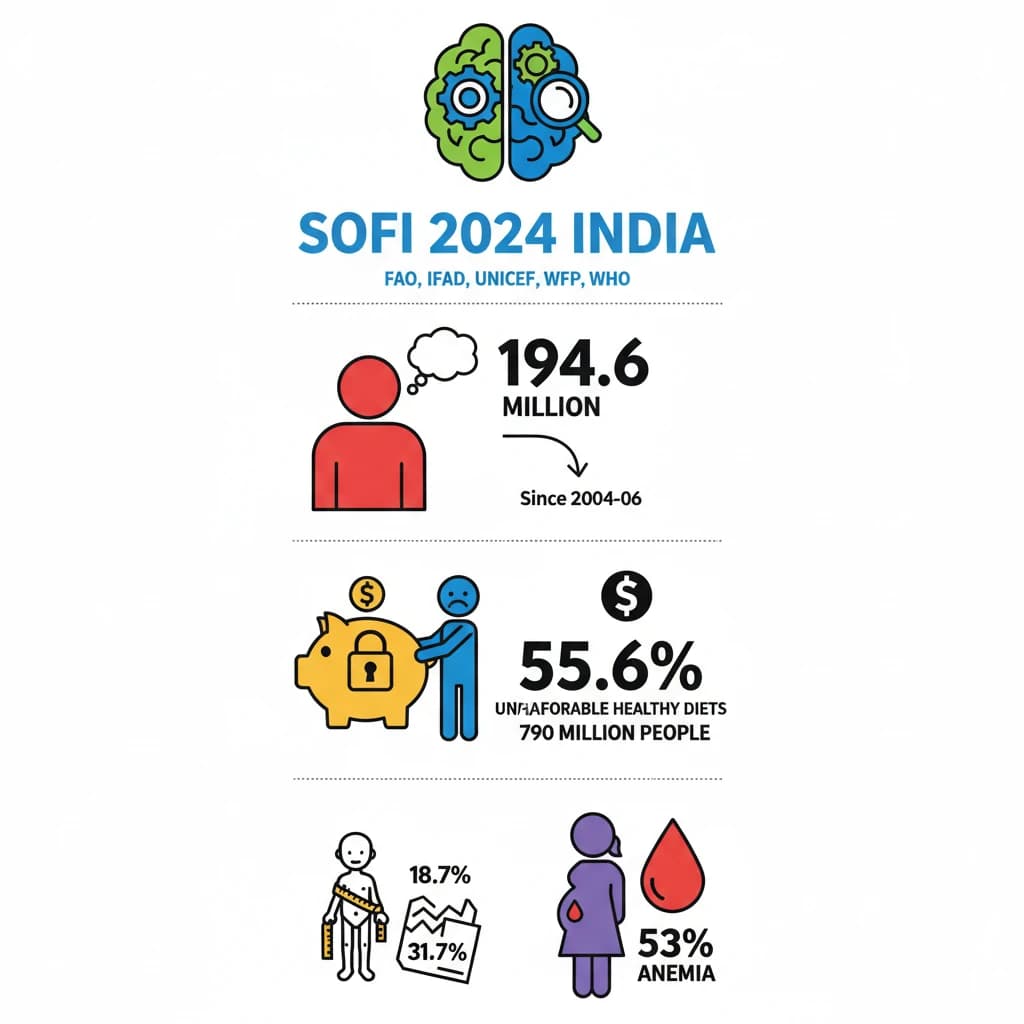
  • •India has the highest number of undernourished individuals globally (194.6 million), though numbers have decreased since 2004-06.
  • •Over half of India's population (55.6%) cannot afford a healthy diet, impacting 790 million people.
  • •India faces a significant burden of child malnutrition (18.7% wasting, 31.7% stunting) and maternal anemia (53%).
  • •Low birth weight (27.4%) is highest globally in India, indicating severe maternal malnutrition.
  • •Rising obesity (7.3% adults) alongside undernutrition presents a 'double burden of malnutrition' challenge.
  • •The report calls for increased financing to end hunger and malnutrition, emphasizing the urgency for SDG 2.

🧠 Memory Techniques
Memory Aid
95% Verified Content

📚 Reference Sources

•Drishti IAS Summary of SOFI 2024 Report
•Government of India official documents (NFSA, POSHAN Abhiyaan)

Related Topics

Loading related topics...
Explore:Social Issues Topics·All Subjects·Daily Current Affairs·Editorial Analysis·Previous Year Questions·UPSC GPT