📖 Introduction
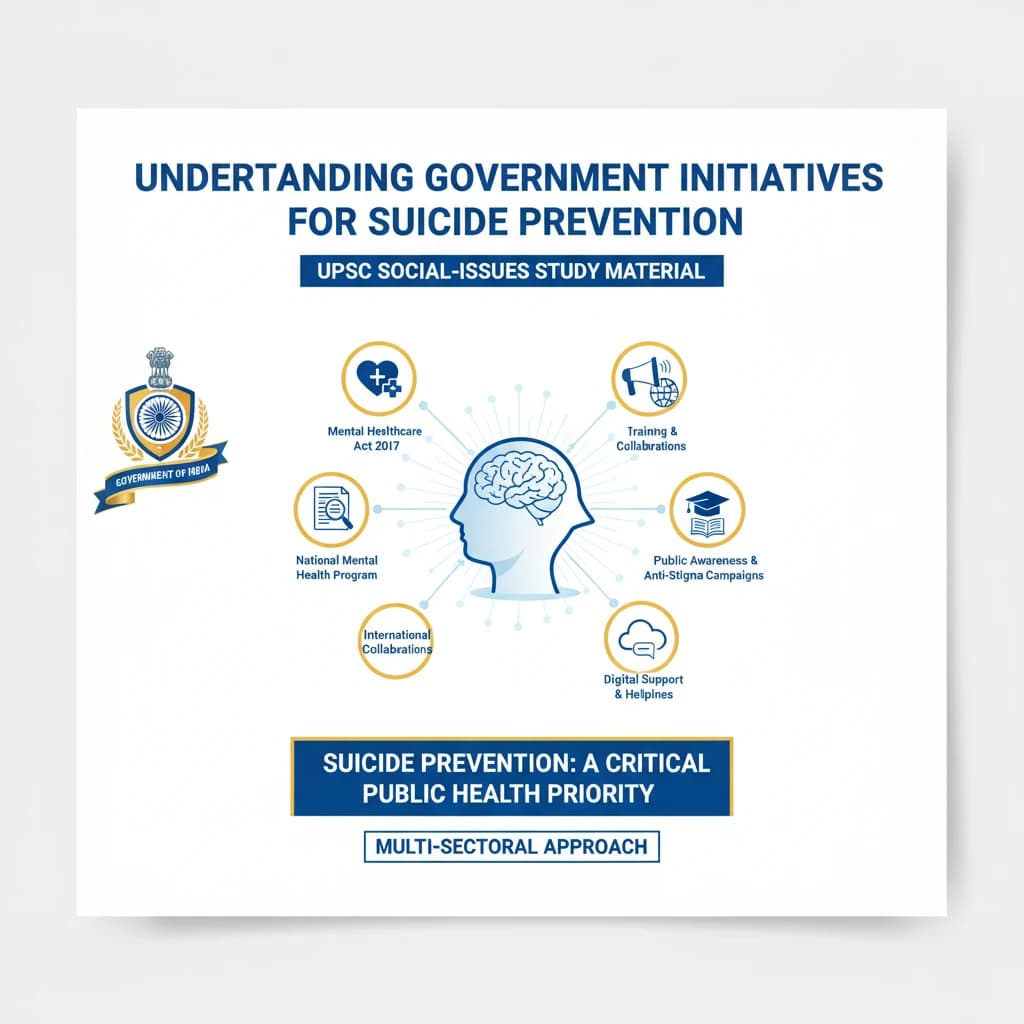
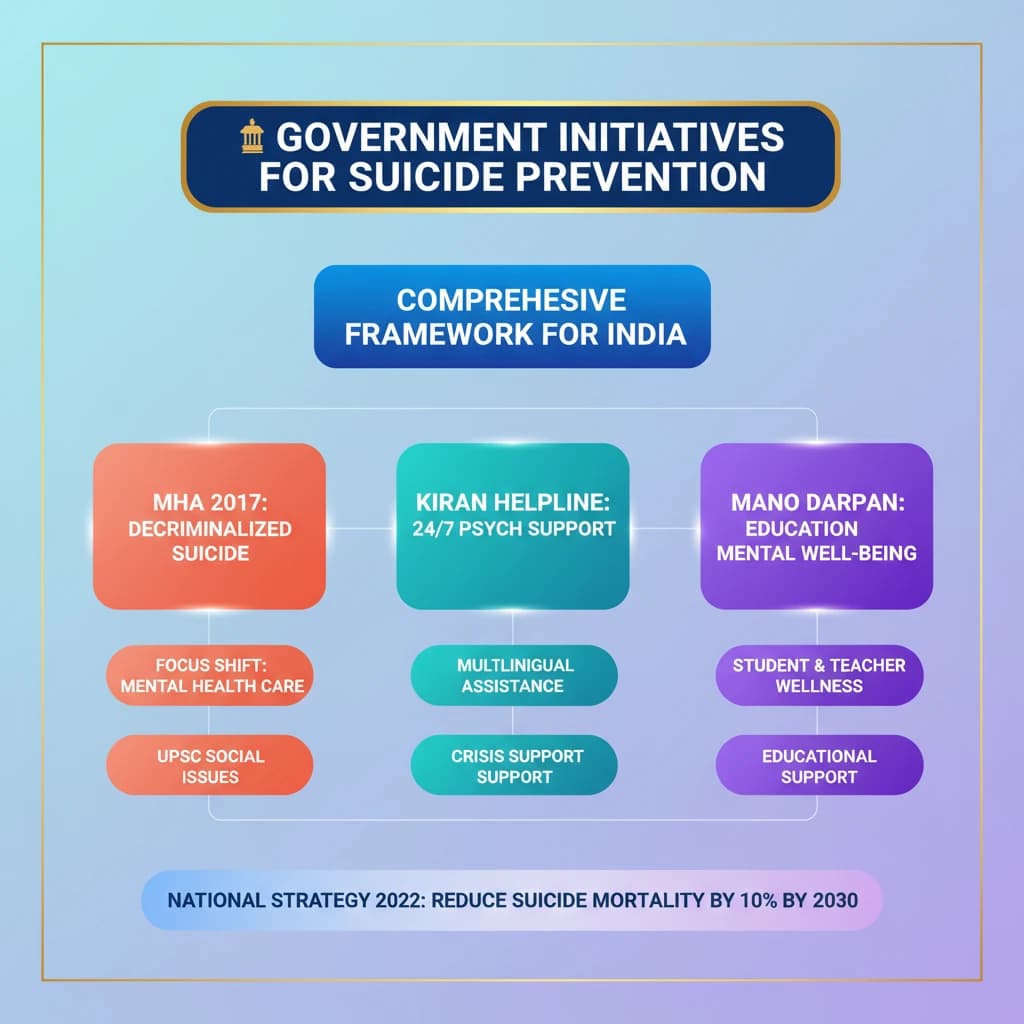
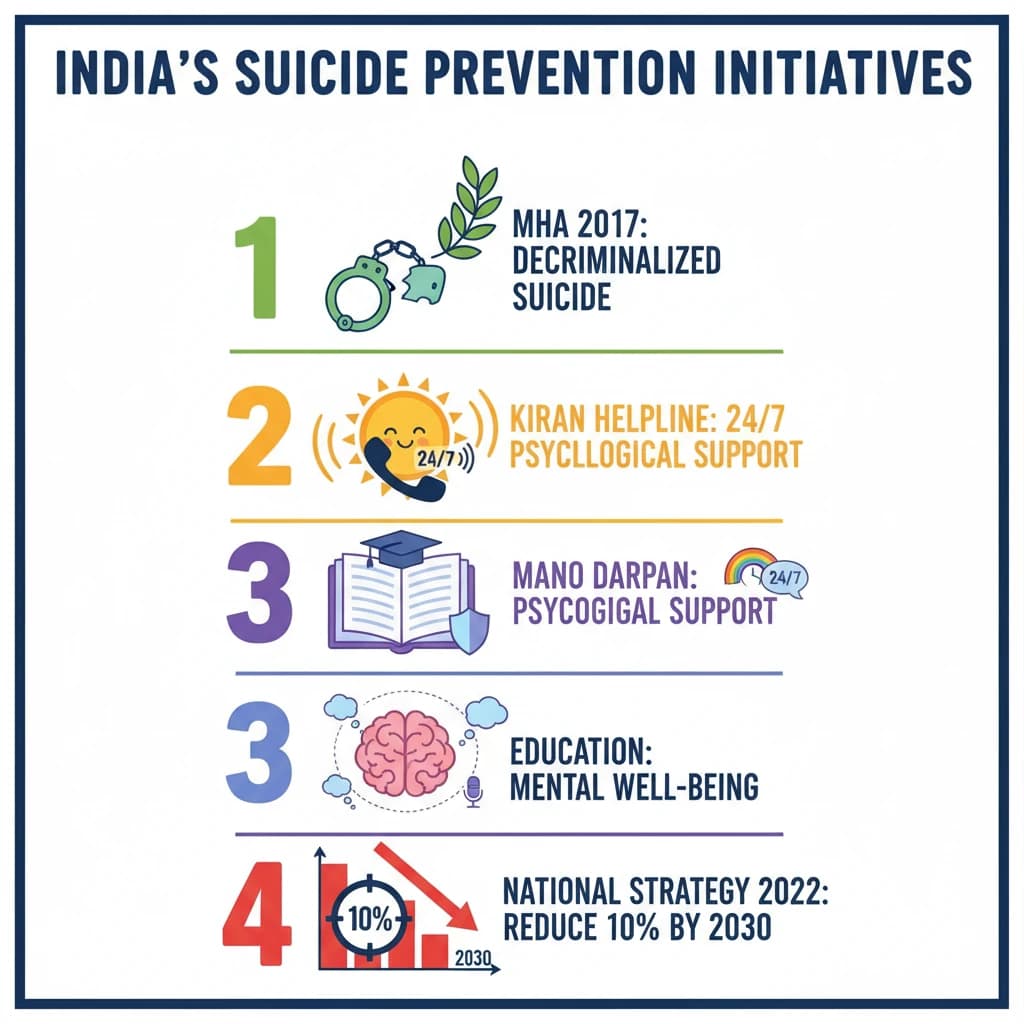
<h4>Understanding Government Initiatives for Suicide Prevention</h4><p>The Government of India has launched several significant initiatives to address the growing concern of <strong>suicide and mental health challenges</strong> across the nation. These programs aim to provide support, reduce stigma, and build a robust framework for prevention and care.</p><div class='key-point-box'><p><strong>Suicide prevention</strong> is recognized as a critical public health priority, requiring a multi-sectoral approach involving healthcare, social welfare, and education.</p></div><h4>Mental Healthcare Act (MHA), 2017</h4><p>The <strong>Mental Healthcare Act (MHA), 2017</strong>, is a landmark legislation that came into force on <strong>May 29, 2018</strong>. It replaced the earlier <strong>Mental Health Act, 1987</strong>, aiming to align Indian law with the <strong>United Nations Convention on the Rights of Persons with Disabilities (UNCRPD)</strong>.</p><p>A key provision of the MHA, 2017, is the <strong>decriminalization of suicide</strong>. Section 115 states that a person who attempts suicide shall be presumed to have severe stress and shall not be punished.</p><div class='info-box'><p><strong>Key Provisions of MHA, 2017:</strong><ul><li><strong>Right to Mental Healthcare:</strong> Ensures access to mental healthcare services for all citizens.</li><li><strong>Advance Directives:</strong> Allows individuals to make decisions about their future mental healthcare.</li><li><strong>Decriminalization of Suicide:</strong> Treats suicide attempts as a mental health issue, not a criminal offense.</li><li><strong>Establishment of Mental Health Authorities:</strong> Central and State Mental Health Authorities for oversight.</li></ul></p></div><div class='exam-tip-box'><p>The <strong>decriminalization of suicide</strong> under <strong>MHA 2017</strong> is a crucial point for <strong>UPSC Mains GS-II (Social Justice)</strong>, highlighting a shift from punitive to public health approach.</p></div><h4>KIRAN Helpline</h4><p>The <strong>KIRAN Helpline</strong> (Toll-Free Number: <strong>1800-599-0019</strong>) is a national helpline launched by the <strong>Ministry of Social Justice and Empowerment</strong>. It provides <strong>first-line psychological support</strong> and mental health services.</p><p>This initiative aims to offer immediate support to people experiencing anxiety, stress, depression, suicidal thoughts, and other mental health concerns. It operates <strong>24x7</strong> in <strong>13 languages</strong>.</p><div class='info-box'><p><strong>KIRAN Helpline Features:</strong><ul><li><strong>24/7 Availability:</strong> Accessible anytime, anywhere.</li><li><strong>Multilingual Support:</strong> Available in 13 languages to cater to diverse populations.</li><li><strong>Comprehensive Services:</strong> Offers counseling, psychological first aid, and referral services.</li><li><strong>Target Audience:</strong> Individuals with mental health issues, their families, and caregivers.</li></ul></p></div><h4>Mano Darpan Initiative</h4><p>The <strong>Mano Darpan Initiative</strong> was launched by the <strong>Ministry of Education</strong> (then Ministry of Human Resource Development) in <strong>July 2020</strong>, during the <strong>COVID-19 pandemic</strong>. Its primary focus is on providing <strong>psychosocial support</strong> to students, teachers, and families for their mental health and well-being.</p><p>This initiative recognizes the unique mental health challenges faced by the academic community, especially during times of crisis. It includes a dedicated webpage, a toll-free helpline, and a national database of counselors.</p><div class='key-point-box'><p><strong>Mano Darpan</strong> emphasizes the importance of mental health in the <strong>educational ecosystem</strong>, promoting a supportive and nurturing environment for learning.</p></div><div class='info-box'><p><strong>Components of Mano Darpan:</strong><ul><li><strong>Website:</strong> Resource materials, advisories, and practical tips.</li><li><strong>National Toll-Free Helpline:</strong> For direct counseling and support.</li><li><strong>Online Chat Platform:</strong> Facilitating immediate assistance.</li><li><strong>Database of Counselors:</strong> Connecting individuals with mental health professionals.</li></ul></p></div><h4>National Suicide Prevention Strategy (NSPS) 2022</h4><p>The <strong>National Suicide Prevention Strategy (NSPS)</strong> was unveiled by the <strong>Ministry of Health and Family Welfare</strong> in <strong>November 2022</strong>. It is the <strong>first-ever national strategy</strong> for suicide prevention in India.</p><p>The strategy sets time-bound objectives to reduce suicide mortality by <strong>10% by 2030</strong>. It outlines a comprehensive framework focusing on strengthening surveillance, establishing psychiatric outpatient departments, and promoting mental well-being across the lifespan.</p><div class='info-box'><p><strong>Key Objectives of NSPS 2022:</strong><ul><li><strong>Strengthening Surveillance:</strong> To collect robust data on suicide attempts and deaths.</li><li><strong>Establishing Psychiatric OPDs:</strong> Ensuring mental health services in all districts.</li><li><strong>Promoting Mental Well-being:</strong> Through school mental health programs and workplace interventions.</li><li><strong>Responsible Media Reporting:</strong> Guidelines for sensitive portrayal of suicide.</li><li><strong>Reducing Access to Means:</strong> Limiting access to pesticides, firearms, etc.</li></ul></p></div><div class='exam-tip-box'><p>The <strong>NSPS 2022</strong> is highly relevant for <strong>UPSC Mains GS-II (Social Justice & Health)</strong>, especially for questions on public health policy and government initiatives.</p></div>