Loading page, please wait…
Vaidra Logo
Vaidra

Top 4 items + smart groups

UPSC GPT
New
Current Affairs
Daily Solutions
Daily Puzzle
Mains Evaluator

Version 2.0.0 • Built with ❤️ for UPSC aspirants

Loading...
Loading...
Loading...
Loading...
Loading...
Loading...
Loading...
Loading...
Loading...
Loading...
Loading...
Loading...
Loading...
Back
All Subjects

Topics

0 topics • 0 completed

Loading topics...
Loading...
Loading...
Loading...
Loading...
Loading...
Overall Progress0%

Leprosy in India: Status, Initiatives, and Global Strategies - UPSC Social Issues

What is Leprosy in India: Status, Initiatives, and Global Strategies in UPSC Social Issues?

Leprosy in India: Status, Initiatives, and Global Strategies is a key topic under Social Issues for UPSC Civil Services Examination. Key points include: India achieved national leprosy elimination (prevalence <1/10,000) in 2005.. Leprosy remains endemic in several Indian states/UTs, with a current prevalence of 0.4 per 10,000.. Global initiatives include WHO's Global Leprosy Strategy and Global Partnership for Zero Leprosy (GPZL).. Understanding this topic is essential for both UPSC Prelims and Mains preparation.

Why is Leprosy in India: Status, Initiatives, and Global Strategies important for UPSC exam?

Leprosy in India: Status, Initiatives, and Global Strategies is a Medium-level topic in UPSC Social Issues. It is tested in both Prelims (factual MCQs) and Mains (analytical answer writing). Previous year UPSC questions have frequently covered aspects of Leprosy in India: Status, Initiatives, and Global Strategies, making it essential for comprehensive IAS preparation.

How to prepare Leprosy in India: Status, Initiatives, and Global Strategies for UPSC?

To prepare Leprosy in India: Status, Initiatives, and Global Strategies for UPSC: (1) Study the comprehensive notes covering all key concepts on Vaidra. (2) Practice previous year questions on this topic. (3) Connect it with current affairs using daily updates. (4) Revise using key takeaways and mind maps available for Social Issues. (5) Write practice answers linking Leprosy in India: Status, Initiatives, and Global Strategies to related GS Paper topics.

Key takeaways of Leprosy in India: Status, Initiatives, and Global Strategies for UPSC

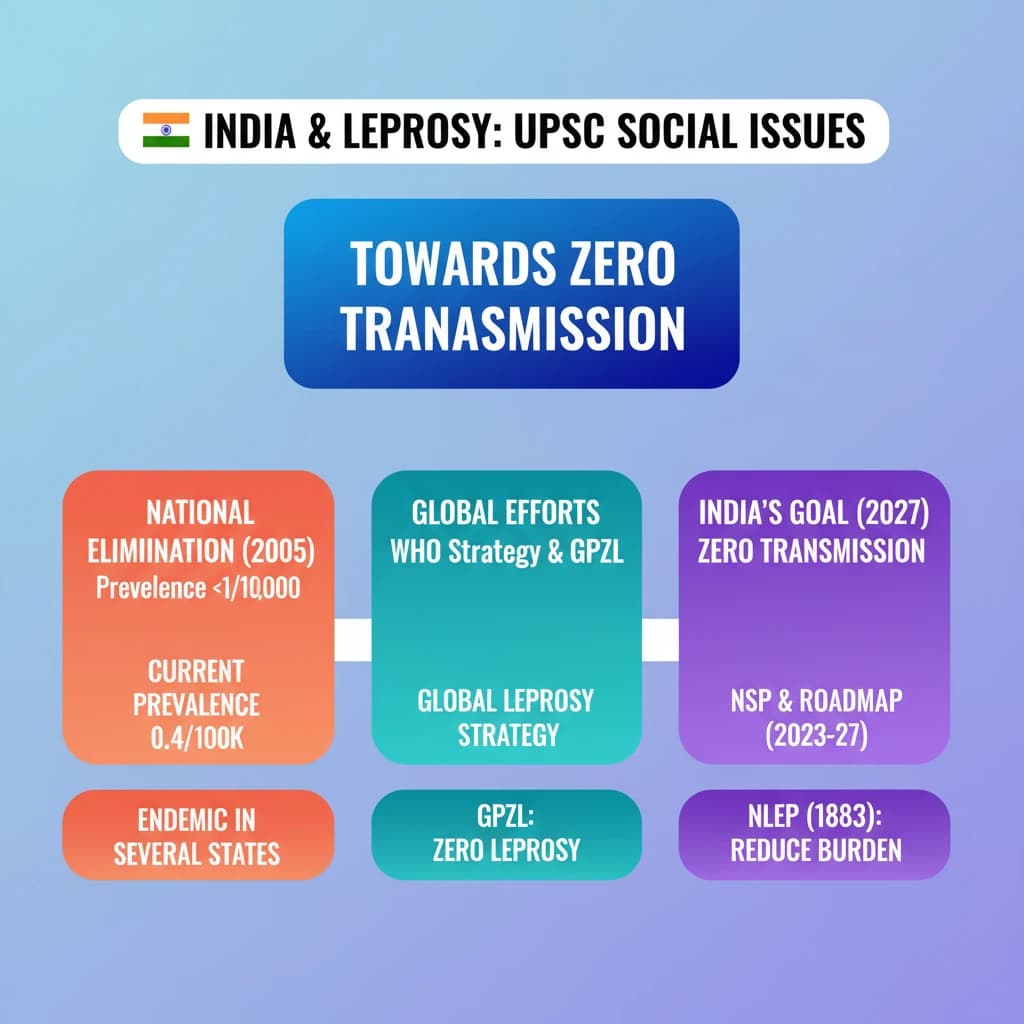
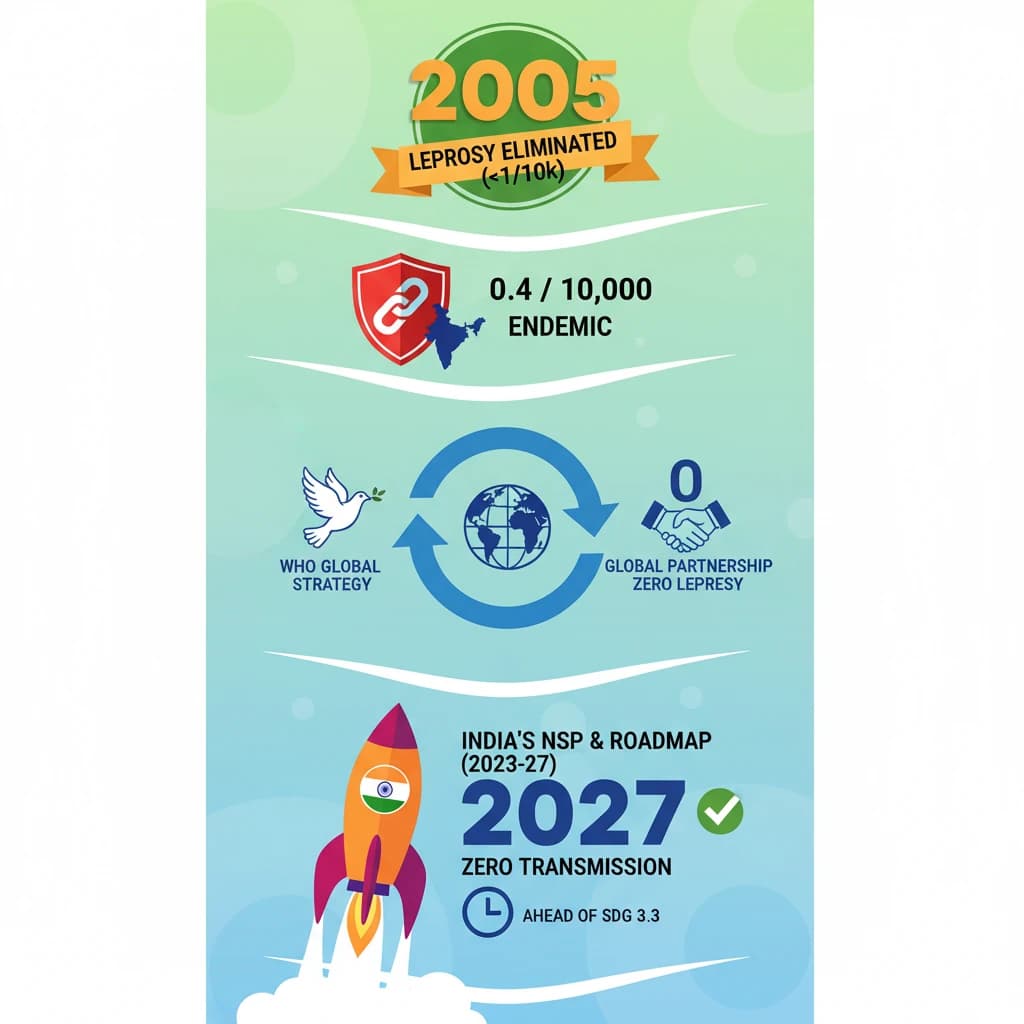
  • India achieved national leprosy elimination (prevalence <1/10,000) in 2005.
  • Leprosy remains endemic in several Indian states/UTs, with a current prevalence of 0.4 per 10,000.
  • Global initiatives include WHO's Global Leprosy Strategy and Global Partnership for Zero Leprosy (GPZL).
  • India's National Strategic Plan (NSP) & Roadmap (2023-27) aims for zero transmission by 2027, ahead of SDG 3.3.
  • The National Leprosy Eradication Programme (NLEP), launched in 1983, focuses on reducing disease burden, preventing disability, and raising awareness.
Leprosy in India: Status, Initiatives, and Global Strategies

Leprosy in India: Status, Initiatives, and Global Strategies

Medium⏱️ 6 min read✓ 95% Verified
social issues

📖 Introduction

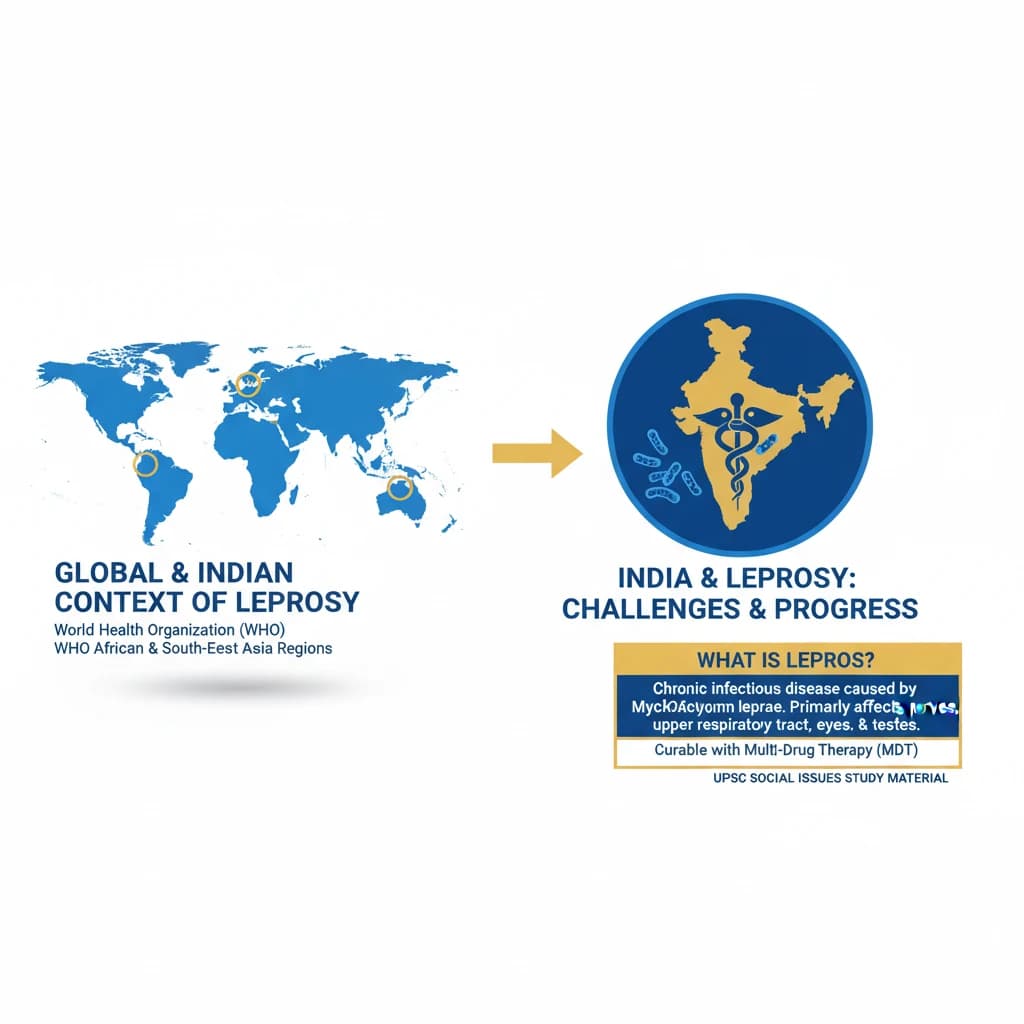
<h4>Global and Indian Context of Leprosy</h4><p>The <strong>World Health Organization (WHO)</strong> identifies several countries with high rates of new <strong>leprosy</strong> cases, predominantly located in the <strong>WHO African</strong> and <strong>South-East Asia Regions</strong>. This highlights the continued global challenge posed by the disease.</p><div class='info-box'><p><strong>Leprosy</strong> is a chronic infectious disease caused by <strong>Mycobacterium leprae</strong>, primarily affecting the skin, peripheral nerves, upper respiratory tract, eyes, and testes.</p></div><h4>India's Achievement and Current Status</h4><p><strong>India</strong> successfully achieved the <strong>elimination of leprosy as a public health problem</strong> in <strong>2005</strong>. This milestone was reached according to <strong>WHO criteria</strong>, which defines elimination as a prevalence rate of less than <strong>1 case per 10,000 population</strong> at the national level.</p><p>Despite this national achievement, <strong>leprosy</strong> remains <strong>endemic</strong> in several states and union territories across <strong>India</strong>. This indicates pockets where the disease still poses a significant health challenge.</p><div class='info-box'><p>The current <strong>prevalence rate of leprosy</strong> in <strong>India</strong> is recorded at <strong>0.4 per 10,000 population</strong>. This figure underscores the ongoing need for targeted interventions.</p></div><h4>Global Initiatives Against Leprosy</h4><p>International bodies and partnerships play a crucial role in the global fight against <strong>leprosy</strong>. These initiatives aim to coordinate efforts, provide strategic direction, and mobilize resources.</p><ul><li><strong>The Global Leprosy Strategy (2016–2020)</strong>: Launched by <strong>WHO</strong>, this strategy aimed to revitalize efforts in <strong>leprosy control</strong> and prevent disabilities, especially among children in endemic countries.</li><li><strong>Global Partnership for Zero Leprosy (GPZL)</strong>: This is a collaborative coalition of individuals and organizations dedicated to achieving the ultimate goal of ending <strong>leprosy</strong> worldwide.</li><li><strong>World Leprosy Day</strong>: An annual observance that raises awareness about <strong>leprosy</strong> and calls for an end to the stigma and discrimination associated with the disease.</li></ul><h4>India's National Initiatives Against Leprosy</h4><p><strong>India</strong> has implemented robust national programs and strategic plans to further reduce the burden of <strong>leprosy</strong> and move towards complete eradication.</p><ul><li><strong>National Strategic Plan (NSP) & Roadmap for Leprosy (2023-27)</strong>: This ambitious plan was launched with the specific goal of achieving <strong>zero transmission of leprosy by 2027</strong>. This target is set three years ahead of the relevant <strong>Sustainable Development Goal (SDG)</strong>.</li></ul><div class='info-box'><p><strong>SDG 3.3</strong> aims to end the epidemics of <strong>AIDS, tuberculosis, malaria, and neglected tropical diseases</strong> by <strong>2030</strong>, and combat <strong>hepatitis, water-borne diseases</strong>, and other communicable diseases.</p></div><ul><li><strong>National Leprosy Eradication Programme (NLEP)</strong>: Introduced in <strong>1983</strong>, the <strong>NLEP</strong> is a <strong>Centrally Sponsored Health Scheme</strong>. Its primary objectives include reducing disease burden, preventing disabilities, and enhancing public awareness about <strong>leprosy</strong> and its curability.</li></ul><div class='exam-tip-box'><p>For UPSC, understanding the distinction between <strong>'elimination as a public health problem'</strong> and <strong>'zero transmission'</strong> is crucial. Also, note the alignment of national goals with global <strong>SDGs</strong>.</p></div>
Concept Diagram

💡 Key Takeaways

  • •India achieved national leprosy elimination (prevalence <1/10,000) in 2005.
  • •Leprosy remains endemic in several Indian states/UTs, with a current prevalence of 0.4 per 10,000.
  • •Global initiatives include WHO's Global Leprosy Strategy and Global Partnership for Zero Leprosy (GPZL).
  • •India's National Strategic Plan (NSP) & Roadmap (2023-27) aims for zero transmission by 2027, ahead of SDG 3.3.
  • •The National Leprosy Eradication Programme (NLEP), launched in 1983, focuses on reducing disease burden, preventing disability, and raising awareness.

🧠 Memory Techniques
Memory Aid
95% Verified Content

Related Topics

Loading related topics...
Explore:Social Issues Topics·All Subjects·Daily Current Affairs·Editorial Analysis·Previous Year Questions·UPSC GPT
Leprosy in India: Status, Initiatives, and Global Strategies - UPSC Social Issues