Loading page, please wait…
Vaidra Logo
Vaidra

Top 4 items + smart groups

UPSC GPT
New
Current Affairs
Daily Solutions
Daily Puzzle
Mains Evaluator

Version 2.0.0 • Built with ❤️ for UPSC aspirants

Loading...
Loading...
Loading...
Loading...
Loading...
Loading...
Loading...
Loading...
Loading...
Loading...
Loading...
Loading...
Loading...
What are the Key Facts Related to India? - UPSC Social Issues
Back
All Subjects

Topics

0 topics • 0 completed

Loading topics...
Loading...
Loading...
Loading...
Loading...
Loading...
Overall Progress0%

What are the Key Facts Related to India? - UPSC Social Issues

What is What are the Key Facts Related to India? in UPSC Social Issues?

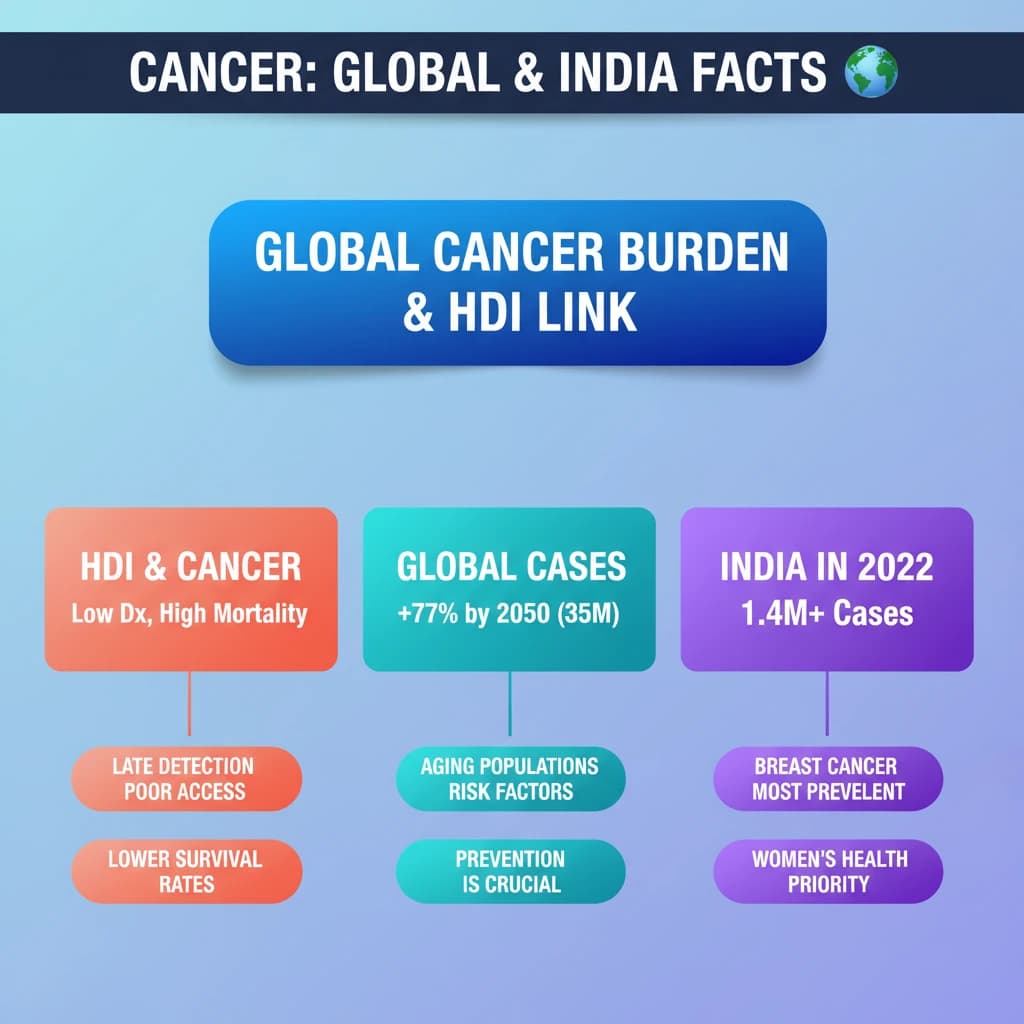
What are the Key Facts Related to India? is a key topic under Social Issues for UPSC Civil Services Examination. Key points include: Cancer incidence and mortality vary significantly with a country's HDI.. Lower HDI countries have lower diagnosis rates but higher mortality due to late detection and poor access to care.. Global cancer cases are projected to increase by 77% by 2050 (35M cases), driven by aging populations and risk factors.. Understanding this topic is essential for both UPSC Prelims and Mains preparation.

Why is What are the Key Facts Related to India? important for UPSC exam?

What are the Key Facts Related to India? is a Medium-level topic in UPSC Social Issues. It is tested in both Prelims (factual MCQs) and Mains (analytical answer writing). Previous year UPSC questions have frequently covered aspects of What are the Key Facts Related to India?, making it essential for comprehensive IAS preparation.

How to prepare What are the Key Facts Related to India? for UPSC?

To prepare What are the Key Facts Related to India? for UPSC: (1) Study the comprehensive notes covering all key concepts on Vaidra. (2) Practice previous year questions on this topic. (3) Connect it with current affairs using daily updates. (4) Revise using key takeaways and mind maps available for Social Issues. (5) Write practice answers linking What are the Key Facts Related to India? to related GS Paper topics.

Key takeaways of What are the Key Facts Related to India? for UPSC

  • Cancer incidence and mortality vary significantly with a country's HDI.
  • Lower HDI countries have lower diagnosis rates but higher mortality due to late detection and poor access to care.
  • Global cancer cases are projected to increase by 77% by 2050 (35M cases), driven by aging populations and risk factors.
  • Key risk factors include tobacco, alcohol, obesity, and air pollution.
  • India reported over 1.4 million new cases in 2022, with breast cancer being the most prevalent, especially among women.
  • Urgent global investment is needed to address inequities in cancer care access.
What are the Key Facts Related to India?

What are the Key Facts Related to India?

Medium⏱️ 8 min read✓ 95% Verified
social issues

📖 Introduction

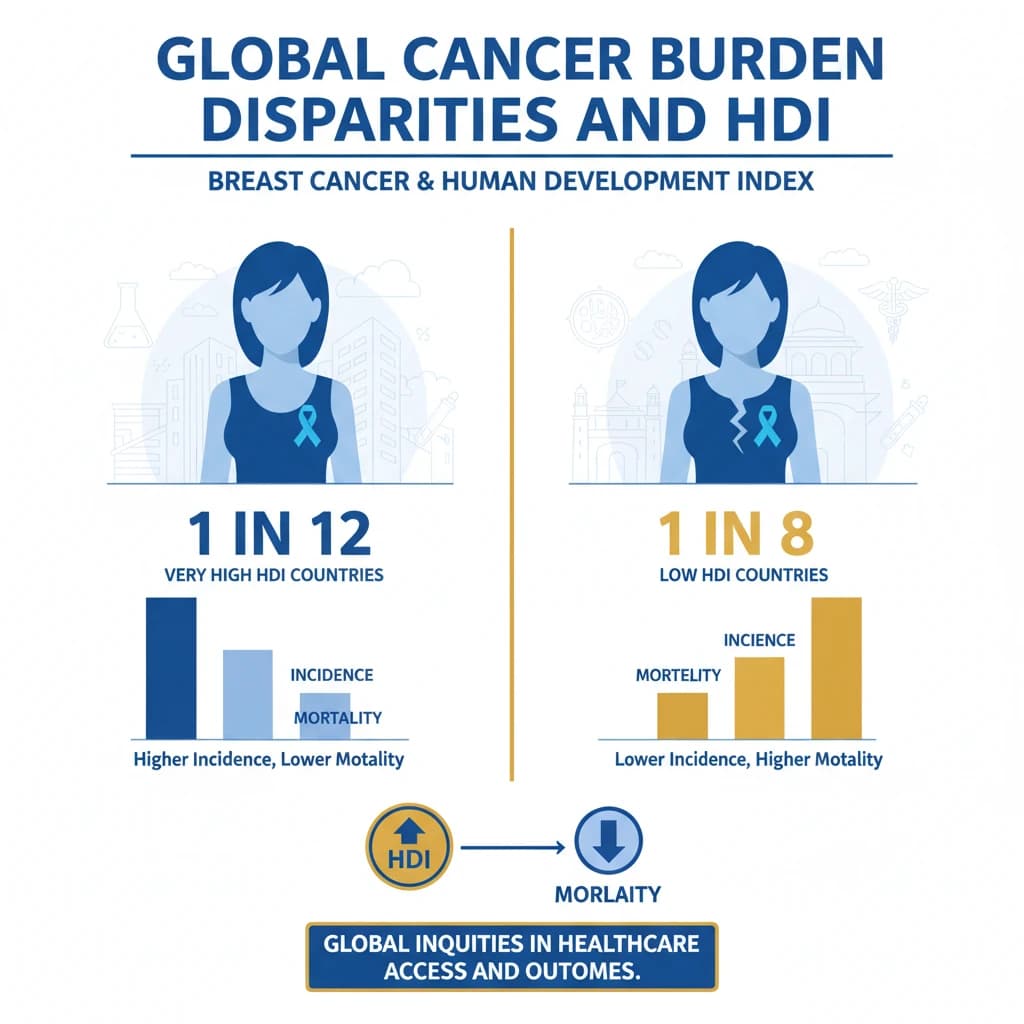
<h4>Global Cancer Burden Disparities and HDI</h4><p>The incidence and mortality rates of <strong>breast cancer</strong> show significant disparities based on a country's <strong>Human Development Index (HDI)</strong>. These differences highlight global inequities in healthcare access and outcomes.</p><div class='info-box'><p>In countries with a <strong>very high HDI</strong>, approximately <strong>1 in 12 women</strong> are diagnosed with <strong>breast cancer</strong> in their lifetime. The mortality rate is about <strong>1 in 71 women</strong>.</p></div><div class='info-box'><p>Conversely, in countries with a <strong>low HDI</strong>, only about <strong>1 in 27 women</strong> are diagnosed with <strong>breast cancer</strong>. However, the mortality rate is significantly higher, with <strong>1 in 48 women</strong> dying from the disease.</p></div><div class='key-point-box'><p>Women in <strong>lower HDI countries</strong> are <strong>50% less likely</strong> to be diagnosed with <strong>breast cancer</strong>. Despite this lower incidence, they face a <strong>much higher risk of dying</strong> due to factors like <strong>late diagnosis</strong> and <strong>inadequate access to quality treatment</strong>.</p></div><h4>Projected Global Cancer Burden Increase</h4><p>The global cancer burden is projected to increase substantially in the coming decades. This rise is attributed to a combination of demographic shifts and changing risk factor exposures.</p><div class='info-box'><p>Over <strong>35 million new cancer cases</strong> are predicted globally by <strong>2050</strong>. This represents a substantial <strong>77% increase</strong> from the estimated <strong>20 million cases in 2022</strong>.</p></div><p>The rapidly growing burden reflects both <strong>population ageing</strong> and <strong>growth</strong>. Additionally, changes in people’s exposure to various <strong>risk factors</strong>, often associated with <strong>socioeconomic development</strong>, play a crucial role.</p><h4>Key Risk Factors for Cancer</h4><p>Several factors contribute significantly to the increasing incidence of cancer worldwide. These include lifestyle choices and environmental exposures.</p><ul><li><strong>Tobacco</strong> use is a major contributor to cancer development.</li><li><strong>Alcohol consumption</strong> is another significant risk factor.</li><li><strong>Obesity</strong> is increasingly recognized as a key driver of cancer incidence.</li><li><strong>Air pollution</strong> remains a critical environmental risk factor, contributing to various cancers.</li></ul><p>In terms of absolute burden, <strong>high HDI countries</strong> are expected to experience the greatest increase. An additional <strong>4.8 million new cases</strong> are predicted in these nations by <strong>2050</strong> compared to <strong>2022</strong> estimates.</p><h4>Call for Global Action</h4><p>Addressing the escalating global cancer burden requires concerted international efforts. A focus on equity and access to care is paramount.</p><div class='exam-tip-box'><p><strong>UPSC Mains GS-II (Health)</strong>: Questions on health inequities and global health initiatives often link to such data. Emphasize the need for policy interventions.</p></div><p>There is an urgent need for significant <strong>investments</strong> to tackle <strong>global inequities in cancer outcomes</strong>. Ensuring access to <strong>affordable, quality cancer care</strong> for all individuals is crucial.</p><p>This access must be universal, regardless of an individual's <strong>geographical location</strong> or <strong>socioeconomic status</strong>.</p><h4>Key Findings Related to India's Cancer Burden</h4><p>India contributes significantly to the global cancer burden, with specific patterns observed in its population.</p><div class='info-box'><p><strong>India</strong> reported <strong>1,413,316 new cancer cases</strong> in <strong>2022</strong>. There was a slightly higher proportion of <strong>female patients</strong> (<strong>722,138 women</strong>) compared to <strong>men</strong> (<strong>691,178 men</strong>).</p></div><div class='highlight-box'><p><strong>Breast cancer</strong> had the highest proportion in India, accounting for <strong>192,624 new cases</strong>. This represents <strong>13.6% of all cancer patients</strong> and over <strong>26% of all cancer cases in women</strong>.</p></div>
Concept Diagram

💡 Key Takeaways

  • •Cancer incidence and mortality vary significantly with a country's HDI.
  • •Lower HDI countries have lower diagnosis rates but higher mortality due to late detection and poor access to care.
  • •Global cancer cases are projected to increase by 77% by 2050 (35M cases), driven by aging populations and risk factors.
  • •Key risk factors include tobacco, alcohol, obesity, and air pollution.
  • •India reported over 1.4 million new cases in 2022, with breast cancer being the most prevalent, especially among women.
  • •Urgent global investment is needed to address inequities in cancer care access.

🧠 Memory Techniques
Memory Aid
95% Verified Content

📚 Reference Sources

•World Health Organization (WHO) reports on cancer burden and NCDs
•International Agency for Research on Cancer (IARC) data

Related Topics

Loading related topics...
Explore:Social Issues Topics·All Subjects·Daily Current Affairs·Editorial Analysis·Previous Year Questions·UPSC GPT