Loading page, please wait…
Vaidra Logo
Vaidra

Top 4 items + smart groups

UPSC GPT
New
Current Affairs
Daily Solutions
Daily Puzzle
Mains Evaluator

Version 2.0.0 • Built with ❤️ for UPSC aspirants

Loading...
Loading...
Loading...
Loading...
Loading...
Loading...
Loading...
Loading...
Loading...
Loading...
Loading...
Loading...
Loading...

What are the Major Global Initiatives Related to Immunization? - UPSC Social Issues

What is What are the Major Global Initiatives Related to Immunization? in UPSC Social Issues?

What are the Major Global Initiatives Related to Immunization? is a key topic under Social Issues for UPSC Civil Services Examination. Key points include: Global immunization initiatives like EPI and IA2030 are essential for preventing vaccine-preventable diseases worldwide.. India's UIP provides free immunization against 12 diseases, showcasing a significant national public health effort.. The Expanded Programme on Immunization (EPI), established in 1974, dramatically expanded vaccine access and was instrumental in smallpox eradication.. Understanding this topic is essential for both UPSC Prelims and Mains preparation.

Why is What are the Major Global Initiatives Related to Immunization? important for UPSC exam?

What are the Major Global Initiatives Related to Immunization? is a Medium-level topic in UPSC Social Issues. It is tested in both Prelims (factual MCQs) and Mains (analytical answer writing). Previous year UPSC questions have frequently covered aspects of What are the Major Global Initiatives Related to Immunization?, making it essential for comprehensive IAS preparation.

How to prepare What are the Major Global Initiatives Related to Immunization? for UPSC?

To prepare What are the Major Global Initiatives Related to Immunization? for UPSC: (1) Study the comprehensive notes covering all key concepts on Vaidra. (2) Practice previous year questions on this topic. (3) Connect it with current affairs using daily updates. (4) Revise using key takeaways and mind maps available for Social Issues. (5) Write practice answers linking What are the Major Global Initiatives Related to Immunization? to related GS Paper topics.

Key takeaways of What are the Major Global Initiatives Related to Immunization? for UPSC

  • Global immunization initiatives like EPI and IA2030 are essential for preventing vaccine-preventable diseases worldwide.
  • India's UIP provides free immunization against 12 diseases, showcasing a significant national public health effort.
  • The Expanded Programme on Immunization (EPI), established in 1974, dramatically expanded vaccine access and was instrumental in smallpox eradication.
  • Immunization Agenda 2030 (IA2030) is the current global strategy, emphasizing equitable, life-course vaccination for all ages.
  • Key challenges include vaccine hesitancy, ensuring equitable access, and securing adequate funding, exacerbated by the COVID-19 pandemic.
  • Immunization is a highly cost-effective public health intervention vital for achieving multiple Sustainable Development Goals (SDGs).
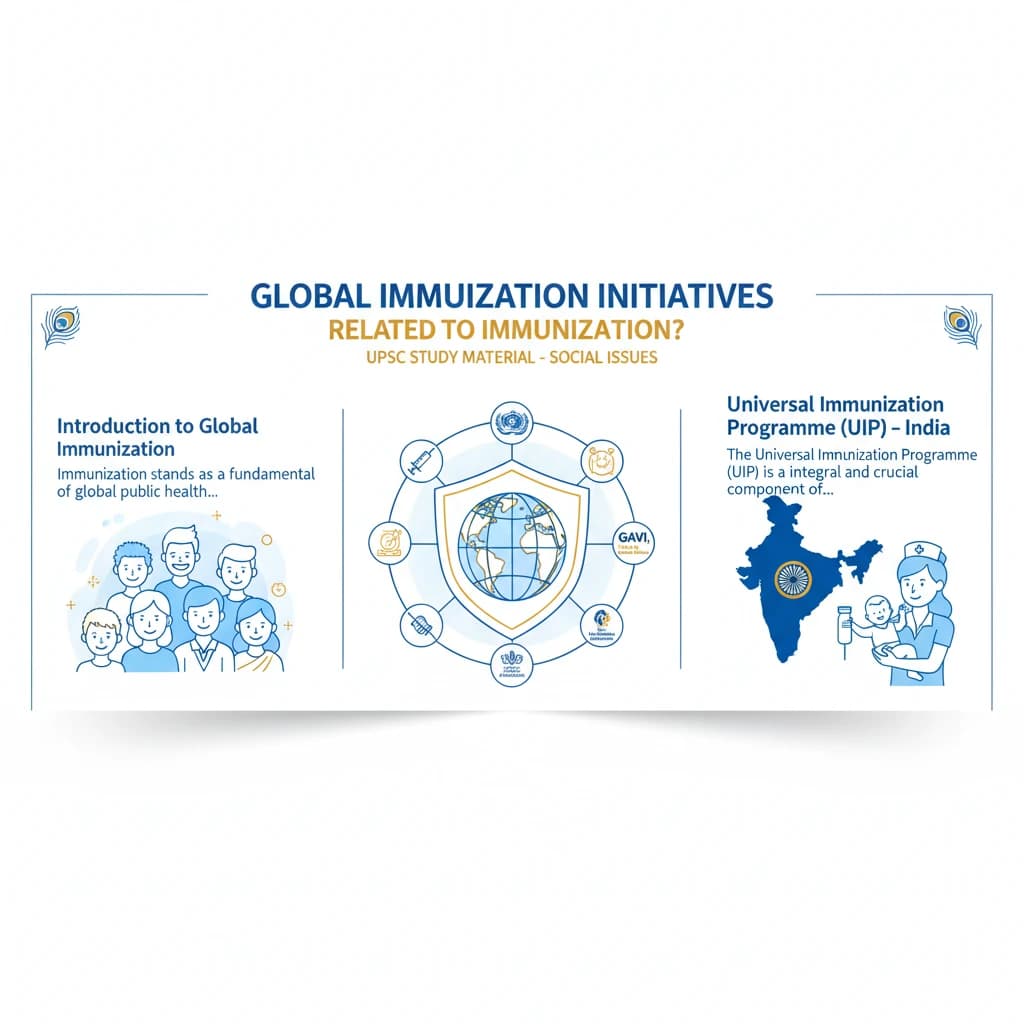
What are the Major Global Initiatives Related to Immunization?

What are the Major Global Initiatives Related to Immunization?

Medium⏱️ 8 min read✓ 95% Verified
social issues

📖 Introduction

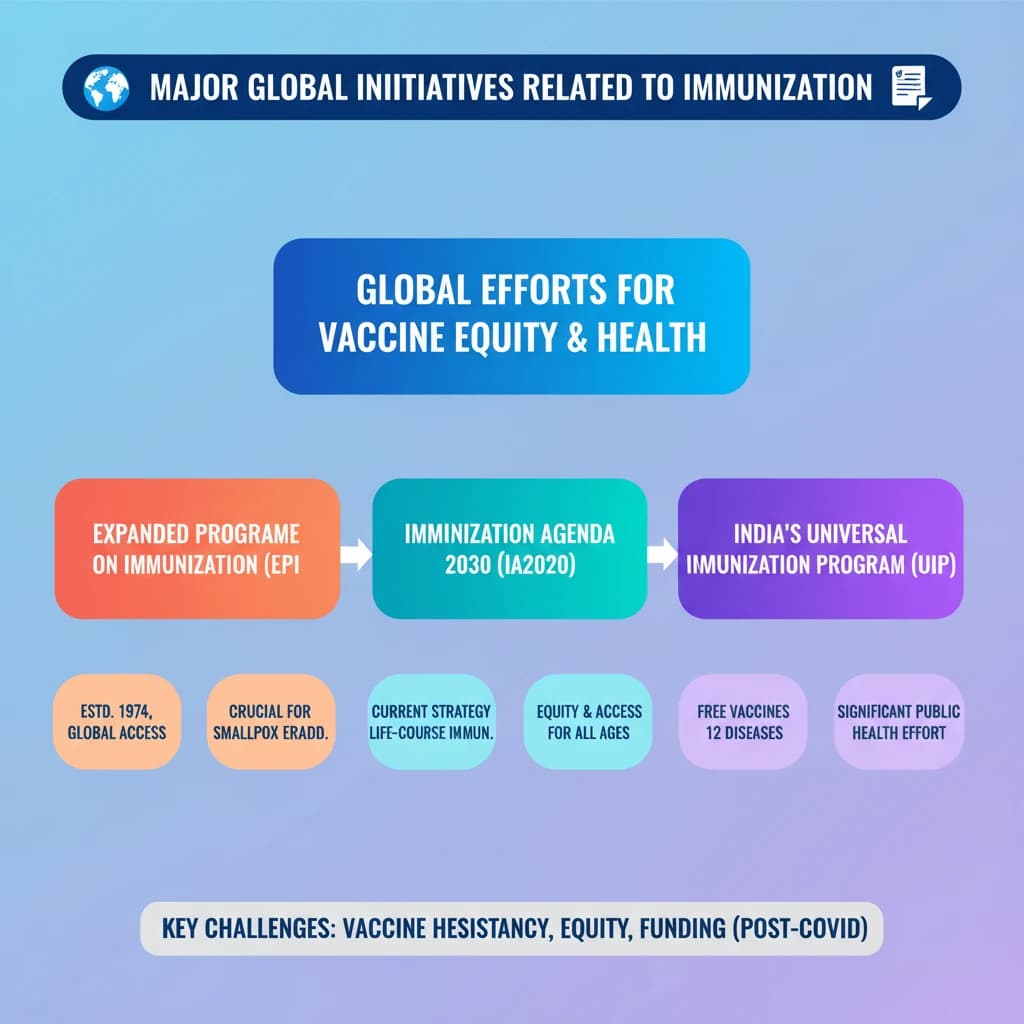
<h4>Introduction to Global Immunization Initiatives</h4><p><strong>Immunization</strong> stands as a fundamental pillar of global public health, actively preventing millions of deaths each year from various infectious diseases. A combination of international and national programs diligently works to ensure widespread vaccine coverage.</p><h4>Universal Immunization Programme (UIP) - India</h4><p>The <strong>Universal Immunization Programme (UIP)</strong> is an integral and crucial component of India's public health strategy. Its primary objective is to provide free immunization services across the entire nation.</p><div class='info-box'><p>Under the <strong>UIP</strong>, immunization is offered <strong>free of cost</strong> against a total of <strong>12 vaccine-preventable diseases</strong>.</p></div><p>The diseases covered under <strong>UIP</strong> are categorized based on their inclusion scope, either nationally or sub-nationally:</p><ul><li><strong>Nationally Covered (9 Diseases):</strong> These include <strong>Diphtheria</strong>, <strong>Pertussis</strong> (Whooping Cough), <strong>Tetanus</strong>, <strong>Polio</strong>, <strong>Measles</strong>, <strong>Rubella</strong>, severe forms of <strong>Childhood Tuberculosis</strong>, <strong>Hepatitis B</strong>, and <strong>Meningitis & Pneumonia</strong> caused by <strong>Haemophilus influenzae type B</strong>.</li><li><strong>Sub-nationally Covered (3 Diseases):</strong> These are <strong>Rotavirus diarrhoea</strong>, <strong>Pneumococcal Pneumonia</strong>, and <strong>Japanese Encephalitis</strong> (specifically in endemic districts).</li></ul><h4>Expanded Programme on Immunization (EPI)</h4><p>The <strong>Expanded Programme on Immunization (EPI)</strong> represents a foundational global initiative dedicated to vaccine delivery. It was specifically established to address vaccine-preventable diseases worldwide.</p><div class='info-box'><p>The <strong>EPI</strong> was founded in <strong>1974</strong> by the <strong>World Health Assembly</strong>. Its initial focus was on providing basic vaccinations to children globally.</p></div><p>The original goal of <strong>EPI</strong> was to vaccinate all children against a specific set of diseases, making significant contributions to global health improvements during its early years.</p><ul><li><strong>Original EPI Target Diseases:</strong> These included <strong>Diphtheria</strong>, <strong>Measles</strong>, <strong>Pertussis</strong>, <strong>Polio</strong>, <strong>Tetanus</strong>, <strong>Tuberculosis</strong>, and <strong>Smallpox</strong>. Notably, <strong>Smallpox</strong> is recognized as the only human disease ever globally eradicated.</li></ul><p>Over several decades, the scope of <strong>EPI</strong> has expanded considerably to encompass a broader range of diseases and age groups, reflecting continuous advancements in vaccinology.</p><div class='key-point-box'><p><strong>Current EPI Scope:</strong> It now includes <strong>universal recommendations</strong> to vaccinate against <strong>13 diseases</strong> and provides <strong>context-specific recommendations</strong> for an additional <strong>17 diseases</strong>. Its reach has extended beyond children to include <strong>adolescents and adults</strong>.</p></div><h4>Immunization Agenda 2030</h4><p>The <strong>Immunization Agenda 2030 (IA2030)</strong> is a comprehensive global strategy aiming to achieve a world where everyone, everywhere, at every age, benefits from vaccines for better health and well-being. It serves as the successor to the previous Global Vaccine Action Plan (GVAP).</p><div class='exam-tip-box'><p><strong>UPSC Insight:</strong> <strong>IA2030</strong> places strong emphasis on equitable access, a life-course approach, and integration with primary healthcare. Understanding this agenda is crucial for topics in <strong>GS-II (Social Justice)</strong> and <strong>GS-III (Science & Technology)</strong>, particularly concerning current global health policy.</p></div><h4>World Immunization Week</h4><p><strong>World Immunization Week</strong> is a prominent global public health campaign spearheaded by the <strong>World Health Organization (WHO)</strong>. It is observed annually during the last week of <strong>April</strong>.</p><p>The primary objective of this campaign is to promote the widespread use of vaccines to protect people of all ages against disease. It effectively raises awareness about the critical importance of immunization for individual and community health.</p>
Concept Diagram

💡 Key Takeaways

  • •Global immunization initiatives like EPI and IA2030 are essential for preventing vaccine-preventable diseases worldwide.
  • •India's UIP provides free immunization against 12 diseases, showcasing a significant national public health effort.
  • •The Expanded Programme on Immunization (EPI), established in 1974, dramatically expanded vaccine access and was instrumental in smallpox eradication.
  • •Immunization Agenda 2030 (IA2030) is the current global strategy, emphasizing equitable, life-course vaccination for all ages.
  • •Key challenges include vaccine hesitancy, ensuring equitable access, and securing adequate funding, exacerbated by the COVID-19 pandemic.
  • •Immunization is a highly cost-effective public health intervention vital for achieving multiple Sustainable Development Goals (SDGs).

🧠 Memory Techniques
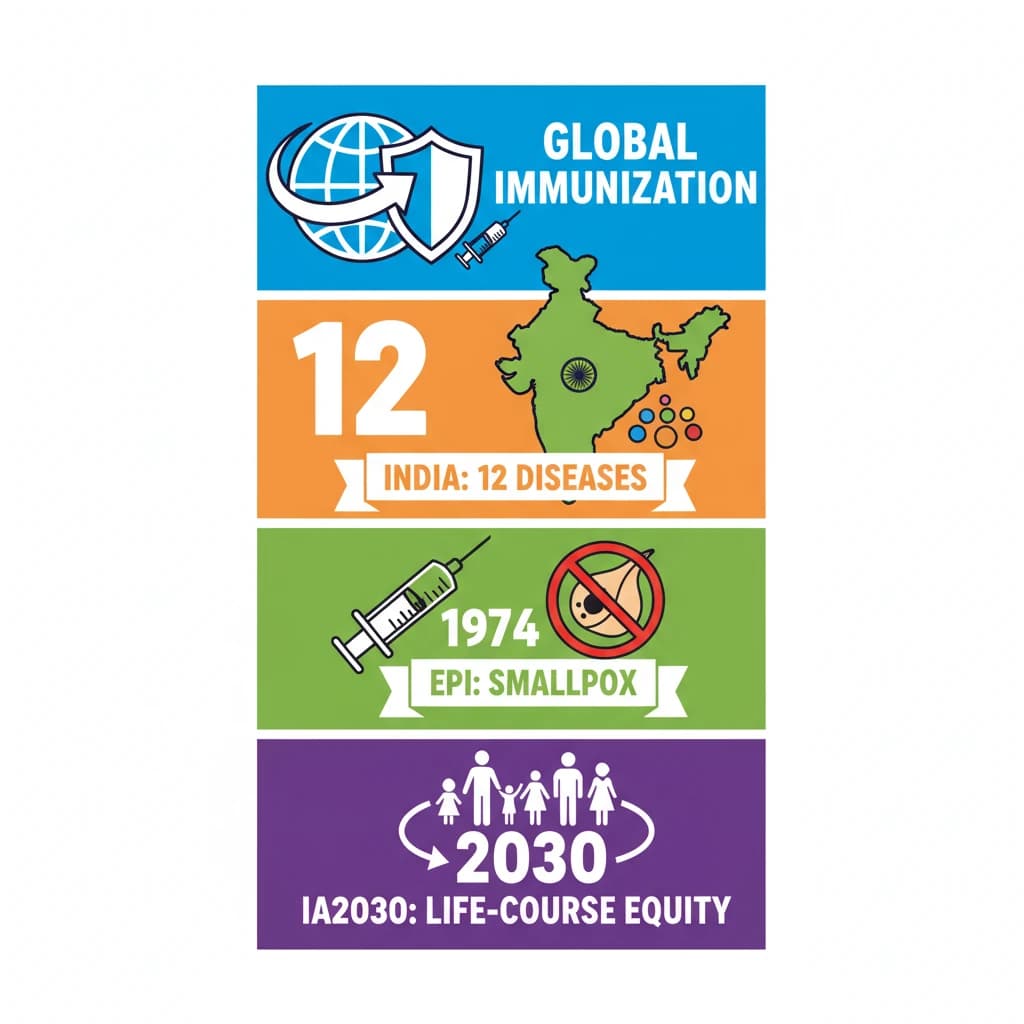
Memory Aid
95% Verified Content

📚 Reference Sources

•UNICEF immunization reports
•Gavi, the Vaccine Alliance publications
•Ministry of Health & Family Welfare, Government of India (for UIP details)
•Drishti IAS (original source summary)

Related Topics

Loading related topics...
Explore:Social Issues Topics·All Subjects·Daily Current Affairs·Editorial Analysis·Previous Year Questions·UPSC GPT
Back
All Subjects

Topics

0 topics • 0 completed

Loading topics...
Loading...
Loading...
Loading...
Loading...
Loading...
Overall Progress0%
What are the Major Global Initiatives Related to Immunization? - UPSC Social Issues