Loading page, please wait…
Vaidra Logo
Vaidra

Top 4 items + smart groups

UPSC GPT
New
Current Affairs
Daily Solutions
Daily Puzzle
Mains Evaluator

Version 2.0.0 • Built with ❤️ for UPSC aspirants

Loading...
Loading...
Loading...
Loading...
Loading...
Loading...
Loading...
Loading...
Loading...
Loading...
Loading...
Loading...
Loading...
Back
All Subjects

Topics

0 topics • 0 completed

Loading topics...
Loading...
Loading...
Loading...
Loading...
Loading...
Overall Progress0%
What are the Major Provisions of the Amended Surrogacy Rules? - UPSC Social Issues

What are the Major Provisions of the Amended Surrogacy Rules? - UPSC Social Issues

What is What are the Major Provisions of the Amended Surrogacy Rules? in UPSC Social Issues?

What are the Major Provisions of the Amended Surrogacy Rules? is a key topic under Social Issues for UPSC Civil Services Examination. Key points include: March 2023 Surrogacy Rules initially mandated only intending couple's own gametes.. This restriction barred many couples with specific medical conditions from accessing surrogacy.. Caused distress and challenged the fundamental right to parenthood for affected individuals.. Understanding this topic is essential for both UPSC Prelims and Mains preparation.

Why is What are the Major Provisions of the Amended Surrogacy Rules? important for UPSC exam?

What are the Major Provisions of the Amended Surrogacy Rules? is a Medium-level topic in UPSC Social Issues. It is tested in both Prelims (factual MCQs) and Mains (analytical answer writing). Previous year UPSC questions have frequently covered aspects of What are the Major Provisions of the Amended Surrogacy Rules?, making it essential for comprehensive IAS preparation.

How to prepare What are the Major Provisions of the Amended Surrogacy Rules? for UPSC?

To prepare What are the Major Provisions of the Amended Surrogacy Rules? for UPSC: (1) Study the comprehensive notes covering all key concepts on Vaidra. (2) Practice previous year questions on this topic. (3) Connect it with current affairs using daily updates. (4) Revise using key takeaways and mind maps available for Social Issues. (5) Write practice answers linking What are the Major Provisions of the Amended Surrogacy Rules? to related GS Paper topics.

Key takeaways of What are the Major Provisions of the Amended Surrogacy Rules? for UPSC

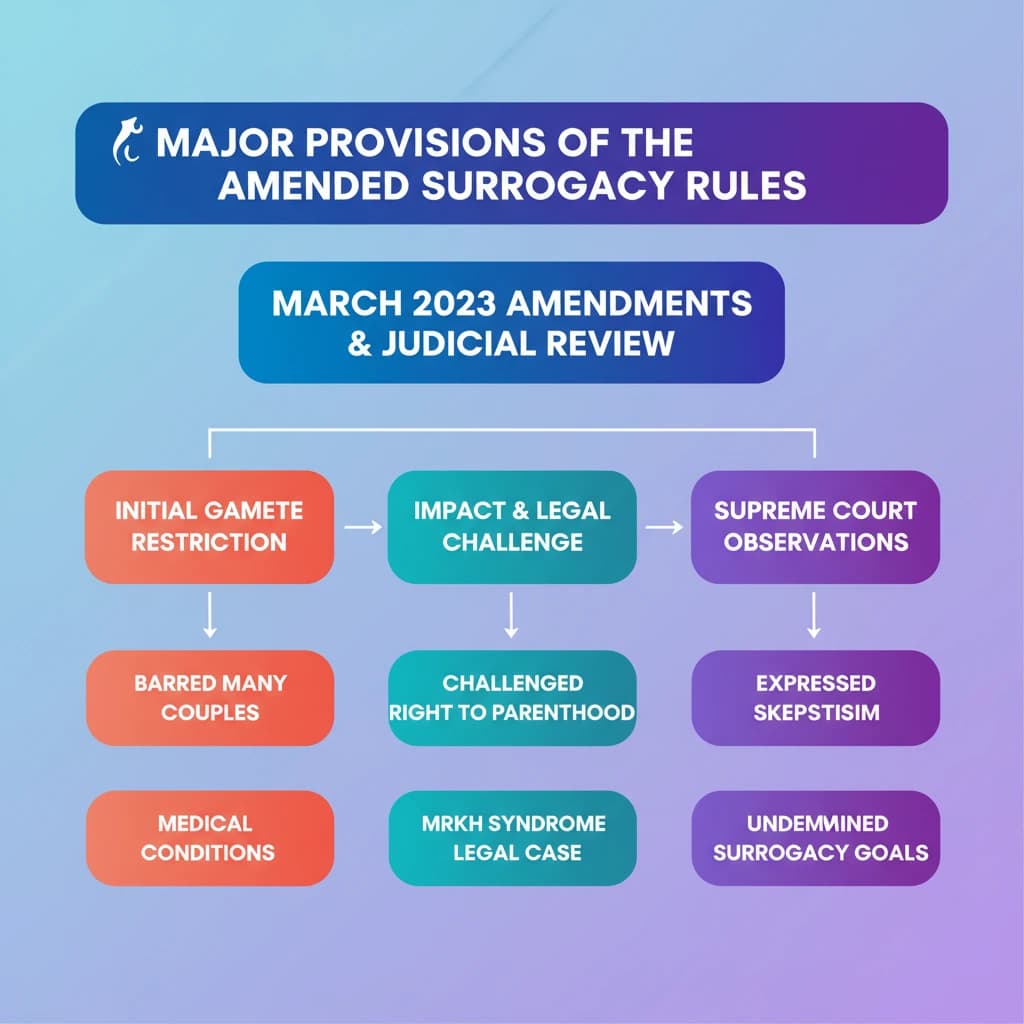
  • March 2023 Surrogacy Rules initially mandated only intending couple's own gametes.
  • This restriction barred many couples with specific medical conditions from accessing surrogacy.
  • Caused distress and challenged the fundamental right to parenthood for affected individuals.
  • A woman with MRKH Syndrome legally challenged the rules in the Supreme Court.
  • Supreme Court expressed skepticism, asserting rules undermined surrogacy's fundamental objectives.
  • Highlights the ongoing debate on reproductive rights, medical ethics, and judicial oversight in India.
What are the Major Provisions of the Amended Surrogacy Rules?

What are the Major Provisions of the Amended Surrogacy Rules?

Medium⏱️ 10 min read✓ 95% Verified
social issues

📖 Introduction

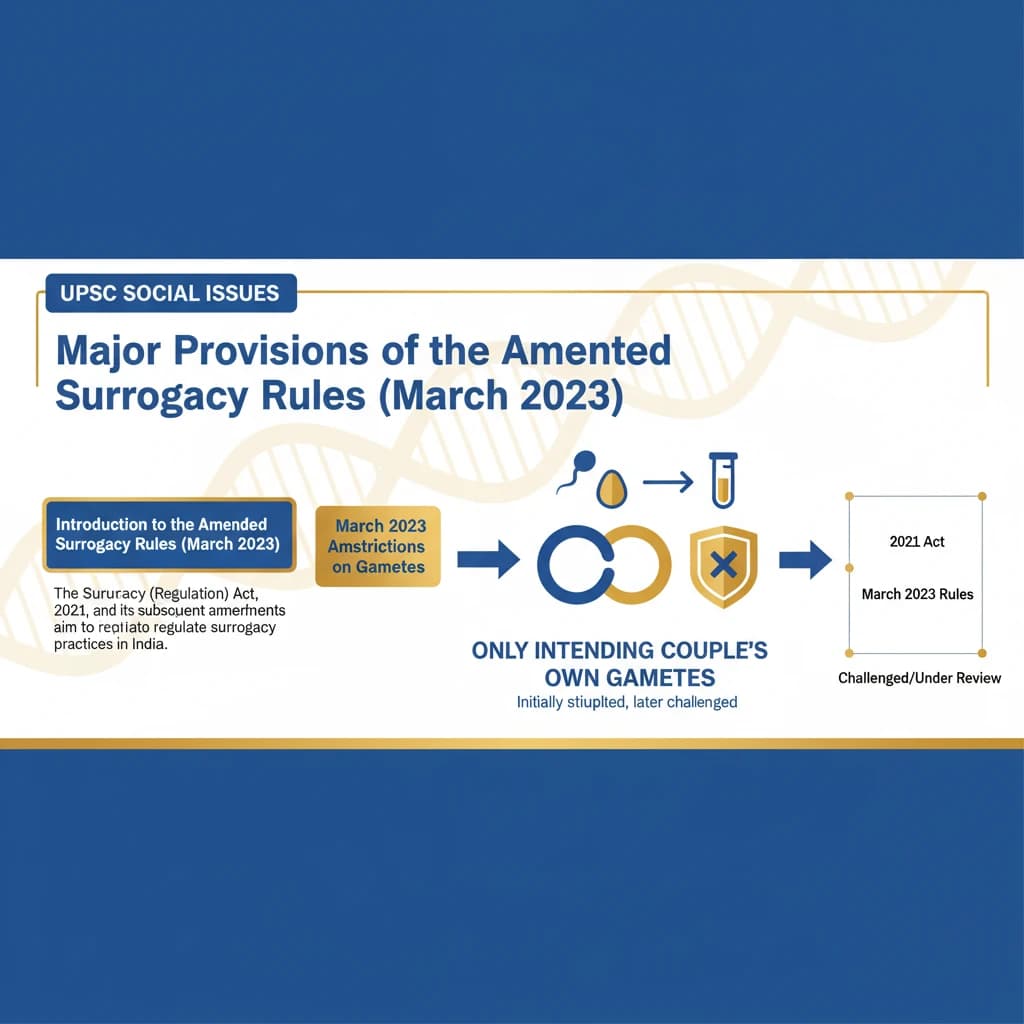
<h4>Introduction to the Amended Surrogacy Rules (March 2023)</h4><p>The <strong>Surrogacy (Regulation) Act, 2021</strong>, and its subsequent amendments aim to regulate surrogacy practices in India. A significant amendment was introduced in <strong>March 2023</strong>, which brought about specific restrictions on the use of gametes.</p><p>These <strong>March 2023 amended rules</strong> initially stipulated that only the <strong>intending couple’s own gametes</strong> could be used for surrogacy. This provision had far-reaching implications for many couples seeking to have children through this process.</p><h4>Impact of Initial Restrictions on Parenthood Rights</h4><p>The restriction on gamete use effectively <strong>barred couples with specific medical conditions</strong> from having biological children through surrogacy. This included individuals or couples where one or both partners could not produce viable gametes.</p><p>These limitations caused considerable <strong>distress</strong> among affected couples. It also raised serious questions regarding their fundamental <strong>right to parenthood</strong>, as the pathway to having biological children was significantly narrowed.</p><div class='key-point-box'><p>The core issue with the <strong>March 2023 amendment</strong> was its strict mandate for <strong>autologous gamete use</strong>, excluding many infertile couples from accessing surrogacy.</p></div><h4>Legal Challenges and Supreme Court Intervention</h4><p>The restrictive nature of the <strong>March 2023 rules</strong> led to significant <strong>legal challenges</strong>. One prominent case involved a woman who approached the <strong>Supreme Court of India</strong>, challenging the validity of these regulations.</p><p>This woman was diagnosed with <strong>Mayer-Rokitansky-Kuster-Hauser (MRKH) Syndrome</strong>, a congenital disorder. This condition results in the absence or underdevelopment of the uterus and vagina, leading to <strong>infertility</strong> and making it impossible for her to carry a pregnancy.</p><div class='info-box'><p><strong>Mayer-Rokitansky-Kuster-Hauser (MRKH) Syndrome:</strong> A congenital disorder affecting approximately 1 in 4,500-5,000 female births, characterized by an underdeveloped or absent uterus and vagina, while external genitalia and ovarian function are typically normal.</p></div><p>The <strong>Supreme Court</strong>, upon reviewing the petition and the implications of the rules, expressed considerable <strong>skepticism</strong> regarding their efficacy. The court observed that such stringent regulations seemed to undermine the very <strong>fundamental objectives of surrogacy</strong>.</p><div class='exam-tip-box'><p>UPSC aspirants should note the role of the <strong>Supreme Court</strong> in safeguarding <strong>fundamental rights</strong>, especially the <strong>right to life and personal liberty (Article 21)</strong>, which implicitly includes the right to reproductive choice and parenthood. This case highlights judicial review of legislative amendments.</p></div>
Concept Diagram

💡 Key Takeaways

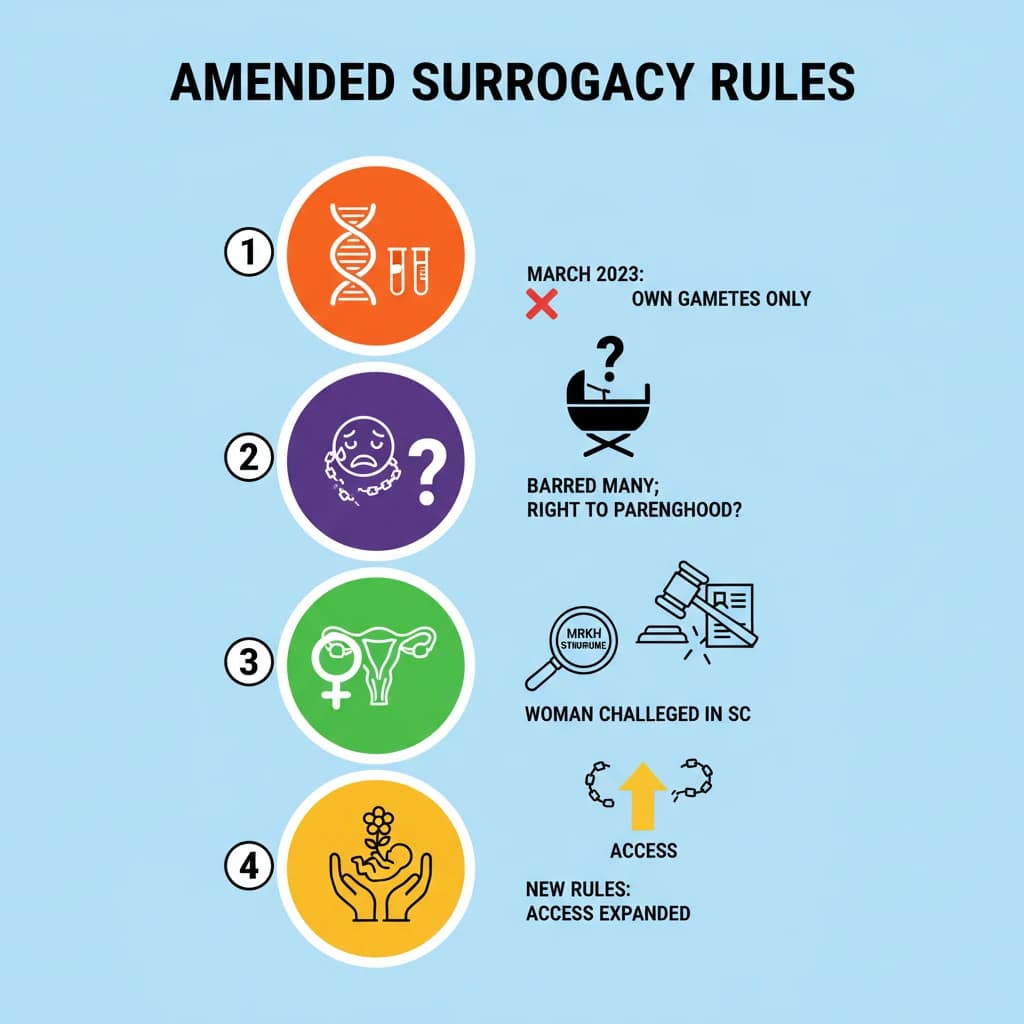
  • •March 2023 Surrogacy Rules initially mandated only intending couple's own gametes.
  • •This restriction barred many couples with specific medical conditions from accessing surrogacy.
  • •Caused distress and challenged the fundamental right to parenthood for affected individuals.
  • •A woman with MRKH Syndrome legally challenged the rules in the Supreme Court.
  • •Supreme Court expressed skepticism, asserting rules undermined surrogacy's fundamental objectives.
  • •Highlights the ongoing debate on reproductive rights, medical ethics, and judicial oversight in India.

🧠 Memory Techniques
Memory Aid
95% Verified Content

📚 Reference Sources

•The Surrogacy (Regulation) Act, 2021
•Surrogacy (Regulation) Amendment Rules, March 2023
•Supreme Court of India observations/reports on the MRKH Syndrome case
•Ministry of Health and Family Welfare official notifications

Related Topics

Loading related topics...
Explore:Social Issues Topics·All Subjects·Daily Current Affairs·Editorial Analysis·Previous Year Questions·UPSC GPT