Loading page, please wait…
Vaidra Logo
Vaidra

Top 4 items + smart groups

UPSC GPT
New
Current Affairs
Daily Solutions
Daily Puzzle
Mains Evaluator

Version 2.0.0 • Built with ❤️ for UPSC aspirants

Loading...
Loading...
Loading...
Loading...
Loading...
Loading...
Loading...
Loading...
Loading...
Loading...
Loading...
Loading...
Loading...
What are the Procedure for Altering the SC/ST/OBC List in India? - UPSC Social Issues
Back
All Subjects

Topics

0 topics • 0 completed

Loading topics...
Loading...
Loading...
Loading...
Loading...
Loading...
Overall Progress0%

What are the Procedure for Altering the SC/ST/OBC List in India? - UPSC Social Issues

What is What are the Procedure for Altering the SC/ST/OBC List in India? in UPSC Social Issues?

What are the Procedure for Altering the SC/ST/OBC List in India? is a key topic under Social Issues for UPSC Civil Services Examination. Key points include: Inclusion criteria vary for SCs (untouchability-linked backwardness), STs (primitive traits, isolation), and OBCs (social, educational, economic backwardness, inadequate representation).. The alteration procedure begins with State/UT proposals, supported by RGI and respective National Commissions (NCSC/NCST/NCBC).. For Central OBC list, NCBC recommendation (Section 9, NCBC Act, 1993) is mandatory.. Understanding this topic is essential for both UPSC Prelims and Mains preparation.

Why is What are the Procedure for Altering the SC/ST/OBC List in India? important for UPSC exam?

What are the Procedure for Altering the SC/ST/OBC List in India? is a Medium-level topic in UPSC Social Issues. It is tested in both Prelims (factual MCQs) and Mains (analytical answer writing). Previous year UPSC questions have frequently covered aspects of What are the Procedure for Altering the SC/ST/OBC List in India?, making it essential for comprehensive IAS preparation.

How to prepare What are the Procedure for Altering the SC/ST/OBC List in India? for UPSC?

To prepare What are the Procedure for Altering the SC/ST/OBC List in India? for UPSC: (1) Study the comprehensive notes covering all key concepts on Vaidra. (2) Practice previous year questions on this topic. (3) Connect it with current affairs using daily updates. (4) Revise using key takeaways and mind maps available for Social Issues. (5) Write practice answers linking What are the Procedure for Altering the SC/ST/OBC List in India? to related GS Paper topics.

Key takeaways of What are the Procedure for Altering the SC/ST/OBC List in India? for UPSC

  • Inclusion criteria vary for SCs (untouchability-linked backwardness), STs (primitive traits, isolation), and OBCs (social, educational, economic backwardness, inadequate representation).
  • The alteration procedure begins with State/UT proposals, supported by RGI and respective National Commissions (NCSC/NCST/NCBC).
  • For Central OBC list, NCBC recommendation (Section 9, NCBC Act, 1993) is mandatory.
  • SC/ST list changes are governed by Articles 341 and 342, requiring a Constitutional Amendment Bill in Parliament.
  • Parliamentary approval requires a special majority (2/3 present & voting + >50% total strength), followed by Presidential assent.
  • RGI (est. 1961, MHA) provides crucial demographic data for these alterations.
What are the Procedure for
Altering the SC/ST/OBC List in India?

What are the Procedure for Altering the SC/ST/OBC List in India?

Medium⏱️ 8 min read✓ 100% Verified
social issues

📖 Introduction

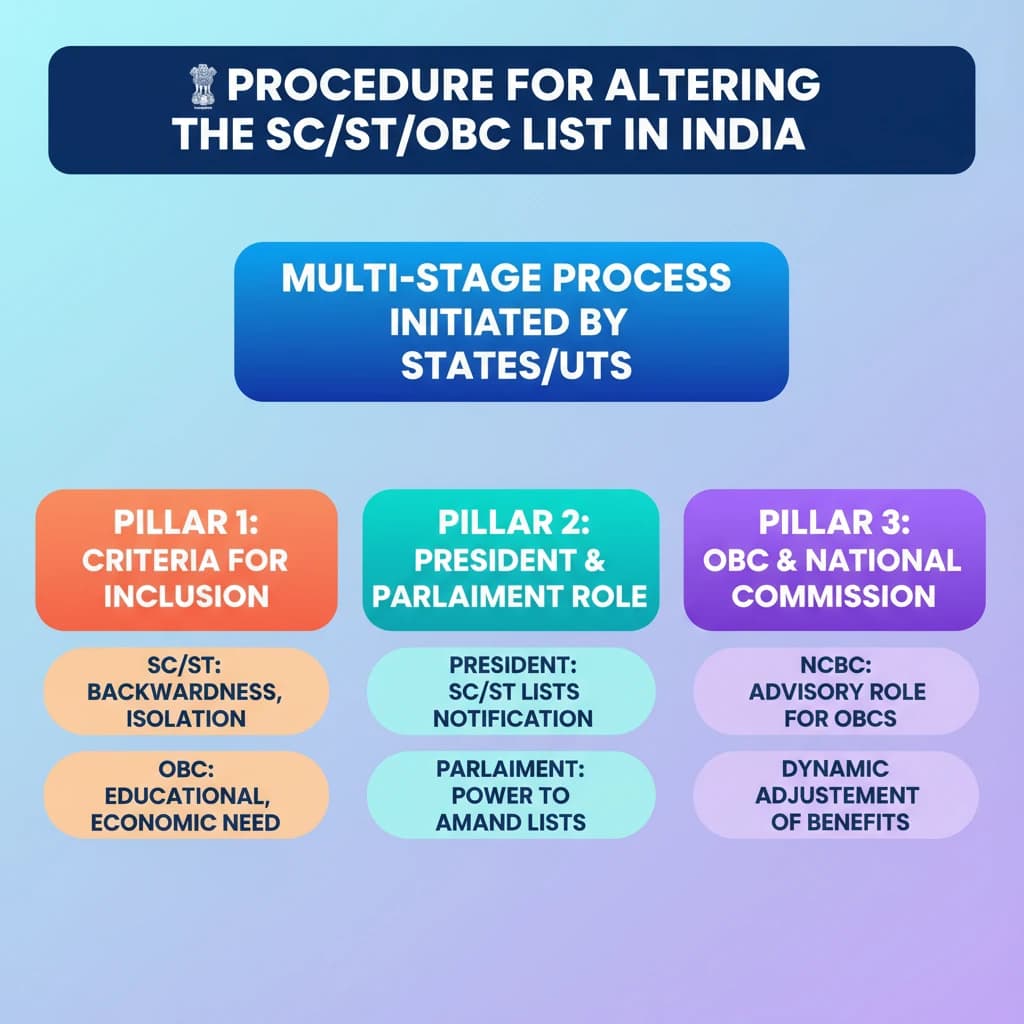
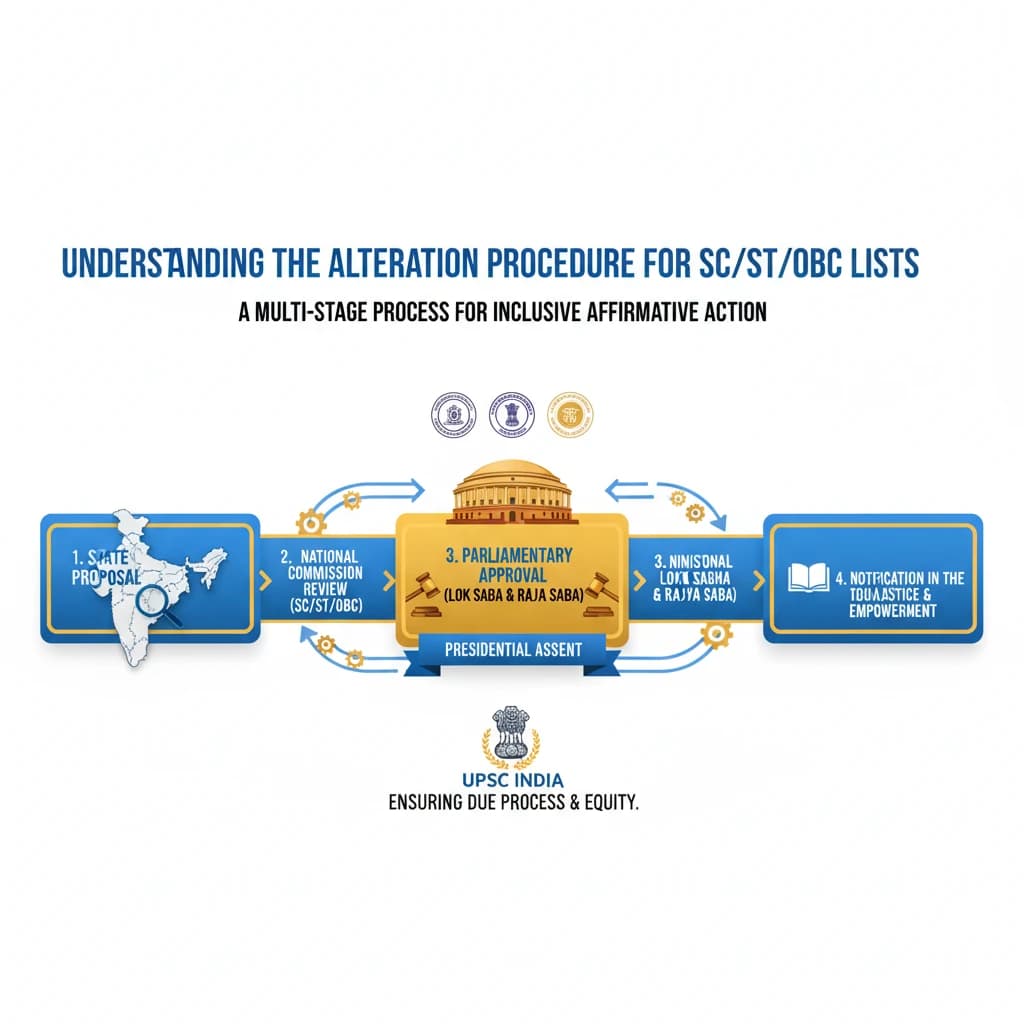
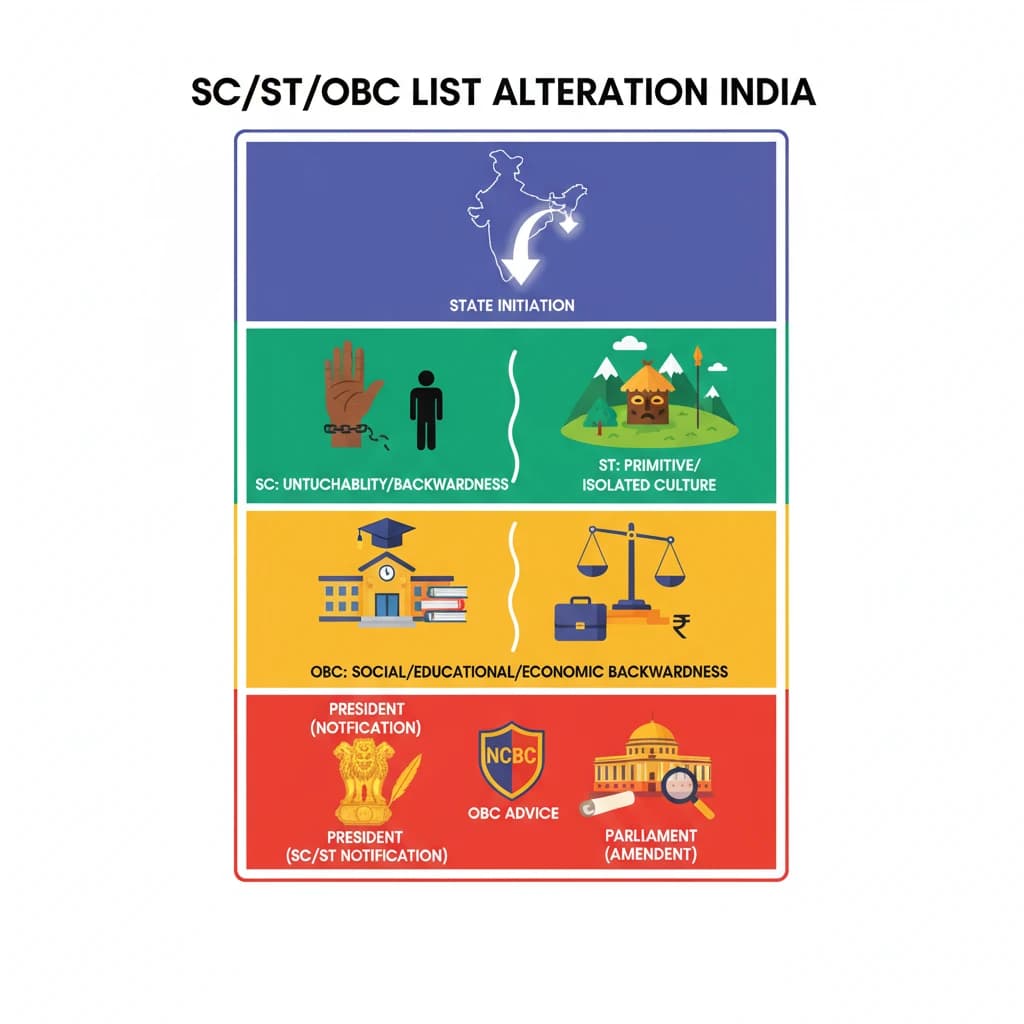
<h4>Inclusion Criteria for Reserved Categories</h4><p>The identification of communities for inclusion in the <strong>Scheduled Castes (SCs)</strong>, <strong>Scheduled Tribes (STs)</strong>, and <strong>Other Backward Classes (OBCs)</strong> lists is based on specific criteria designed to address historical disadvantages.</p><p>These criteria ensure that only genuinely backward and underrepresented communities receive the benefits of affirmative action.</p><ul><li><strong>Scheduled Castes (SCs):</strong> Inclusion is based on extreme <strong>social, educational, and economic backwardness</strong>. This is often intrinsically linked to the historical practice of <strong>untouchability</strong> and the discrimination faced by these communities.</li><li><strong>Scheduled Tribes (STs):</strong> Communities are identified as STs based on indications of <strong>primitive traits</strong>, distinct <strong>cultural practices</strong>, <strong>geographical isolation</strong>, and a general state of <strong>backwardness</strong>.</li><li><strong>Other Backward Classes (OBCs):</strong> Criteria for OBCs include significant <strong>social, educational, and economic backwardness</strong>, coupled with <strong>inadequate representation in government services</strong>.</li></ul><div class='key-point-box'><p>Each category has distinct identification parameters, reflecting the unique challenges faced by these groups in Indian society.</p></div><h4>Procedure for Altering the Lists</h4><p>The process of altering the <strong>SC/ST/OBC lists</strong> is a multi-stage procedure involving various governmental and constitutional bodies, culminating in parliamentary approval.</p><h5>Initiation and Scrutiny</h5><p>The process typically begins with a proposal initiated by <strong>State Governments</strong> or <strong>Union Territories (UTs)</strong> for the inclusion or exclusion of a community.</p><p>This proposal is then supported by the <strong>Registrar General of India (RGI)</strong> and the respective National Commissions – the <strong>National Commission for Scheduled Castes (NCSC)</strong> or the <strong>National Commission for Scheduled Tribes (NCST)</strong>.</p><div class='info-box'><p>For inclusion in the <strong>Central OBC list</strong>, recommendations from the <strong>National Commission for Backward Classes (NCBC)</strong> are mandatory, as per <strong>Section 9 of the NCBC Act, 1993</strong>.</p></div><div class='key-point-box'><p>The procedure for inclusion in the <strong>SC/ST category</strong> is governed by specific constitutional articles: <strong>Article 341</strong> for SCs and <strong>Article 342</strong> for STs.</p></div><p>The proposal undergoes rigorous scrutiny by the <strong>Ministry of Social Justice and Empowerment</strong>. This evaluation considers socio-economic factors and historical data, with crucial inputs from the <strong>Registrar General of India (RGI)</strong>.</p><p>Ultimately, any amendments to these lists are subject to review and approval by the <strong>Union Cabinet</strong> before proceeding to the legislative stage.</p><h5>Parliamentary Process</h5><p>To formally enact the proposed changes to the <strong>SC/ST/OBC list</strong>, a <strong>Constitutional Amendment Bill</strong> is introduced in <strong>Parliament</strong>.</p><div class='info-box'><p>The Bill requires passage by a <strong>special majority</strong> in both Houses of Parliament. This means a <strong>two-thirds majority</strong> of members present and voting, along with the support of <strong>more than 50%</strong> of the total strength of the respective House.</p></div><h5>Presidential Assent and Implementation</h5><p>After successfully being passed by both Houses of Parliament, the <strong>Constitutional Amendment Bill</strong> is sent to the <strong>President of India</strong> for assent.</p><p>Once the <strong>President</strong> grants assent, the amendments to the <strong>SC/ST/OBC list</strong> are officially enacted and become law, thereby altering the respective lists.</p><h4>Role of Registrar General of India (RGI)</h4><p>The <strong>Registrar General of India (RGI)</strong> plays a pivotal role in providing essential demographic data and support for the process of altering these lists.</p><div class='info-box'><p>The <strong>RGI</strong> was established in <strong>1961</strong> under the <strong>Ministry of Home Affairs</strong>. It is responsible for overseeing the demographic surveys of India.</p></div><p>These surveys include the decennial <strong>Census of India</strong> and the <strong>Linguistic Survey of India</strong>, providing crucial statistical information necessary for evaluating the backwardness and representation of communities.</p>
Concept Diagram

💡 Key Takeaways

  • •Inclusion criteria vary for SCs (untouchability-linked backwardness), STs (primitive traits, isolation), and OBCs (social, educational, economic backwardness, inadequate representation).
  • •The alteration procedure begins with State/UT proposals, supported by RGI and respective National Commissions (NCSC/NCST/NCBC).
  • •For Central OBC list, NCBC recommendation (Section 9, NCBC Act, 1993) is mandatory.
  • •SC/ST list changes are governed by Articles 341 and 342, requiring a Constitutional Amendment Bill in Parliament.
  • •Parliamentary approval requires a special majority (2/3 present & voting + >50% total strength), followed by Presidential assent.
  • •RGI (est. 1961, MHA) provides crucial demographic data for these alterations.

🧠 Memory Techniques
Memory Aid
100% Verified Content

📚 Reference Sources

•The Constitution of India (Articles 341, 342)
•National Commission for Backward Classes Act, 1993

Related Topics

Loading related topics...
Explore:Social Issues Topics·All Subjects·Daily Current Affairs·Editorial Analysis·Previous Year Questions·UPSC GPT