Loading page, please wait…
Vaidra Logo
Vaidra

Top 4 items + smart groups

UPSC GPT
New
Current Affairs
Daily Solutions
Daily Puzzle
Mains Evaluator

Version 2.0.0 • Built with ❤️ for UPSC aspirants

Loading...
Loading...
Loading...
Loading...
Loading...
Loading...
Loading...
Loading...
Loading...
Loading...
Loading...
Loading...
Loading...
What are the Key Findings of the Report? - UPSC Social Issues
Back
All Subjects

Topics

0 topics • 0 completed

Loading topics...
Loading...
Loading...
Loading...
Loading...
Loading...
Overall Progress0%

What are the Key Findings of the Report? - UPSC Social Issues

What is What are the Key Findings of the Report? in UPSC Social Issues?

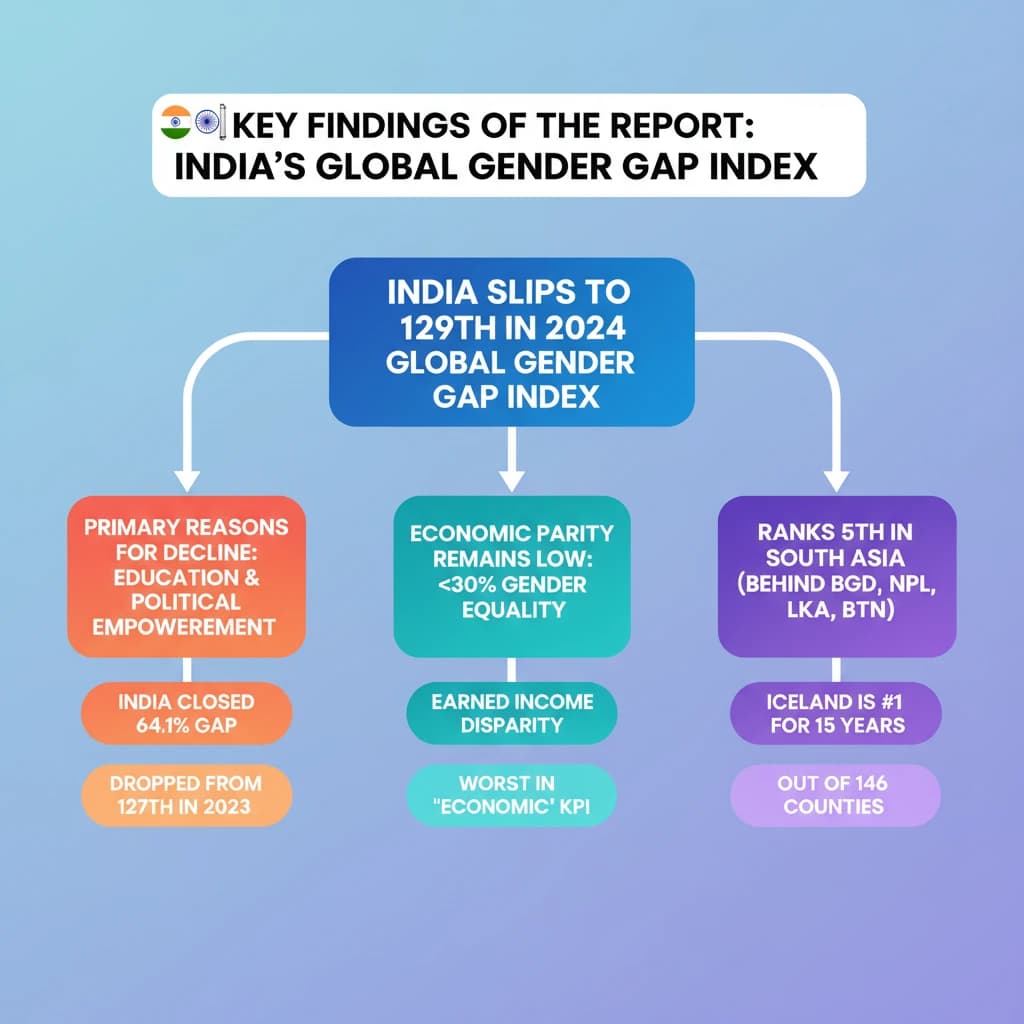
What are the Key Findings of the Report? is a key topic under Social Issues for UPSC Civil Services Examination. Key points include: India slipped to 129th rank in the 2024 Global Gender Gap Index, down from 127th in 2023, out of 146 countries.. India closed 64.1% of its gender gap, with declines in 'Educational Attainment' and 'Political Empowerment' being primary reasons for the slip.. India has among the lowest levels of economic parity, with less than 30% gender parity in estimated earned income.. Understanding this topic is essential for both UPSC Prelims and Mains preparation.

Why is What are the Key Findings of the Report? important for UPSC exam?

What are the Key Findings of the Report? is a Medium-level topic in UPSC Social Issues. It is tested in both Prelims (factual MCQs) and Mains (analytical answer writing). Previous year UPSC questions have frequently covered aspects of What are the Key Findings of the Report?, making it essential for comprehensive IAS preparation.

How to prepare What are the Key Findings of the Report? for UPSC?

To prepare What are the Key Findings of the Report? for UPSC: (1) Study the comprehensive notes covering all key concepts on Vaidra. (2) Practice previous year questions on this topic. (3) Connect it with current affairs using daily updates. (4) Revise using key takeaways and mind maps available for Social Issues. (5) Write practice answers linking What are the Key Findings of the Report? to related GS Paper topics.

Key takeaways of What are the Key Findings of the Report? for UPSC

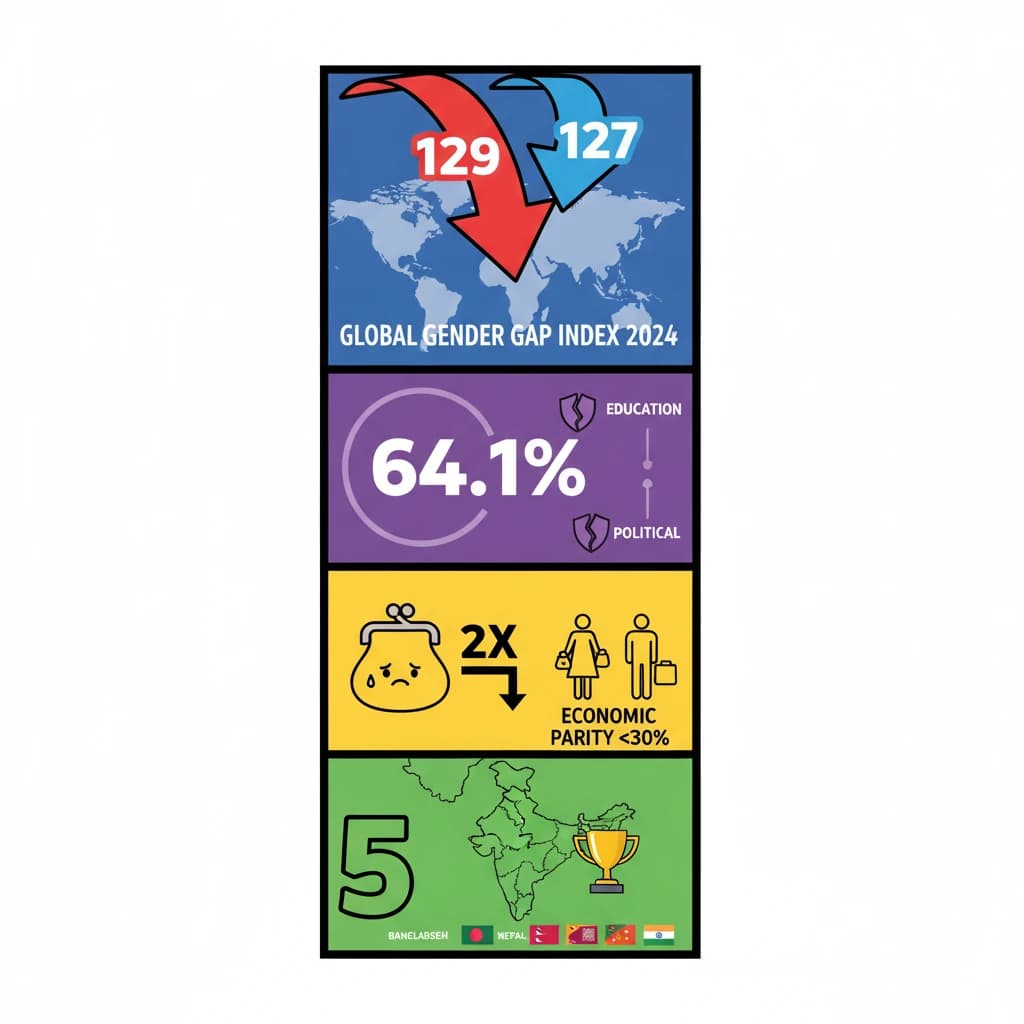
  • India slipped to 129th rank in the 2024 Global Gender Gap Index, down from 127th in 2023, out of 146 countries.
  • India closed 64.1% of its gender gap, with declines in 'Educational Attainment' and 'Political Empowerment' being primary reasons for the slip.
  • India has among the lowest levels of economic parity, with less than 30% gender parity in estimated earned income.
  • Within South Asia, India ranks fifth, behind Bangladesh, Nepal, Sri Lanka, and Bhutan.
  • Iceland remains the most gender-equal society for the 15th consecutive year.
What are the Key Findings of the Report?

What are the Key Findings of the Report?

Medium⏱️ 8 min read✓ 95% Verified
social issues

📖 Introduction

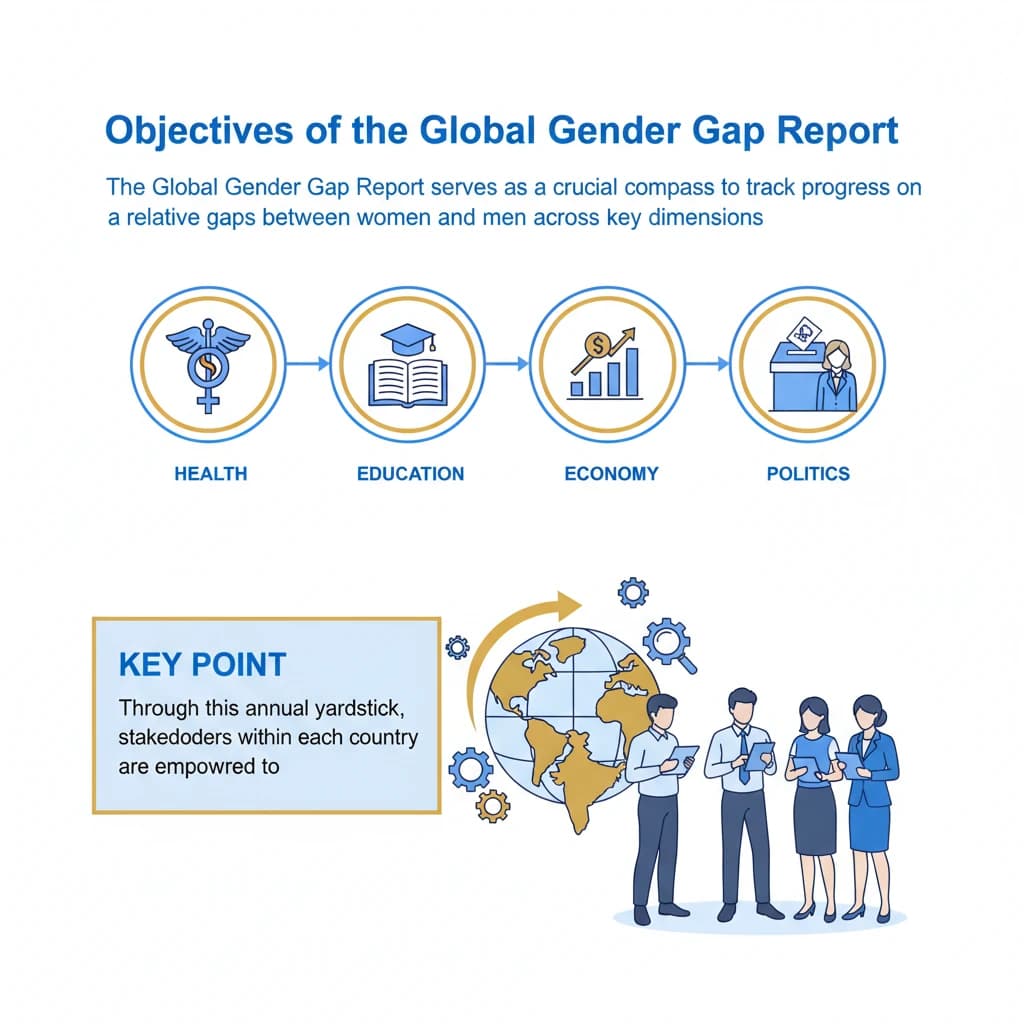
<h4>Objectives of the Global Gender Gap Report</h4><p>The <strong>Global Gender Gap Report</strong> serves as a crucial compass to track progress on the relative gaps between <strong>women</strong> and <strong>men</strong> across key dimensions.</p><p>These dimensions include <strong>health</strong>, <strong>education</strong>, <strong>economy</strong>, and <strong>politics</strong>.</p><div class='key-point-box'><p>Through this annual yardstick, stakeholders within each country are empowered to set <strong>priorities</strong> relevant to their specific <strong>economic</strong>, <strong>political</strong>, and <strong>cultural context</strong>.</p></div><h4>Top-Ranking Countries in Gender Equality</h4><p>For the <strong>15th consecutive year</strong>, <strong>Iceland</strong> (with a <strong>93.5%</strong> gender gap closure) maintains its position as the world’s most <strong>gender-equal society</strong>.</p><p>It is closely followed by <strong>Finland</strong>, <strong>Norway</strong>, <strong>New Zealand</strong>, and <strong>Sweden</strong>, completing the top 5 rankings.</p><div class='info-box'><p><strong>7 out of the top 10 countries</strong> are from <strong>Europe</strong>, including <strong>Iceland</strong>, <strong>Finland</strong>, <strong>Norway</strong>, <strong>Sweden</strong>, <strong>Germany</strong>, <strong>Ireland</strong>, and <strong>Spain</strong>.</p></div><p>Other regions represented in the top 10 include <strong>Eastern Asia and the Pacific</strong> (with <strong>New Zealand</strong> at rank 4), <strong>Latin America and the Caribbean</strong> (with <strong>Nicaragua</strong> at rank 6), and <strong>Sub-Saharan Africa</strong> (with <strong>Namibia</strong> at rank 8).</p><p>Notably, <strong>Spain</strong> and <strong>Ireland</strong> made significant jumps into the top 10 in <strong>2024</strong>, climbing <strong>8</strong> and <strong>2 ranks</strong> respectively compared to their <strong>2023</strong> positions.</p><h4>India's Performance in the Global Gender Gap Index</h4><p><strong>India</strong> has experienced a slip in its global ranking, moving down <strong>two places</strong> to <strong>129th</strong> in <strong>2024</strong> from <strong>127th</strong> in <strong>2023</strong>, out of a total of <strong>146 countries</strong>.</p><div class='info-box'><p>Within the <strong>South Asia</strong> region, <strong>India</strong> ranks <strong>fifth</strong>, trailing behind <strong>Bangladesh</strong>, <strong>Nepal</strong>, <strong>Sri Lanka</strong>, and <strong>Bhutan</strong>. <strong>Pakistan</strong> holds the last position in the region.</p></div><p>As of <strong>2024</strong>, <strong>India</strong> has closed <strong>64.1%</strong> of its <strong>gender gap</strong>.</p><p>The decline in ranking from <strong>127th</strong> to <strong>129th</strong> was primarily attributed to small decreases in the <strong>‘Educational Attainment’</strong> and <strong>‘Political Empowerment’</strong> parameters.</p><p>Despite these declines, <strong>India’s scores</strong> in <strong>‘Economic Participation and Opportunity’</strong> saw slight improvements.</p><h4>Economic Parity in India</h4><p><strong>India</strong> is identified among the countries exhibiting the <strong>lowest levels of economic parity</strong>.</p><p>It shares this characteristic with nations such as <strong>Bangladesh</strong>, <strong>Sudan</strong>, <strong>Iran</strong>, <strong>Pakistan</strong>, and <strong>Morocco</strong>.</p><div class='info-box'><p>These countries demonstrate <strong>less than 30% gender parity</strong> in <strong>estimated earned income</strong>.</p></div><h4>Educational Attainment in India</h4><p>In terms of <strong>educational attainment</strong>, <strong>India</strong> showed the <strong>best gender parity</strong> specifically in <strong>secondary education enrolment</strong>.</p>
Concept Diagram

💡 Key Takeaways

  • •India slipped to 129th rank in the 2024 Global Gender Gap Index, down from 127th in 2023, out of 146 countries.
  • •India closed 64.1% of its gender gap, with declines in 'Educational Attainment' and 'Political Empowerment' being primary reasons for the slip.
  • •India has among the lowest levels of economic parity, with less than 30% gender parity in estimated earned income.
  • •Within South Asia, India ranks fifth, behind Bangladesh, Nepal, Sri Lanka, and Bhutan.
  • •Iceland remains the most gender-equal society for the 15th consecutive year.

🧠 Memory Techniques
Memory Aid
95% Verified Content

📚 Reference Sources

•World Economic Forum (implied source of the Global Gender Gap Report)

Related Topics

Loading related topics...
Explore:Social Issues Topics·All Subjects·Daily Current Affairs·Editorial Analysis·Previous Year Questions·UPSC GPT