Loading page, please wait…
Vaidra Logo
Vaidra

Top 4 items + smart groups

UPSC GPT
New
Current Affairs
Daily Solutions
Daily Puzzle
Mains Evaluator

Version 2.0.0 • Built with ❤️ for UPSC aspirants

Loading...
Loading...
Loading...
Loading...
Loading...
Loading...
Loading...
Loading...
Loading...
Loading...
Loading...
Loading...
Loading...
Back
All Subjects

Topics

0 topics • 0 completed

Loading topics...
Loading...
Loading...
Loading...
Loading...
Loading...
Overall Progress0%

What is the Special Marriage Act (SMA), 1954? - UPSC Social Issues

What is What is the Special Marriage Act (SMA), 1954? in UPSC Social Issues?

What is the Special Marriage Act (SMA), 1954? is a key topic under Social Issues for UPSC Civil Services Examination. Key points include: The Special Marriage Act (SMA), 1954, provides a legal framework for civil marriages between individuals of different religions or castes in India.. It applies to people of all faiths across India and allows foreigners to register their marriage under specific conditions.. Key provisions include legal recognition of marriages, granting rights like inheritance, and requiring a 30-day notice period to the Marriage Officer.. Understanding this topic is essential for both UPSC Prelims and Mains preparation.

Why is What is the Special Marriage Act (SMA), 1954? important for UPSC exam?

What is the Special Marriage Act (SMA), 1954? is a Medium-level topic in UPSC Social Issues. It is tested in both Prelims (factual MCQs) and Mains (analytical answer writing). Previous year UPSC questions have frequently covered aspects of What is the Special Marriage Act (SMA), 1954?, making it essential for comprehensive IAS preparation.

How to prepare What is the Special Marriage Act (SMA), 1954? for UPSC?

To prepare What is the Special Marriage Act (SMA), 1954? for UPSC: (1) Study the comprehensive notes covering all key concepts on Vaidra. (2) Practice previous year questions on this topic. (3) Connect it with current affairs using daily updates. (4) Revise using key takeaways and mind maps available for Social Issues. (5) Write practice answers linking What is the Special Marriage Act (SMA), 1954? to related GS Paper topics.

Key takeaways of What is the Special Marriage Act (SMA), 1954? for UPSC

  • The Special Marriage Act (SMA), 1954, provides a legal framework for civil marriages between individuals of different religions or castes in India.
  • It applies to people of all faiths across India and allows foreigners to register their marriage under specific conditions.
  • Key provisions include legal recognition of marriages, granting rights like inheritance, and requiring a 30-day notice period to the Marriage Officer.
  • Section 7 allows for a 30-day objection period after the marriage notice is published.
  • The SMA promotes secularism, individual choice, and equality by offering an alternative to religion-specific personal laws.
What is the Special Marriage Act (SMA), 1954?

What is the Special Marriage Act (SMA), 1954?

Medium⏱️ 7 min read✓ 98% Verified
social issues

📖 Introduction

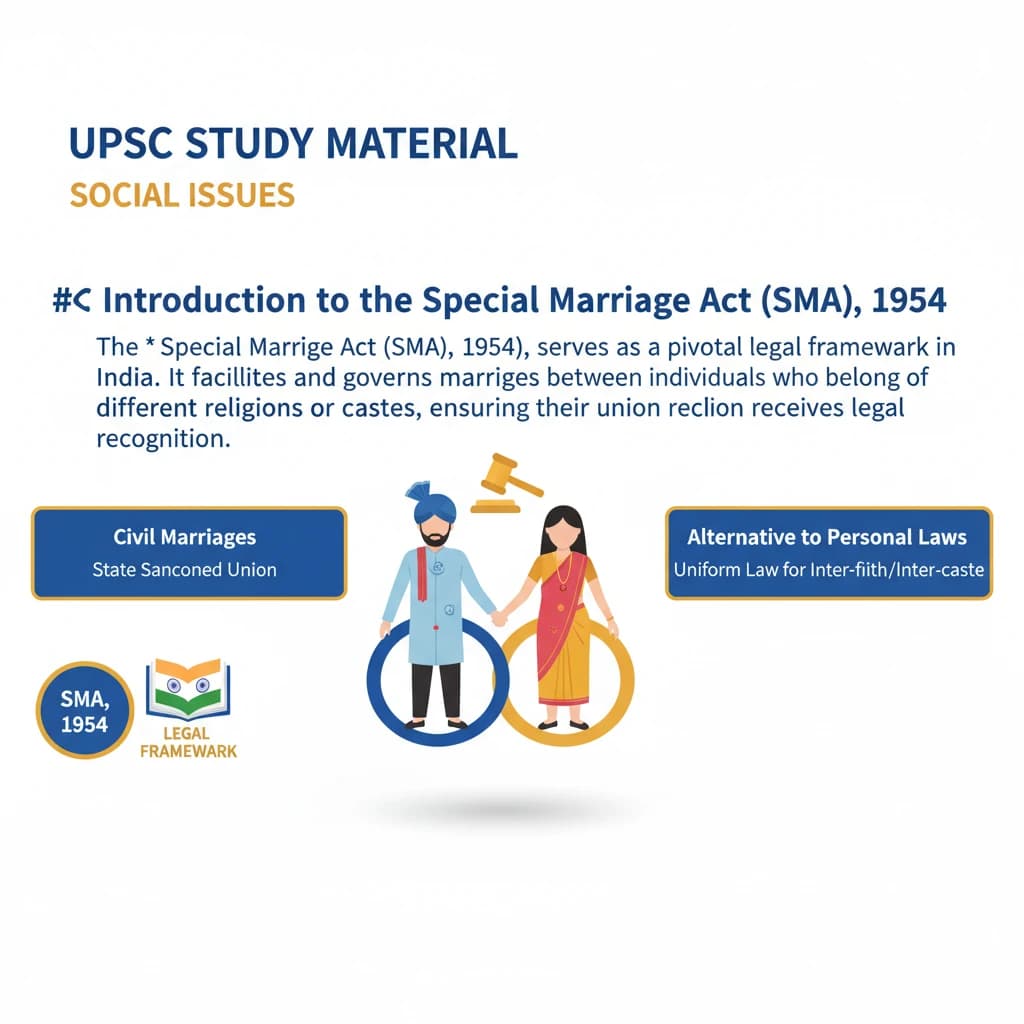
<h4>Introduction to the Special Marriage Act (SMA), 1954</h4><p>The <strong>Special Marriage Act (SMA), 1954</strong>, serves as a pivotal legal framework in India. It facilitates and governs marriages between individuals who belong to different religions or castes, ensuring their union receives legal recognition.</p><p>This Act specifically deals with <strong>civil marriages</strong>, where the state, rather than religious authorities, sanctions the marital bond. It provides an alternative to personal religious laws for those seeking an inter-faith or inter-caste union.</p><div class='key-point-box'><p>The <strong>SMA, 1954</strong>, is a secular law designed to uphold individual choice and promote social harmony by enabling marriages irrespective of religious or caste affiliations.</p></div><h4>Applicability of the Special Marriage Act</h4><p>The <strong>SMA</strong> extends its provisions to people of all faiths across India. This includes adherents of <strong>Hinduism, Islam, Sikhism, Christianity, Jainism, and Buddhism</strong>, among others. It ensures a uniform legal process for civil marriages for all citizens.</p><p>Significantly, the Act also allows <strong>foreigners</strong> to register their marriage in India under specific conditions. This provision makes India a viable location for civil marriages involving international couples.</p><div class='info-box'><p>For foreigners to register their marriage under SMA, 1954, both parties must possess <strong>valid passports</strong>. Additionally, at least one of the parties must have resided in India for a minimum period of <strong>30 days</strong> immediately preceding the filing of the marriage notice.</p></div><h4>Key Provisions of the SMA, 1954</h4><ul><li><p><strong>Marriage Recognition:</strong> The Act provides for the legal registration of marriages, which is crucial for establishing the legal validity of the union. This recognition grants couples various essential rights and benefits.</p></li><li><p>These rights include entitlements related to <strong>inheritance, succession, and social security benefits</strong>, ensuring legal protection and stability for the married couple and their offspring.</p></li><li><p><strong>Notice Requirement (Section 5):</strong> A fundamental provision under the SMA mandates that parties intending to marry must provide a <strong>written notice</strong> to the Marriage Officer of the district. This notice formally declares their intention to marry.</p></li><li><p>Crucially, at least one of the parties must have resided in that specific district for a minimum period of <strong>30 days</strong> immediately before the date on which the notice is given.</p></li><li><p><strong>Objection Period (Section 7):</strong> Following the publication of the marriage notice, <strong>Section 7</strong> of the Act allows for a period during which objections to the intended marriage can be raised. This period is set at <strong>30 days</strong> from the date the notice is published.</p></li><li><p>If valid objections are raised, the Marriage Officer is required to inquire into them before proceeding with the marriage registration.</p></li></ul><div class='exam-tip-box'><p>Understanding the <strong>30-day notice period</strong> and <strong>30-day objection period</strong> is vital for UPSC Prelims. These timelines are frequently tested factual details related to the <strong>Special Marriage Act</strong>.</p></div>
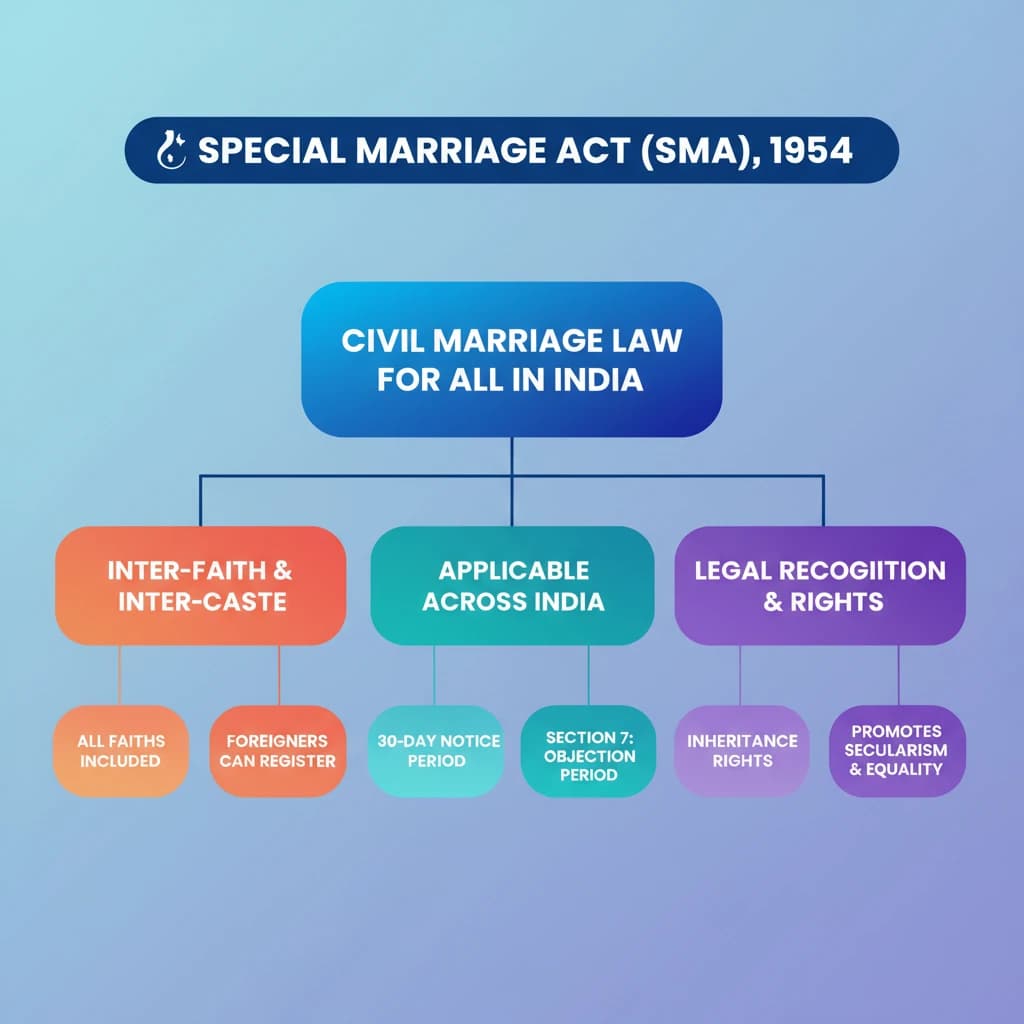
Concept Diagram

💡 Key Takeaways

  • •The Special Marriage Act (SMA), 1954, provides a legal framework for civil marriages between individuals of different religions or castes in India.
  • •It applies to people of all faiths across India and allows foreigners to register their marriage under specific conditions.
  • •Key provisions include legal recognition of marriages, granting rights like inheritance, and requiring a 30-day notice period to the Marriage Officer.
  • •Section 7 allows for a 30-day objection period after the marriage notice is published.
  • •The SMA promotes secularism, individual choice, and equality by offering an alternative to religion-specific personal laws.

🧠 Memory Techniques
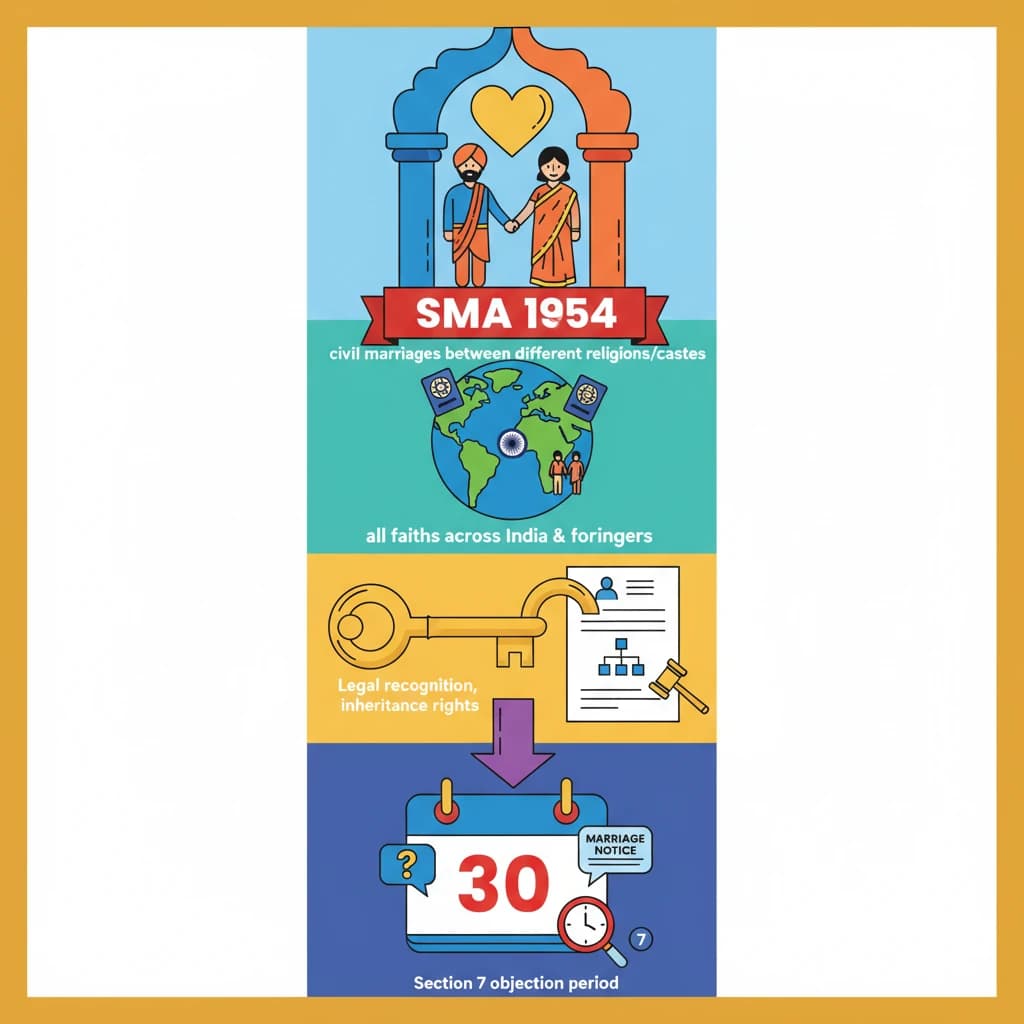
Memory Aid
98% Verified Content

📚 Reference Sources

•The Special Marriage Act, 1954 (Bare Act)

Related Topics

Loading related topics...
Explore:Social Issues Topics·All Subjects·Daily Current Affairs·Editorial Analysis·Previous Year Questions·UPSC GPT
What is the Special Marriage Act (SMA), 1954? - UPSC Social Issues