Loading page, please wait…
Vaidra Logo
Vaidra

Top 4 items + smart groups

UPSC GPT
New
Current Affairs
Daily Solutions
Daily Puzzle
Mains Evaluator

Version 2.0.0 • Built with ❤️ for UPSC aspirants

Loading...
Loading...
Loading...
Loading...
Loading...
Loading...
Loading...
Loading...
Loading...
Loading...
Loading...
Loading...
Loading...
What are the Government Initiatives Related to HIV? - UPSC Social Issues
Back
All Subjects

Topics

0 topics • 0 completed

Loading topics...
Loading...
Loading...
Loading...
Loading...
Loading...
Overall Progress0%

What are the Government Initiatives Related to HIV? - UPSC Social Issues

What is What are the Government Initiatives Related to HIV? in UPSC Social Issues?

What are the Government Initiatives Related to HIV? is a key topic under Social Issues for UPSC Civil Services Examination. Key points include: NACP is India's primary program for HIV/AIDS, launched in 1992 and evolving through five phases.. The program focuses on prevention, treatment, and care, adapting strategies over time.. The HIV/AIDS Prevention and Control Act (2017) provides a legal framework to protect rights and prevent discrimination.. Understanding this topic is essential for both UPSC Prelims and Mains preparation.

Why is What are the Government Initiatives Related to HIV? important for UPSC exam?

What are the Government Initiatives Related to HIV? is a Medium-level topic in UPSC Social Issues. It is tested in both Prelims (factual MCQs) and Mains (analytical answer writing). Previous year UPSC questions have frequently covered aspects of What are the Government Initiatives Related to HIV?, making it essential for comprehensive IAS preparation.

How to prepare What are the Government Initiatives Related to HIV? for UPSC?

To prepare What are the Government Initiatives Related to HIV? for UPSC: (1) Study the comprehensive notes covering all key concepts on Vaidra. (2) Practice previous year questions on this topic. (3) Connect it with current affairs using daily updates. (4) Revise using key takeaways and mind maps available for Social Issues. (5) Write practice answers linking What are the Government Initiatives Related to HIV? to related GS Paper topics.

Key takeaways of What are the Government Initiatives Related to HIV? for UPSC

  • NACP is India's primary program for HIV/AIDS, launched in 1992 and evolving through five phases.
  • The program focuses on prevention, treatment, and care, adapting strategies over time.
  • The HIV/AIDS Prevention and Control Act (2017) provides a legal framework to protect rights and prevent discrimination.
  • NACP Phase V (2021-2026) aims to reduce new infections and AIDS-related deaths by 80% by 2025-26.
  • International partners like UNAIDS, WHO, and the World Bank provide crucial technical and financial support.
What are the Government Initiatives Related to HIV?

What are the Government Initiatives Related to HIV?

Medium⏱️ 6 min read✓ 98% Verified
social issues

📖 Introduction

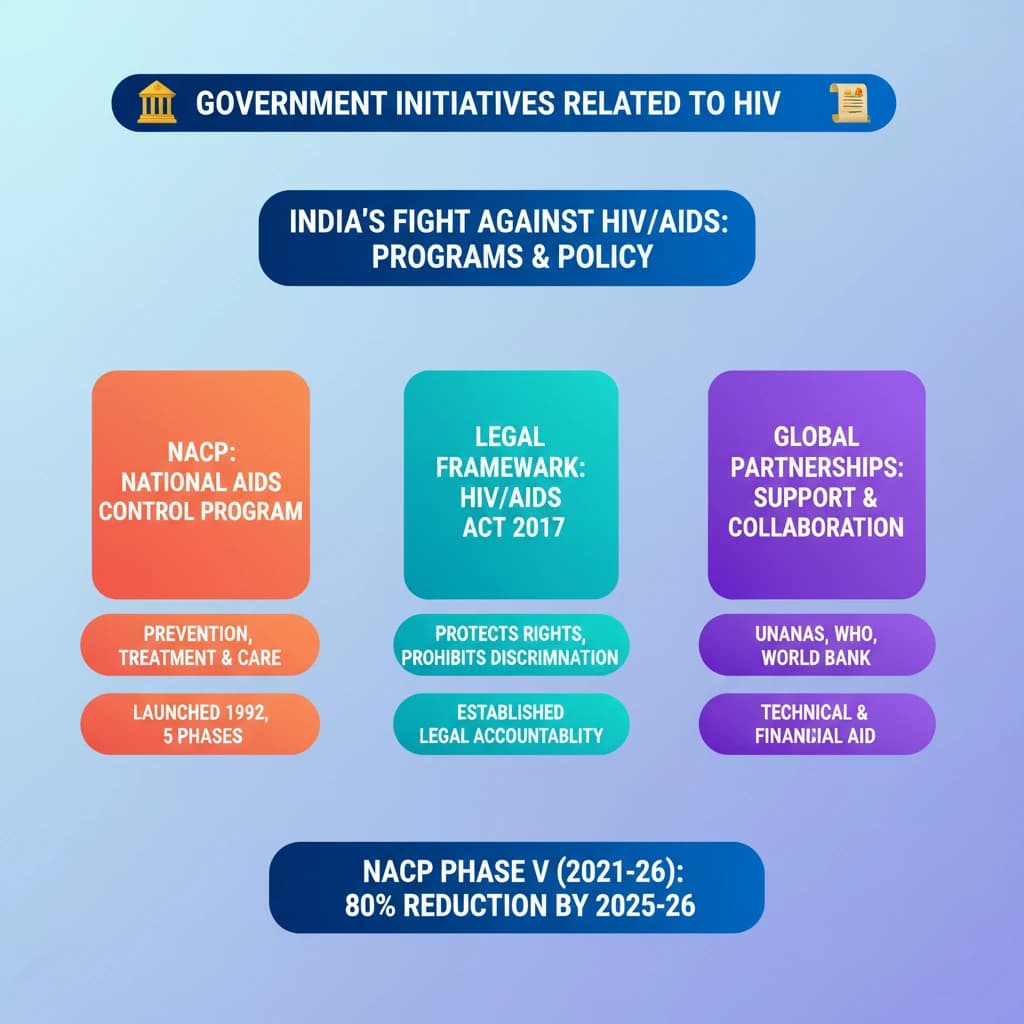
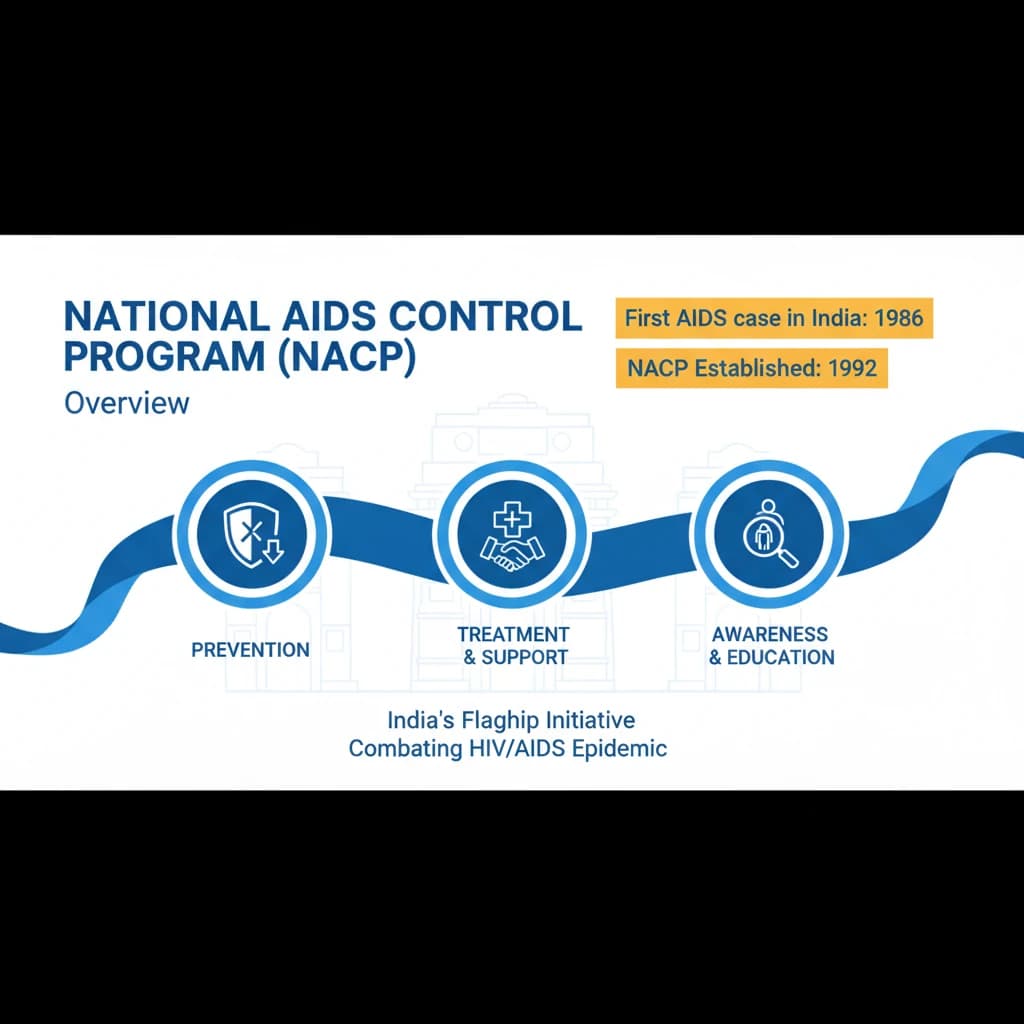
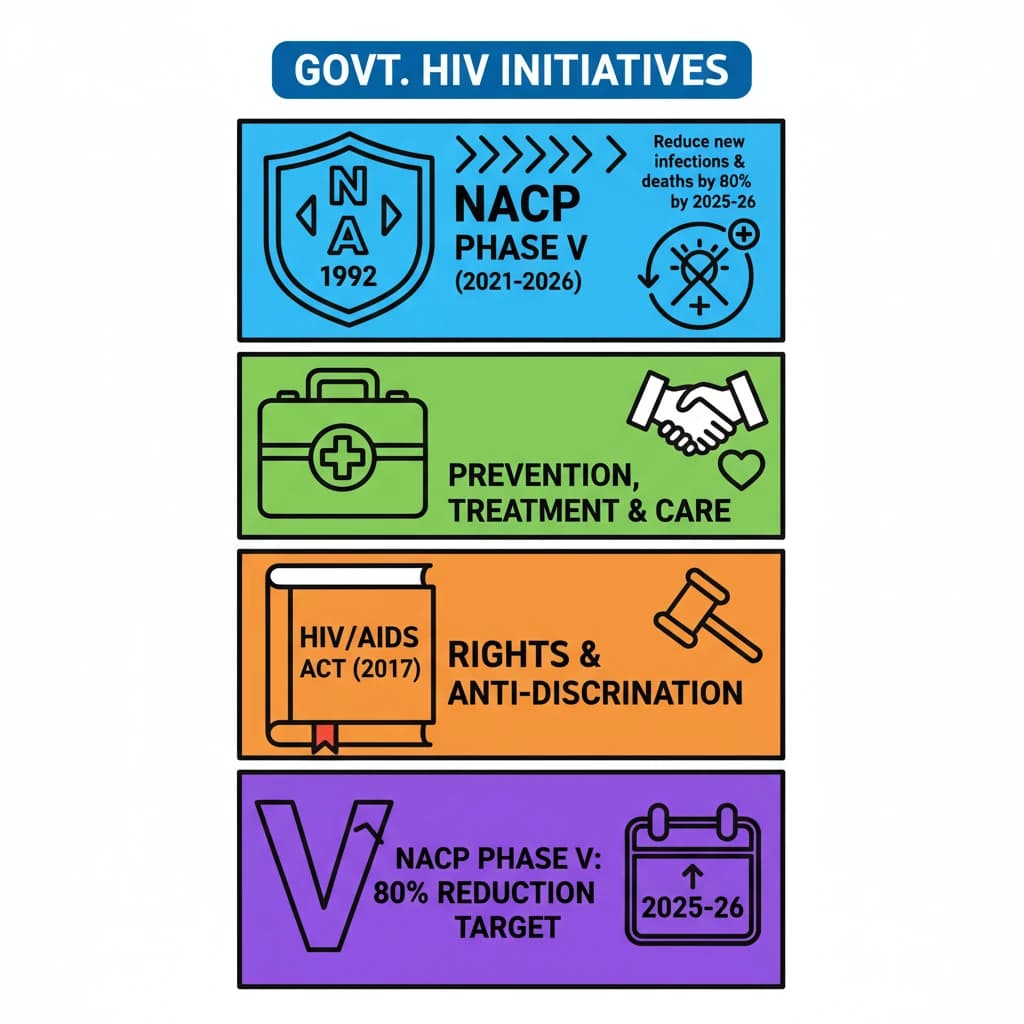
<h4>National AIDS Control Program (NACP): Overview</h4><p>The <strong>National AIDS Control Program (NACP)</strong> is India's flagship initiative to combat the HIV/AIDS epidemic. It was established shortly after the <strong>first AIDS case</strong> was reported in India in <strong>1986</strong>.</p><p>Since its inception in <strong>1992</strong>, NACP has undergone significant evolution through multiple phases. The program's core focus remains on the crucial areas of <strong>prevention</strong>, <strong>treatment</strong>, and <strong>care</strong> for people living with <strong>HIV/AIDS</strong>.</p><div class='info-box'><p>The <strong>first AIDS case</strong> in India was reported in <strong>1986</strong>, prompting the need for a national response.</p></div><h4>Phases of NACP: A Chronological Evolution</h4><p>The NACP has systematically addressed the epidemic through distinct phases, adapting strategies to emerging challenges and knowledge.</p><ol><li><strong>Phase I (1992-1999):</strong> This phase primarily focused on <strong>awareness generation</strong>, ensuring <strong>blood safety</strong>, and establishing robust <strong>surveillance systems</strong> across the country.</li><li><strong>Phase II (1999-2006):</strong> During this period, the program significantly <strong>expanded targeted interventions</strong> for <strong>high-risk populations</strong>. It also marked increased involvement of <strong>NGOs</strong> in the implementation process.</li><li><strong>Phase III (2007-2012):</strong> This phase saw a dramatic <strong>scaling up of targeted interventions</strong> and further <strong>strengthening of surveillance</strong> mechanisms. There was a strong emphasis on partnerships with <strong>civil society organizations</strong> to enhance community involvement.</li><li><strong>Phase IV (2012-2021):</strong> The objective of Phase IV was to <strong>consolidate gains</strong> made in previous phases and further <strong>integrate HIV services</strong> into the broader public health system. It focused on providing <strong>comprehensive care, support, and treatment</strong> for people living with HIV.</li><li><strong>Phase V (2021-2026):</strong> The current phase aims to achieve ambitious targets, specifically to <strong>reduce new HIV infections</strong> and <strong>AIDS-related deaths by 80%</strong> by the end of <strong>2025-26</strong>, compared to <strong>2010 levels</strong>.</li></ol><div class='info-box'><p><strong>NACP Phase V (2021-2026)</strong> targets an <strong>80% reduction</strong> in new HIV infections and AIDS-related deaths by <strong>2025-26</strong> (relative to 2010).</p></div><h4>Legislative Framework: The HIV/AIDS Act</h4><p>India's commitment to protecting the rights of individuals affected by HIV/AIDS is enshrined in law. The <strong>HIV/AIDS Prevention and Control Act (2017)</strong> provides a vital legal framework.</p><p>This Act ensures access to <strong>treatment</strong> without facing <strong>stigma or discrimination</strong>, safeguarding the dignity and rights of people living with HIV/AIDS.</p><div class='key-point-box'><p>The <strong>HIV/AIDS Prevention and Control Act (2017)</strong> is crucial for protecting the rights of people living with HIV, ensuring <strong>non-discrimination</strong> and <strong>access to treatment</strong>.</p></div><h4>International Collaboration and Support</h4><p>India's fight against HIV/AIDS is bolstered by significant international collaboration. The country receives both <strong>technical assistance</strong> and crucial <strong>funding</strong> from various global partners.</p><ul><li><strong>UNAIDS</strong></li><li><strong>WHO (World Health Organization)</strong></li><li>The <strong>World Bank</strong></li><li>Private foundations such as the <strong>Bill & Melinda Gates Foundation</strong></li></ul>
Concept Diagram

💡 Key Takeaways

  • •NACP is India's primary program for HIV/AIDS, launched in 1992 and evolving through five phases.
  • •The program focuses on prevention, treatment, and care, adapting strategies over time.
  • •The HIV/AIDS Prevention and Control Act (2017) provides a legal framework to protect rights and prevent discrimination.
  • •NACP Phase V (2021-2026) aims to reduce new infections and AIDS-related deaths by 80% by 2025-26.
  • •International partners like UNAIDS, WHO, and the World Bank provide crucial technical and financial support.

🧠 Memory Techniques
Memory Aid
98% Verified Content

📚 Reference Sources

•National AIDS Control Organization (NACO) official website
•Ministry of Health and Family Welfare, Government of India

Related Topics

Loading related topics...
Explore:Social Issues Topics·All Subjects·Daily Current Affairs·Editorial Analysis·Previous Year Questions·UPSC GPT