Loading page, please wait…
Vaidra Logo
Vaidra

Top 4 items + smart groups

UPSC GPT
New
Current Affairs
Daily Solutions
Daily Puzzle
Mains Evaluator

Version 2.0.0 • Built with ❤️ for UPSC aspirants

Loading...
Loading...
Loading...
Loading...
Loading...
Loading...
Loading...
Loading...
Loading...
Loading...
Loading...
Loading...
Loading...
Back
All Subjects

Topics

0 topics • 0 completed

Loading topics...
Loading...
Loading...
Loading...
Loading...
Loading...
Overall Progress0%
Deletion of MGNREGA Job Cards - UPSC Social Issues

Deletion of MGNREGA Job Cards - UPSC Social Issues

What is Deletion of MGNREGA Job Cards in UPSC Social Issues?

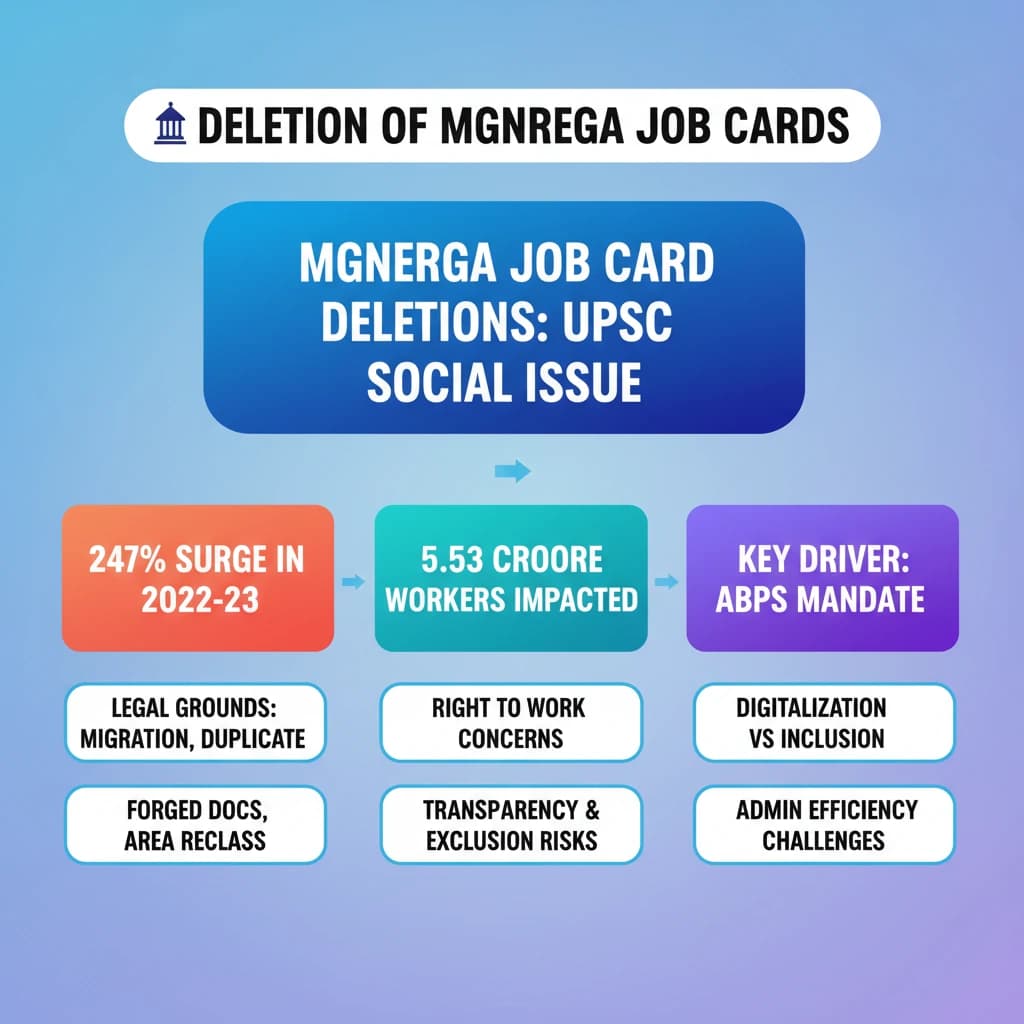
Deletion of MGNREGA Job Cards is a key topic under Social Issues for UPSC Civil Services Examination. Key points include: MGNREGA job card deletions surged by 247% in 2022-23, impacting over 5.53 crore workers.. Legal grounds for deletion include permanent migration, duplicate cards, forged documents, and area reclassification (MGNREGA Act, Schedule II, Para 23).. The mandatory Aadhaar-based Payment System (ABPS) implementation was a key driver for the recent deletions.. Understanding this topic is essential for both UPSC Prelims and Mains preparation.

Why is Deletion of MGNREGA Job Cards important for UPSC exam?

Deletion of MGNREGA Job Cards is a Medium-level topic in UPSC Social Issues. It is tested in both Prelims (factual MCQs) and Mains (analytical answer writing). Previous year UPSC questions have frequently covered aspects of Deletion of MGNREGA Job Cards, making it essential for comprehensive IAS preparation.

How to prepare Deletion of MGNREGA Job Cards for UPSC?

To prepare Deletion of MGNREGA Job Cards for UPSC: (1) Study the comprehensive notes covering all key concepts on Vaidra. (2) Practice previous year questions on this topic. (3) Connect it with current affairs using daily updates. (4) Revise using key takeaways and mind maps available for Social Issues. (5) Write practice answers linking Deletion of MGNREGA Job Cards to related GS Paper topics.

Key takeaways of Deletion of MGNREGA Job Cards for UPSC

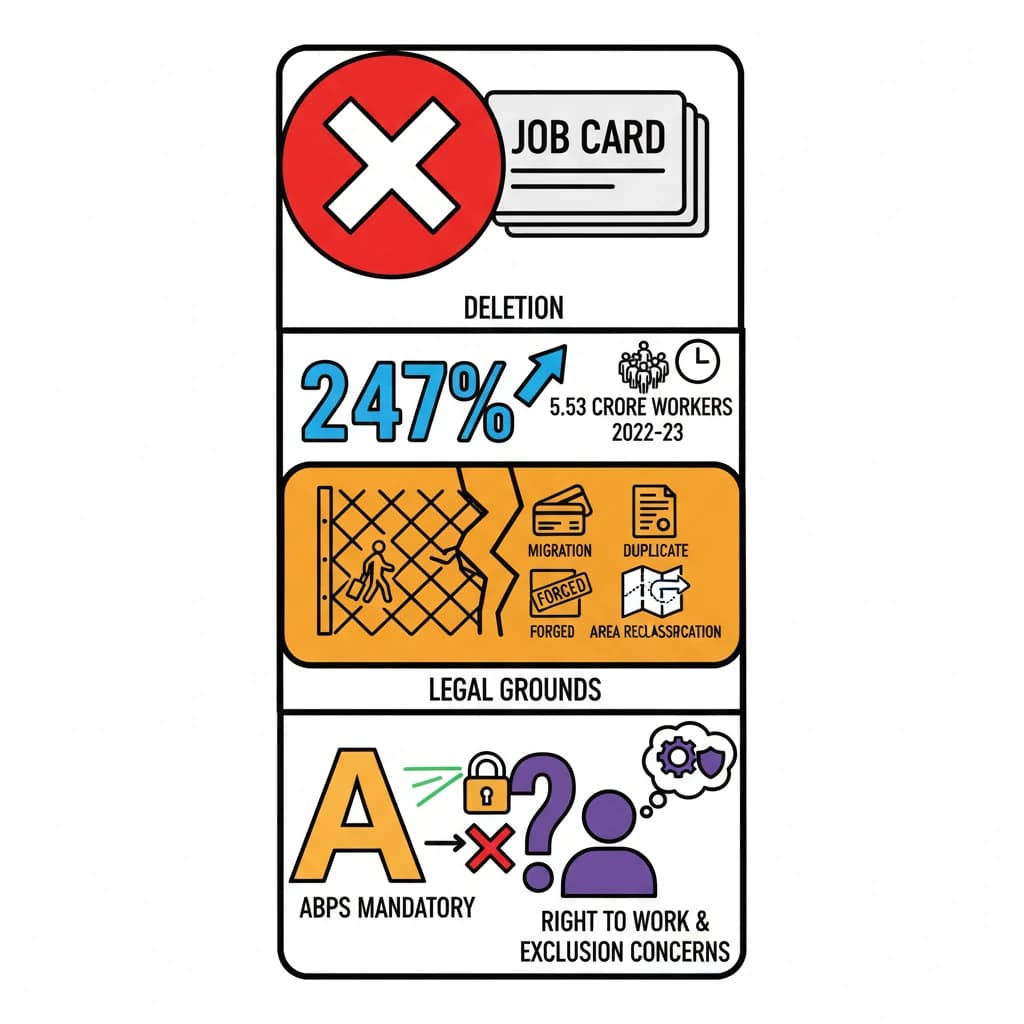
  • MGNREGA job card deletions surged by 247% in 2022-23, impacting over 5.53 crore workers.
  • Legal grounds for deletion include permanent migration, duplicate cards, forged documents, and area reclassification (MGNREGA Act, Schedule II, Para 23).
  • The mandatory Aadhaar-based Payment System (ABPS) implementation was a key driver for the recent deletions.
  • Deletions raise significant concerns about the right to work, transparency, and potential exclusion of genuine beneficiaries.
  • Balancing administrative efficiency through digitalization with ensuring social inclusion remains a critical challenge for welfare schemes.
Deletion of MGNREGA Job Cards

Deletion of MGNREGA Job Cards

Medium⏱️ 10 min read✓ 95% Verified
social issues

📖 Introduction

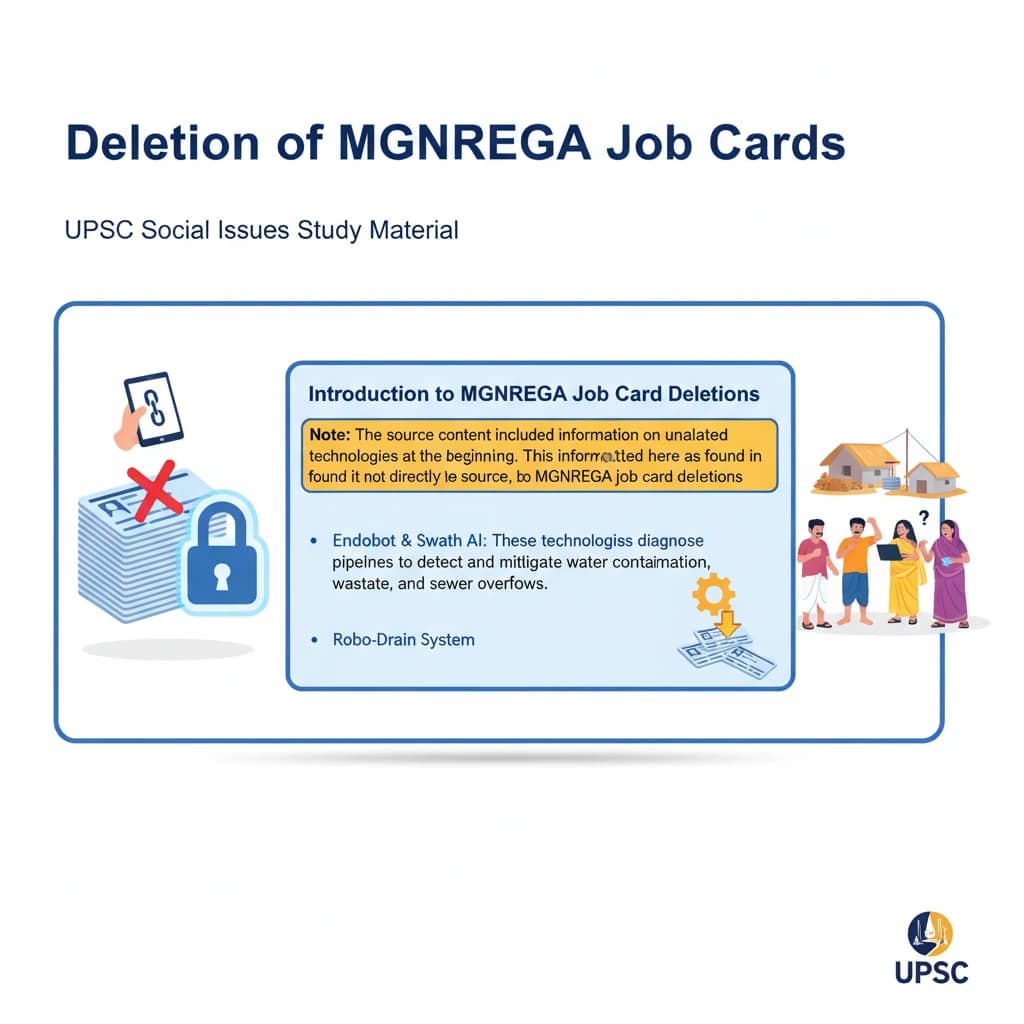
<h4>Introduction to MGNREGA Job Card Deletions</h4><div class='info-box'><p><strong>Note:</strong> The source content included information on unrelated technologies at the beginning. This information is presented here as found in the source, but it is not directly related to MGNREGA job card deletions.</p><ul><li><strong>Endobot & Swath AI:</strong> These technologies diagnose pipelines to detect and mitigate water contamination, wastage, and sewer overflows.</li><li><strong>Robo-Drain System:</strong> This refers to automated robotic technology specifically designed for cleaning underground sewers.</li><li><strong>Vacuum Trucks:</strong> These vehicles utilize powerful pumps to remove sewage waste, eliminating the need for human entry into sewers.</li></ul></div><p>The <strong>Mahatma Gandhi National Rural Employment Guarantee Act, 2005 (MGNREGA)</strong> is a crucial social security measure. Recently, there has been a significant increase in the deletion of workers from job cards under this Act.</p><p>This surge has raised serious concerns regarding the fundamental <strong>right to work</strong> for rural laborers. It also brings into question the overall <strong>transparency</strong> and effectiveness of the scheme's implementation.</p><h4>Recent Trends in Job Card Deletions</h4><div class='info-box'><p><strong>Deletion Statistics (2022-23)</strong></p><ul><li>Over <strong>5.53 crore workers</strong> were removed from MGNREGA job cards.</li><li>This represents a staggering <strong>247% increase</strong> in deletions compared to the previous financial year (2021-22).</li></ul></div><p>The unprecedented scale of these deletions highlights a critical issue affecting millions of rural households. Understanding the reasons behind this trend is essential for policy evaluation.</p><h4>Legal Grounds for Job Card Deletion</h4><div class='key-point-box'><p>As per <strong>Schedule II, Paragraph 23 of the MGNREGA Act, 2005</strong>, job cards can only be deleted under specific, clearly defined conditions. These provisions aim to ensure legitimate management of the scheme.</p></div><p>The Act outlines several valid reasons for removing a worker's job card. These are designed to prevent misuse and maintain the integrity of the program.</p><ul><li><strong>Permanent Migration:</strong> A job card can be deleted if a household permanently relocates from the concerned <strong>Gram Panchayat</strong>. This ensures benefits are tied to the local area.</li><li><strong>Duplicate Job Cards:</strong> Deletion occurs if a job card is identified as a <strong>duplicate</strong>. This prevents individuals from holding multiple cards and claiming benefits illicitly.</li><li><strong>Forged Documents:</strong> If a job card was originally issued based on <strong>forged documents</strong>, it is subject to deletion. This combats fraud and ensures eligibility.</li><li><strong>Reclassification of Area:</strong> Should a <strong>Gram Panchayat</strong> be reclassified as a <strong>Municipal Corporation</strong>, all associated job cards are deleted. This is because MGNREGA applies to rural areas.</li></ul><h4>Additional Reasons via MGNREGA MIS</h4><p>The <strong>MGNREGA Management Information System (MIS)</strong> provides further categories for job card deletions. These reasons are often administrative in nature.</p><ul><li><strong>Duplicate Applicant:</strong> Similar to duplicate job cards, this refers to instances where the same individual applies multiple times.</li><li><strong>Fake Applicant:</strong> This category covers cases where an applicant is found to be non-existent or fraudulent.</li><li><strong>Not Willing to Work:</strong> If a registered worker consistently expresses unwillingness to participate in work, their card may be deleted.</li></ul><h4>Impact of Aadhaar-Based Payment Systems (ABPS)</h4><div class='exam-tip-box'><p>The implementation of <strong>Aadhaar-based Payment Systems (ABPS)</strong> is a critical factor in the recent surge of job card deletions. This connection is vital for UPSC Mains answers on governance and social welfare.</p></div><p>The sharp increase in MGNREGA job card deletions during <strong>2022-23</strong> coincided directly with the mandatory implementation of <strong>ABPS</strong>. This system requires workers to link their <strong>Aadhaar numbers</strong> to their job cards for wage payments.</p><p>A significant number of deletions occurred because workers had <strong>non-linked</strong> or <strong>improperly linked Aadhaar numbers</strong>. This administrative requirement inadvertently led to the exclusion of many genuine beneficiaries from the scheme.</p>
Concept Diagram

💡 Key Takeaways

  • •MGNREGA job card deletions surged by 247% in 2022-23, impacting over 5.53 crore workers.
  • •Legal grounds for deletion include permanent migration, duplicate cards, forged documents, and area reclassification (MGNREGA Act, Schedule II, Para 23).
  • •The mandatory Aadhaar-based Payment System (ABPS) implementation was a key driver for the recent deletions.
  • •Deletions raise significant concerns about the right to work, transparency, and potential exclusion of genuine beneficiaries.
  • •Balancing administrative efficiency through digitalization with ensuring social inclusion remains a critical challenge for welfare schemes.

🧠 Memory Techniques
Memory Aid
95% Verified Content

📚 Reference Sources

•Mahatma Gandhi National Rural Employment Guarantee Act, 2005 (Schedule II, Paragraph 23)
•Reports from the Ministry of Rural Development (implied for deletion statistics and ABPS implementation)

Related Topics

Loading related topics...
Explore:Social Issues Topics·All Subjects·Daily Current Affairs·Editorial Analysis·Previous Year Questions·UPSC GPT