Loading page, please wait…
Vaidra Logo
Vaidra

Top 4 items + smart groups

UPSC GPT
New
Current Affairs
Daily Solutions
Daily Puzzle
Mains Evaluator

Version 2.0.0 • Built with ❤️ for UPSC aspirants

Loading...
Loading...
Loading...
Loading...
Loading...
Loading...
Loading...
Loading...
Loading...
Loading...
Loading...
Loading...
Loading...
Back
All Subjects

Topics

0 topics • 0 completed

Loading topics...
Loading...
Loading...
Loading...
Loading...
Loading...
Overall Progress0%

What are the WHO’s Important Guiding Principles Related to Organ Donation? - UPSC Social Issues

What is What are the WHO’s Important Guiding Principles Related to Organ Donation? in UPSC Social Issues?

What are the WHO’s Important Guiding Principles Related to Organ Donation? is a key topic under Social Issues for UPSC Civil Services Examination. Key points include: WHO principles ensure ethical and safe organ donation globally.. Consent (deceased) and voluntary (living) donation are paramount.. Strict separation of roles for physicians prevents conflicts of interest.. Understanding this topic is essential for both UPSC Prelims and Mains preparation.

Why is What are the WHO’s Important Guiding Principles Related to Organ Donation? important for UPSC exam?

What are the WHO’s Important Guiding Principles Related to Organ Donation? is a Medium-level topic in UPSC Social Issues. It is tested in both Prelims (factual MCQs) and Mains (analytical answer writing). Previous year UPSC questions have frequently covered aspects of What are the WHO’s Important Guiding Principles Related to Organ Donation?, making it essential for comprehensive IAS preparation.

How to prepare What are the WHO’s Important Guiding Principles Related to Organ Donation? for UPSC?

To prepare What are the WHO’s Important Guiding Principles Related to Organ Donation? for UPSC: (1) Study the comprehensive notes covering all key concepts on Vaidra. (2) Practice previous year questions on this topic. (3) Connect it with current affairs using daily updates. (4) Revise using key takeaways and mind maps available for Social Issues. (5) Write practice answers linking What are the WHO’s Important Guiding Principles Related to Organ Donation? to related GS Paper topics.

Key takeaways of What are the WHO’s Important Guiding Principles Related to Organ Donation? for UPSC

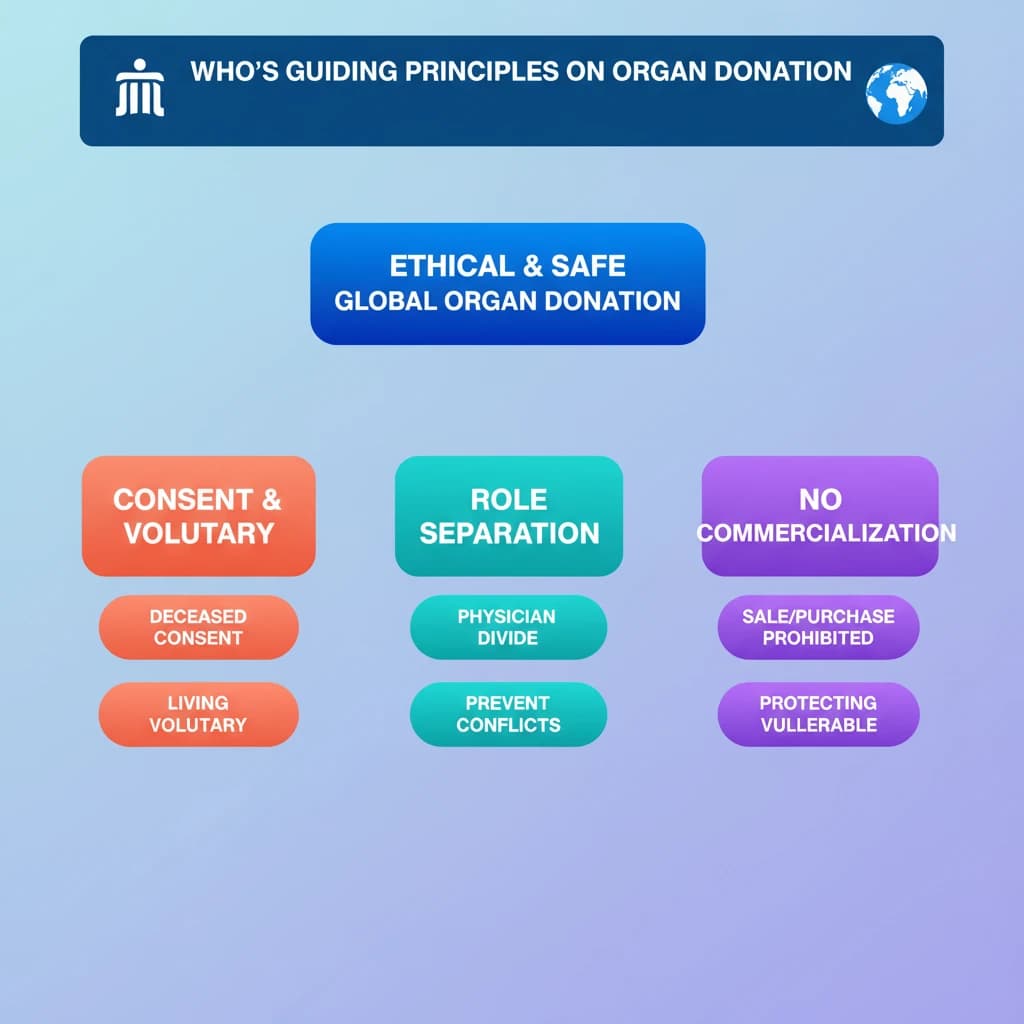
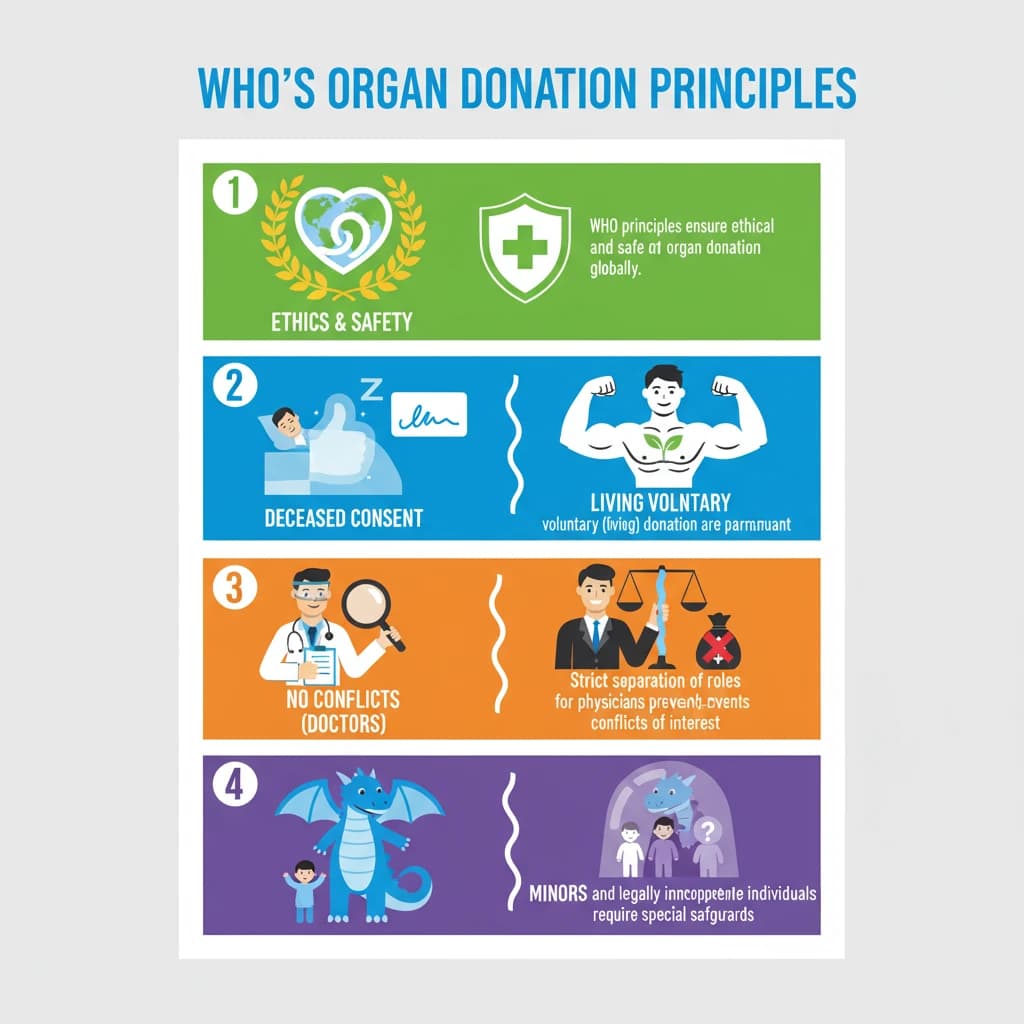
  • WHO principles ensure ethical and safe organ donation globally.
  • Consent (deceased) and voluntary (living) donation are paramount.
  • Strict separation of roles for physicians prevents conflicts of interest.
  • Minors and legally incompetent individuals require special safeguards.
  • Commercialization (sale/purchase) of organs is strictly prohibited.
  • Principles aim to maximize therapeutic potential while upholding human rights.
What are the WHO’s Important Guiding Principles Related to Organ Donation?

What are the WHO’s Important Guiding Principles Related to Organ Donation?

Medium⏱️ 10 min read✓ 98% Verified
social issues

📖 Introduction

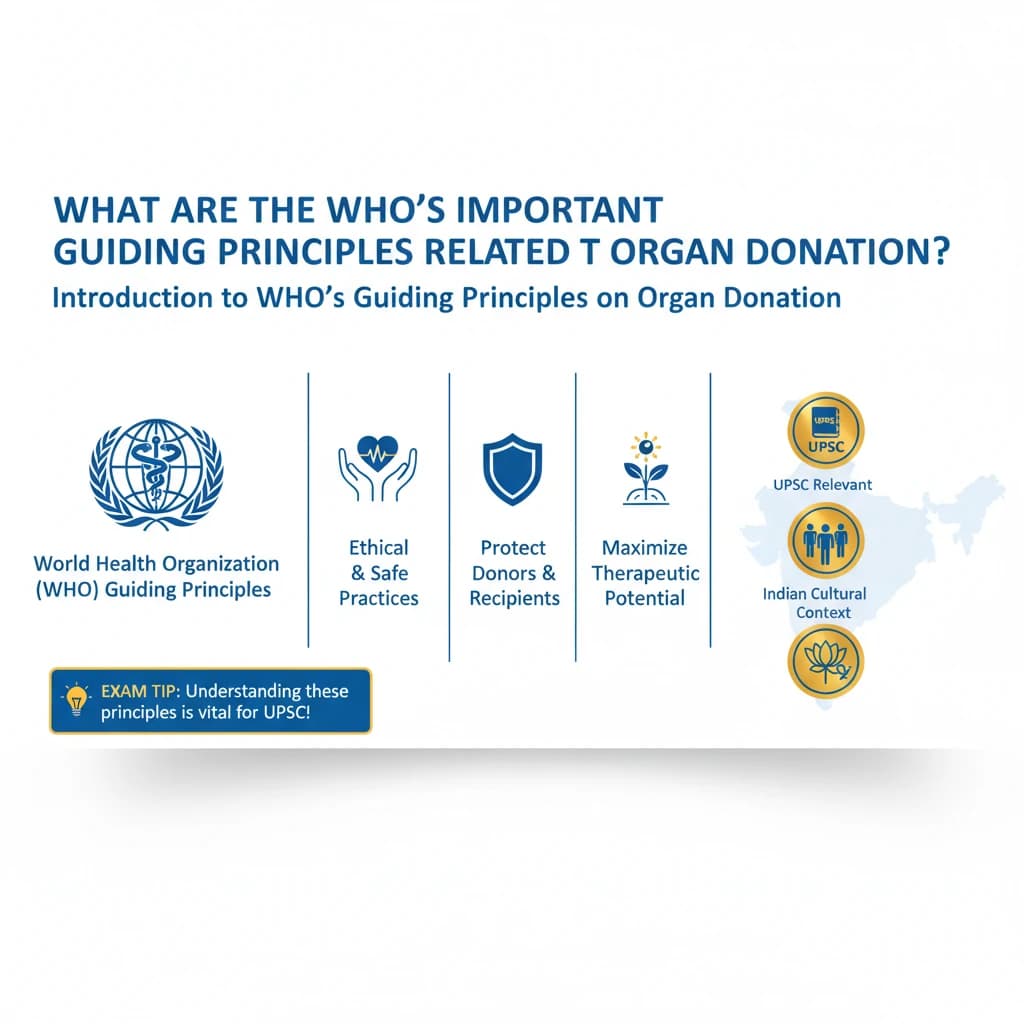
<h4>Introduction to WHO's Guiding Principles on Organ Donation</h4><p>The <strong>World Health Organization (WHO)</strong> has established crucial <strong>Guiding Principles</strong> to ensure ethical and safe practices in <strong>organ, tissue, and cell donation and transplantation</strong>. These principles aim to protect donors and recipients, prevent exploitation, and maximize the therapeutic potential of donations.</p><div class='exam-tip-box'><p>Understanding these principles is vital for <strong>UPSC Mains GS-II (Social Justice)</strong> and <strong>GS-IV (Ethics)</strong>, especially for questions on health policy, medical ethics, and human rights.</p></div><h4>Guiding Principle 1: Consent for Deceased Donation</h4><div class='key-point-box'><p><strong>Cells, tissues, and organs</strong> can be removed from <strong>deceased persons</strong> for transplantation only if <strong>legal consent</strong> has been obtained. This also requires that there is <strong>no evidence of the deceased's objection</strong> to such a donation.</p></div><p>This principle underscores the importance of respecting individual autonomy, even after death, through explicit or presumed consent mechanisms established by national laws.</p><h4>Guiding Principle 2: Separation of Medical Roles</h4><div class='key-point-box'><p><strong>Physicians</strong> responsible for determining a potential donor's death must maintain a clear separation of roles. They should <strong>not be directly involved</strong> in the subsequent procedures of <strong>cell, tissue, or organ removal</strong> from the donor.</p></div><p>Furthermore, these physicians should <strong>not be responsible for the care of any intended recipient</strong>. This strict separation prevents conflicts of interest and ensures that the declaration of death is impartial and solely based on medical criteria.</p><h4>Guiding Principle 3: Maximizing Therapeutic Potential and Living Donor Connection</h4><div class='key-point-box'><p><strong>Deceased donation</strong> should always aim to <strong>maximise therapeutic potential</strong>, ensuring that valuable organs are utilized effectively to save lives.</p></div><p>For <strong>living adult donors</strong>, compliance with <strong>domestic regulations</strong> is paramount. Typically, such donors should have a <strong>genetic, legal, or emotional connection</strong> to their recipient to mitigate potential coercion and ensure altruism.</p><h4>Guiding Principle 4: Safeguarding Minors and Legally Incompetent Individuals</h4><div class='key-point-box'><p>Generally, <strong>no organs should be taken from living minors</strong> for transplantation. Limited exceptions may be allowed only if explicitly permitted by <strong>national law</strong>.</p></div><p>When exceptions exist, <strong>special measures</strong> must be implemented to <strong>safeguard minors</strong>. Whenever possible, their <strong>consent</strong> should be obtained before donation, respecting their developing autonomy.</p><p>The <strong>same principles</strong> of stringent safeguards and consent considerations also apply to <strong>legally incompetent individuals</strong> who are unable to testify or stand trial.</p><h4>Guiding Principle 5: Voluntary Donation and Prohibition of Commercialization</h4><div class='key-point-box'><p>All donations of <strong>cells, tissues, and organs</strong> must be strictly <strong>voluntary</strong> and made <strong>without monetary compensation</strong>. This is a foundational ethical tenet.</p></div><p>The <strong>sale or purchase</strong> of these items for transplantation purposes is unequivocally <strong>prohibited</strong> under WHO guidelines. This principle aims to prevent organ trafficking and the exploitation of vulnerable populations.</p>
Concept Diagram

💡 Key Takeaways

  • •WHO principles ensure ethical and safe organ donation globally.
  • •Consent (deceased) and voluntary (living) donation are paramount.
  • •Strict separation of roles for physicians prevents conflicts of interest.
  • •Minors and legally incompetent individuals require special safeguards.
  • •Commercialization (sale/purchase) of organs is strictly prohibited.
  • •Principles aim to maximize therapeutic potential while upholding human rights.

🧠 Memory Techniques
Memory Aid
98% Verified Content

📚 Reference Sources

•World Health Organization (WHO) Guiding Principles on Human Organ Transplantation (General Knowledge)

Related Topics

Loading related topics...
Explore:Social Issues Topics·All Subjects·Daily Current Affairs·Editorial Analysis·Previous Year Questions·UPSC GPT
What are the WHO’s Important Guiding Principles Related to Organ Donation? - UPSC Social Issues