Loading page, please wait…
Vaidra Logo
Vaidra

Top 4 items + smart groups

UPSC GPT
New
Current Affairs
Daily Solutions
Daily Puzzle
Mains Evaluator

Version 2.0.0 • Built with ❤️ for UPSC aspirants

Loading...
Loading...
Loading...
Loading...
Loading...
Loading...
Loading...
Loading...
Loading...
Loading...
Loading...
Loading...
Loading...
What is the Status of Immunisation in India? - UPSC Social Issues
Back
All Subjects

Topics

0 topics • 0 completed

Loading topics...
Loading...
Loading...
Loading...
Loading...
Loading...
Overall Progress0%

What is the Status of Immunisation in India? - UPSC Social Issues

What is What is the Status of Immunisation in India? in UPSC Social Issues?

What is the Status of Immunisation in India? is a key topic under Social Issues for UPSC Civil Services Examination. Key points include: India's Universal Immunization Programme (UIP) is one of the world's largest public health initiatives.. UIP annually vaccinates over 30 million pregnant women and 27 million children.. A child is fully immunised if they receive all required vaccines per the national schedule within their first year of life.. Understanding this topic is essential for both UPSC Prelims and Mains preparation.

Why is What is the Status of Immunisation in India? important for UPSC exam?

What is the Status of Immunisation in India? is a Medium-level topic in UPSC Social Issues. It is tested in both Prelims (factual MCQs) and Mains (analytical answer writing). Previous year UPSC questions have frequently covered aspects of What is the Status of Immunisation in India?, making it essential for comprehensive IAS preparation.

How to prepare What is the Status of Immunisation in India? for UPSC?

To prepare What is the Status of Immunisation in India? for UPSC: (1) Study the comprehensive notes covering all key concepts on Vaidra. (2) Practice previous year questions on this topic. (3) Connect it with current affairs using daily updates. (4) Revise using key takeaways and mind maps available for Social Issues. (5) Write practice answers linking What is the Status of Immunisation in India? to related GS Paper topics.

Key takeaways of What is the Status of Immunisation in India? for UPSC

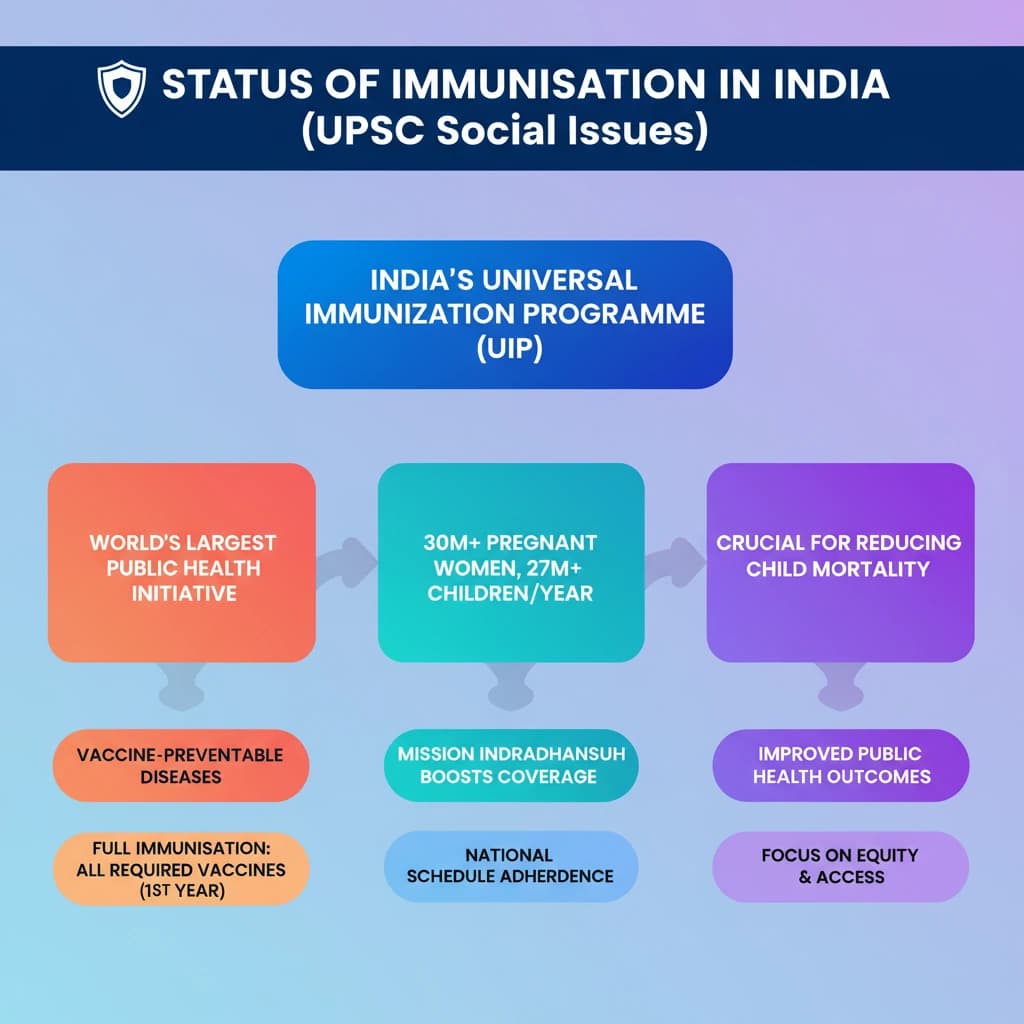
  • India's Universal Immunization Programme (UIP) is one of the world's largest public health initiatives.
  • UIP annually vaccinates over 30 million pregnant women and 27 million children.
  • A child is fully immunised if they receive all required vaccines per the national schedule within their first year of life.
  • The programme is crucial for reducing child mortality and morbidity from vaccine-preventable diseases.
  • Initiatives like Mission Indradhanush aim to boost full immunisation coverage across the country.
What is the Status of Immunisation in India?

What is the Status of Immunisation in India?

Medium⏱️ 7 min read✓ 95% Verified
social issues

📖 Introduction

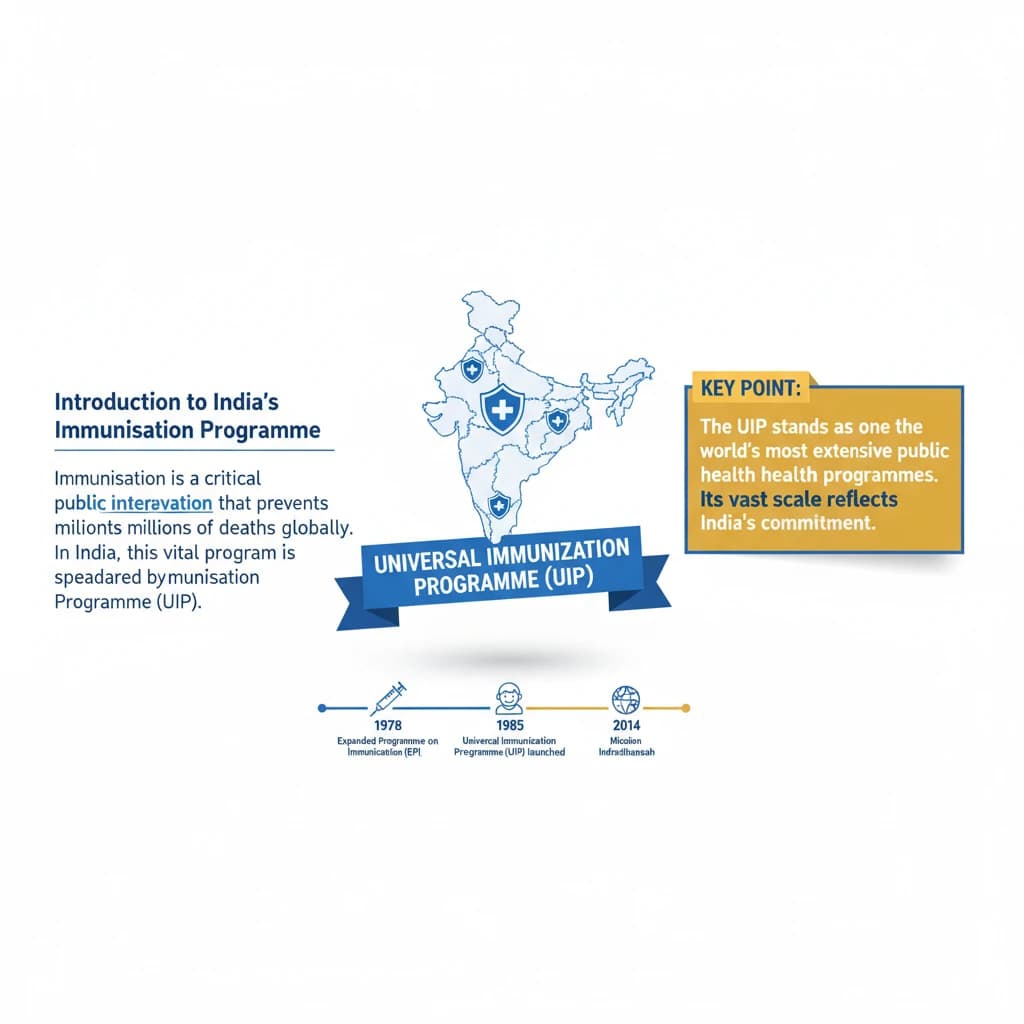
<h4>Introduction to India's Immunisation Programme</h4><p><strong>Immunisation</strong> is a critical public health intervention that prevents millions of deaths globally. In <strong>India</strong>, this vital program is spearheaded by the <strong>Universal Immunization Programme (UIP)</strong>.</p><div class='key-point-box'><p>The <strong>UIP</strong> stands as one of the <strong>world's most extensive public health programmes</strong>. Its vast scale reflects <strong>India's</strong> commitment to safeguarding the health of its youngest citizens and expectant mothers.</p></div><h4>Scale and Reach of UIP</h4><p>The <strong>Universal Immunization Programme (UIP)</strong> demonstrates an impressive reach across the nation. It targets a significant portion of the population to ensure widespread protection against vaccine-preventable diseases.</p><div class='info-box'><p>Annually, the <strong>UIP</strong> successfully vaccinates:</p><ul><li>More than <strong>30 million pregnant women</strong></li><li>Over <strong>27 million children</strong></li></ul><p>This extensive coverage is crucial for building herd immunity and reducing disease burden.</p></div><h4>Defining a Fully Immunised Child</h4><p>Understanding what constitutes a <strong>fully immunised child</strong> is fundamental to assessing the success and coverage of <strong>immunisation programmes</strong>. This definition guides health workers and policymakers.</p><div class='info-box'><p>A child is officially considered <strong>fully immunised</strong> if they:</p><ul><li>Receive <strong>all the required vaccines</strong></li><li>Adhere to the <strong>national immunisation schedule</strong></li><li>Complete this schedule within their <strong>first year of life</strong></li></ul></div><div class='exam-tip-box'><p><strong>UPSC Insight:</strong> Questions on <strong>public health programmes</strong> often require knowledge of their scale, beneficiaries, and definitions of success metrics like 'fully immunised'. Be prepared to discuss the challenges and achievements of <strong>UIP</strong> in your answers for <strong>GS Paper II: Social Justice</strong>.</p></div>
Concept Diagram

💡 Key Takeaways

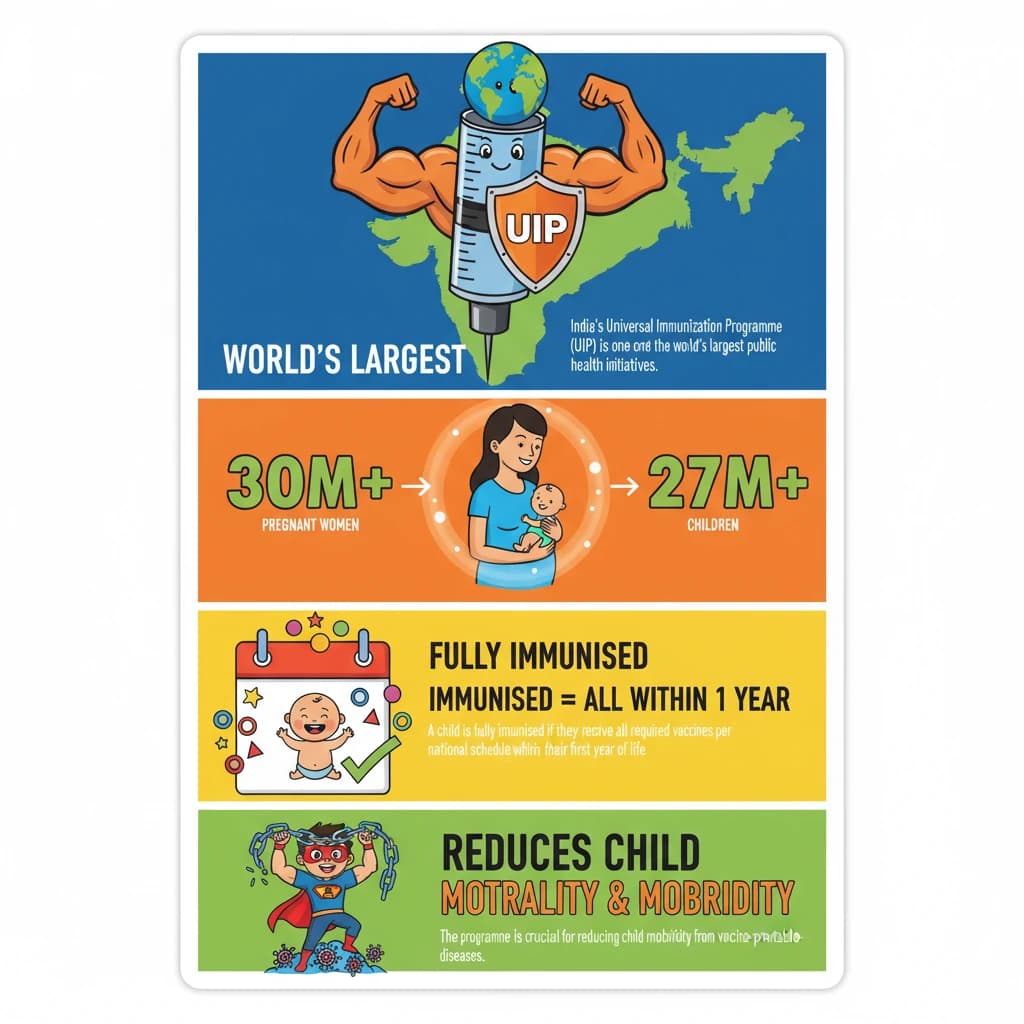
  • •India's Universal Immunization Programme (UIP) is one of the world's largest public health initiatives.
  • •UIP annually vaccinates over 30 million pregnant women and 27 million children.
  • •A child is fully immunised if they receive all required vaccines per the national schedule within their first year of life.
  • •The programme is crucial for reducing child mortality and morbidity from vaccine-preventable diseases.
  • •Initiatives like Mission Indradhanush aim to boost full immunisation coverage across the country.

🧠 Memory Techniques
Memory Aid
95% Verified Content

📚 Reference Sources

•Ministry of Health & Family Welfare, Government of India (for UIP details and statistics)
•WHO and UNICEF reports on global immunisation coverage (for contextual understanding)

Related Topics

Loading related topics...
Explore:Social Issues Topics·All Subjects·Daily Current Affairs·Editorial Analysis·Previous Year Questions·UPSC GPT