Loading page, please wait…
Vaidra Logo
Vaidra

Top 4 items + smart groups

UPSC GPT
New
Current Affairs
Daily Solutions
Daily Puzzle
Mains Evaluator

Version 2.0.0 • Built with ❤️ for UPSC aspirants

Loading...
Loading...
Loading...
Loading...
Loading...
Loading...
Loading...
Loading...
Loading...
Loading...
Loading...
Loading...
Loading...
Back
All Subjects

Topics

0 topics • 0 completed

Loading topics...
Loading...
Loading...
Loading...
Loading...
Loading...
Overall Progress0%

50 Years of Chipko Movement - UPSC Social Issues

What is 50 Years of Chipko Movement in UPSC Social Issues?

50 Years of Chipko Movement is a key topic under Social Issues for UPSC Civil Services Examination. Key points include: Chipko Movement completed 50 years in 2023, originating in Uttarakhand in 1973.. It was a non-violent, grassroots environmental movement to protect trees from commercial logging.. Key figures included Sunderlal Bahuguna, Chandi Prasad Bhatt, and Gaura Devi.. Understanding this topic is essential for both UPSC Prelims and Mains preparation.

Why is 50 Years of Chipko Movement important for UPSC exam?

50 Years of Chipko Movement is a Medium-level topic in UPSC Social Issues. It is tested in both Prelims (factual MCQs) and Mains (analytical answer writing). Previous year UPSC questions have frequently covered aspects of 50 Years of Chipko Movement, making it essential for comprehensive IAS preparation.

How to prepare 50 Years of Chipko Movement for UPSC?

To prepare 50 Years of Chipko Movement for UPSC: (1) Study the comprehensive notes covering all key concepts on Vaidra. (2) Practice previous year questions on this topic. (3) Connect it with current affairs using daily updates. (4) Revise using key takeaways and mind maps available for Social Issues. (5) Write practice answers linking 50 Years of Chipko Movement to related GS Paper topics.

Key takeaways of 50 Years of Chipko Movement for UPSC

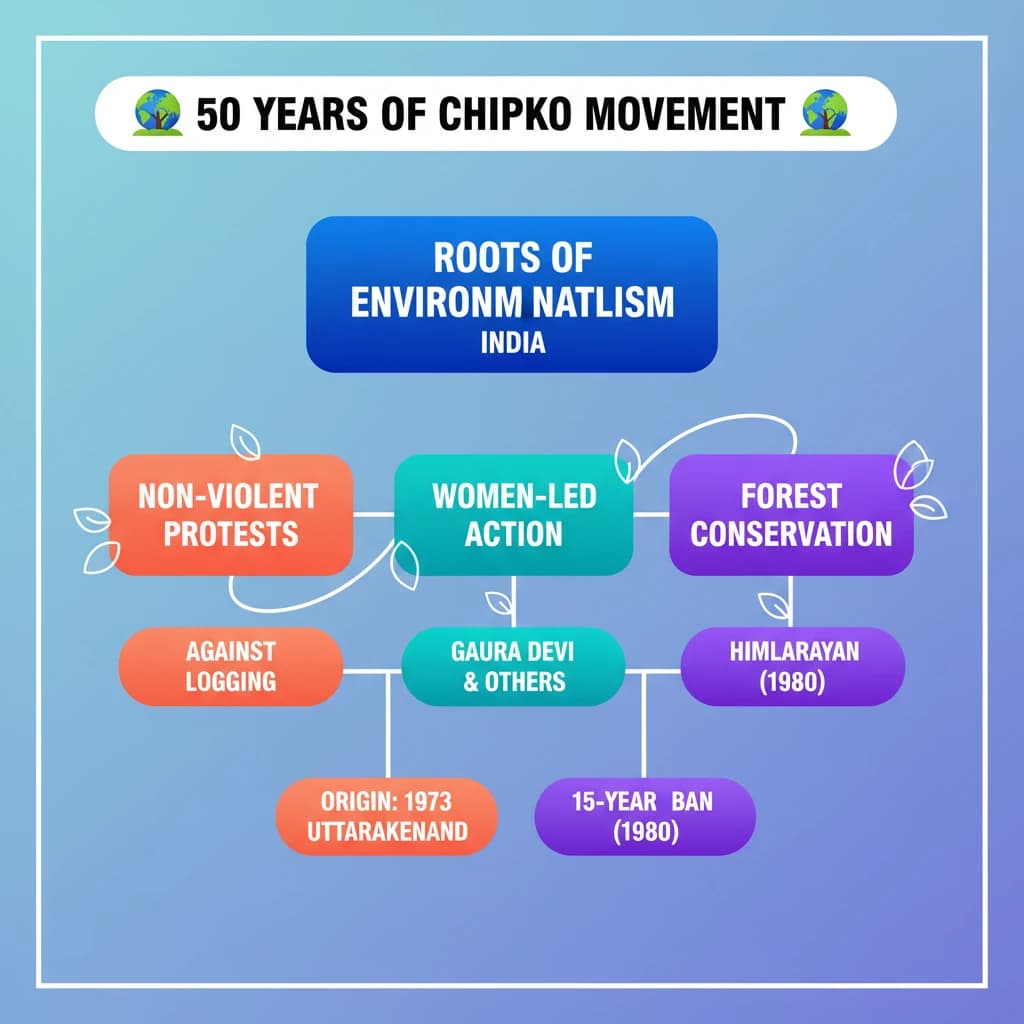
  • Chipko Movement completed 50 years in 2023, originating in Uttarakhand in 1973.
  • It was a non-violent, grassroots environmental movement to protect trees from commercial logging.
  • Key figures included Sunderlal Bahuguna, Chandi Prasad Bhatt, and Gaura Devi.
  • Women played a pivotal role, often leading the protests.
  • Led to a 15-year ban on commercial tree felling in the Himalayan region (1980).
  • Inspired subsequent environmental movements and influenced India's forest policies.
50 Years of Chipko Movement

50 Years of Chipko Movement

Medium⏱️ 5 min read✓ 95% Verified
social issues

📖 Introduction

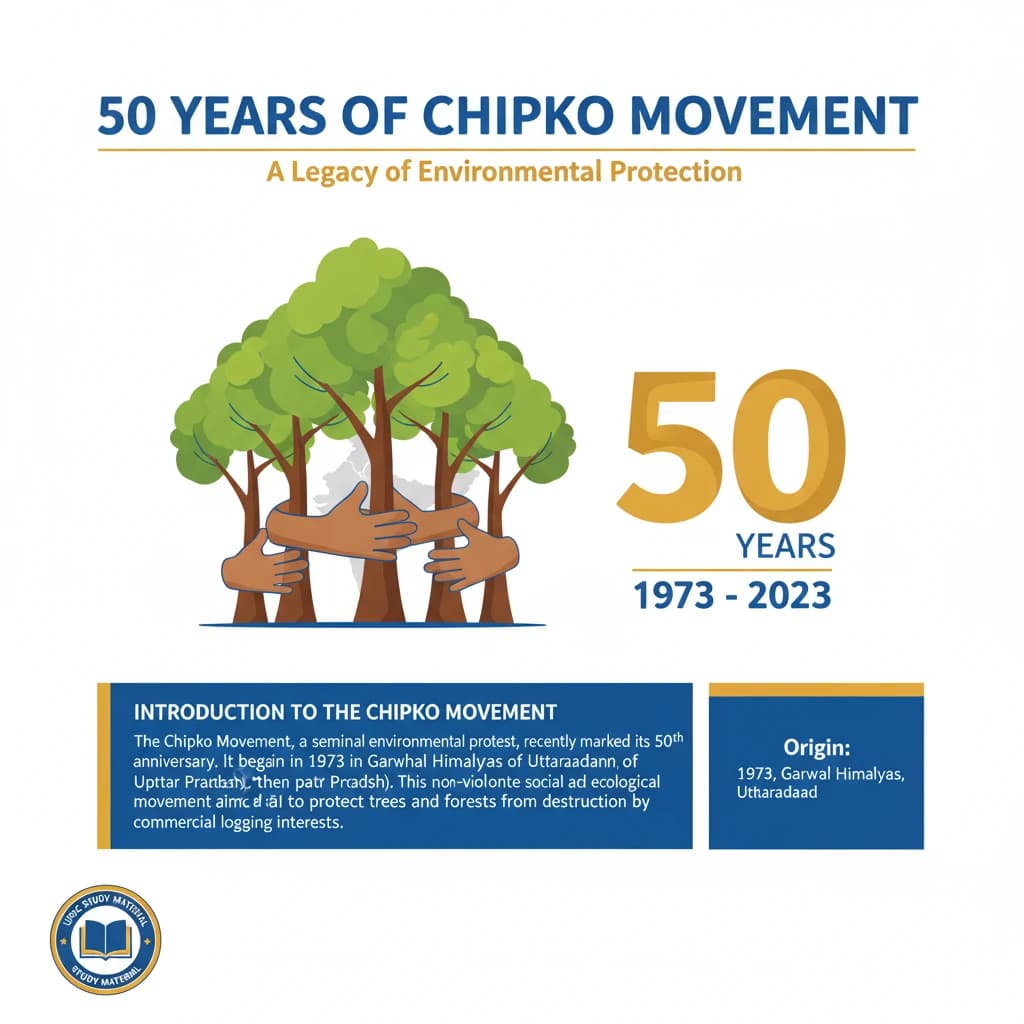
<h4>Introduction to the Chipko Movement</h4><p>The <strong>Chipko Movement</strong>, a seminal environmental protest, recently marked its <strong>50th anniversary</strong>. It began in <strong>1973</strong> in the <strong>Garhwal Himalayas</strong> of <strong>Uttarakhand</strong> (then part of Uttar Pradesh).</p><p>This non-violent social and ecological movement aimed to protect trees and forests from destruction by commercial logging interests.</p><div class='info-box'><p><strong>Origin:</strong> The word "Chipko" literally means "to hug" or "to cling to" in Hindi. Participants would embrace trees to prevent them from being felled.</p></div><h4>Genesis and Key Figures</h4><p>The movement was sparked by the government's decision to allocate forest land to a sports goods company, while local villagers were denied access for their traditional needs.</p><p>Key figures included <strong>Sunderlal Bahuguna</strong>, who popularized the movement globally through his "Save the Himalayas" marches, and <strong>Chandi Prasad Bhatt</strong>, who founded the Dasholi Gram Swarajya Sangh (DGSS).</p><p>The active participation of <strong>women</strong> was a defining characteristic, as they bore the brunt of ecological degradation and were at the forefront of the protests.</p><h4>Core Principles and Impact</h4><div class='key-point-box'><p>The Chipko Movement was rooted in <strong>Gandhian principles</strong> of non-violent resistance (Satyagraha) and self-sufficiency, advocating for sustainable forest management by local communities.</p></div><p>Its immediate success led to a <strong>15-year ban on commercial tree felling</strong> in the Himalayan forests of Uttar Pradesh in <strong>1980</strong>.</p><div class='exam-tip-box'><p>UPSC often asks about the <strong>socio-economic impact</strong> of such movements and the role of <strong>women in environmental conservation</strong>. Highlight these aspects in your answers for <strong>GS Paper I</strong> and <strong>GS Paper III</strong>.</p></div>
Concept Diagram

💡 Key Takeaways

  • •Chipko Movement completed 50 years in 2023, originating in Uttarakhand in 1973.
  • •It was a non-violent, grassroots environmental movement to protect trees from commercial logging.
  • •Key figures included Sunderlal Bahuguna, Chandi Prasad Bhatt, and Gaura Devi.
  • •Women played a pivotal role, often leading the protests.
  • •Led to a 15-year ban on commercial tree felling in the Himalayan region (1980).
  • •Inspired subsequent environmental movements and influenced India's forest policies.

🧠 Memory Techniques

Memory Aid
95% Verified Content

📚 Reference Sources

•"Chipko Movement: A People's History" by Shekhar Pathak
•Ministry of Environment, Forest and Climate Change (MoEFCC) reports
•Reputable news archives (e.g., The Hindu, Indian Express on 50th anniversary)

Related Topics

Loading related topics...
Explore:Social Issues Topics·All Subjects·Daily Current Affairs·Editorial Analysis·Previous Year Questions·UPSC GPT
50 Years of Chipko Movement - UPSC Social Issues