Loading page, please wait…
Vaidra Logo
Vaidra

Top 4 items + smart groups

UPSC GPT
New
Current Affairs
Daily Solutions
Daily Puzzle
Mains Evaluator

Version 2.0.0 • Built with ❤️ for UPSC aspirants

Loading...
Loading...
Loading...
Loading...
Loading...
Loading...
Loading...
Loading...
Loading...
Loading...
Loading...
Loading...
Loading...
Back
All Subjects

Topics

0 topics • 0 completed

Loading topics...
Loading...
Loading...
Loading...
Loading...
Loading...
Overall Progress0%

Civil Society and Women’s Movements - UPSC Social Issues

What is Civil Society and Women’s Movements in UPSC Social Issues?

Civil Society and Women’s Movements is a key topic under Social Issues for UPSC Civil Services Examination. Key points include: Civil society and women's movements are crucial for advancing gender equality and women's rights.. Sustained advocacy has been key to achieving political representation for women.. The 73rd and 74th Amendments successfully reserved one-third of seats for women in local bodies.. Understanding this topic is essential for both UPSC Prelims and Mains preparation.

Why is Civil Society and Women’s Movements important for UPSC exam?

Civil Society and Women’s Movements is a Medium-level topic in UPSC Social Issues. It is tested in both Prelims (factual MCQs) and Mains (analytical answer writing). Previous year UPSC questions have frequently covered aspects of Civil Society and Women’s Movements, making it essential for comprehensive IAS preparation.

How to prepare Civil Society and Women’s Movements for UPSC?

To prepare Civil Society and Women’s Movements for UPSC: (1) Study the comprehensive notes covering all key concepts on Vaidra. (2) Practice previous year questions on this topic. (3) Connect it with current affairs using daily updates. (4) Revise using key takeaways and mind maps available for Social Issues. (5) Write practice answers linking Civil Society and Women’s Movements to related GS Paper topics.

Key takeaways of Civil Society and Women’s Movements for UPSC

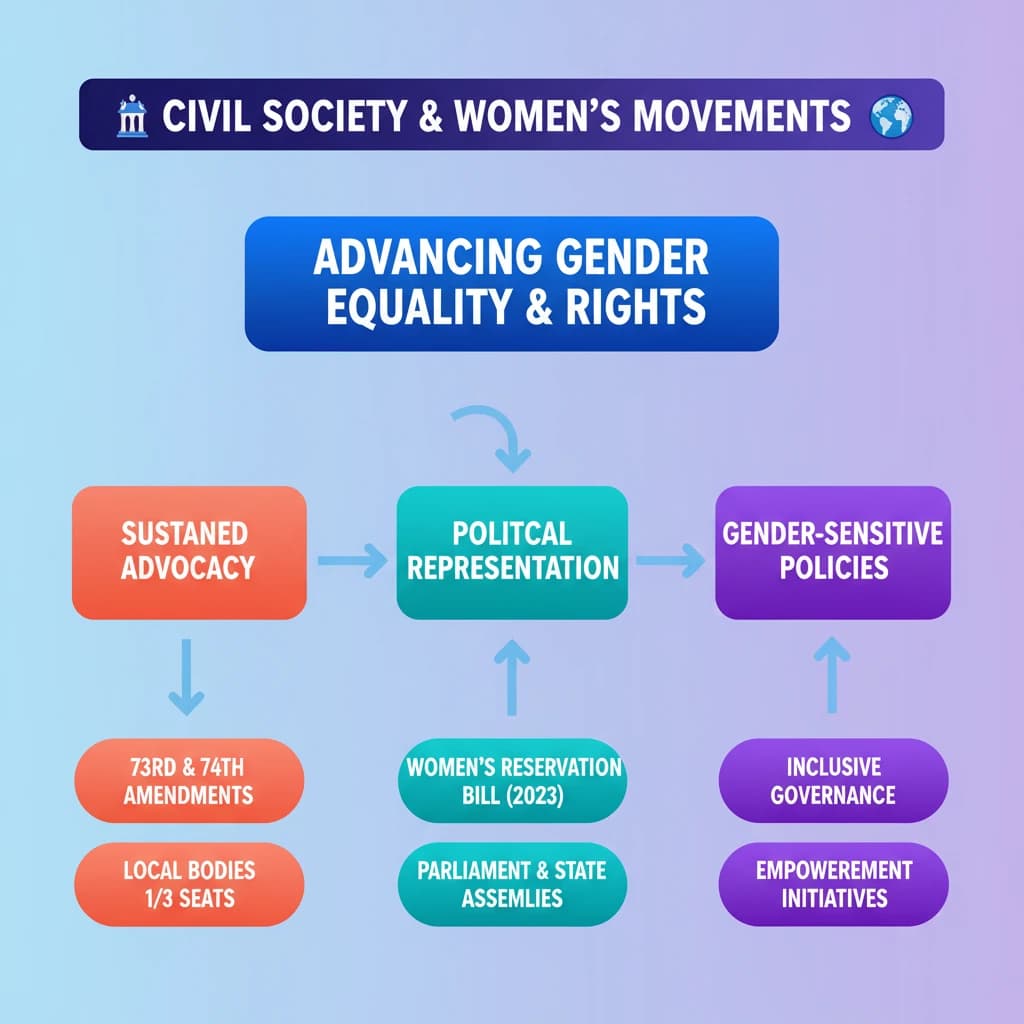
  • Civil society and women's movements are crucial for advancing gender equality and women's rights.
  • Sustained advocacy has been key to achieving political representation for women.
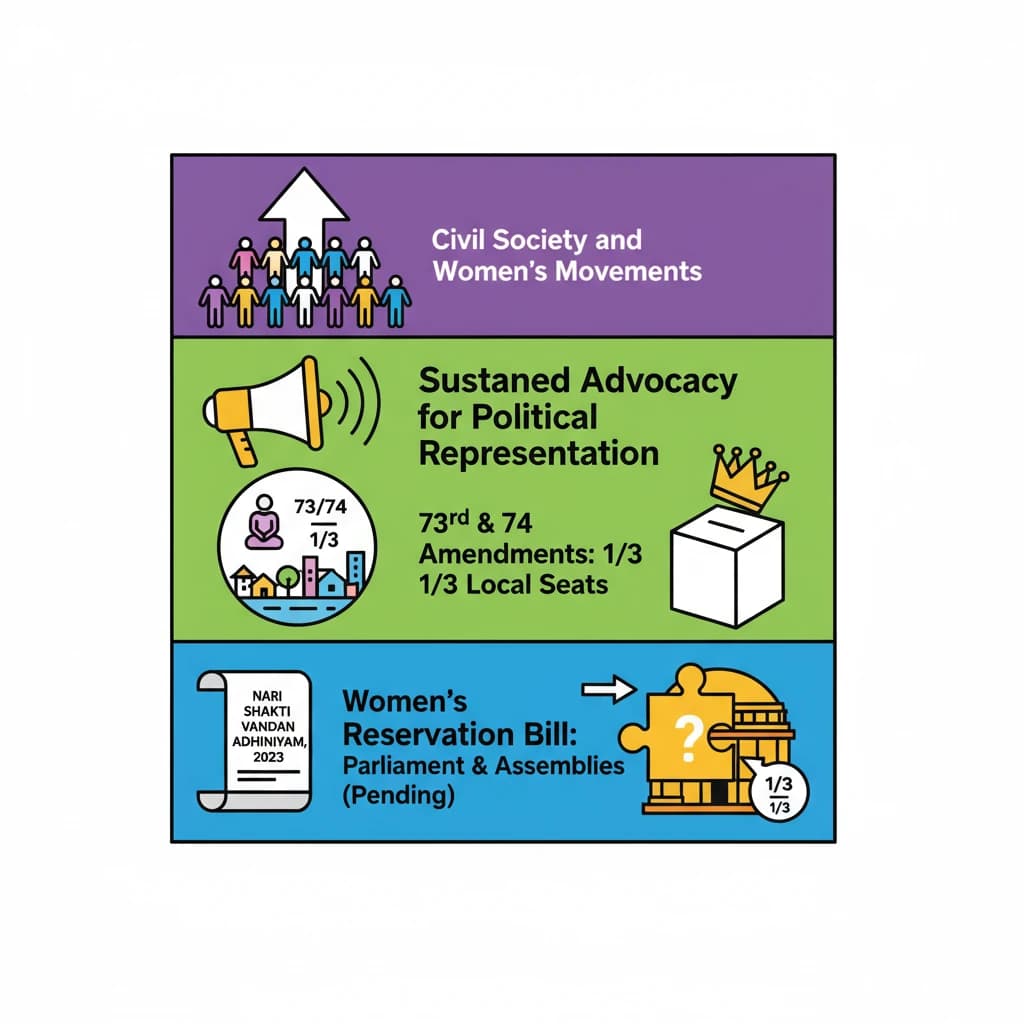
  • The 73rd and 74th Amendments successfully reserved one-third of seats for women in local bodies.
  • The Women's Reservation Bill (Nari Shakti Vandan Adhiniyam, 2023) aims for similar reservation in Parliament and State Assemblies, though implementation is pending.
  • Increased political representation leads to more gender-sensitive policies and inclusive governance.
  • Challenges like patriarchy and resource constraints persist, requiring ongoing advocacy.
Civil Society and Women’s Movements

Civil Society and Women’s Movements

Medium⏱️ 8 min read✓ 95% Verified
social issues

📖 Introduction

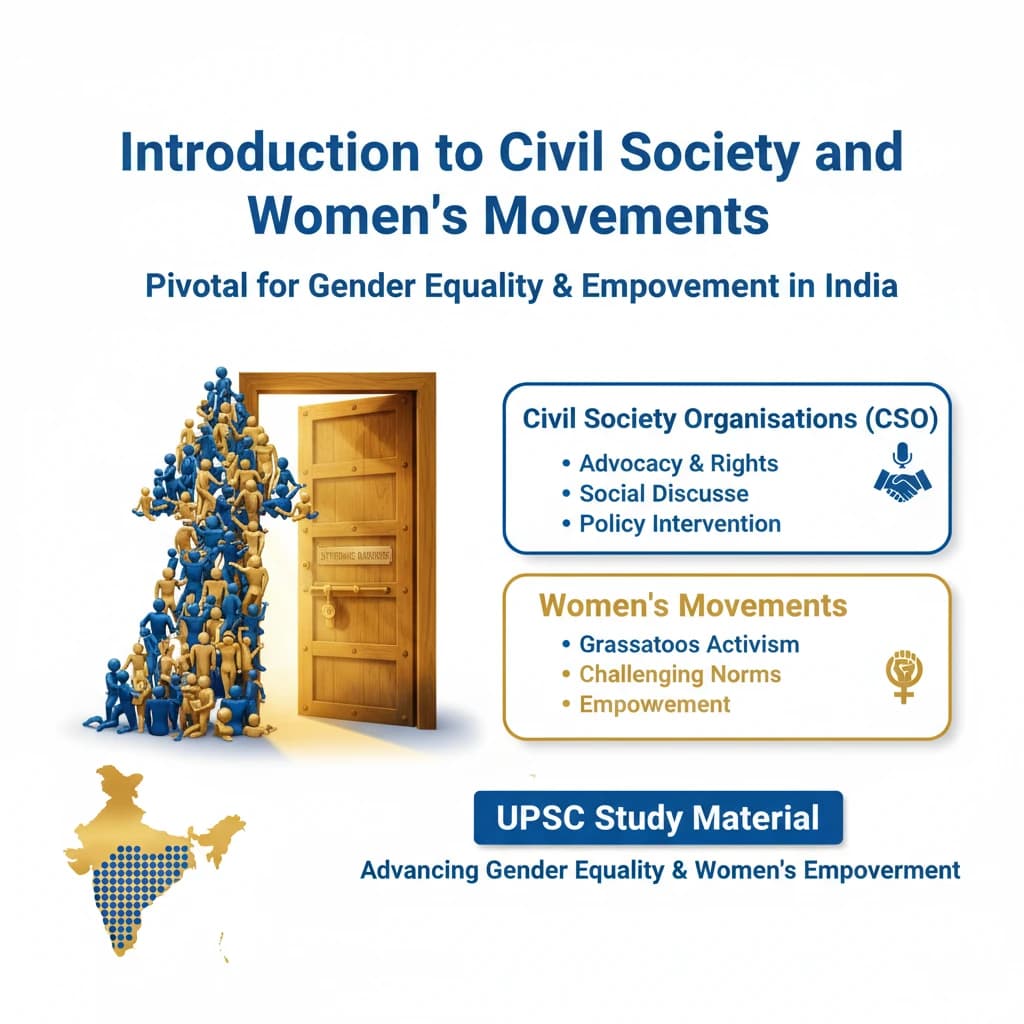
<h4>Introduction to Civil Society and Women's Movements</h4><p>The role of <strong>Civil Society Organisations</strong> (CSOs) and <strong>Women's Movements</strong> has been pivotal in shaping social discourse and advocating for rights in India. Their sustained efforts have significantly contributed to advancing gender equality and women's empowerment.</p><p>These movements encompass a broad spectrum of activities, from grassroots activism to policy-level interventions. They aim to address systemic inequalities and ensure women's rightful place in all spheres of life.</p><h4>Understanding Sustained Advocacy</h4><p><strong>Sustained advocacy</strong> refers to the continuous and persistent efforts made by various groups to influence public opinion, policy-making, and legislative changes. For women's movements, this often involves long-term campaigns and strategic interventions.</p><div class='key-point-box'><p><strong>Key aspects of sustained advocacy include:</strong></p><ul><li><strong>Long-term commitment:</strong> Addressing deep-rooted societal issues requires consistent effort over decades.</li><li><strong>Multi-pronged approach:</strong> Utilizing legal reforms, public awareness, and direct action.</li><li><strong>Building alliances:</strong> Collaborating with other CSOs, political parties, and international bodies.</li></ul></div><h4>Role of Women's Rights Groups and Activists</h4><p><strong>Women's rights groups</strong> are formal and informal collectives dedicated to promoting and protecting women's rights. They operate at local, national, and international levels, engaging in diverse activities.</p><p><strong>Activists</strong> are individuals who champion these causes, often at significant personal risk. Their leadership and dedication are crucial in mobilizing public support and challenging existing norms.</p><div class='info-box'><p><strong>Examples of activities:</strong></p><ul><li>Organizing protests and rallies.</li><li>Conducting research and policy analysis.</li><li>Providing legal aid and support services.</li><li>Running awareness campaigns and educational programs.</li></ul></div><h4>Organisations and Their Impact</h4><p>Various <strong>organisations</strong>, ranging from non-governmental organisations (NGOs) to self-help groups (SHGs), play a critical role. They provide structured platforms for collective action and resource mobilization.</p><p>These organisations often act as intermediaries between marginalized women and government bodies, ensuring that the voices of the most vulnerable are heard in policy debates.</p><h4>Advocacy for Greater Political Representation</h4><p>A primary focus of women's movements has been the demand for <strong>greater political representation</strong>. This includes increasing the number of women in legislative bodies, local governance, and decision-making positions.</p><p>The belief is that increased representation leads to policies that are more gender-sensitive and inclusive, reflecting the diverse needs and perspectives of women.</p><div class='exam-tip-box'><p><strong>UPSC Relevance:</strong> This topic is crucial for <strong>GS Paper I (Society)</strong>, <strong>GS Paper II (Polity & Governance, Social Justice)</strong>. Be prepared to discuss the evolution, challenges, and achievements of women's movements, especially concerning political empowerment.</p></div>
Concept Diagram

💡 Key Takeaways

  • •Civil society and women's movements are crucial for advancing gender equality and women's rights.
  • •Sustained advocacy has been key to achieving political representation for women.
  • •The 73rd and 74th Amendments successfully reserved one-third of seats for women in local bodies.
  • •The Women's Reservation Bill (Nari Shakti Vandan Adhiniyam, 2023) aims for similar reservation in Parliament and State Assemblies, though implementation is pending.
  • •Increased political representation leads to more gender-sensitive policies and inclusive governance.
  • •Challenges like patriarchy and resource constraints persist, requiring ongoing advocacy.

🧠 Memory Techniques
Memory Aid
95% Verified Content

📚 Reference Sources

•Report of the Committee on the Status of Women in India: 'Towards Equality' (1974)
•Ministry of Women and Child Development, Government of India reports
•Parliamentary debates and legislative history of the Women's Reservation Bill
•Academic research on women's political participation in India

Related Topics

Loading related topics...
Explore:Social Issues Topics·All Subjects·Daily Current Affairs·Editorial Analysis·Previous Year Questions·UPSC GPT
Civil Society and Women’s Movements - UPSC Social Issues