Loading page, please wait…
Vaidra Logo
Vaidra

Top 4 items + smart groups

UPSC GPT
New
Current Affairs
Daily Solutions
Daily Puzzle
Mains Evaluator

Version 2.0.0 • Built with ❤️ for UPSC aspirants

Loading...
Loading...
Loading...
Loading...
Loading...
Loading...
Loading...
Loading...
Loading...
Loading...
Loading...
Loading...
Loading...
Back
All Subjects

Topics

0 topics • 0 completed

Loading topics...
Loading...
Loading...
Loading...
Loading...
Loading...
Overall Progress0%
Kala Azar Elimination Progress in India: Status and Challenges - UPSC Social Issues

Kala Azar Elimination Progress in India: Status and Challenges - UPSC Social Issues

What is Kala Azar Elimination Progress in India: Status and Challenges in UPSC Social Issues?

Kala Azar Elimination Progress in India: Status and Challenges is a key topic under Social Issues for UPSC Civil Services Examination. Key points include: Kala Azar (Visceral Leishmaniasis) is a fatal parasitic disease caused by Leishmania donovani, transmitted by sandflies.. Symptoms include irregular fever, weight loss, enlarged spleen/liver, and anaemia.. India achieved less than one case per 10,000 population in 2023, showing significant progress towards elimination.. Understanding this topic is essential for both UPSC Prelims and Mains preparation.

Why is Kala Azar Elimination Progress in India: Status and Challenges important for UPSC exam?

Kala Azar Elimination Progress in India: Status and Challenges is a Medium-level topic in UPSC Social Issues. It is tested in both Prelims (factual MCQs) and Mains (analytical answer writing). Previous year UPSC questions have frequently covered aspects of Kala Azar Elimination Progress in India: Status and Challenges, making it essential for comprehensive IAS preparation.

How to prepare Kala Azar Elimination Progress in India: Status and Challenges for UPSC?

To prepare Kala Azar Elimination Progress in India: Status and Challenges for UPSC: (1) Study the comprehensive notes covering all key concepts on Vaidra. (2) Practice previous year questions on this topic. (3) Connect it with current affairs using daily updates. (4) Revise using key takeaways and mind maps available for Social Issues. (5) Write practice answers linking Kala Azar Elimination Progress in India: Status and Challenges to related GS Paper topics.

Key takeaways of Kala Azar Elimination Progress in India: Status and Challenges for UPSC

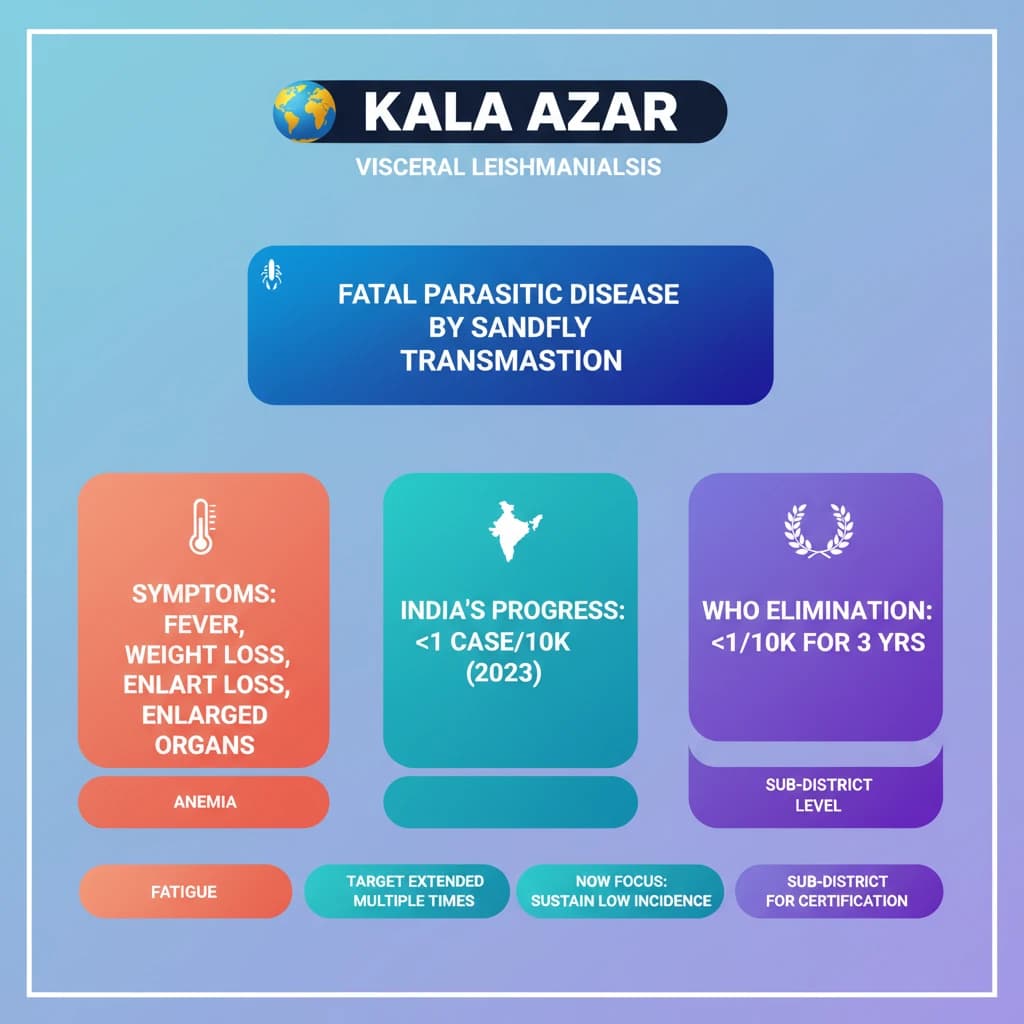
  • Kala Azar (Visceral Leishmaniasis) is a fatal parasitic disease caused by Leishmania donovani, transmitted by sandflies.
  • Symptoms include irregular fever, weight loss, enlarged spleen/liver, and anaemia.
  • India achieved less than one case per 10,000 population in 2023, showing significant progress towards elimination.
  • WHO defines elimination as <1 case per 10,000 at sub-district level, sustained for 3 years for certification.
  • India's elimination target was extended multiple times (2010, 2015, 2017, 2020) and is now focused on sustaining current low incidence.
  • Bangladesh became the first country validated by WHO for Kala Azar elimination in October 2023.
  • Poverty, poor housing, sanitation, and malnutrition are major risk factors for Kala Azar.
Kala Azar Elimination Progress in India: Status and Challenges

Kala Azar Elimination Progress in India: Status and Challenges

Medium⏱️ 8 min read✓ 95% Verified
social issues

📖 Introduction

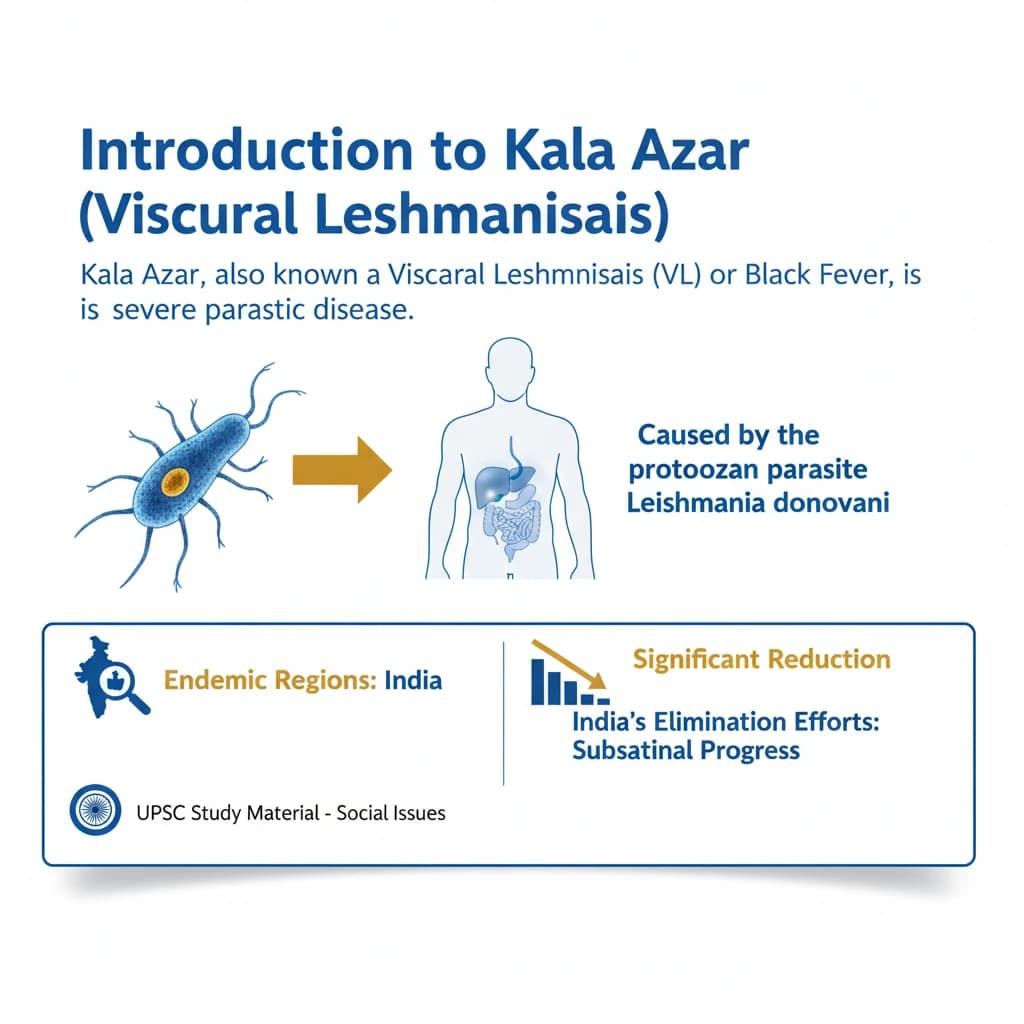
<h4>Introduction to Kala Azar (Visceral Leishmaniasis)</h4><p><strong>Kala Azar</strong>, also known as <strong>Visceral Leishmaniasis (VL)</strong> or <strong>Black Fever</strong>, is a severe parasitic disease. It is caused by the <strong>protozoan parasite Leishmania donovani</strong>, making it a significant public health concern, especially in endemic regions.</p><p>India has demonstrated substantial progress in its efforts to eliminate Kala Azar. Recent data indicates a significant reduction in case numbers, moving closer to the national elimination target.</p><h4>India's Progress in Kala Azar Elimination</h4><p>India reported less than <strong>one case per 10,000 population in 2023</strong>, marking a notable improvement compared to previous years. This achievement reflects dedicated public health interventions and sustained efforts.</p><div class='info-box'><p>The <strong>National Vector Borne Disease Control Programme</strong> data shows a decline in cases:</p><ul><li><strong>2023: 595 cases</strong> and <strong>four deaths</strong></li><li><strong>2022: 891 cases</strong> and <strong>three deaths</strong></li></ul></div><p>While significant progress has been made, India has not yet achieved formal elimination of Kala Azar. The country continues to work towards this crucial public health goal.</p><h4>WHO Elimination Criteria and India's Targets</h4><p>The <strong>World Health Organization (WHO)</strong> defines elimination for Kala Azar as having fewer than <strong>one case per 10,000 people</strong> at the sub-district (block Primary Health Centres) level.</p><p>Once this threshold is met, the elimination status must be sustained for <strong>three consecutive years</strong> to receive official <strong>WHO certification</strong>.</p><div class='exam-tip-box'><p>India's initial target year for Kala Azar elimination was <strong>2010</strong>. This target was subsequently extended multiple times to <strong>2015</strong>, <strong>2017</strong>, and then <strong>2020</strong>. The country now needs to sustain its current momentum for three years to achieve certification.</p></div><h4>Global Context: Bangladesh's Achievement</h4><p>In <strong>October 2023</strong>, <strong>Bangladesh</strong> made history by becoming the <strong>first country globally</strong> to be officially validated by the WHO for eliminating Kala Azar as a public health problem. This serves as a significant benchmark and inspiration for other endemic nations, including India.</p><h4>Key Facts About Kala Azar</h4><p>Understanding the fundamental characteristics of Kala Azar is crucial for both prevention and control strategies.</p><h5>About Kala Azar</h5><div class='info-box'><p><strong>Kala Azar</strong> is medically known as <strong>Visceral Leishmaniasis (VL)</strong>. It is caused by the <strong>protozoan parasite Leishmania donovani</strong> and is often referred to as <strong>Black Fever</strong> due to some of its characteristic symptoms.</p></div><h5>Symptoms of Kala Azar</h5><p>The disease manifests with a range of debilitating symptoms that can severely impact an individual's health.</p><ul><li><strong>Irregular bouts of fever</strong>: A primary and persistent symptom.</li><li><strong>Weight loss</strong>: Significant and often unexplained reduction in body mass.</li><li><strong>Enlargement of the spleen and liver</strong>: These organs become noticeably swollen.</li><li><strong>Anaemia</strong>: A reduction in red blood cells, leading to fatigue and weakness.</li></ul><h5>Prevalence and Global Burden</h5><p>Kala Azar remains a global health challenge, with a high concentration of cases in specific regions.</p><div class='info-box'><p>Most cases of Kala Azar occur in <strong>Brazil</strong>, <strong>East Africa</strong>, and <strong>India</strong>. Globally, an estimated <strong>50,000 to 90,000 new cases of VL</strong> occur annually, but only <strong>25-45%</strong> are reported to the WHO. The disease has significant outbreak and mortality potential.</p></div><h5>Transmission of Kala Azar</h5><p>The parasite responsible for Kala Azar is transmitted through a specific vector.</p><p><strong>Leishmania parasites</strong> are spread through the bites of infected female <strong>sandflies</strong>. These sandflies feed on blood for egg production, acquiring and transmitting the parasite in the process. Over <strong>70 animal species</strong>, including humans, can act as carriers for these parasites.</p><h5>Major Risk Factors for Kala Azar</h5><p>Several socio-economic and environmental factors contribute to the spread and severity of Kala Azar.</p><ul><li><strong>Poverty</strong>: Limited access to healthcare and resources.</li><li><strong>Poor housing and sanitation</strong>: Creates favourable breeding grounds for sandflies.</li><li><strong>Diets lacking essential nutrients</strong>: Weakens the immune system, making individuals more susceptible.</li></ul>
Concept Diagram

💡 Key Takeaways

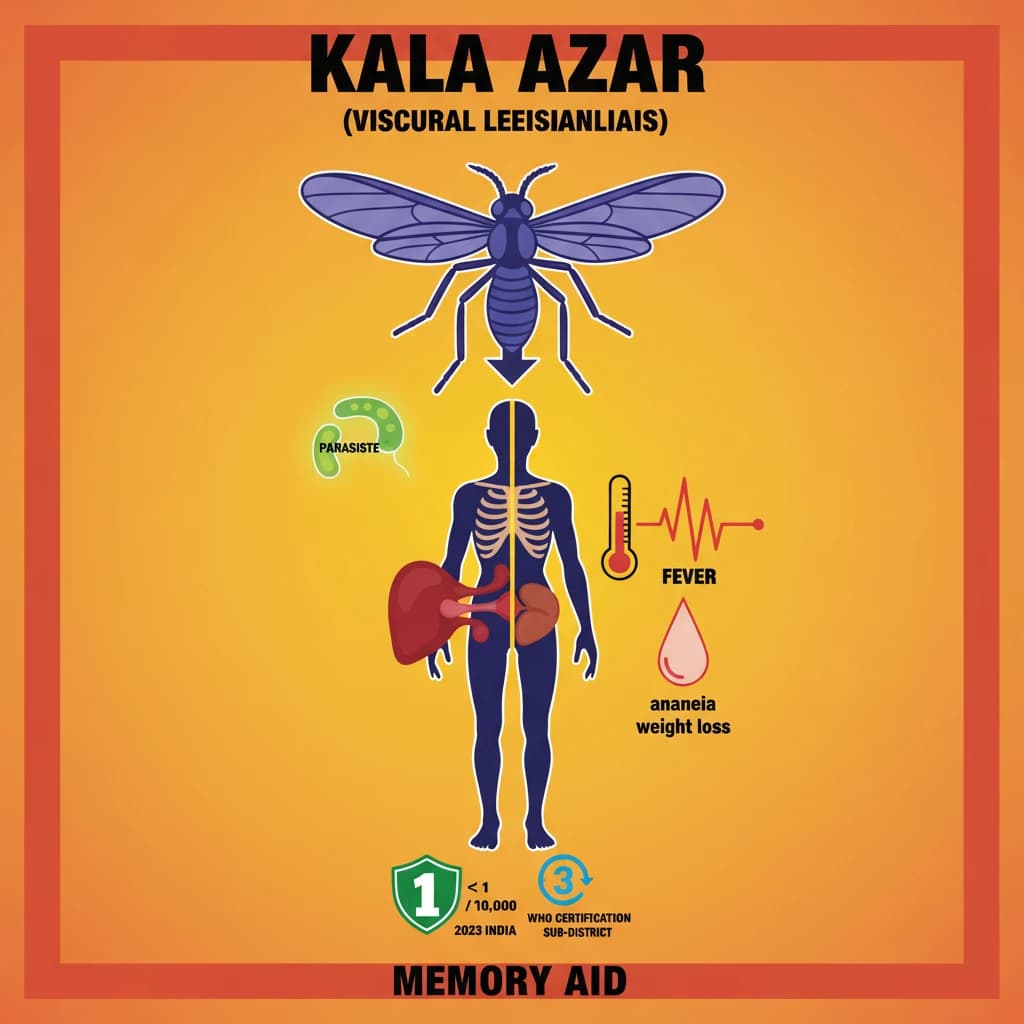
  • •Kala Azar (Visceral Leishmaniasis) is a fatal parasitic disease caused by Leishmania donovani, transmitted by sandflies.
  • •Symptoms include irregular fever, weight loss, enlarged spleen/liver, and anaemia.
  • •India achieved less than one case per 10,000 population in 2023, showing significant progress towards elimination.
  • •WHO defines elimination as <1 case per 10,000 at sub-district level, sustained for 3 years for certification.
  • •India's elimination target was extended multiple times (2010, 2015, 2017, 2020) and is now focused on sustaining current low incidence.
  • •Bangladesh became the first country validated by WHO for Kala Azar elimination in October 2023.
  • •Poverty, poor housing, sanitation, and malnutrition are major risk factors for Kala Azar.

🧠 Memory Techniques
Memory Aid
95% Verified Content

📚 Reference Sources

•World Health Organization (WHO) reports on Visceral Leishmaniasis

Related Topics

Loading related topics...
Explore:Social Issues Topics·All Subjects·Daily Current Affairs·Editorial Analysis·Previous Year Questions·UPSC GPT