Loading page, please wait…
Vaidra Logo
Vaidra

Top 4 items + smart groups

UPSC GPT
New
Current Affairs
Daily Solutions
Daily Puzzle
Mains Evaluator

Version 2.0.0 • Built with ❤️ for UPSC aspirants

Loading...
Loading...
Loading...
Loading...
Loading...
Loading...
Loading...
Loading...
Loading...
Loading...
Loading...
Loading...
Loading...
Back
All Subjects

Topics

0 topics • 0 completed

Loading topics...
Loading...
Loading...
Loading...
Loading...
Loading...
Overall Progress0%
What are India’s Initiatives to Address Hunger? - UPSC Social Issues

What are India’s Initiatives to Address Hunger? - UPSC Social Issues

What is What are India’s Initiatives to Address Hunger? in UPSC Social Issues?

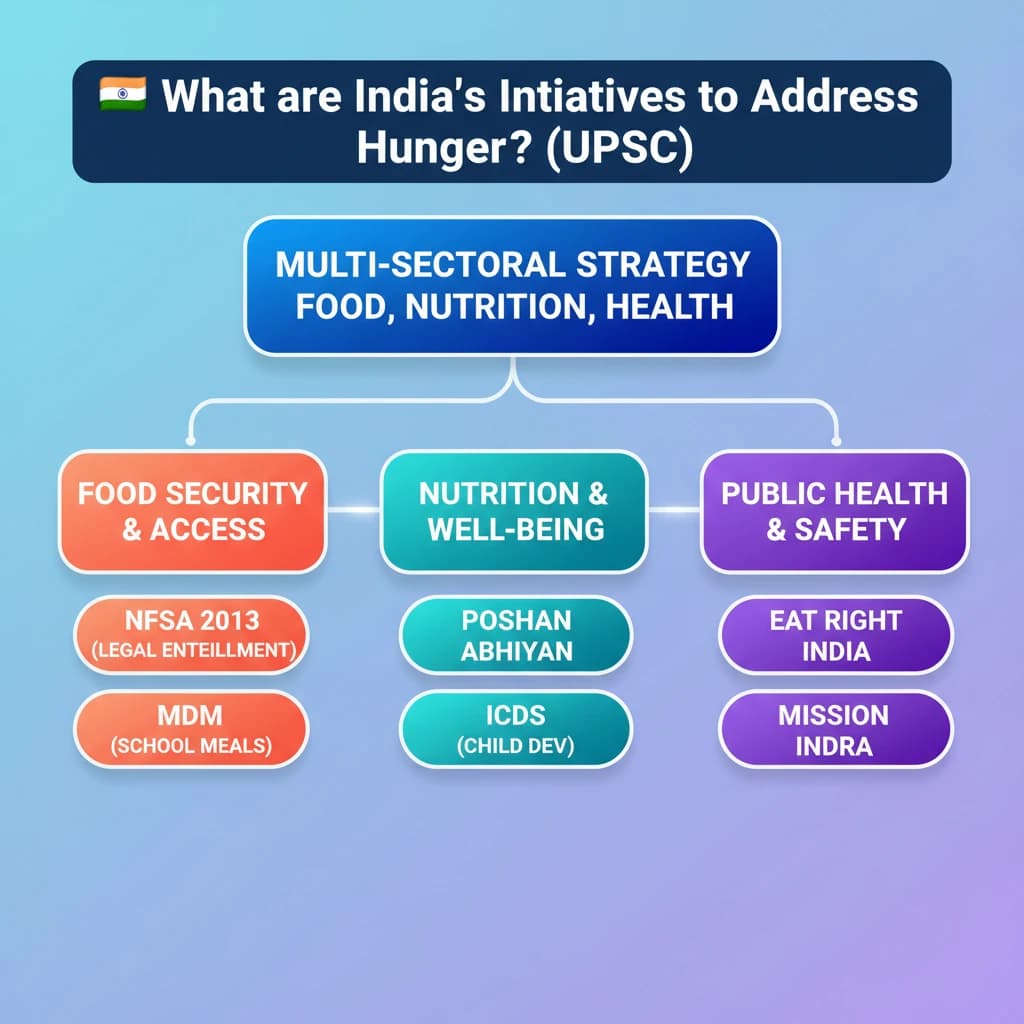
What are India’s Initiatives to Address Hunger? is a key topic under Social Issues for UPSC Civil Services Examination. Key points include: India employs a multi-sectoral strategy to combat hunger, encompassing food security, nutrition, and public health.. Key initiatives include NFSA (legal food entitlement), POSHAN Abhiyan (nutrition improvement), MDM (school meals), PMMVY (maternity benefits), ICDS (early childhood development), Eat Right India (food safety), and Mission Indradhanush (immunization).. There's a shift from welfare-based to rights-based approach (NFSA) and a focus on holistic nutrition (POSHAN Abhiyan).. Understanding this topic is essential for both UPSC Prelims and Mains preparation.

Why is What are India’s Initiatives to Address Hunger? important for UPSC exam?

What are India’s Initiatives to Address Hunger? is a Medium-level topic in UPSC Social Issues. It is tested in both Prelims (factual MCQs) and Mains (analytical answer writing). Previous year UPSC questions have frequently covered aspects of What are India’s Initiatives to Address Hunger?, making it essential for comprehensive IAS preparation.

How to prepare What are India’s Initiatives to Address Hunger? for UPSC?

To prepare What are India’s Initiatives to Address Hunger? for UPSC: (1) Study the comprehensive notes covering all key concepts on Vaidra. (2) Practice previous year questions on this topic. (3) Connect it with current affairs using daily updates. (4) Revise using key takeaways and mind maps available for Social Issues. (5) Write practice answers linking What are India’s Initiatives to Address Hunger? to related GS Paper topics.

Key takeaways of What are India’s Initiatives to Address Hunger? for UPSC

  • India employs a multi-sectoral strategy to combat hunger, encompassing food security, nutrition, and public health.
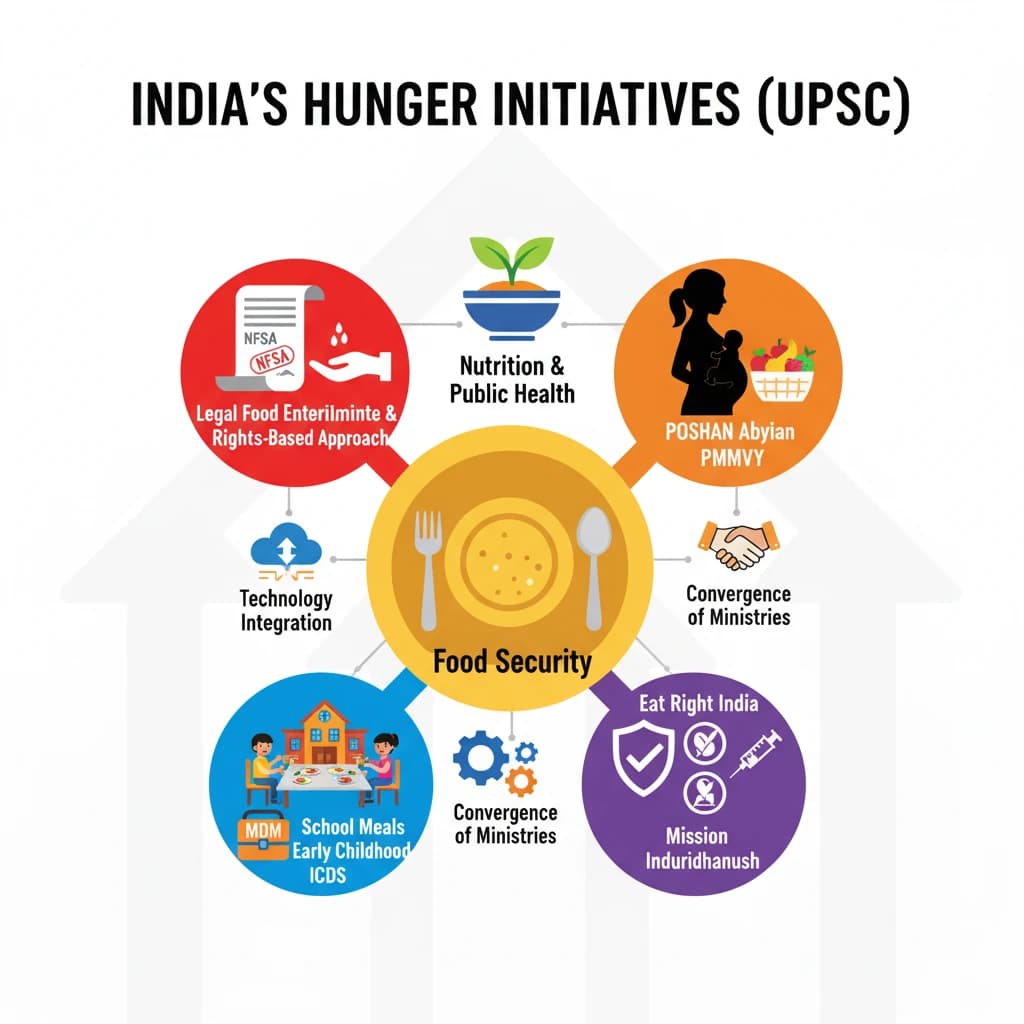
  • Key initiatives include NFSA (legal food entitlement), POSHAN Abhiyan (nutrition improvement), MDM (school meals), PMMVY (maternity benefits), ICDS (early childhood development), Eat Right India (food safety), and Mission Indradhanush (immunization).
  • There's a shift from welfare-based to rights-based approach (NFSA) and a focus on holistic nutrition (POSHAN Abhiyan).
  • Convergence of ministries and technology integration are crucial for effective implementation and monitoring.
  • Challenges remain, emphasizing the need for continuous evaluation, adaptation, and community participation to achieve Zero Hunger.
What are India’s Initiatives to Address Hunger?

What are India’s Initiatives to Address Hunger?

Medium⏱️ 8 min read✓ 95% Verified
social issues

📖 Introduction

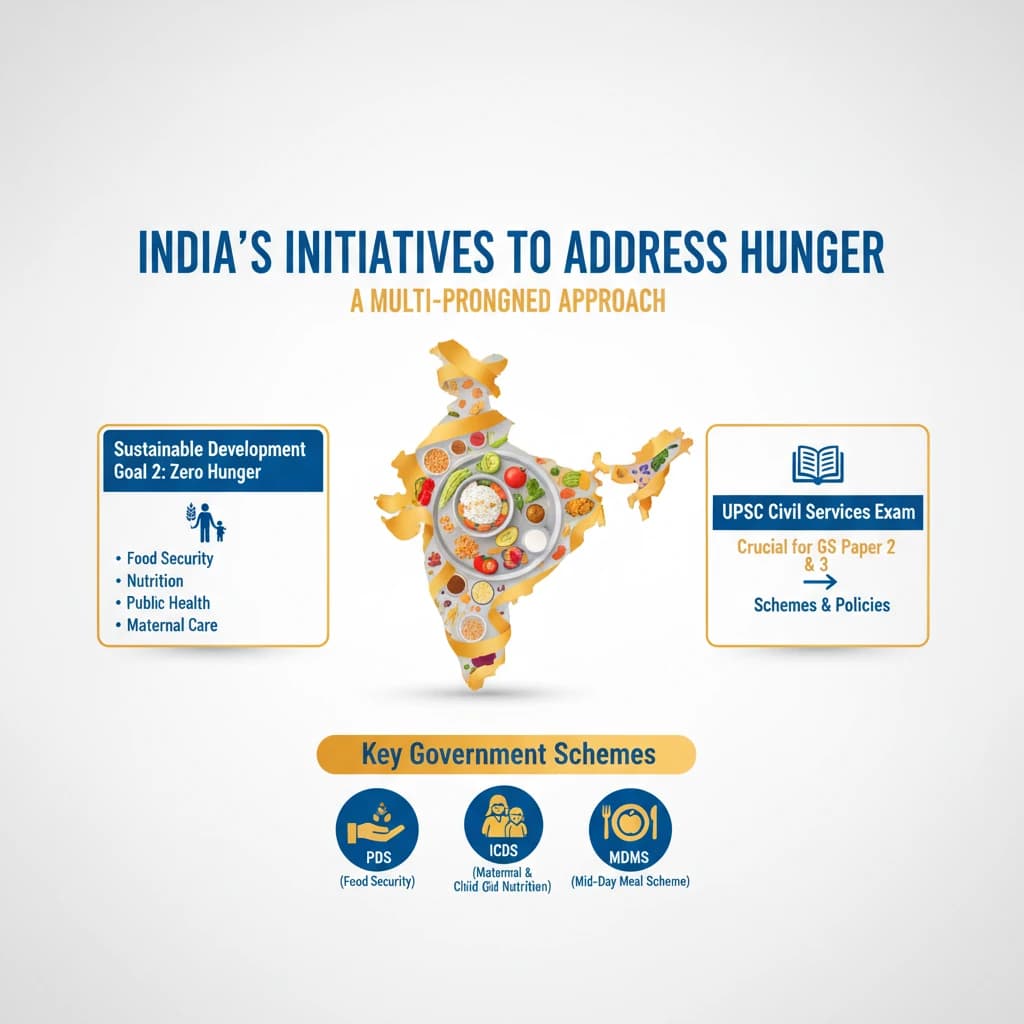
<h4>Introduction to India's Hunger Initiatives</h4><p>India, a nation committed to achieving <strong>Sustainable Development Goal 2 (Zero Hunger)</strong>, has launched a multi-pronged approach to combat hunger and malnutrition. These initiatives span various sectors, from food security and nutrition to public health and maternal care, aiming for holistic development.</p><div class='exam-tip-box'><p>Understanding these schemes is crucial for <strong>UPSC Civil Services Exam</strong>, particularly for <strong>GS Paper I (Social Issues)</strong> and <strong>GS Paper II (Governance, Social Justice)</strong>. Focus on objectives, beneficiaries, and outcomes.</p></div><h4>Eat Right India Movement</h4><p>The <strong>Eat Right India Movement</strong>, spearheaded by the <strong>Food Safety and Standards Authority of India (FSSAI)</strong>, aims to improve public health by ensuring safe, healthy, and sustainable food for all citizens. It adopts a 'preventive healthcare' approach.</p><div class='info-box'><p><strong>Objective:</strong> To nudge people towards healthier food choices and to ensure food safety standards across the country.</p><p><strong>Key Pillars:</strong> 'Eat Safe', 'Eat Healthy', 'Eat Sustainable'.</p></div><h4>POSHAN Abhiyan (National Nutrition Mission)</h4><p>The <strong>POSHAN Abhiyan</strong>, launched in <strong>2018</strong>, is the Government of India's flagship program to improve nutritional outcomes for children, adolescent girls, pregnant women, and lactating mothers. It employs a life-cycle approach to nutrition.</p><div class='key-point-box'><p>This mission aims to reduce <strong>stunting</strong>, <strong>under-nutrition</strong>, <strong>anemia</strong>, and <strong>low birth weight</strong> among children, and anemia among women and adolescent girls.</p></div><h4>Mid-day Meal (MDM) Scheme</h4><p>The <strong>Mid-day Meal Scheme</strong>, now known as <strong>PM-POSHAN Scheme</strong>, is a centrally sponsored scheme providing one hot cooked meal to children in government and government-aided schools. It was launched in <strong>1995</strong>.</p><div class='info-box'><p><strong>Dual Objectives:</strong> To enhance enrollment, retention, and attendance in schools, and to improve the nutritional status of children.</p></div><h4>Pradhan Mantri Matru Vandana Yojana (PMMVY)</h4><p>The <strong>Pradhan Mantri Matru Vandana Yojana (PMMVY)</strong> is a maternity benefit program launched in <strong>2017</strong>. It provides partial compensation for wage loss during pregnancy and childbirth, ensuring safe delivery and good nutrition.</p><div class='key-point-box'><p>Eligible pregnant women and lactating mothers receive a cash incentive of <strong>₹5,000</strong> in three installments upon fulfilling specific health conditions.</p></div><h4>National Food Security Act (NFSA), 2013</h4><p>The <strong>National Food Security Act (NFSA), 2013</strong>, legally entitles up to <strong>75% of the rural population</strong> and <strong>50% of the urban population</strong> to receive subsidized food grains. It is a landmark legislation in ensuring food security.</p><div class='info-box'><p><strong>Key Provisions:</strong> Provides <strong>5 kg of food grains per person per month</strong> at highly subsidized prices (rice at ₹3, wheat at ₹2, coarse grains at ₹1 per kg).</p><p>Also includes provisions for maternity benefits and child nutrition.</p></div><h4>Mission Indradhanush</h4><p><strong>Mission Indradhanush</strong>, launched in <strong>2014</strong>, is a flagship immunization program by the Ministry of Health & Family Welfare. While primarily focused on health, it indirectly addresses malnutrition by preventing diseases that exacerbate nutritional deficiencies.</p><div class='key-point-box'><p>It aims to immunize all unvaccinated and partially vaccinated children and pregnant women against <strong>12 vaccine-preventable diseases</strong>.</p></div><h4>Integrated Child Development Services (ICDS) Scheme</h4><p>The <strong>Integrated Child Development Services (ICDS) Scheme</strong>, launched in <strong>1975</strong>, is one of the world's largest and most unique programs for early childhood development. It provides a package of services to children below 6 years and pregnant/lactating mothers.</p><div class='info-box'><p><strong>Services include:</strong> Supplementary nutrition, immunization, health check-up, referral services, pre-school non-formal education, and nutrition & health education.</p></div>
Concept Diagram

💡 Key Takeaways

  • •India employs a multi-sectoral strategy to combat hunger, encompassing food security, nutrition, and public health.
  • •Key initiatives include NFSA (legal food entitlement), POSHAN Abhiyan (nutrition improvement), MDM (school meals), PMMVY (maternity benefits), ICDS (early childhood development), Eat Right India (food safety), and Mission Indradhanush (immunization).
  • •There's a shift from welfare-based to rights-based approach (NFSA) and a focus on holistic nutrition (POSHAN Abhiyan).
  • •Convergence of ministries and technology integration are crucial for effective implementation and monitoring.
  • •Challenges remain, emphasizing the need for continuous evaluation, adaptation, and community participation to achieve Zero Hunger.

🧠 Memory Techniques
Memory Aid
95% Verified Content

📚 Reference Sources

•Ministry of Health & Family Welfare (MoHFW) - Mission Indradhanush, PMMVY
•Ministry of Consumer Affairs, Food & Public Distribution - NFSA, PDS
•Food Safety and Standards Authority of India (FSSAI) - Eat Right India Movement
•NITI Aayog reports on nutrition and food security
•Press Information Bureau (PIB) releases

Related Topics

Loading related topics...
Explore:Social Issues Topics·All Subjects·Daily Current Affairs·Editorial Analysis·Previous Year Questions·UPSC GPT