Loading page, please wait…
Vaidra Logo
Vaidra

Top 4 items + smart groups

UPSC GPT
New
Current Affairs
Daily Solutions
Daily Puzzle
Mains Evaluator

Version 2.0.0 • Built with ❤️ for UPSC aspirants

Loading...
Loading...
Loading...
Loading...
Loading...
Loading...
Loading...
Loading...
Loading...
Loading...
Loading...
Loading...
Loading...
Back
All Subjects

Topics

0 topics • 0 completed

Loading topics...
Loading...
Loading...
Loading...
Loading...
Loading...
Overall Progress0%

Lymphatic Filariasis - UPSC Social Issues

What is Lymphatic Filariasis in UPSC Social Issues?

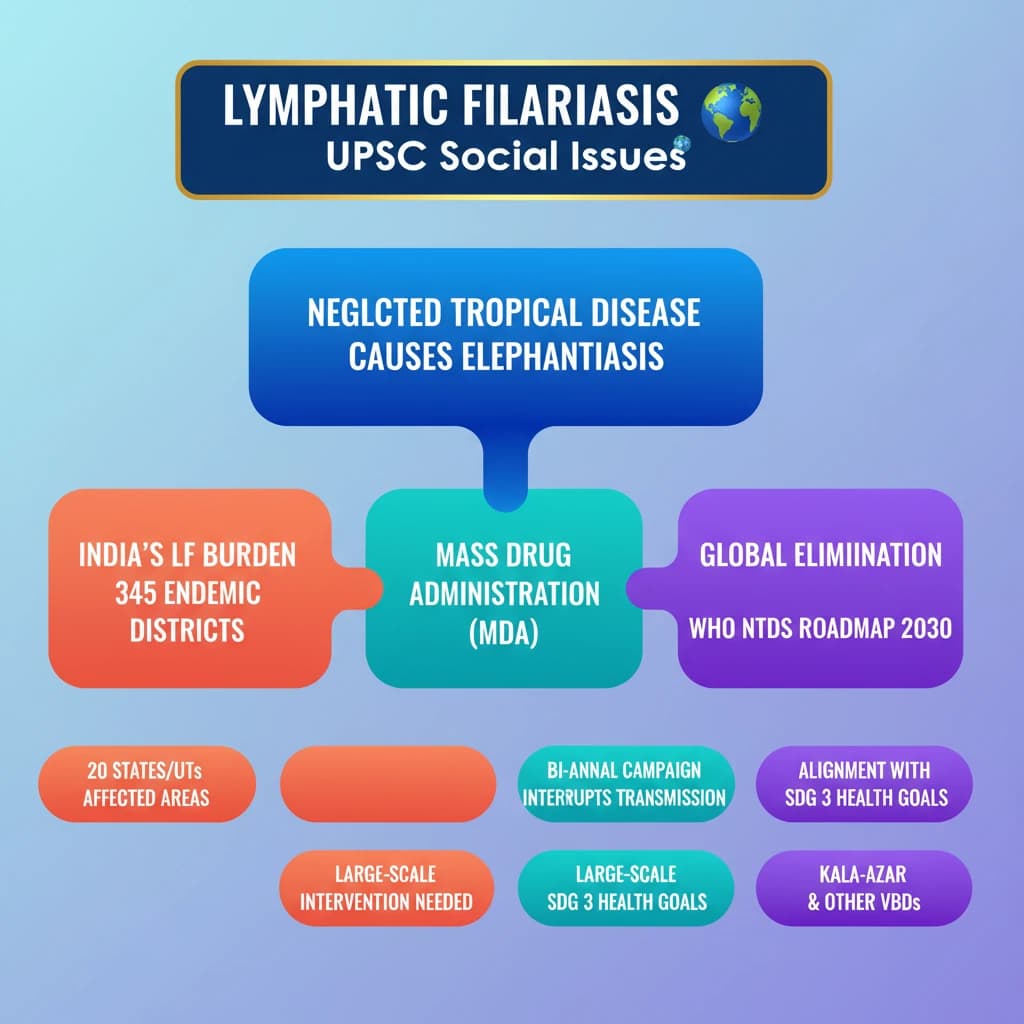
Lymphatic Filariasis is a key topic under Social Issues for UPSC Civil Services Examination. Key points include: Lymphatic Filariasis (LF), or elephantiasis, is a Neglected Tropical Disease (NTD) caused by filarial parasites transmitted by mosquitoes.. It leads to irreversible chronic conditions like lymphoedema, elephantiasis, and hydrocele, causing physical disfigurement and significant socio-economic burden.. India launched a Bi-annual Nationwide Mass Drug Administration (MDA) campaign, covering 92 districts in 11 states, to eliminate LF by providing free preventive medications.. Understanding this topic is essential for both UPSC Prelims and Mains preparation.

Why is Lymphatic Filariasis important for UPSC exam?

Lymphatic Filariasis is a Medium-level topic in UPSC Social Issues. It is tested in both Prelims (factual MCQs) and Mains (analytical answer writing). Previous year UPSC questions have frequently covered aspects of Lymphatic Filariasis, making it essential for comprehensive IAS preparation.

How to prepare Lymphatic Filariasis for UPSC?

To prepare Lymphatic Filariasis for UPSC: (1) Study the comprehensive notes covering all key concepts on Vaidra. (2) Practice previous year questions on this topic. (3) Connect it with current affairs using daily updates. (4) Revise using key takeaways and mind maps available for Social Issues. (5) Write practice answers linking Lymphatic Filariasis to related GS Paper topics.

Key takeaways of Lymphatic Filariasis for UPSC

  • Lymphatic Filariasis (LF), or elephantiasis, is a Neglected Tropical Disease (NTD) caused by filarial parasites transmitted by mosquitoes.
  • It leads to irreversible chronic conditions like lymphoedema, elephantiasis, and hydrocele, causing physical disfigurement and significant socio-economic burden.
  • India launched a Bi-annual Nationwide Mass Drug Administration (MDA) campaign, covering 92 districts in 11 states, to eliminate LF by providing free preventive medications.
  • Wuchereria bancrofti causes 90% of cases; the adult worms reside in lymphatic vessels, producing microfilariae that circulate in the blood.
  • Preventive chemotherapy via annual MDA is the WHO-recommended strategy to interrupt transmission and eliminate the disease.
Lymphatic Filariasis

Lymphatic Filariasis

Medium⏱️ 8 min read✓ 98% Verified
social issues

📖 Introduction

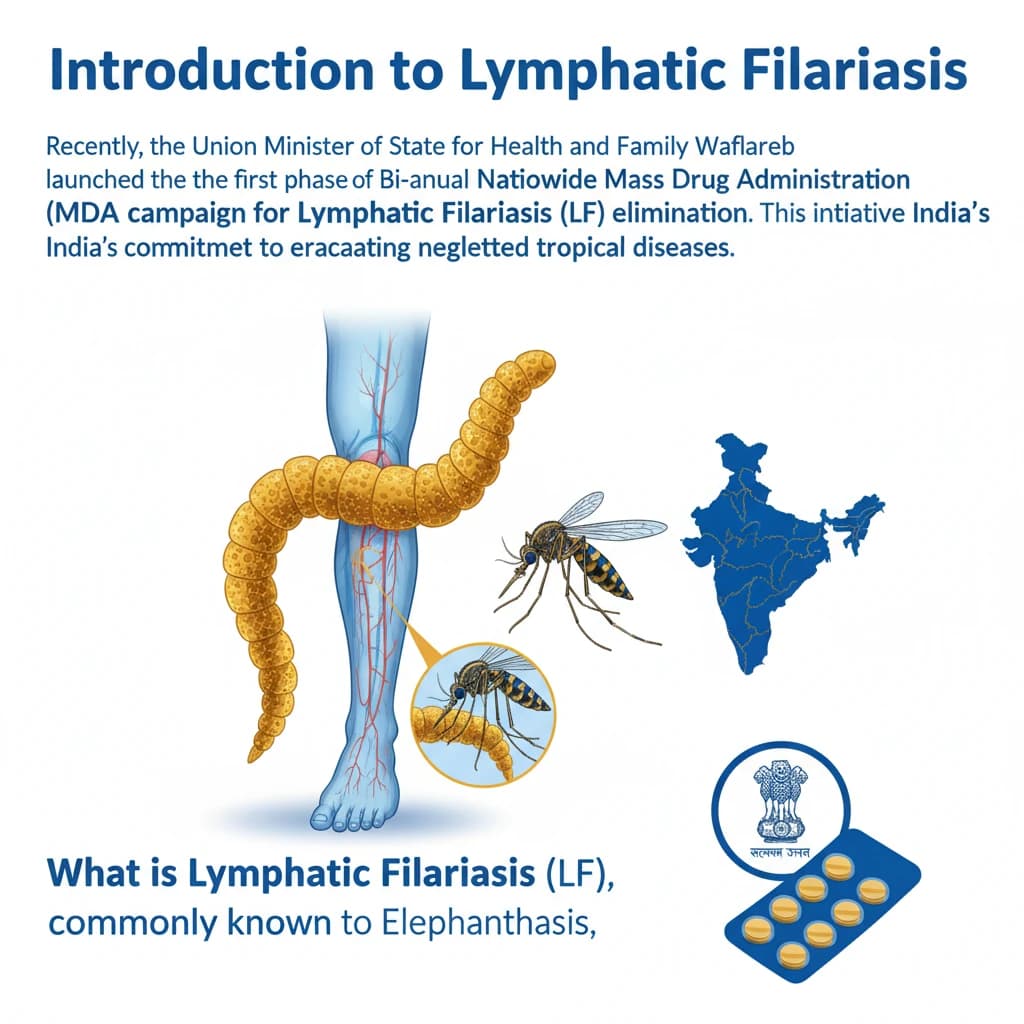
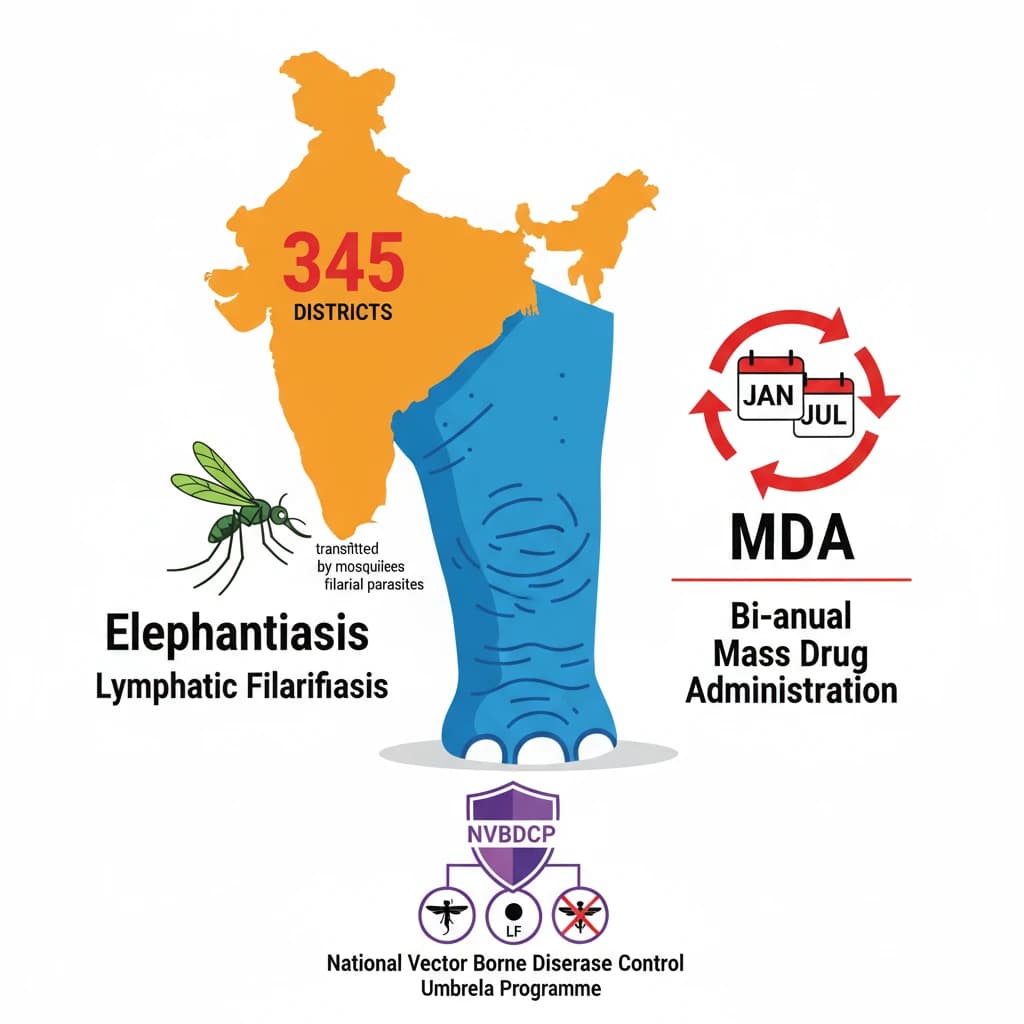
<h4>Introduction to Lymphatic Filariasis (LF)</h4><p>Recently, the <strong>Union Minister of State for Health and Family Welfare</strong> inaugurated the first phase of the <strong>Bi-annual Nationwide Mass Drug Administration (MDA) campaign</strong>. This significant initiative aims at the elimination of <strong>Lymphatic Filariasis (LF)</strong> across affected regions in India.</p><div class='info-box'><p>The <strong>MDA campaign</strong> is designed to halt disease transmission by offering free preventive medications. It targets residents in areas where the disease is prevalent and will encompass <strong>92 districts</strong> across <strong>11 states</strong> in its initial phase.</p></div><h4>Understanding Lymphatic Filariasis</h4><p><strong>Lymphatic Filariasis</strong>, commonly known as <strong>elephantiasis</strong>, is categorized as a <strong>neglected tropical disease (NTD)</strong>. It is caused by an infection with specific <strong>filarial parasites</strong>, which are transmitted to humans through <strong>mosquito bites</strong>.</p><div class='key-point-box'><p>The infection typically begins in <strong>childhood</strong> and progressively worsens throughout adulthood. This accumulation often leads to <strong>irreversible chronic disease conditions</strong>, making early intervention crucial.</p></div><h4>Global and National Prevalence</h4><p>In <strong>2021</strong>, an estimated <strong>882.5 million people</strong> residing in <strong>44 countries</strong> required preventive chemotherapy to control the spread of <strong>Lymphatic Filariasis</strong>. This highlights the disease's significant global burden.</p><p>In <strong>India</strong>, <strong>LF</strong> remains a serious public health challenge. Currently, there are <strong>345 Lymphatic Filariasis endemic districts</strong> spread across <strong>20 states and union territories</strong>.</p><div class='info-box'><p>A significant concentration of <strong>MDA districts</strong>, approximately <strong>75%</strong>, are located in five key states: <strong>Bihar, Jharkhand, Uttar Pradesh, Odisha</strong>, and <strong>Telangana</strong>. The disease disproportionately affects the <strong>urban poor</strong> and impacts all segments of the <strong>rural population</strong>.</p></div><h4>Impact of Lymphatic Filariasis</h4><p>The disease carries a profound societal and economic burden. It inflicts severe <strong>stigma</strong> and considerable <strong>mental suffering</strong> on affected individuals.</p><p>Beyond health, <strong>LF</strong> leads to significant <strong>social deprivation</strong> and substantial <strong>economic loss</strong>. It is recognized as a major contributing factor to <strong>poverty</strong> within affected communities.</p><h4>Causes and Transmission Cycle</h4><p><strong>Lymphatic Filariasis</strong> is caused by an infection with <strong>parasites</strong> belonging to the <strong>nematodes (roundworms)</strong> family, specifically <strong>Filariodidea</strong>. There are three primary types of these thread-like filarial worms responsible for the disease:</p><ul><li><strong>Wuchereria bancrofti</strong>: Responsible for approximately <strong>90%</strong> of all <strong>LF cases</strong>.</li><li><strong>Brugia malayi</strong>: Accounts for most of the remaining cases.</li><li><strong>Brugia timori</strong>: Also a known cause of the disease.</li></ul><div class='info-box'><p>The adult worms reside in the <strong>lymphatic vessels</strong> of infected individuals, where they produce microscopic larvae known as <strong>microfilariae</strong>. These <strong>microfilariae</strong> then circulate in the bloodstream.</p></div><p>The transmission cycle continues when <strong>mosquitoes</strong> bite an infected host and ingest the <strong>microfilariae</strong>. These larvae develop within the mosquito and are subsequently transmitted to healthy humans during another mosquito bite, thus perpetuating the infection.</p><h4>Symptoms and Complications</h4><p>A significant challenge with <strong>LF</strong> is that the majority of infections are initially <strong>asymptomatic</strong>, meaning individuals show no outward signs of the disease for a long period.</p><p>However, chronic conditions can develop, leading to severe and disfiguring symptoms:</p><ul><li><strong>Lymphoedema</strong>: Characterized by painful swelling of the limbs.</li><li><strong>Elephantiasis</strong>: Involves the extreme thickening of the skin and underlying tissues, leading to gross enlargement of body parts.</li><li><strong>Hydrocele</strong>: Manifests as swelling of the scrotum in males.</li></ul><p>These chronic conditions not only cause severe <strong>physical disfigurement</strong> but also profound <strong>psychological distress</strong> for those affected.</p><div class='key-point-box'><p>In addition to chronic conditions, individuals often experience <strong>acute inflammatory episodes</strong>. These episodes are debilitating, causing intense pain and leading to a significant loss of productivity among infected individuals.</p></div><h4>Treatment and Prevention Strategies</h4><p>The primary global strategy for controlling and eliminating <strong>Lymphatic Filariasis</strong> is <strong>preventive chemotherapy</strong>. This involves <strong>Mass Drug Administration (MDA)</strong>.</p><div class='exam-tip-box'><p>The <strong>World Health Organization (WHO)</strong> recommends annual doses of specific medicines to the entire at-risk population in endemic areas. This approach aims to reduce the parasite load in the community and interrupt transmission.</p></div>
Concept Diagram

💡 Key Takeaways

  • •Lymphatic Filariasis (LF), or elephantiasis, is a Neglected Tropical Disease (NTD) caused by filarial parasites transmitted by mosquitoes.
  • •It leads to irreversible chronic conditions like lymphoedema, elephantiasis, and hydrocele, causing physical disfigurement and significant socio-economic burden.
  • •India launched a Bi-annual Nationwide Mass Drug Administration (MDA) campaign, covering 92 districts in 11 states, to eliminate LF by providing free preventive medications.
  • •Wuchereria bancrofti causes 90% of cases; the adult worms reside in lymphatic vessels, producing microfilariae that circulate in the blood.
  • •Preventive chemotherapy via annual MDA is the WHO-recommended strategy to interrupt transmission and eliminate the disease.

🧠 Memory Techniques
Memory Aid
98% Verified Content

📚 Reference Sources

•World Health Organization (WHO) fact sheets on Lymphatic Filariasis
•Ministry of Health & Family Welfare, Government of India press releases on MDA campaigns

Related Topics

Loading related topics...
Explore:Social Issues Topics·All Subjects·Daily Current Affairs·Editorial Analysis·Previous Year Questions·UPSC GPT
Lymphatic Filariasis - UPSC Social Issues