Loading page, please wait…
Vaidra Logo
Vaidra

Top 4 items + smart groups

UPSC GPT
New
Current Affairs
Daily Solutions
Daily Puzzle
Mains Evaluator

Version 2.0.0 • Built with ❤️ for UPSC aspirants

Loading...
Loading...
Loading...
Loading...
Loading...
Loading...
Loading...
Loading...
Loading...
Loading...
Loading...
Loading...
Loading...
Back
All Subjects

Topics

0 topics • 0 completed

Loading topics...
Loading...
Loading...
Loading...
Loading...
Loading...
Overall Progress0%

What are Key Facts About Transgender Persons Act, 2019? - UPSC Social Issues

What is What are Key Facts About Transgender Persons Act, 2019? in UPSC Social Issues?

What are Key Facts About Transgender Persons Act, 2019? is a key topic under Social Issues for UPSC Civil Services Examination. Key points include: The Transgender Persons Act, 2019, provides a legal framework for transgender rights in India.. It defines a transgender person based on self-perceived gender identity, not medical intervention.. The Act prohibits discrimination in education, employment, healthcare, and public facilities.. Understanding this topic is essential for both UPSC Prelims and Mains preparation.

Why is What are Key Facts About Transgender Persons Act, 2019? important for UPSC exam?

What are Key Facts About Transgender Persons Act, 2019? is a Medium-level topic in UPSC Social Issues. It is tested in both Prelims (factual MCQs) and Mains (analytical answer writing). Previous year UPSC questions have frequently covered aspects of What are Key Facts About Transgender Persons Act, 2019?, making it essential for comprehensive IAS preparation.

How to prepare What are Key Facts About Transgender Persons Act, 2019? for UPSC?

To prepare What are Key Facts About Transgender Persons Act, 2019? for UPSC: (1) Study the comprehensive notes covering all key concepts on Vaidra. (2) Practice previous year questions on this topic. (3) Connect it with current affairs using daily updates. (4) Revise using key takeaways and mind maps available for Social Issues. (5) Write practice answers linking What are Key Facts About Transgender Persons Act, 2019? to related GS Paper topics.

Key takeaways of What are Key Facts About Transgender Persons Act, 2019? for UPSC

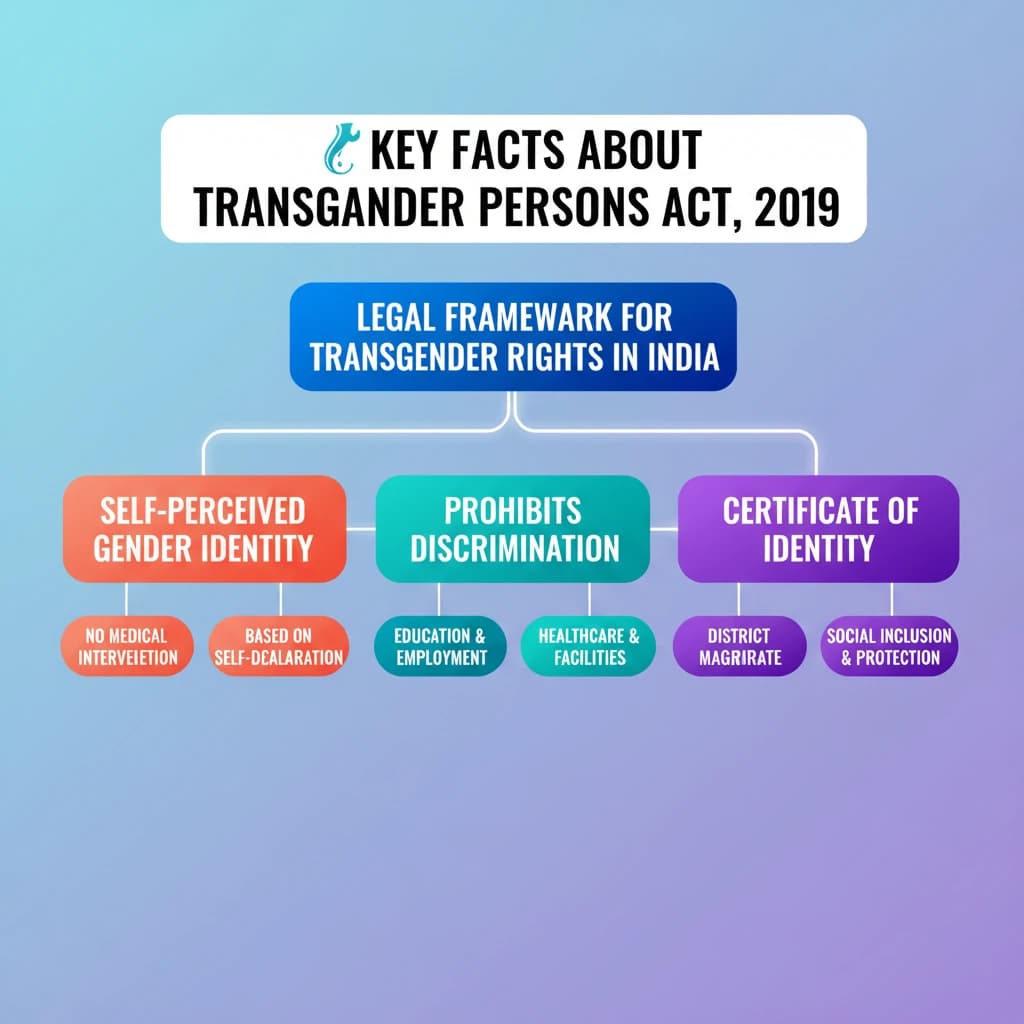
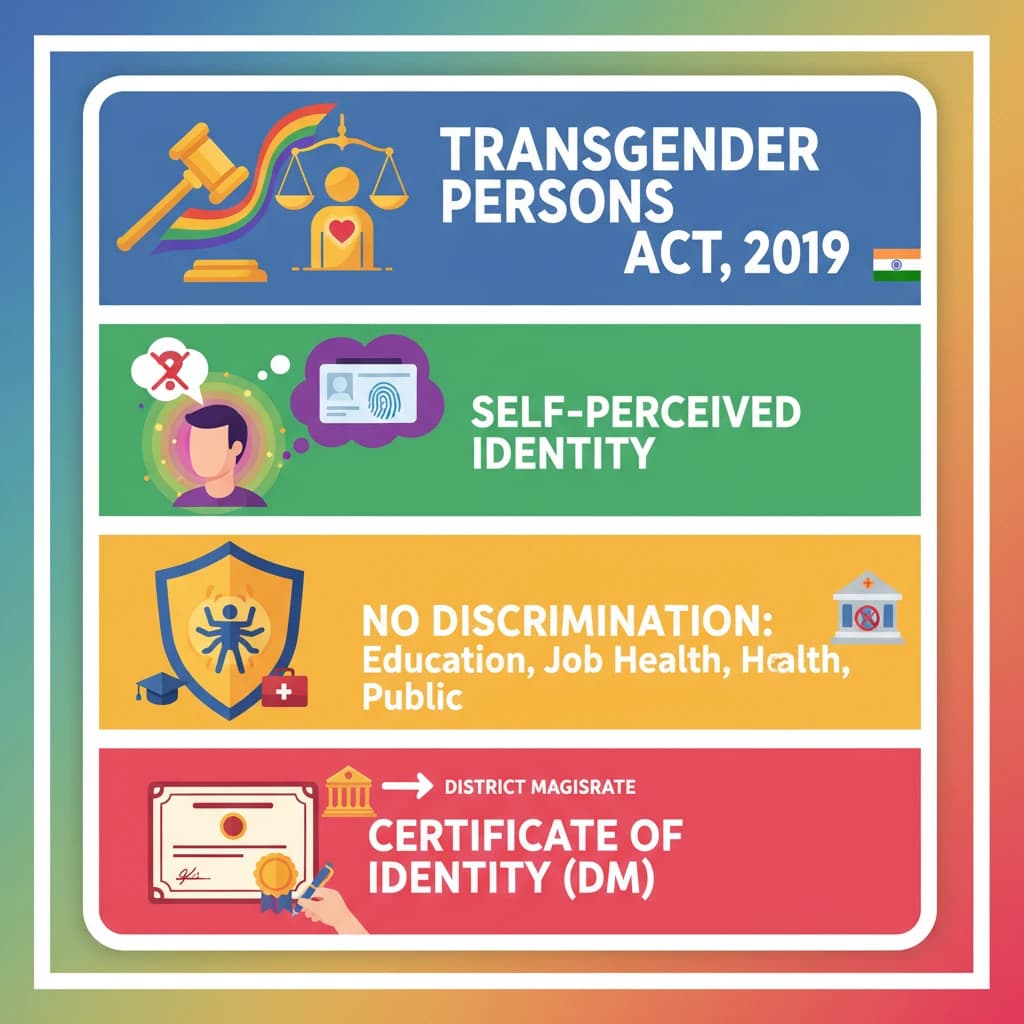
  • The Transgender Persons Act, 2019, provides a legal framework for transgender rights in India.
  • It defines a transgender person based on self-perceived gender identity, not medical intervention.
  • The Act prohibits discrimination in education, employment, healthcare, and public facilities.
  • It grants the right to a Certificate of Identity from the District Magistrate based on self-declaration.
  • The Act aims to ensure social inclusion and protection of fundamental rights for transgender persons.
What are Key Facts About Transgender Persons Act, 2019?

What are Key Facts About Transgender Persons Act, 2019?

Medium⏱️ 10 min read✓ 95% Verified
social issues

📖 Introduction

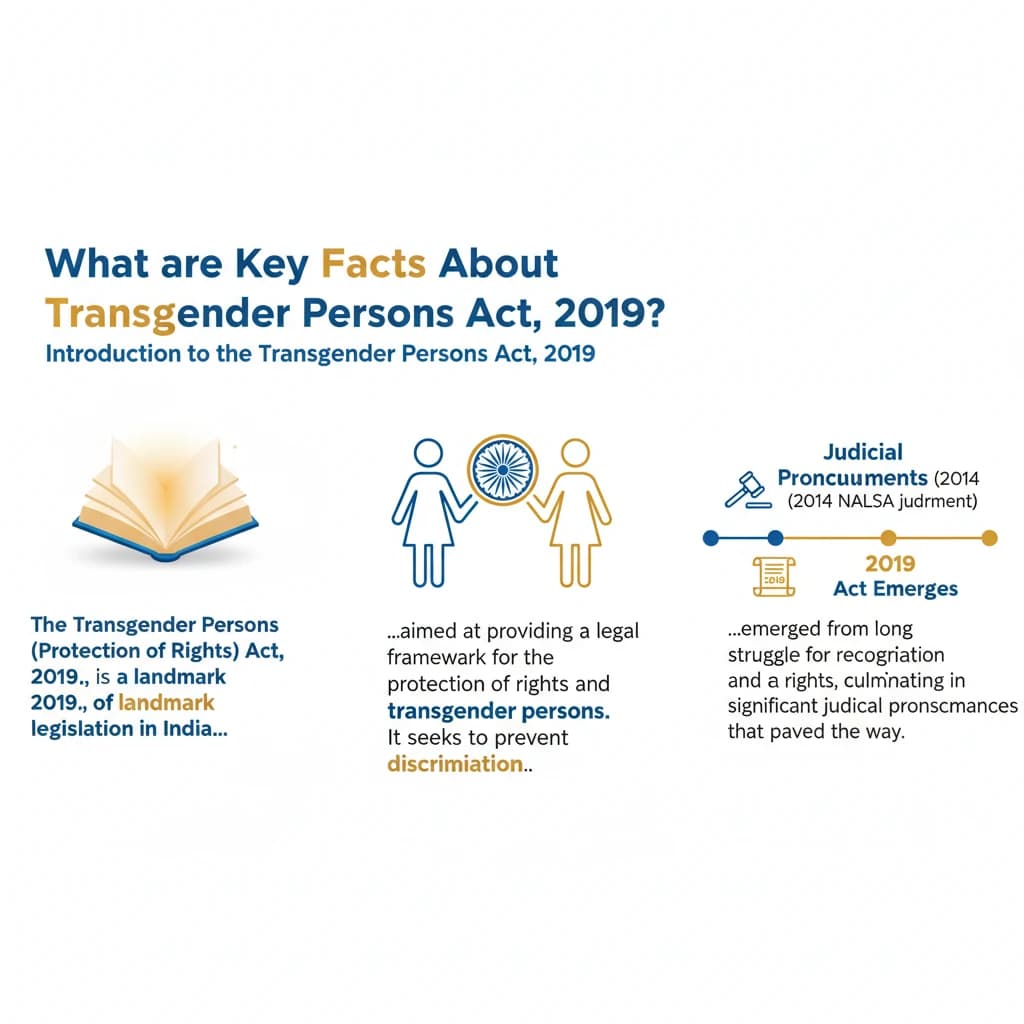
<h4>Introduction to the Transgender Persons Act, 2019</h4><p>The <strong>Transgender Persons (Protection of Rights) Act, 2019</strong>, is a landmark legislation in India aimed at providing a legal framework for the protection of rights and welfare of <strong>transgender persons</strong>. It seeks to prevent discrimination and ensure their inclusion in society.</p><p>This Act emerged from a long struggle for recognition and rights, culminating in significant judicial pronouncements that paved the way for legislative action.</p><h4>Defining a Transgender Person</h4><p>The Act provides a clear definition of a <strong>transgender person</strong>. It states that a transgender person is someone whose <strong>gender does not match with the gender assigned to that person at birth</strong>.</p><div class='info-box'><p><strong>Definition:</strong> A <strong>transgender person</strong> is an individual whose gender identity differs from the sex they were assigned at birth.</p></div><p>This definition emphasizes <strong>self-perceived gender identity</strong>, a crucial aspect of transgender rights globally.</p><h4>Clarification of Key Terms</h4><p>The Act further clarifies various related terms to ensure comprehensive coverage. It explicitly includes <strong>trans men</strong> and <strong>trans women</strong> within its ambit.</p><div class='info-box'><p><strong>Inclusions:</strong> The Act covers individuals with <strong>intersex variations</strong> and explicitly includes <strong>trans men</strong> and <strong>trans women</strong>.</p></div><p>Crucially, this inclusion is irrespective of whether a person has undergone any <strong>surgery or therapy</strong> for gender affirmation. This reinforces the principle of self-identification.</p><h4>Prohibition of Discrimination</h4><p>A cornerstone of the Act is its strong stance against discrimination. It prohibits discrimination against transgender persons in various spheres of life.</p><div class='key-point-box'><p><strong>Non-Discrimination Areas:</strong> The Act prohibits discrimination in:</p><ul><li><strong>Education</strong> (admission, facilities)</li><li><strong>Employment</strong> (recruitment, promotion)</li><li><strong>Healthcare</strong> (access to services)</li><li><strong>Access to public facilities</strong> (transport, housing)</li></ul></div><p>Beyond these, the Act also affirms their fundamental rights to <strong>movement</strong>, to <strong>property ownership</strong>, and to hold <strong>public office</strong>, ensuring their full participation in civic life.</p><h4>Right to Self-Perceived Gender Identity and Certificate</h4><p>The Act grants every transgender person the fundamental right to <strong>self-perceived gender identity</strong>. This is a significant step towards affirming individual autonomy.</p><p>To formalize this right, the Act mandates a process for obtaining a <strong>Certificate of Identity</strong>. This certificate is crucial for legal recognition of their gender identity.</p><div class='info-box'><p><strong>Certificate of Identity Process:</strong></p><ul><li>A transgender person can apply to the <strong>District Magistrate</strong> for a certificate of identity.</li><li>The application is based on their <strong>self-perceived gender identity</strong>.</li><li>Crucially, no <strong>medical examination</strong> or surgical proof is required for the initial certificate.</li></ul></div><div class='exam-tip-box'><p><strong>UPSC Insight:</strong> The emphasis on <strong>self-perceived gender identity</strong> and the absence of mandatory medical examination for the initial certificate are key features to highlight in answers related to social justice and human rights (<strong>GS Paper I & II</strong>).</p></div>
Concept Diagram

💡 Key Takeaways

  • •The Transgender Persons Act, 2019, provides a legal framework for transgender rights in India.
  • •It defines a transgender person based on self-perceived gender identity, not medical intervention.
  • •The Act prohibits discrimination in education, employment, healthcare, and public facilities.
  • •It grants the right to a Certificate of Identity from the District Magistrate based on self-declaration.
  • •The Act aims to ensure social inclusion and protection of fundamental rights for transgender persons.

🧠 Memory Techniques
Memory Aid
95% Verified Content

📚 Reference Sources

•National Legal Services Authority v. Union of India (NALSA Judgment), 2014, Supreme Court of India
•Ministry of Social Justice and Empowerment, Government of India

Related Topics

Loading related topics...
Explore:Social Issues Topics·All Subjects·Daily Current Affairs·Editorial Analysis·Previous Year Questions·UPSC GPT
What are Key Facts About Transgender Persons Act, 2019? - UPSC Social Issues