Loading page, please wait…
Vaidra Logo
Vaidra

Top 4 items + smart groups

UPSC GPT
New
Current Affairs
Daily Solutions
Daily Puzzle
Mains Evaluator

Version 2.0.0 • Built with ❤️ for UPSC aspirants

Loading...
Loading...
Loading...
Loading...
Loading...
Loading...
Loading...
Loading...
Loading...
Loading...
Loading...
Loading...
Loading...
Equality in Business: Judicial Interpretations & Article 21 - UPSC Social Issues
Back
All Subjects

Topics

0 topics • 0 completed

Loading topics...
Loading...
Loading...
Loading...
Loading...
Loading...
Overall Progress0%

Equality in Business: Judicial Interpretations & Article 21 - UPSC Social Issues

What is Equality in Business: Judicial Interpretations & Article 21 in UPSC Social Issues?

Equality in Business: Judicial Interpretations & Article 21 is a key topic under Social Issues for UPSC Civil Services Examination. Key points include: Every individual has an equal fundamental right to carry on any lawful business or profession.. The Supreme Court's ruling in Budhadev Karmaskar V. State of West Bengal (2011) affirmed the rights and dignity of sex workers under Article 21.. Article 21 (Right to Life and Personal Liberty) has a broad scope, encompassing the right to livelihood and dignity for all.. Understanding this topic is essential for both UPSC Prelims and Mains preparation.

Why is Equality in Business: Judicial Interpretations & Article 21 important for UPSC exam?

Equality in Business: Judicial Interpretations & Article 21 is a Medium-level topic in UPSC Social Issues. It is tested in both Prelims (factual MCQs) and Mains (analytical answer writing). Previous year UPSC questions have frequently covered aspects of Equality in Business: Judicial Interpretations & Article 21, making it essential for comprehensive IAS preparation.

How to prepare Equality in Business: Judicial Interpretations & Article 21 for UPSC?

To prepare Equality in Business: Judicial Interpretations & Article 21 for UPSC: (1) Study the comprehensive notes covering all key concepts on Vaidra. (2) Practice previous year questions on this topic. (3) Connect it with current affairs using daily updates. (4) Revise using key takeaways and mind maps available for Social Issues. (5) Write practice answers linking Equality in Business: Judicial Interpretations & Article 21 to related GS Paper topics.

Key takeaways of Equality in Business: Judicial Interpretations & Article 21 for UPSC

  • Every individual has an equal fundamental right to carry on any lawful business or profession.
  • The Supreme Court's ruling in Budhadev Karmaskar V. State of West Bengal (2011) affirmed the rights and dignity of sex workers under Article 21.
  • Article 21 (Right to Life and Personal Liberty) has a broad scope, encompassing the right to livelihood and dignity for all.
  • Article 19(1)(g) directly grants the freedom to practice any profession or business, subject to reasonable restrictions.
  • Judicial interpretations are crucial in extending constitutional protections to marginalized groups and informal sectors.
  • Government policies like Stand-Up India aim to promote inclusive entrepreneurship, aligning with the principle of equality in business.

Equality in Business: Judicial Interpretations & Article 21

Equality in Business: Judicial Interpretations & Article 21

Medium⏱️ 7 min read✓ 95% Verified
social issues

📖 Introduction

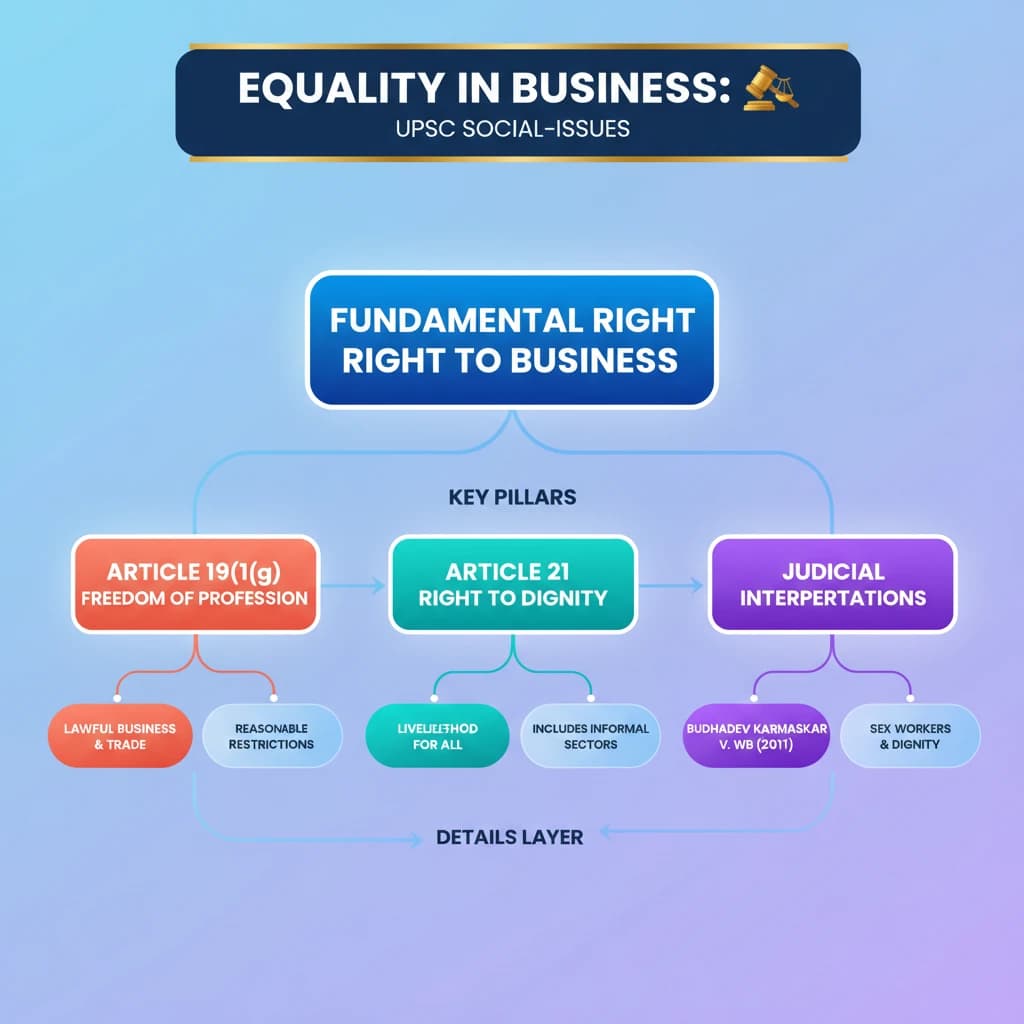
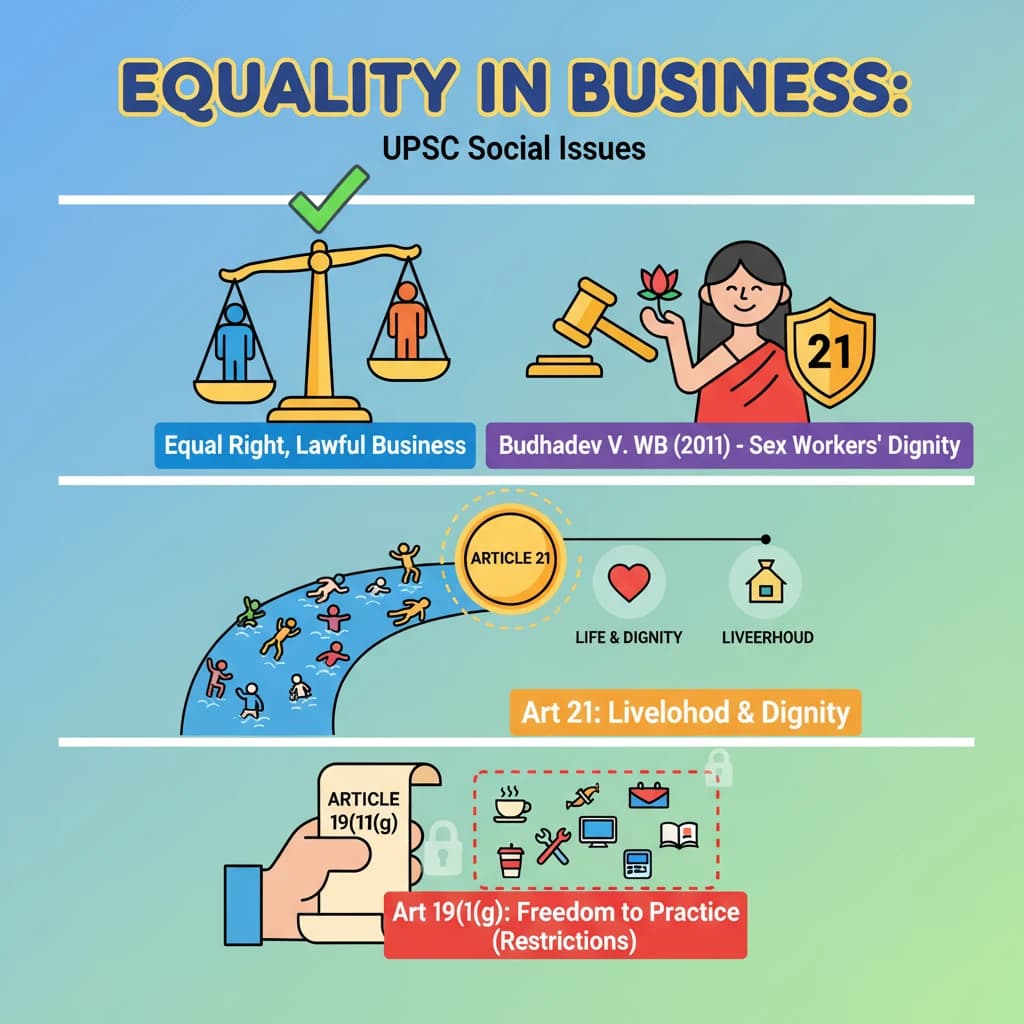
<h4>The Principle of Equality in Business</h4><p>In India, the legal framework upholds the fundamental principle that all <strong>individuals</strong> possess an <strong>equal right</strong> to pursue any chosen <strong>profession</strong> or engage in any <strong>business</strong>. This right is enshrined within the <strong>Indian Constitution</strong>, ensuring that no citizen is arbitrarily denied the opportunity to earn a livelihood.</p><div class='key-point-box'><p>The core idea is <strong>non-discrimination</strong> and <strong>equal opportunity</strong> in economic pursuits, safeguarding the ability of every person to participate in the economy without undue restrictions.</p></div><h4>Landmark Judgment: Budhadev Karmaskar V. State of West Bengal (2011)</h4><p>A pivotal moment in affirming these rights came with the <strong>Supreme Court of India's</strong> ruling in <strong>Budhadev Karmaskar V. State of West Bengal (2011)</strong>. This case specifically addressed the rights of <strong>sex workers</strong>, a highly marginalized community.</p><p>The Court recognized that even individuals in professions traditionally viewed with social stigma are entitled to <strong>constitutional protection</strong>. This judgment underscored the expansive interpretation of fundamental rights.</p><div class='info-box'><p><strong>Case Name:</strong> <strong>Budhadev Karmaskar V. State of West Bengal</strong></p><p><strong>Year:</strong> <strong>2011</strong></p><p><strong>Key Outcome:</strong> Secured the <strong>rights of sex workers</strong>, emphasizing their entitlement to a life of dignity.</p></div><h4>Protection Under Article 21</h4><p>The Supreme Court, in the <strong>Budhadev Karmaskar</strong> case, heavily relied on <strong>Article 21</strong> of the <strong>Indian Constitution</strong>. <strong>Article 21</strong> guarantees <strong>"Protection of Life and Personal Liberty"</strong>, which has been interpreted broadly by the judiciary.</p><p>This includes the right to live with <strong>human dignity</strong>, the right to a <strong>livelihood</strong>, and protection from exploitation. The judgment highlighted that dignity is not exclusive to certain professions but is inherent to every individual.</p><div class='exam-tip-box'><p><strong>UPSC Insight:</strong> Understanding how the judiciary interprets broad constitutional provisions like <strong>Article 21</strong> to protect marginalized groups is crucial for <strong>GS-II (Polity and Social Justice)</strong>. Be prepared to cite landmark judgments.</p></div>
Concept Diagram

💡 Key Takeaways

  • •Every individual has an equal fundamental right to carry on any lawful business or profession.
  • •The Supreme Court's ruling in Budhadev Karmaskar V. State of West Bengal (2011) affirmed the rights and dignity of sex workers under Article 21.
  • •Article 21 (Right to Life and Personal Liberty) has a broad scope, encompassing the right to livelihood and dignity for all.
  • •Article 19(1)(g) directly grants the freedom to practice any profession or business, subject to reasonable restrictions.
  • •Judicial interpretations are crucial in extending constitutional protections to marginalized groups and informal sectors.
  • •Government policies like Stand-Up India aim to promote inclusive entrepreneurship, aligning with the principle of equality in business.

🧠 Memory Techniques
Memory Aid
95% Verified Content

📚 Reference Sources

•The Constitution of India
•Supreme Court of India judgments (Budhadev Karmaskar V. State of West Bengal, 2011)
•Academic articles on Fundamental Rights and Social Justice in India

Related Topics

Loading related topics...
Explore:Social Issues Topics·All Subjects·Daily Current Affairs·Editorial Analysis·Previous Year Questions·UPSC GPT