Loading page, please wait…
Vaidra Logo
Vaidra

Top 4 items + smart groups

UPSC GPT
New
Current Affairs
Daily Solutions
Daily Puzzle
Mains Evaluator

Version 2.0.0 • Built with ❤️ for UPSC aspirants

Loading...
Loading...
Loading...
Loading...
Loading...
Loading...
Loading...
Loading...
Loading...
Loading...
Loading...
Loading...
Loading...
Back
All Subjects

Topics

0 topics • 0 completed

Loading topics...
Loading...
Loading...
Loading...
Loading...
Loading...
Overall Progress0%
Global Gender Gap Report 2024 - UPSC Social Issues

Global Gender Gap Report 2024 - UPSC Social Issues

What is Global Gender Gap Report 2024 in UPSC Social Issues?

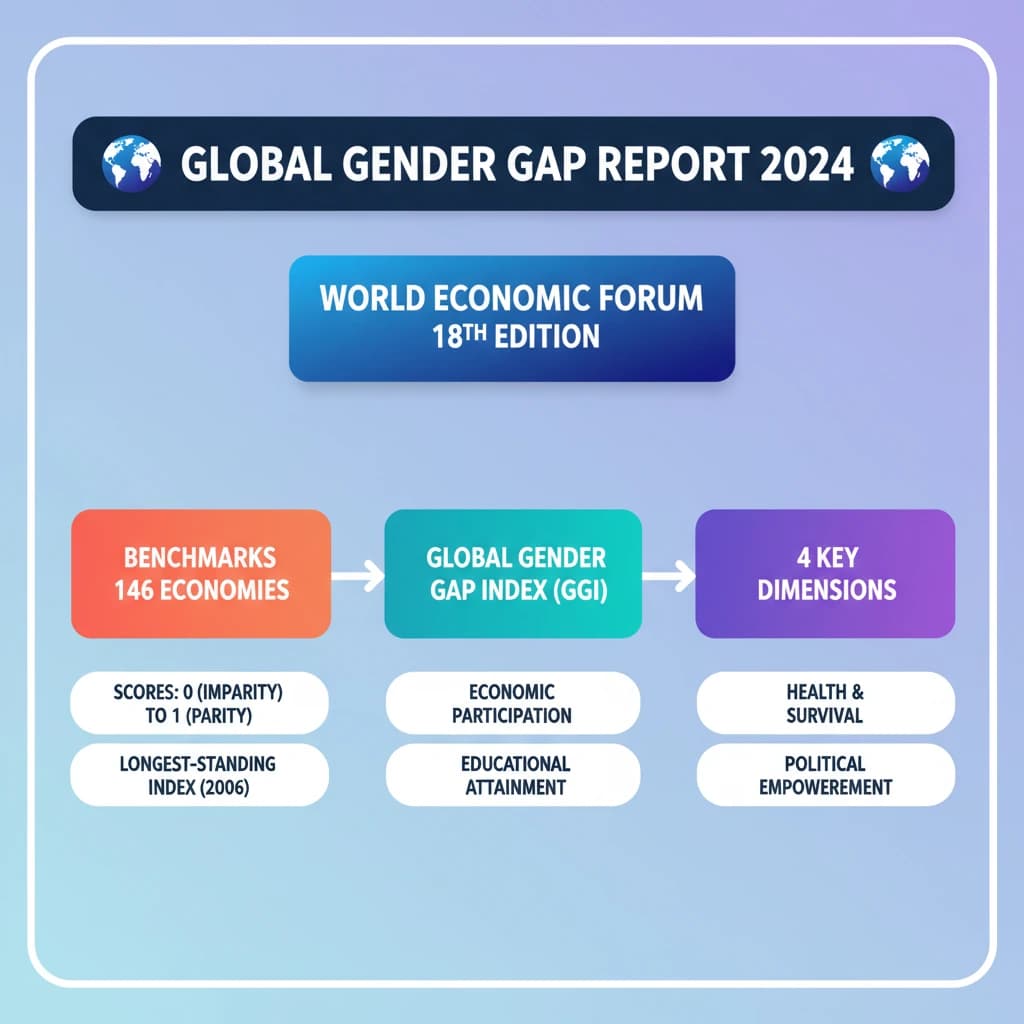
Global Gender Gap Report 2024 is a key topic under Social Issues for UPSC Civil Services Examination. Key points include: Global Gender Gap Report 2024 is the 18th edition, released by the World Economic Forum.. It benchmarks gender parity across 146 economies using the Global Gender Gap Index (GGI).. GGI scores range from 0 (complete imparity) to 1 (full gender parity).. Understanding this topic is essential for both UPSC Prelims and Mains preparation.

Why is Global Gender Gap Report 2024 important for UPSC exam?

Global Gender Gap Report 2024 is a Medium-level topic in UPSC Social Issues. It is tested in both Prelims (factual MCQs) and Mains (analytical answer writing). Previous year UPSC questions have frequently covered aspects of Global Gender Gap Report 2024, making it essential for comprehensive IAS preparation.

How to prepare Global Gender Gap Report 2024 for UPSC?

To prepare Global Gender Gap Report 2024 for UPSC: (1) Study the comprehensive notes covering all key concepts on Vaidra. (2) Practice previous year questions on this topic. (3) Connect it with current affairs using daily updates. (4) Revise using key takeaways and mind maps available for Social Issues. (5) Write practice answers linking Global Gender Gap Report 2024 to related GS Paper topics.

Key takeaways of Global Gender Gap Report 2024 for UPSC

  • Global Gender Gap Report 2024 is the 18th edition, released by the World Economic Forum.
  • It benchmarks gender parity across 146 economies using the Global Gender Gap Index (GGI).
  • GGI scores range from 0 (complete imparity) to 1 (full gender parity).
  • The index measures progress across four key dimensions.
  • It's the longest-standing index, tracking gender gaps since its inception in 2006.
  • Crucial for informing policy, achieving SDGs, and promoting global gender equality.
Global Gender Gap Report 2024

Global Gender Gap Report 2024

Medium⏱️ 5 min read✓ 95% Verified
social issues

📖 Introduction

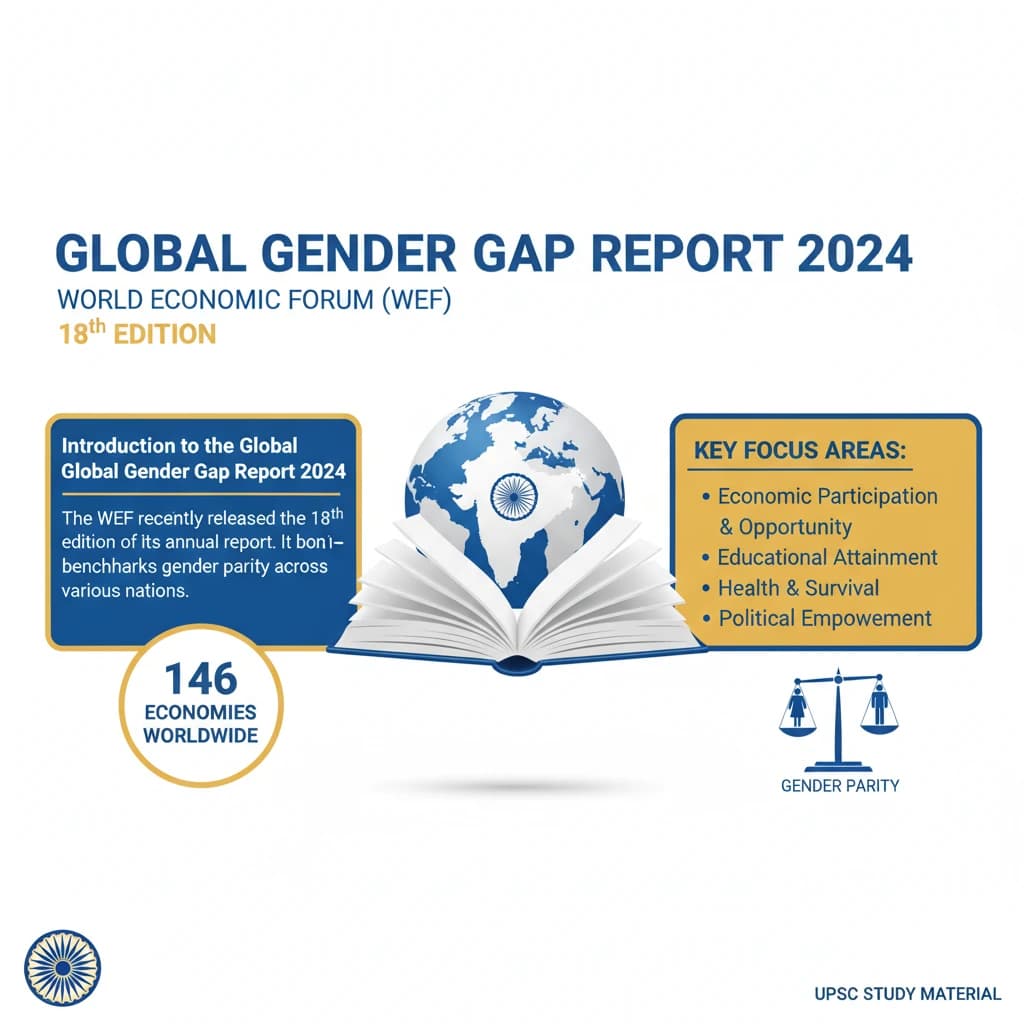
<h4>Introduction to the Global Gender Gap Report 2024</h4><p>The <strong>World Economic Forum (WEF)</strong> recently released the <strong>18th edition</strong> of its annual <strong>Global Gender Gap Report</strong> for <strong>2024</strong>. This report serves as a crucial benchmark for assessing <strong>gender parity</strong> across various nations.</p><p>It provides a comprehensive analysis, benchmarking gender parity across <strong>146 economies worldwide</strong>. This extensive coverage allows for a global perspective on the state of gender equality.</p><h4>Understanding the Global Gender Gap Index (GGI)</h4><div class='info-box'><p>The <strong>Global Gender Gap Index (GGI)</strong> is a unique tool designed to benchmark countries. It measures their progress towards achieving <strong>gender parity</strong> across several critical dimensions.</p></div><p>The index focuses on <strong>four key dimensions</strong>, each comprising multiple sub-matrices. These dimensions allow for a detailed and nuanced understanding of gender disparities in different aspects of society.</p><h4>Scoring Mechanism of the GGI</h4><p>The GGI assigns scores ranging from <strong>0 to 1</strong> for each of its four sub-indices, as well as for the overall index. This standardized scoring system makes comparisons straightforward.</p><div class='key-point-box'><ul><li>A score of <strong>1</strong> signifies <strong>full gender parity</strong>, indicating complete equality between genders in the measured area.</li><li>Conversely, a score of <strong>0</strong> represents <strong>complete imparity</strong>, meaning there is absolute inequality.</li></ul></div><h4>Historical Significance and Tracking Progress</h4><p>The Global Gender Gap Index stands out as the <strong>longest-standing index</strong> dedicated to tracking gender parity. Its consistent methodology allows for long-term trend analysis.</p><p>Since its inception in <strong>2006</strong>, the GGI has continuously tracked progress towards closing gender gaps over time. This historical data is invaluable for policymakers and researchers.</p><div class='exam-tip-box'><p>For <strong>UPSC Prelims</strong>, remember the publishing body (<strong>WEF</strong>), the year of inception (<strong>2006</strong>), and the scoring range (<strong>0-1</strong>). For <strong>Mains</strong>, understanding the <strong>four key dimensions</strong> (though not detailed in the source, it's a common GGI fact) and the concept of <strong>gender parity</strong> is crucial.</p></div>
Concept Diagram

💡 Key Takeaways

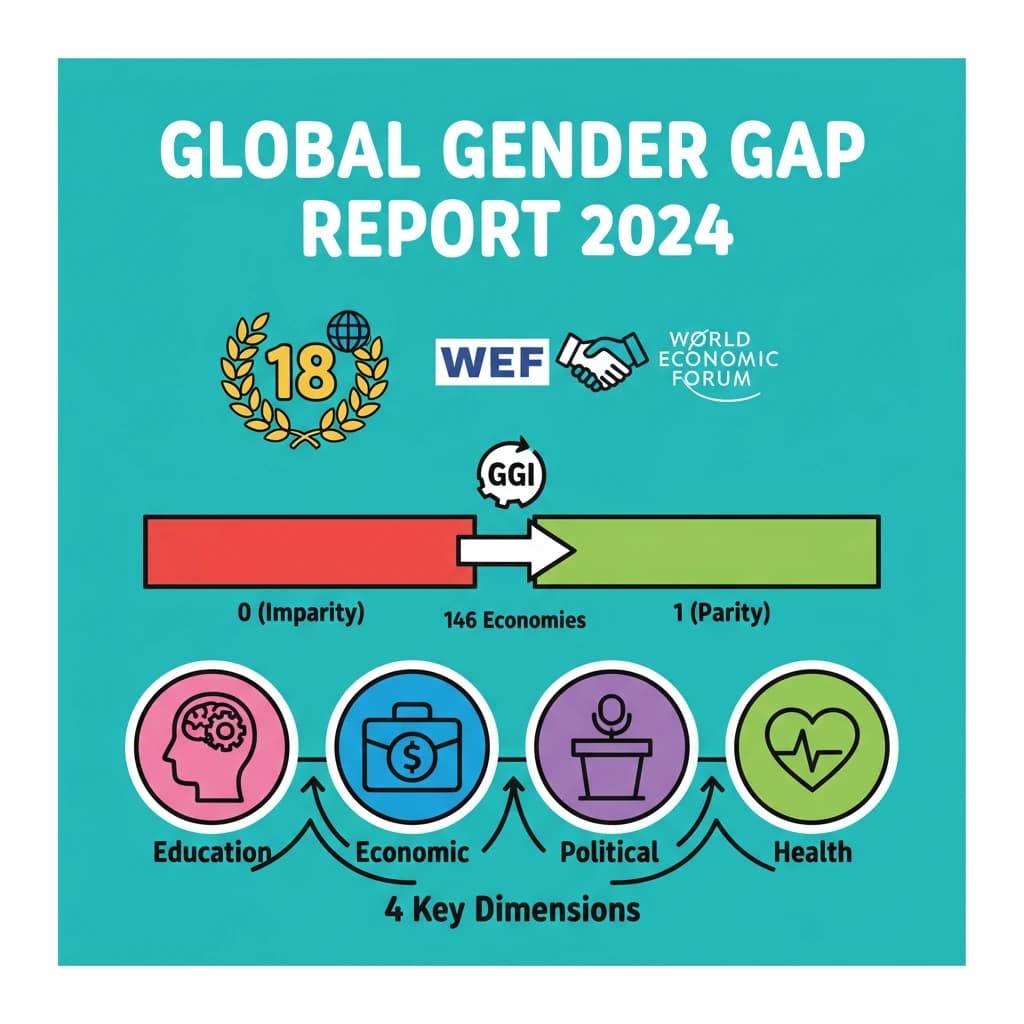
  • •Global Gender Gap Report 2024 is the 18th edition, released by the World Economic Forum.
  • •It benchmarks gender parity across 146 economies using the Global Gender Gap Index (GGI).
  • •GGI scores range from 0 (complete imparity) to 1 (full gender parity).
  • •The index measures progress across four key dimensions.
  • •It's the longest-standing index, tracking gender gaps since its inception in 2006.
  • •Crucial for informing policy, achieving SDGs, and promoting global gender equality.

🧠 Memory Techniques
Memory Aid
95% Verified Content

📚 Reference Sources

•Drishti IAS Summary

Related Topics

Loading related topics...
Explore:Social Issues Topics·All Subjects·Daily Current Affairs·Editorial Analysis·Previous Year Questions·UPSC GPT