Loading page, please wait…
Vaidra Logo
Vaidra

Top 4 items + smart groups

UPSC GPT
New
Current Affairs
Daily Solutions
Daily Puzzle
Mains Evaluator

Version 2.0.0 • Built with ❤️ for UPSC aspirants

Loading...
Loading...
Loading...
Loading...
Loading...
Loading...
Loading...
Loading...
Loading...
Loading...
Loading...
Loading...
Loading...
First All-India Survey on AYUSH - UPSC Social Issues
Back
All Subjects

Topics

0 topics • 0 completed

Loading topics...
Loading...
Loading...
Loading...
Loading...
Loading...
Overall Progress0%

First All-India Survey on AYUSH - UPSC Social Issues

What is First All-India Survey on AYUSH in UPSC Social Issues?

First All-India Survey on AYUSH is a key topic under Social Issues for UPSC Civil Services Examination. Key points include: Creamy layer exclusion aims to ensure reservation benefits reach the truly disadvantaged within SC/STs.. Jarnail Singh v. Union of India (2018) removed the need for quantifiable data for backwardness in SC/ST promotion quotas.. The 103rd Constitutional Amendment Act (2019) introduced 10% reservation for Economically Weaker Sections (EWS) by inserting Articles 15(6) and 16(6).. Understanding this topic is essential for both UPSC Prelims and Mains preparation.

Why is First All-India Survey on AYUSH important for UPSC exam?

First All-India Survey on AYUSH is a Medium-level topic in UPSC Social Issues. It is tested in both Prelims (factual MCQs) and Mains (analytical answer writing). Previous year UPSC questions have frequently covered aspects of First All-India Survey on AYUSH, making it essential for comprehensive IAS preparation.

How to prepare First All-India Survey on AYUSH for UPSC?

To prepare First All-India Survey on AYUSH for UPSC: (1) Study the comprehensive notes covering all key concepts on Vaidra. (2) Practice previous year questions on this topic. (3) Connect it with current affairs using daily updates. (4) Revise using key takeaways and mind maps available for Social Issues. (5) Write practice answers linking First All-India Survey on AYUSH to related GS Paper topics.

Key takeaways of First All-India Survey on AYUSH for UPSC

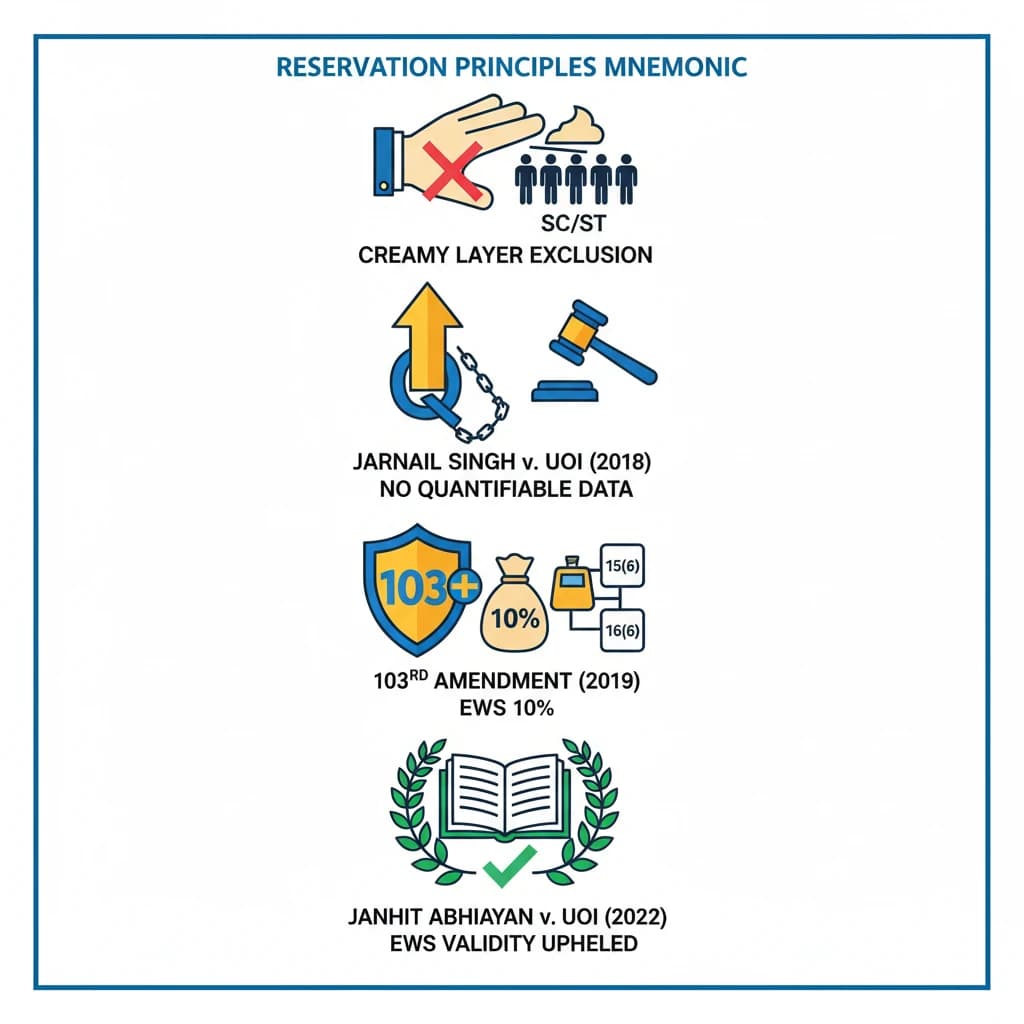
  • Creamy layer exclusion aims to ensure reservation benefits reach the truly disadvantaged within SC/STs.
  • Jarnail Singh v. Union of India (2018) removed the need for quantifiable data for backwardness in SC/ST promotion quotas.
  • The 103rd Constitutional Amendment Act (2019) introduced 10% reservation for Economically Weaker Sections (EWS) by inserting Articles 15(6) and 16(6).
  • Janhit Abhiyan v. Union of India (2022) upheld the constitutional validity of the EWS reservation.
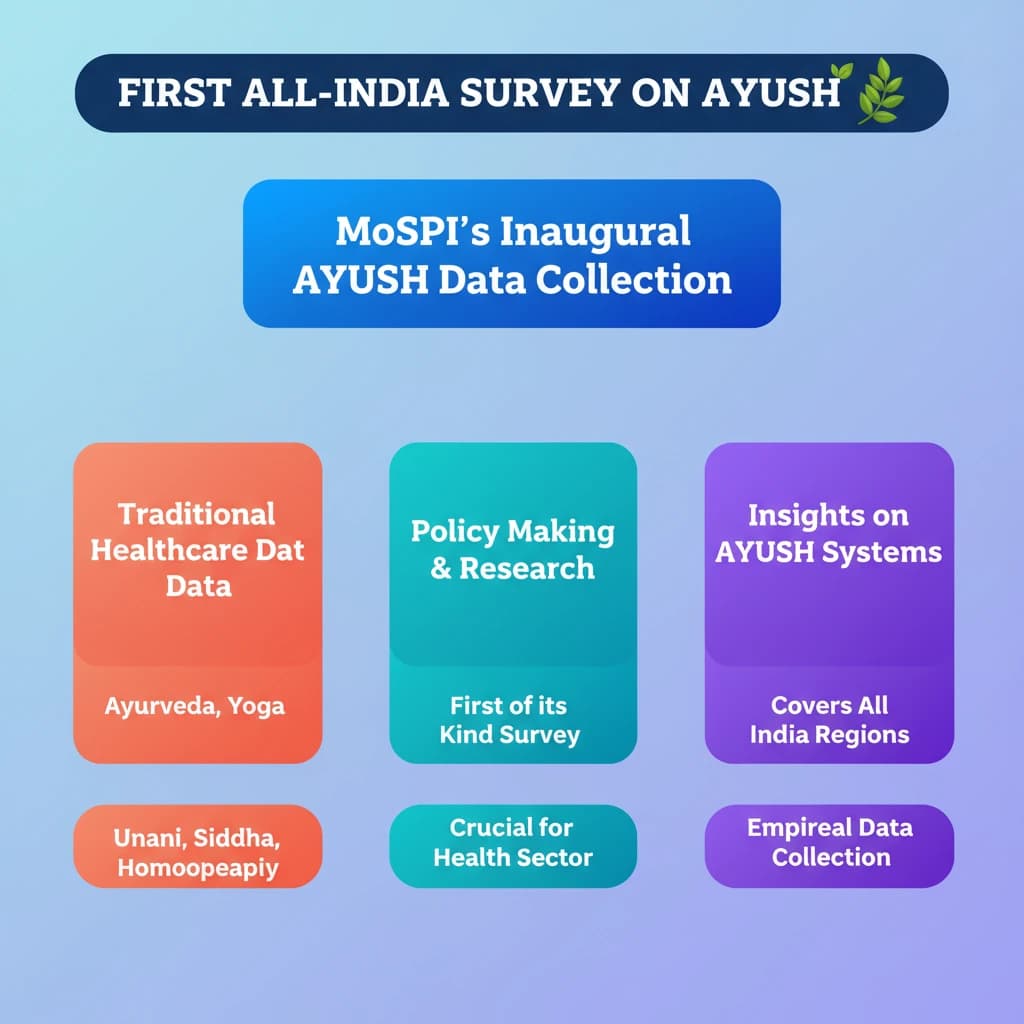
  • The First All-India Survey on AYUSH by MoSPI provides crucial data on traditional Indian healthcare systems (Ayurveda, Yoga, Unani, Siddha, Homoeopathy) for policy making.
First All-India Survey on AYUSH

First All-India Survey on AYUSH

Medium⏱️ 12 min read✓ 98% Verified
social issues

📖 Introduction

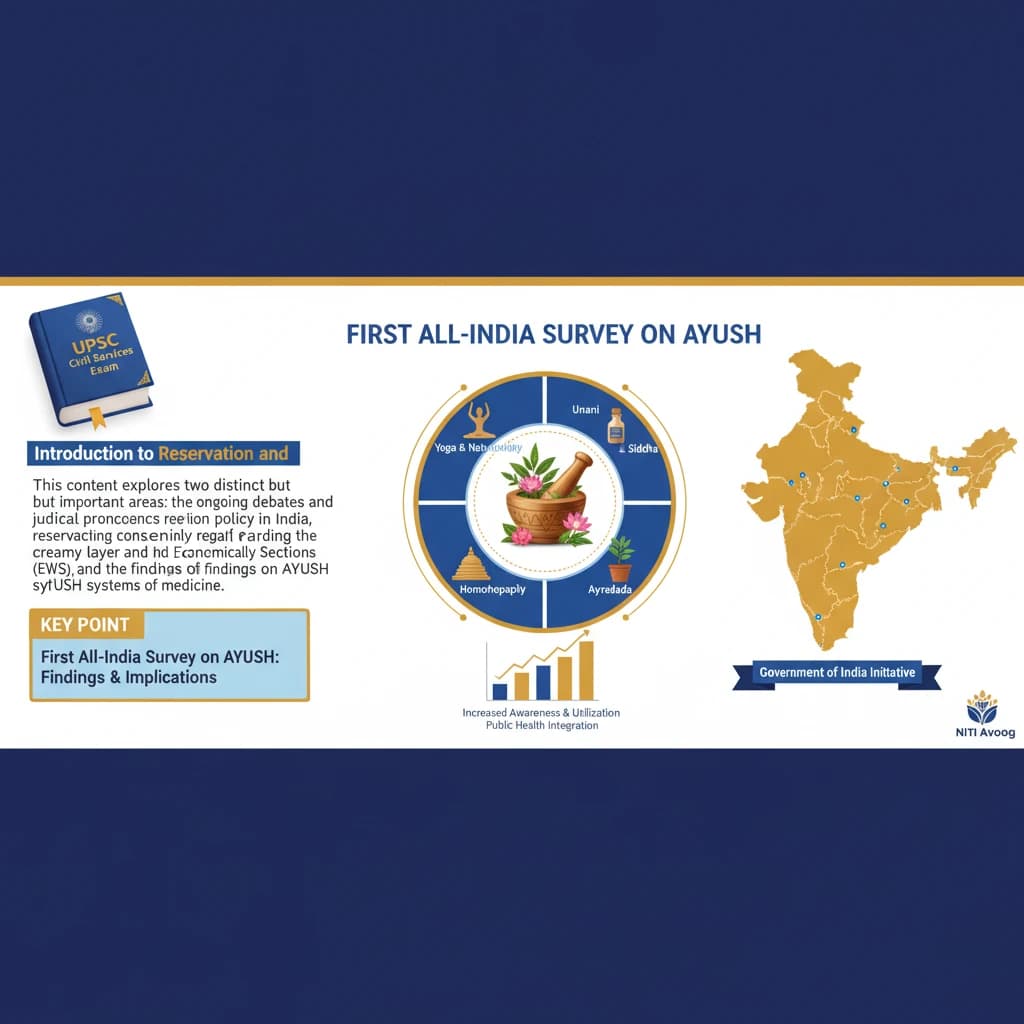
<h4>Introduction to Reservation and AYUSH</h4><p>This content explores two distinct but important areas for the <strong>UPSC Civil Services Exam</strong>: the ongoing debates and judicial pronouncements concerning <strong>reservation policy</strong> in India, particularly regarding the <strong>creamy layer</strong> and <strong>Economically Weaker Sections (EWS)</strong>, and the findings of the <strong>First All-India Survey on AYUSH</strong> systems of medicine.</p><div class='key-point-box'><p>Understanding these topics is crucial for <strong>General Studies Paper II (Polity and Governance)</strong> and <strong>General Studies Paper I (Social Issues)</strong>, as well as for essay writing.</p></div><h4>Creamy Layer Exclusion Principle</h4><p>The concept of the <strong>'creamy layer'</strong> refers to the affluent and advanced sections within <strong>Scheduled Castes (SCs)</strong> and <strong>Scheduled Tribes (STs)</strong>. The principle dictates that these individuals should be excluded from the benefits of reservation.</p><p>The rationale behind this exclusion is to ensure that reservation benefits reach the truly disadvantaged members of these communities, preventing their monopolization by the already well-off.</p><h4>Maintaining Administrative Efficiency</h4><p>A key consideration in implementing reservation policies is to ensure they do not adversely affect overall <strong>administrative efficiency</strong>. This balance is often debated in the context of promotions and appointments.</p><div class='info-box'><p>The Supreme Court has consistently emphasized the need to balance social justice with the imperative of maintaining a competent and efficient public administration.</p></div><h4>Jarnail Singh v. Union of India (2018) Verdict</h4><p>In this landmark case, the <strong>Supreme Court</strong> significantly altered its previous stance on the requirement for data collection in reservation for promotions. This verdict has major implications for states.</p><ul><li>The <strong>SC reversed its stance</strong> on the necessity of collecting quantifiable data.</li><li>States are <strong>no longer required to collect quantifiable data</strong> to prove the backwardness of a class or community when implementing reservation quotas for promotion.</li><li>This ruling facilitated the government's ability to implement <strong>'accelerated promotion with consequential seniority'</strong> for <strong>SC/ST members</strong> more easily.</li></ul><div class='exam-tip-box'><p>This case is vital for understanding the evolution of <strong>reservation in promotions</strong> and the judiciary's role. It's often asked in <strong>GS Paper II</strong>.</p></div><h4>103rd Constitutional Amendment Act, 2019 (EWS Reservation)</h4><p>The <strong>103rd Constitution (Amendment) Act, 2019</strong>, introduced a new category for reservation based on economic criteria, known as <strong>Economically Weaker Sections (EWS)</strong>.</p><ul><li>It provides for <strong>reservation to EWS</strong> in jobs in <strong>central government</strong> and <strong>government educational institutions</strong>.</li><li>The amendment was introduced by amending <strong>Articles 15 and 16</strong> of the Constitution.</li><li>It specifically inserted <strong>Article 15 (6)</strong> and <strong>Article 16 (6)</strong> to enable this reservation.</li></ul><p>The Act aims to promote the welfare of the poor who are not covered by the existing <strong>50% reservation policy</strong> for <strong>Scheduled Castes (SCs)</strong>, <strong>Scheduled Tribes (STs)</strong>, and <strong>Socially and Educationally Backward Classes (SEBCs)</strong>.</p><div class='info-box'><p>This amendment empowers both the <strong>Centre and the States</strong> to provide reservations to the <strong>EWS of society</strong>, addressing economic backwardness irrespective of caste.</p></div><h4>Janhit Abhiyan v. Union of India (2022) Verdict</h4><p>The constitutional validity of the <strong>103rd Constitutional Amendment Act</strong> was challenged in the <strong>Supreme Court</strong> in the case of <strong>Janhit Abhiyan v. Union of India, 2022</strong>.</p><p>In a significant <strong>3-2 verdict</strong>, the Court ultimately <strong>upheld the amendment</strong>. This ruling affirmed the government's power to provide reservation benefits based on economic standing.</p><div class='key-point-box'><p>The verdict confirmed that reservation based on <strong>economic criteria</strong> can exist alongside existing reservations for socially disadvantaged groups, marking a new direction in reservation policy.</p></div><h4>First All-India Survey on AYUSH Systems</h4><p>Moving to a different but equally important social issue, the <strong>Ministry of Statistics and Programme Implementation (MoSPI)</strong> recently released the findings of a national survey on <strong>AYUSH systems of medicine</strong>.</p><div class='info-box'><p><strong>AYUSH</strong> is an acronym for traditional and non-conventional systems of healthcare in India: <strong>Ayurveda, Yoga & Naturopathy, Unani, Siddha, and Homoeopathy</strong>.</p></div><p>This survey represents a significant step towards understanding the prevalence, infrastructure, and utilization of these traditional healthcare systems across the country. The findings are crucial for policy formulation in the health sector.</p>
Concept Diagram

💡 Key Takeaways

  • •Creamy layer exclusion aims to ensure reservation benefits reach the truly disadvantaged within SC/STs.
  • •Jarnail Singh v. Union of India (2018) removed the need for quantifiable data for backwardness in SC/ST promotion quotas.
  • •The 103rd Constitutional Amendment Act (2019) introduced 10% reservation for Economically Weaker Sections (EWS) by inserting Articles 15(6) and 16(6).
  • •Janhit Abhiyan v. Union of India (2022) upheld the constitutional validity of the EWS reservation.
  • •The First All-India Survey on AYUSH by MoSPI provides crucial data on traditional Indian healthcare systems (Ayurveda, Yoga, Unani, Siddha, Homoeopathy) for policy making.

🧠 Memory Techniques
Memory Aid
98% Verified Content

📚 Reference Sources

•Bare Act of 103rd Constitutional Amendment Act, 2019
•Supreme Court judgments: Jarnail Singh v. Union of India (2018), Janhit Abhiyan v. Union of India (2022)

Related Topics

Loading related topics...
Explore:Social Issues Topics·All Subjects·Daily Current Affairs·Editorial Analysis·Previous Year Questions·UPSC GPT