Loading page, please wait…
Vaidra Logo
Vaidra

Top 4 items + smart groups

UPSC GPT
New
Current Affairs
Daily Solutions
Daily Puzzle
Mains Evaluator

Version 2.0.0 • Built with ❤️ for UPSC aspirants

Loading...
Loading...
Loading...
Loading...
Loading...
Loading...
Loading...
Loading...
Loading...
Loading...
Loading...
Loading...
Loading...
Brothel Definition: Section 2 and Key Elements - UPSC Social Issues
Back
All Subjects

Topics

0 topics • 0 completed

Loading topics...
Loading...
Loading...
Loading...
Loading...
Loading...
Overall Progress0%

Brothel Definition: Section 2 and Key Elements - UPSC Social Issues

What is Brothel Definition: Section 2 and Key Elements in UPSC Social Issues?

Brothel Definition: Section 2 and Key Elements is a key topic under Social Issues for UPSC Civil Services Examination. Key points include: A brothel is defined under Section 2 of the Immoral Traffic (Prevention) Act, 1956 (ITP Act).. It refers to any place used for sexual exploitation or abuse.. The definition includes 'gain of another person' or 'mutual gain of two or more prostitutes'.. Understanding this topic is essential for both UPSC Prelims and Mains preparation.

Why is Brothel Definition: Section 2 and Key Elements important for UPSC exam?

Brothel Definition: Section 2 and Key Elements is a Medium-level topic in UPSC Social Issues. It is tested in both Prelims (factual MCQs) and Mains (analytical answer writing). Previous year UPSC questions have frequently covered aspects of Brothel Definition: Section 2 and Key Elements, making it essential for comprehensive IAS preparation.

How to prepare Brothel Definition: Section 2 and Key Elements for UPSC?

To prepare Brothel Definition: Section 2 and Key Elements for UPSC: (1) Study the comprehensive notes covering all key concepts on Vaidra. (2) Practice previous year questions on this topic. (3) Connect it with current affairs using daily updates. (4) Revise using key takeaways and mind maps available for Social Issues. (5) Write practice answers linking Brothel Definition: Section 2 and Key Elements to related GS Paper topics.

Key takeaways of Brothel Definition: Section 2 and Key Elements for UPSC

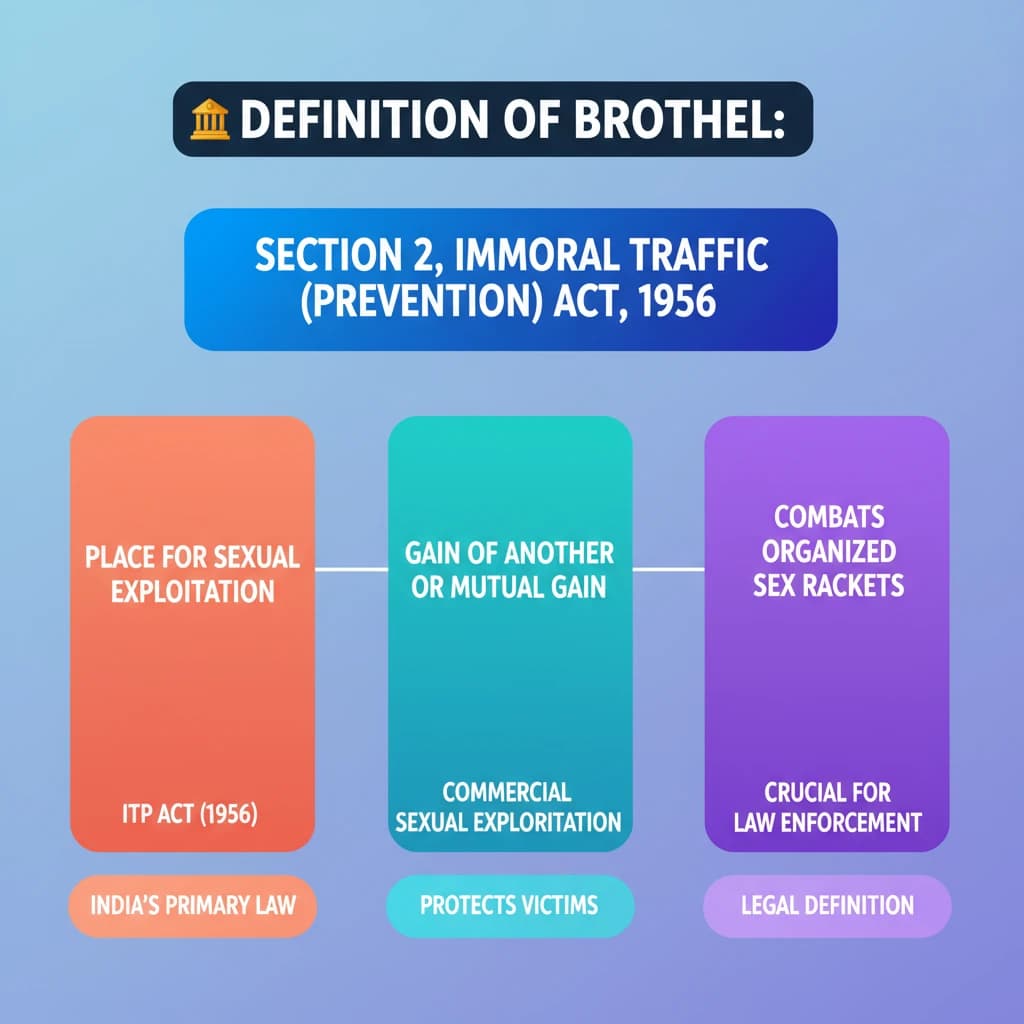
  • A brothel is defined under Section 2 of the Immoral Traffic (Prevention) Act, 1956 (ITP Act).
  • It refers to any place used for sexual exploitation or abuse.
  • The definition includes 'gain of another person' or 'mutual gain of two or more prostitutes'.
  • The ITP Act is India's primary law against immoral trafficking and commercial sexual exploitation.
  • The definition is crucial for law enforcement to combat organized sex rackets and protect victims.
Brothel Definition: Section 2 and Key Elements

Brothel Definition: Section 2 and Key Elements

Medium⏱️ 7 min read✓ 98% Verified
social issues

📖 Introduction

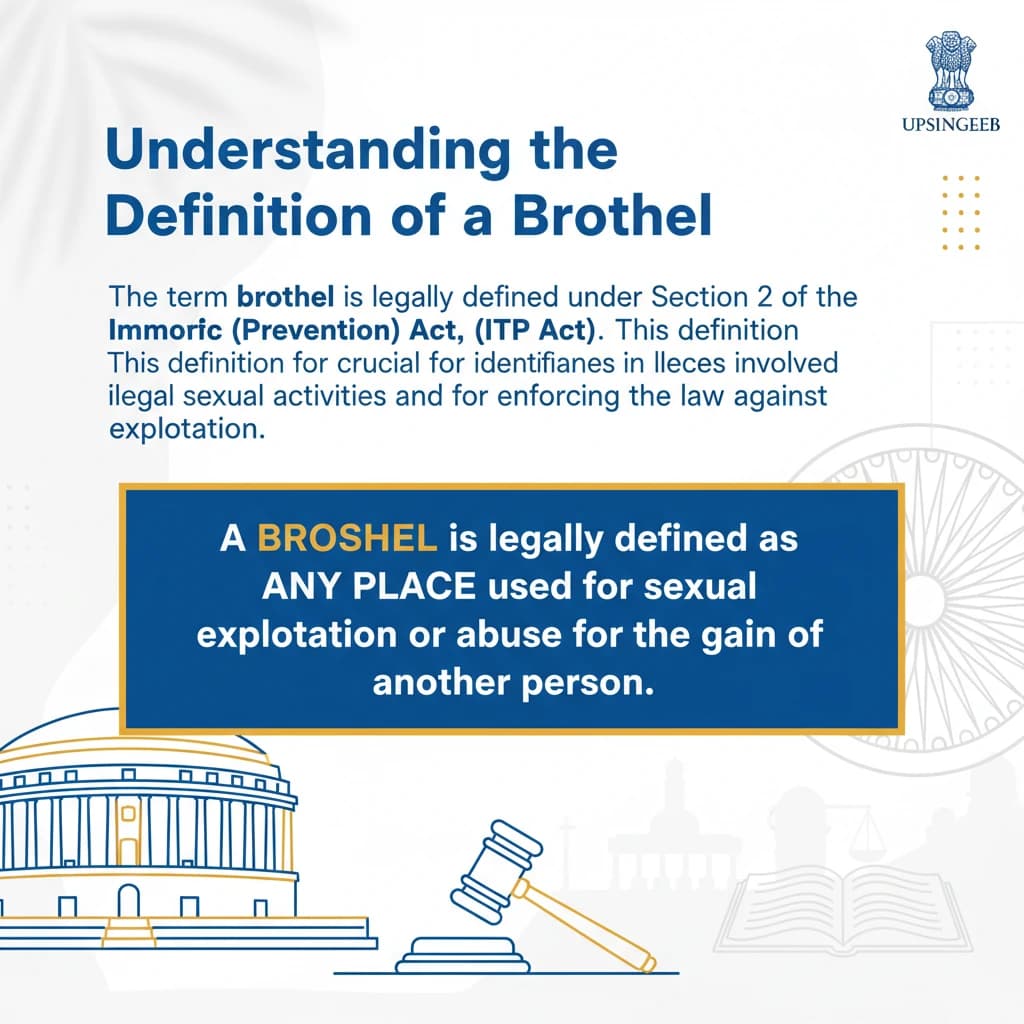
<h4>Understanding the Definition of a Brothel</h4><p>The term <strong>brothel</strong> is legally defined under <strong>Section 2</strong> of the <strong>Immoral Traffic (Prevention) Act, 1956 (ITP Act)</strong>. This definition is crucial for identifying places involved in illegal sexual activities and for enforcing the law against exploitation.</p><div class='info-box'><p>A <strong>brothel</strong> is legally defined as <strong>any place used for sexual exploitation or abuse for the gain of another person or for the mutual gain of two or more prostitutes</strong>.</p></div><h4>Key Components of the Definition</h4><p>The definition of a brothel can be broken down into several critical elements, each carrying significant legal implications. Understanding these components is essential for accurate interpretation and application of the law.</p><ul><li><strong>Place Used for Sexual Exploitation or Abuse:</strong> This refers to any physical location, whether a house, apartment, or other premises, where acts of sexual exploitation or abuse occur. The focus is on the *purpose* for which the place is used.</li><li><strong>For the Gain of Another Person:</strong> This component targets individuals or groups who profit from the sexual exploitation of others. It highlights the element of coercion or undue influence where a third party benefits financially from the illicit activities.</li><li><strong>For the Mutual Gain of Two or More Prostitutes:</strong> This clause covers situations where multiple individuals engaged in prostitution share a common premise and mutually benefit from their activities. It aims to prevent the communal operation of such establishments, even if direct third-party exploitation is not immediately apparent.</li></ul><div class='key-point-box'><p>The core of the <strong>brothel definition</strong> under the <strong>ITP Act</strong> revolves around the elements of <strong>sexual exploitation</strong>, <strong>abuse</strong>, and <strong>financial gain</strong>, whether by a third party or collectively by the individuals involved.</p></div><div class='exam-tip-box'><p>For <strong>UPSC Mains GS Paper I (Social Issues)</strong> and <strong>GS Paper II (Governance, Social Justice)</strong>, understanding this definition is vital. It forms the basis for questions on human trafficking, women's safety, and the effectiveness of anti-trafficking laws. Be prepared to discuss its nuances and challenges in implementation.</p></div>
Concept Diagram

💡 Key Takeaways

  • •A brothel is defined under Section 2 of the Immoral Traffic (Prevention) Act, 1956 (ITP Act).
  • •It refers to any place used for sexual exploitation or abuse.
  • •The definition includes 'gain of another person' or 'mutual gain of two or more prostitutes'.
  • •The ITP Act is India's primary law against immoral trafficking and commercial sexual exploitation.
  • •The definition is crucial for law enforcement to combat organized sex rackets and protect victims.

🧠 Memory Techniques

Memory Aid
98% Verified Content

📚 Reference Sources

•National Crime Records Bureau (NCRB) Reports on Human Trafficking
•Ministry of Women and Child Development, Government of India
•Legal commentaries and academic articles on Indian anti-trafficking laws

Related Topics

Loading related topics...
Explore:Social Issues Topics·All Subjects·Daily Current Affairs·Editorial Analysis·Previous Year Questions·UPSC GPT