📖 Introduction
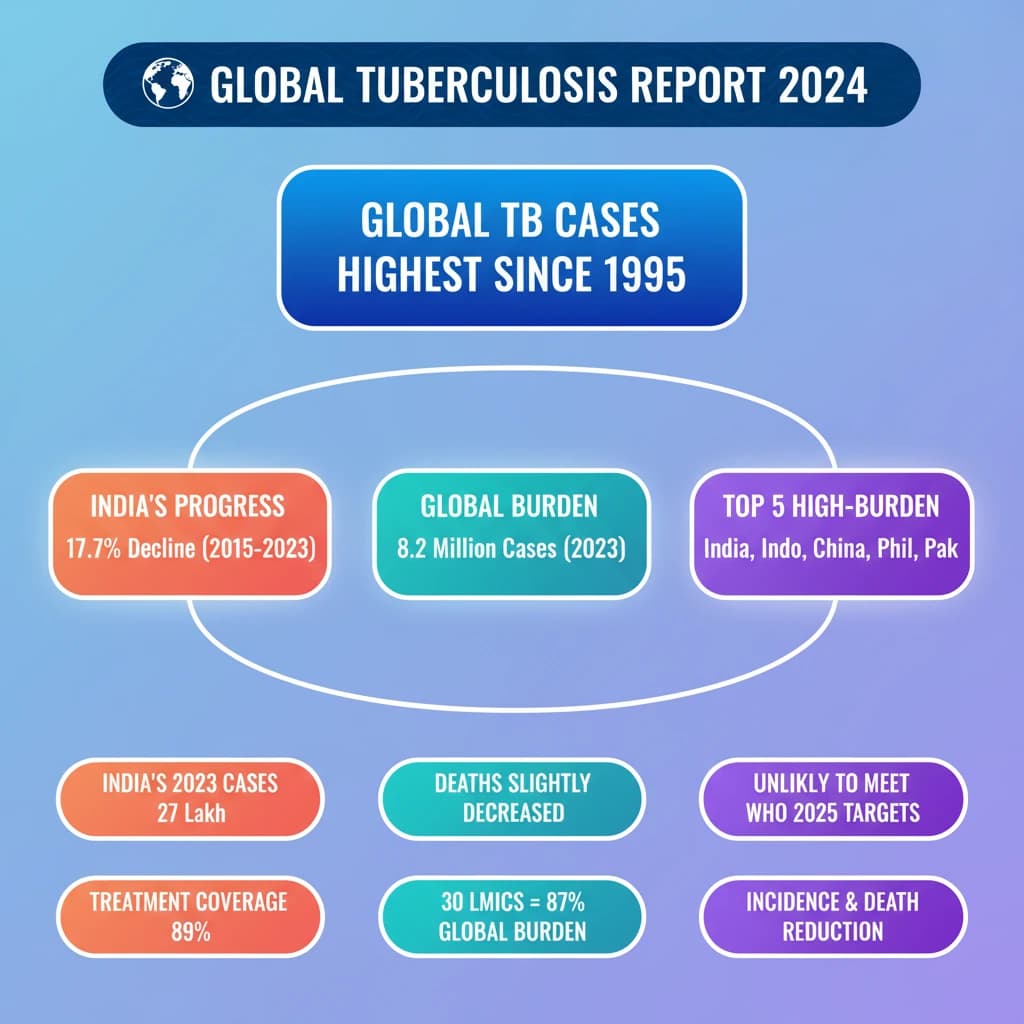
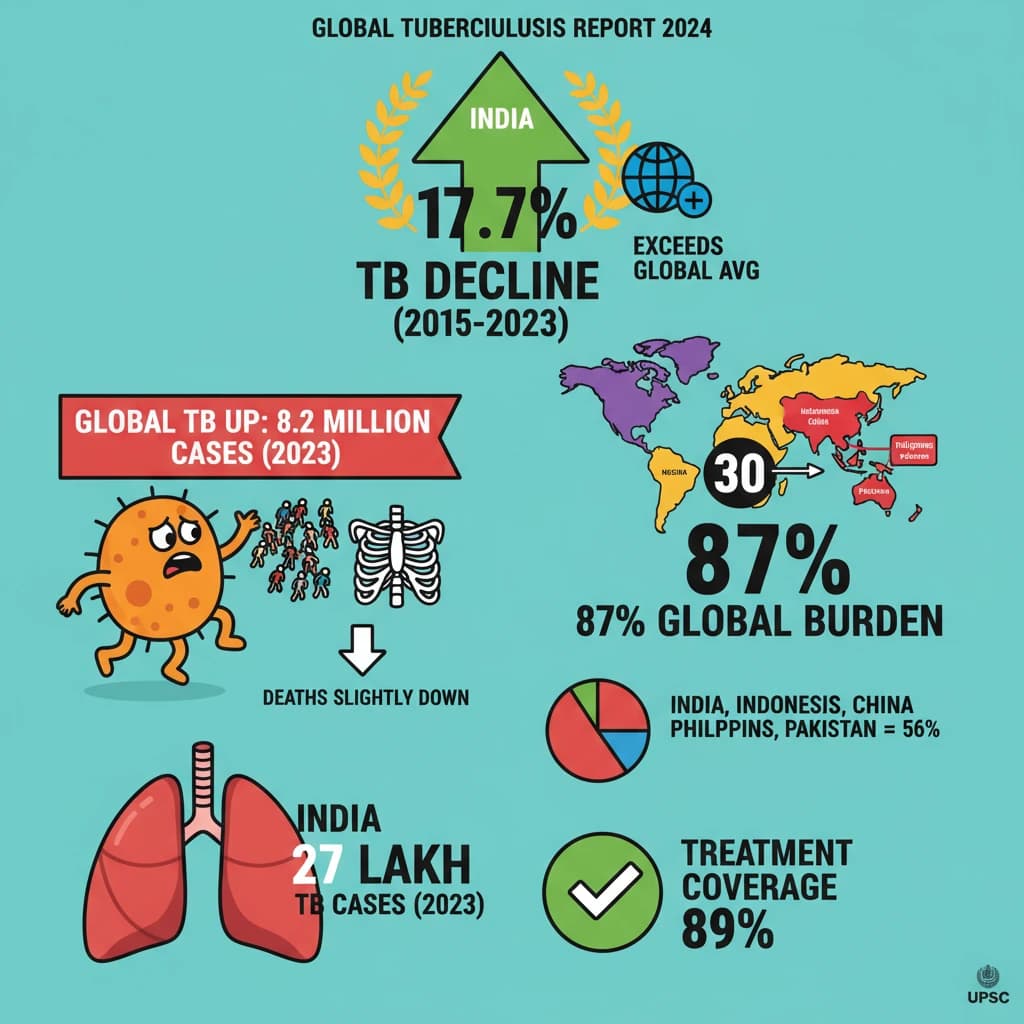
<h4>Introduction to the Global Tuberculosis Report 2024</h4><p>The <strong>WHO Global Tuberculosis Report 2024</strong> provides a crucial update on the global and national fight against <strong>Tuberculosis (TB)</strong>. This report highlights key trends, challenges, and progress in TB elimination efforts worldwide.</p><p>India's performance is a significant focus, showcasing both achievements and areas requiring intensified efforts to meet elimination targets.</p><h4>India's Progress in TB Incidence Decline</h4><p>According to the <strong>WHO Global Tuberculosis Report 2024</strong>, India has demonstrated a remarkable decline in <strong>TB incidence</strong>. From <strong>2015 to 2023</strong>, India achieved a <strong>17.7% reduction</strong> in TB cases.</p><div class='info-box'><p>This decline significantly <strong>exceeds the global average of 8.3%</strong> for the same period. It underscores India's dedication to its <strong>National Tuberculosis Elimination Programme (NTEP)</strong> and the ambitious goal of eliminating TB by <strong>2025</strong>.</p></div><h4>Global TB Incidence Trends in 2023</h4><p>The report reveals a concerning increase in new TB cases globally. In <strong>2023</strong>, approximately <strong>8.2 million new TB cases</strong> were reported, a rise from <strong>7.5 million in 2022</strong>.</p><div class='info-box'><p>This figure marks the <strong>highest number recorded by WHO since 1995</strong>, indicating a persistent global challenge in controlling the disease.</p></div><p>Despite the rise in incidence, there was a slight decrease in TB-related deaths. An estimated <strong>1.25 million TB deaths</strong> were recorded in <strong>2023</strong>, a marginal reduction from <strong>1.32 million in 2022</strong>.</p><h4>Demographics of Global TB Cases</h4><p>The burden of TB is disproportionately concentrated in certain regions and populations. <strong>Low- and middle-income countries (LMICs)</strong> bear the brunt, accounting for <strong>87% of the global TB burden</strong>.</p><div class='info-box'><p>A significant portion of global TB cases originates from just a few countries:</p><ul><li><strong>India: 26%</strong></li><li><strong>Indonesia: 10%</strong></li><li><strong>China: 6.8%</strong></li><li><strong>Philippines: 6.8%</strong></li><li><strong>Pakistan: 6.3%</strong></li></ul><p>These five nations collectively contribute <strong>56% of the global TB burden</strong>.</p></div><p>The report also details the distribution of TB cases by gender and age: <strong>55%</strong> of cases occurred in <strong>men</strong>, <strong>33%</strong> in <strong>women</strong>, and <strong>12%</strong> in <strong>children and young adolescents</strong>.</p><h4>India's Specific TB Scenario in 2023</h4><p>In <strong>2023</strong>, India recorded an estimated <strong>27 lakh TB cases</strong>. Out of these, <strong>25.1 lakh individuals</strong> were successfully diagnosed and initiated treatment, reflecting improved case detection.</p><div class='info-box'><p>India's TB incidence rate saw a notable reduction from <strong>237 cases per lakh population in 2015</strong> to <strong>195 per lakh in 2023</strong>, confirming the <strong>17.7% decline</strong> over this period.</p></div><p><strong>Treatment coverage</strong> in India significantly improved, rising from <strong>72% in 2015 to 89% in 2023</strong>. This expansion has been crucial in reducing the number of undiagnosed or untreated cases.</p><h4>WHO End TB Strategy Goals and India's Position</h4><p>The <strong>WHO's End TB Strategy</strong> sets ambitious post-2015 milestones: a <strong>75% reduction in TB deaths</strong> and a <strong>50% reduction in incidence</strong> from 2015 levels by 2025.</p><div class='key-point-box'><p>The <strong>Global TB Report 2024</strong> indicates that India is currently <strong>unlikely to eliminate TB by its 2025 target</strong>. The country is falling short of these critical WHO milestones.</p></div><p>Current progress suggests India will not achieve the specific targets of reducing TB deaths to <strong>7 per 1,00,000 population</strong> and incidence to <strong>118.5 per 1,00,000 population</strong> by <strong>2025</strong>.</p><h4>Understanding Tuberculosis (TB)</h4><p><strong>Tuberculosis (TB)</strong> is a serious infectious disease primarily caused by the bacterium <strong><em>Mycobacterium tuberculosis</em></strong>. It most commonly affects the <strong>lungs</strong>, but can also impact other parts of the body.</p><div class='info-box'><p><strong>Transmission:</strong> TB spreads from person to person through the <strong>air</strong>. When individuals with lung TB cough, sneeze, or spit, they release tiny droplets containing TB germs, which can then be inhaled by others.</p></div><p><strong>Symptoms:</strong> Common symptoms include a persistent <strong>cough with sputum</strong> (sometimes blood), <strong>chest pains</strong>, general <strong>weakness</strong>, unexplained <strong>weight loss</strong>, persistent <strong>fever</strong>, and drenching <strong>night sweats</strong>.</p><p><strong>Treatment:</strong> TB is both a <strong>treatable and curable disease</strong>. The standard treatment involves a <strong>6-month course of antimicrobial drugs</strong>. This treatment is typically provided with supervision and support from a health worker or trained volunteer to ensure adherence.</p><h4>Drug-Resistant Tuberculosis</h4><p>Over decades, strains of TB bacteria have developed resistance to one or more anti-TB medicines. This poses a significant challenge to global TB control.</p><div class='info-box'><p><strong>Multidrug-resistant tuberculosis (MDR-TB):</strong> This form of TB is caused by bacteria that do not respond to the two most powerful first-line anti-TB drugs: <strong>isoniazid</strong> and <strong>rifampicin</strong>. MDR-TB is treatable and curable using second-line drugs.</p></div><div class='key-point-box'><p><strong>India holds 27% of the global burden of MDR-TB</strong>, highlighting a critical area for intervention and advanced treatment strategies.</p></div><p><strong>Extensively drug-resistant TB (XDR-TB):</strong> This is a more severe form of MDR-TB. It is caused by bacteria that are resistant not only to first-line drugs but also to the most effective second-line anti-TB drugs. XDR-TB often leaves patients with very limited or no further treatment options, making it extremely challenging to cure.</p><h4>Initiatives Mentioned in Source Material (Note: These are Polio-related)</h4><p>The provided source material, within the context of the Global Tuberculosis Report, also listed several initiatives related to <strong>Polio Eradication</strong>. While not directly pertaining to TB, they highlight India's broader public health efforts.</p><ul><li><strong>Pulse Polio Programme</strong></li><li><strong>Intensified Mission Indradhanush 2.0</strong></li><li><strong>Polio Eradication and Endgame Strategic Plan 2013-2018</strong></li><li><strong>World Polio Day (24th October)</strong></li><li><strong>Global Polio Eradication Initiative (GPEI)</strong></li></ul>