Loading page, please wait…
Vaidra Logo
Vaidra

Top 4 items + smart groups

UPSC GPT
New
Current Affairs
Daily Solutions
Daily Puzzle
Mains Evaluator

Version 2.0.0 • Built with ❤️ for UPSC aspirants

Loading...
Loading...
Loading...
Loading...
Loading...
Loading...
Loading...
Loading...
Loading...
Loading...
Loading...
Loading...
Loading...
Back
All Subjects

Topics

0 topics • 0 completed

Loading topics...
Loading...
Loading...
Loading...
Loading...
Loading...
Overall Progress0%
What are the Highlights of the Survey? - UPSC Social Issues

What are the Highlights of the Survey? - UPSC Social Issues

What is What are the Highlights of the Survey? in UPSC Social Issues?

What are the Highlights of the Survey? is a key topic under Social Issues for UPSC Civil Services Examination. Key points include: Indra Sawhney (1992) initially barred reservation in promotions and introduced creamy layer for OBCs.. 85th Amendment (2001) enabled consequential seniority for SC/STs in promotions, retroactive to 1995.. M. Nagaraj (2006) partially overturned Indra Sawhney, allowing conditional reservation in promotions for SC/STs.. Understanding this topic is essential for both UPSC Prelims and Mains preparation.

Why is What are the Highlights of the Survey? important for UPSC exam?

What are the Highlights of the Survey? is a Medium-level topic in UPSC Social Issues. It is tested in both Prelims (factual MCQs) and Mains (analytical answer writing). Previous year UPSC questions have frequently covered aspects of What are the Highlights of the Survey?, making it essential for comprehensive IAS preparation.

How to prepare What are the Highlights of the Survey? for UPSC?

To prepare What are the Highlights of the Survey? for UPSC: (1) Study the comprehensive notes covering all key concepts on Vaidra. (2) Practice previous year questions on this topic. (3) Connect it with current affairs using daily updates. (4) Revise using key takeaways and mind maps available for Social Issues. (5) Write practice answers linking What are the Highlights of the Survey? to related GS Paper topics.

Key takeaways of What are the Highlights of the Survey? for UPSC

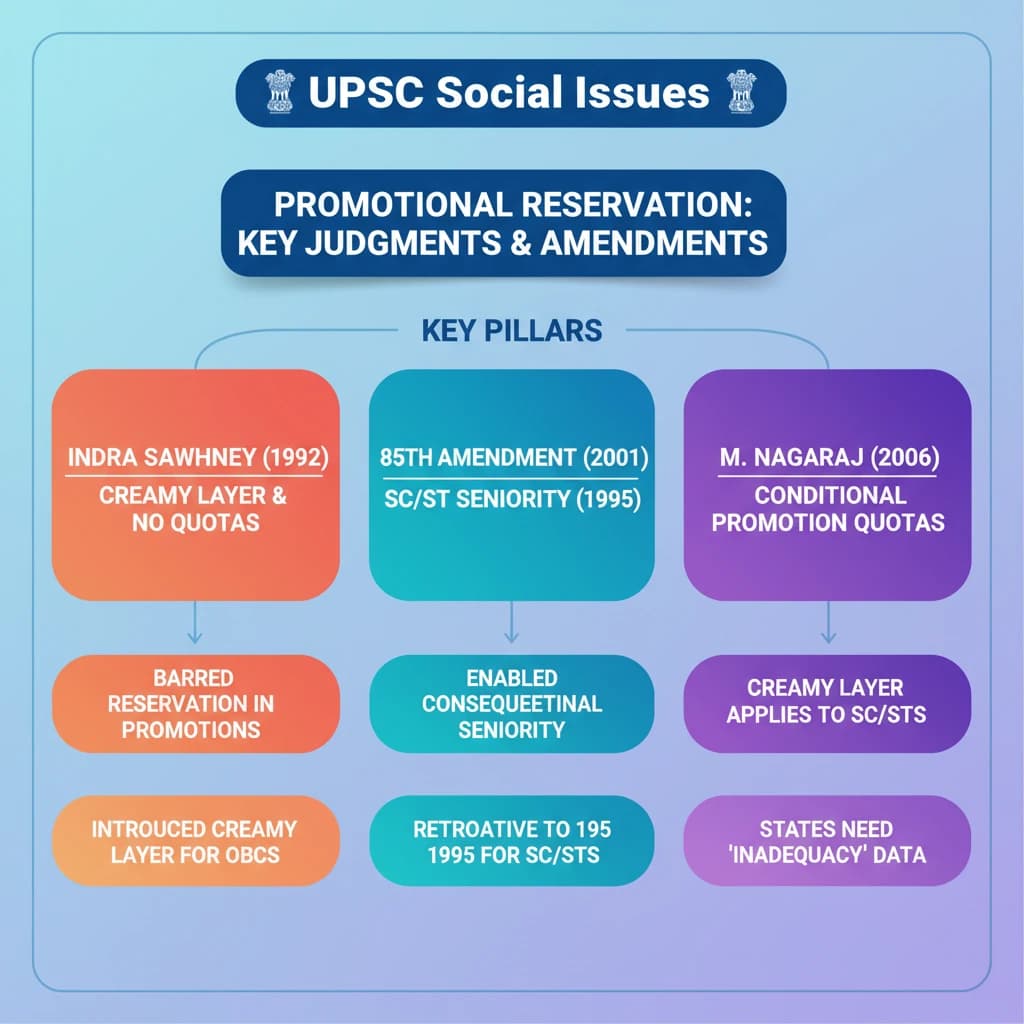
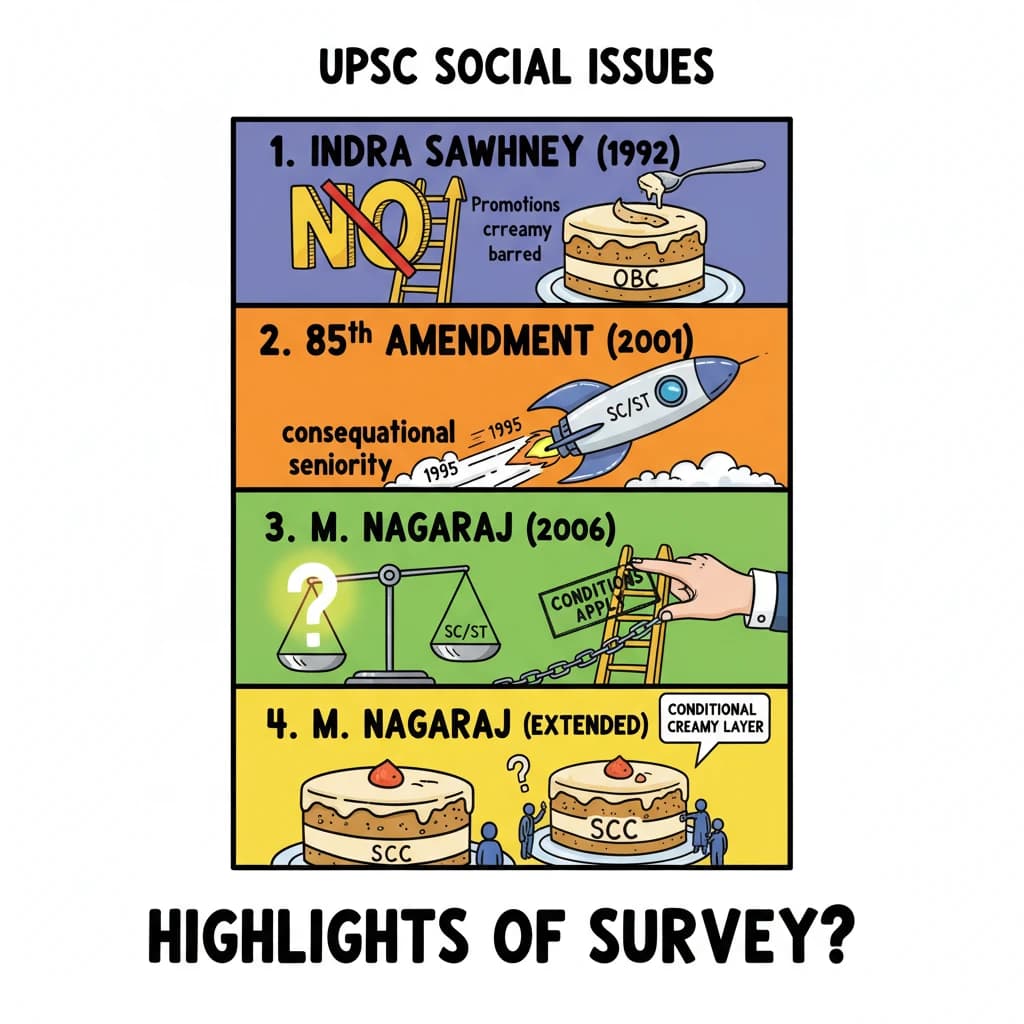
  • Indra Sawhney (1992) initially barred reservation in promotions and introduced creamy layer for OBCs.
  • 85th Amendment (2001) enabled consequential seniority for SC/STs in promotions, retroactive to 1995.
  • M. Nagaraj (2006) partially overturned Indra Sawhney, allowing conditional reservation in promotions for SC/STs.
  • M. Nagaraj extended creamy layer concept conditionally to SC/STs for promotions.
  • States must provide quantifiable data on 'inadequacy of representation' for SC/STs to implement promotional reservations.
What are the Highlights of the Survey?

What are the Highlights of the Survey?

Medium⏱️ 8 min read✓ 95% Verified
social issues

📖 Introduction

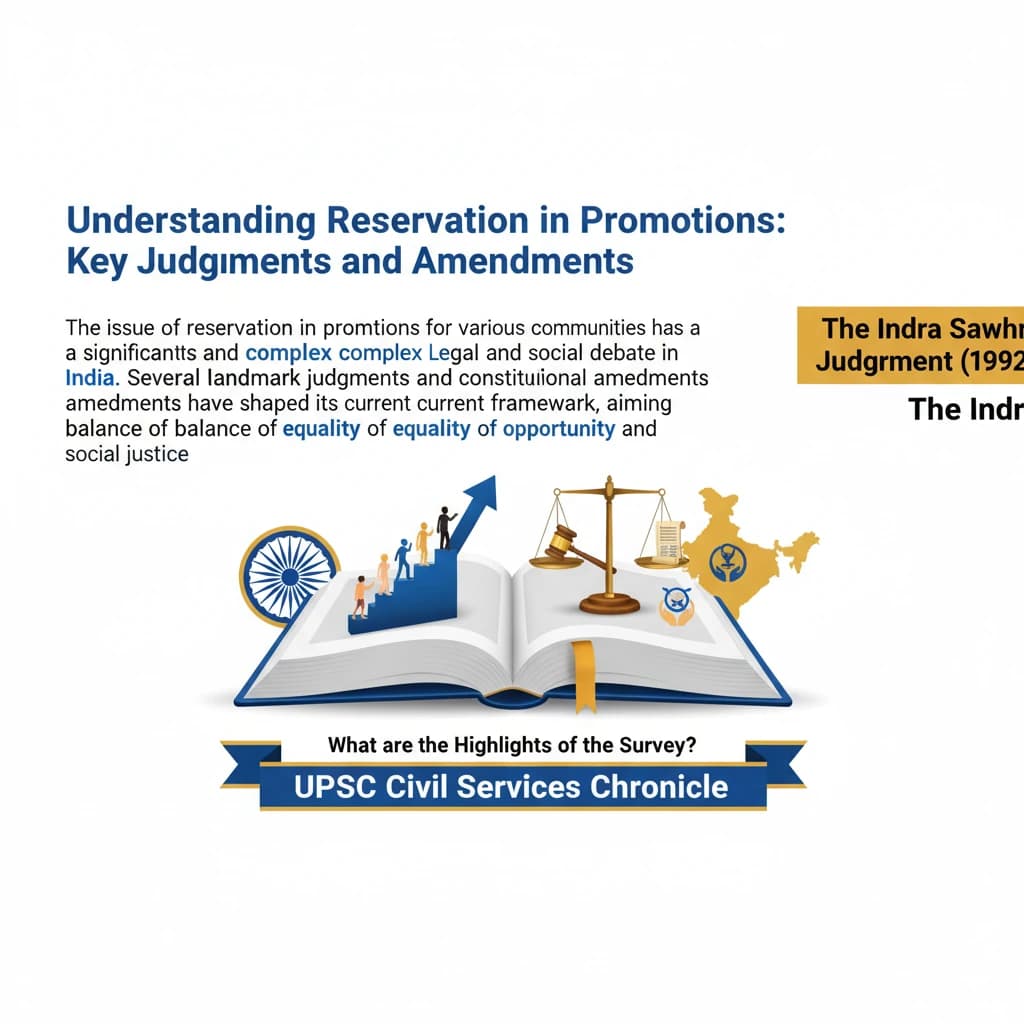
<h4>Understanding Reservation in Promotions: Key Judgments and Amendments</h4><p>The issue of <strong>reservation in promotions</strong> for various communities has been a significant and complex legal and social debate in India. Several landmark judgments and constitutional amendments have shaped its current framework, aiming to balance the principles of <strong>equality of opportunity</strong> and <strong>social justice</strong>.</p><h4>The Indra Sawhney Judgment (1992)</h4><p>The <strong>Indra Sawhney v. Union of India</strong> case, popularly known as the <strong>Mandal Commission case</strong>, was a pivotal moment in India's reservation policy. A <strong>9-judge bench</strong> delivered this landmark judgment.</p><div class='info-box'><p>The judgment held that <strong>Article 16(4)</strong> of the Constitution, which allows reservation in appointments, <strong>does not extend to promotions</strong>. This was a critical ruling that initially restricted reservations only to initial appointments.</p></div><p>The court affirmed the validity of the <strong>carry forward rule</strong> for unfilled reserved vacancies but stipulated that it must remain subject to the overall <strong>50% ceiling</strong> on reservations. This ensured that reservations do not exceed a reasonable proportion.</p><div class='key-point-box'><p>A significant clarification was made regarding the relationship between <strong>Article 16(1)</strong> and <strong>Article 16(4)</strong>. The court stated that <strong>Article 16(1)</strong>, guaranteeing <strong>equality of opportunity</strong>, is a <strong>fundamental right</strong>, while <strong>Article 16(4)</strong> is merely an <strong>enabling provision</strong> and not a separate rule overriding 16(1).</p></div><div class='info-box'><p><strong>Article 16(1):</strong> "It states that there shall be <strong>equality of opportunity</strong> for all citizens in matters relating to employment or appointment to any office under the State."</p></div><p>Furthermore, the judgment directed the exclusion of the <strong>Creamy Layer</strong> (economically well-off) from <strong>Other Backward Classes (OBCs)</strong> from receiving reservation benefits. This aimed to ensure that the benefits reach the most deserving within the backward classes.</p><p>However, the court specifically excluded <strong>Scheduled Castes (SCs)</strong> and <strong>Scheduled Tribes (STs)</strong> from the application of this <strong>creamy layer concept</strong> at that time.</p><h4>The 85th Amendment Act (2001)</h4><p>To address the implications of the <strong>Indra Sawhney judgment</strong>, particularly concerning promotions, the Parliament enacted the <strong>85th Amendment Act</strong> in <strong>2001</strong>.</p><div class='info-box'><p>This amendment introduced the concept of <strong>consequential seniority</strong> for <strong>SC/ST candidates</strong> promoted through reservations. It allowed these candidates to retain their seniority over general category candidates who might have been senior to them in the feeder cadre but were promoted later.</p></div><p>The amendment applied retroactively, effective from <strong>June 1995</strong>, meaning its provisions could be applied to promotions made after that date.</p><div class='info-box'><p><strong>Consequential Seniority:</strong> Refers to the concept of granting seniority to government servants belonging to <strong>SC</strong> and <strong>ST</strong> in cases of promotion through reservation rules.</p></div><h4>M. Nagaraj Judgment (2006)</h4><p>The <strong>M. Nagaraj v. Union of India</strong> judgment in <strong>2006</strong> was another significant ruling that revisited the issue of reservation in promotions, particularly after the <strong>85th Amendment</strong>.</p><div class='key-point-box'><p>This judgment partially overturned the <strong>Indra Sawhney judgment</strong> by allowing states to provide reservations in promotions for <strong>SCs/STs</strong>, but with certain conditions.</p></div><p>Crucially, the <strong>M. Nagaraj judgment</strong> introduced a conditional extension of the <strong>"creamy layer" concept</strong> to <strong>SC/ST communities</strong> seeking promotions in government jobs. This concept was previously applied only to <strong>Other Backward Classes (OBCs)</strong>.</p><p>The judgment laid down <strong>three conditions</strong> to allow states to provide reservations in promotions for <strong>SCs/STs</strong>. The first condition explicitly mentioned is:</p><ul><li><strong>Inadequacy of Representation:</strong> The state must demonstrate that <strong>SCs/STs</strong> are inadequately represented in promotions within the public services.</li></ul><div class='exam-tip-box'><p>Understanding the evolution of reservation policy through these judgments and amendments is crucial for <strong>UPSC Mains GS Paper II (Polity & Governance)</strong>. Focus on the core principles, the changes introduced, and the conditions laid down by the Supreme Court.</p></div>
Concept Diagram

💡 Key Takeaways

  • •Indra Sawhney (1992) initially barred reservation in promotions and introduced creamy layer for OBCs.
  • •85th Amendment (2001) enabled consequential seniority for SC/STs in promotions, retroactive to 1995.
  • •M. Nagaraj (2006) partially overturned Indra Sawhney, allowing conditional reservation in promotions for SC/STs.
  • •M. Nagaraj extended creamy layer concept conditionally to SC/STs for promotions.
  • •States must provide quantifiable data on 'inadequacy of representation' for SC/STs to implement promotional reservations.

🧠 Memory Techniques
Memory Aid
95% Verified Content

Related Topics

Loading related topics...
Explore:Social Issues Topics·All Subjects·Daily Current Affairs·Editorial Analysis·Previous Year Questions·UPSC GPT