Loading page, please wait…
Constitutional & Statutory Safeguards for Vulnerable Sections - UPSC Social Issues
What is Constitutional & Statutory Safeguards for Vulnerable Sections in UPSC Social Issues?
Constitutional & Statutory Safeguards for Vulnerable Sections is a key topic under Social Issues for UPSC Civil Services Examination. Key points include: Article 340: President appoints commission for backward classes (investigate & recommend).. Article 341: President specifies Scheduled Castes (Parliament amends list).. Article 342: President specifies Scheduled Tribes (Parliament amends list).. Understanding this topic is essential for both UPSC Prelims and Mains preparation.
Why is Constitutional & Statutory Safeguards for Vulnerable Sections important for UPSC exam?
Constitutional & Statutory Safeguards for Vulnerable Sections is a Medium-level topic in UPSC Social Issues. It is tested in both Prelims (factual MCQs) and Mains (analytical answer writing). Previous year UPSC questions have frequently covered aspects of Constitutional & Statutory Safeguards for Vulnerable Sections, making it essential for comprehensive IAS preparation.
How to prepare Constitutional & Statutory Safeguards for Vulnerable Sections for UPSC?
To prepare Constitutional & Statutory Safeguards for Vulnerable Sections for UPSC: (1) Study the comprehensive notes covering all key concepts on Vaidra. (2) Practice previous year questions on this topic. (3) Connect it with current affairs using daily updates. (4) Revise using key takeaways and mind maps available for Social Issues. (5) Write practice answers linking Constitutional & Statutory Safeguards for Vulnerable Sections to related GS Paper topics.
Key takeaways of Constitutional & Statutory Safeguards for Vulnerable Sections for UPSC
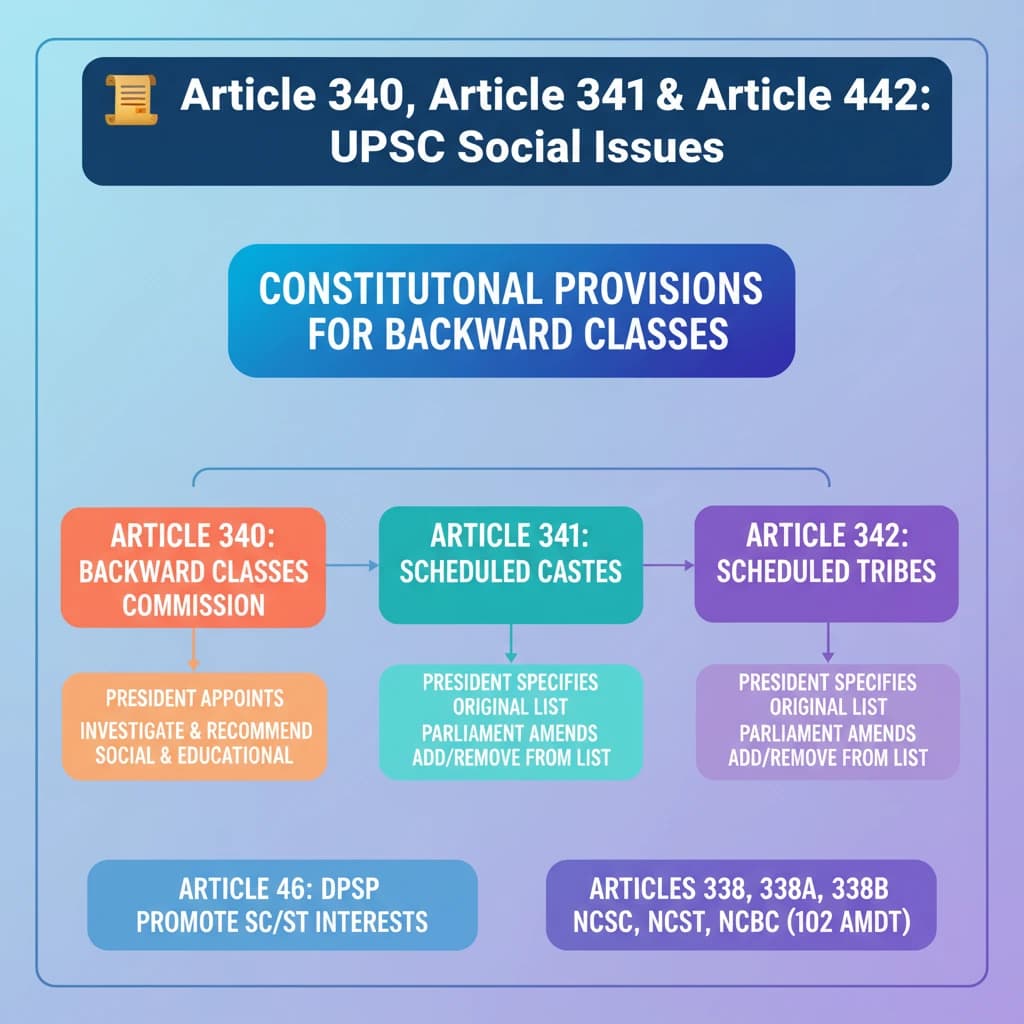
- Article 340: President appoints commission for backward classes (investigate & recommend).
- Article 341: President specifies Scheduled Castes (Parliament amends list).
- Article 342: President specifies Scheduled Tribes (Parliament amends list).
- Article 46: DPSP directing State to promote educational/economic interests of SCs, STs, and weaker sections.
- Articles 338, 338A, 338B: Establish NCSC, NCST, and NCBC (102nd Amendment) respectively.
- Fifth & Sixth Schedules: Special administration for ST areas.
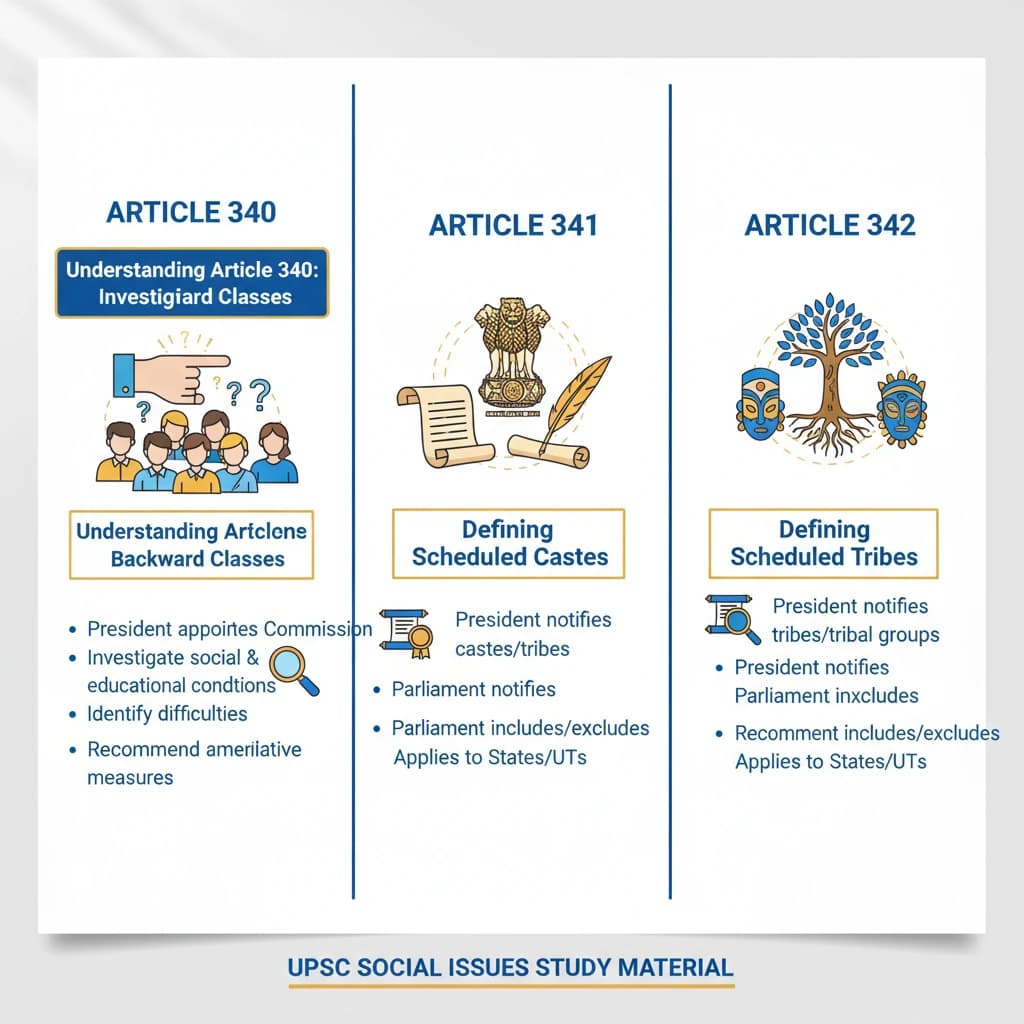
Constitutional & Statutory Safeguards for Vulnerable Sections
Medium⏱️ 6 min read
social issues
📖 Introduction
Understanding Article 340: Investigating Backward Classes
Article 340 of the Indian Constitution grants the President of India the authority to appoint a commission. This commission's primary role is to investigate the conditions of socially and educationally backward classes.
The commission is tasked with identifying the difficulties faced by these groups. Furthermore, it is mandated to recommend specific welfare measures and steps for their upliftment and progress.
Key Power: President appoints a commission for backward classes.
Core Function: Investigate conditions and recommend welfare measures.
Article 341: Specifying Scheduled Castes (SCs)
Article 341 empowers the President to specify which castes, races, or tribes, or parts of or groups within castes, races, or tribes, shall be deemed to be Scheduled Castes.
This specification is done for any particular state or union territory. Once specified by the President, these lists can only be altered by an Act of Parliament.
Presidential Prerogative: The President initially determines the list of Scheduled Castes.
Legislative Control: Parliament holds the power to amend the SC list.
Article 342: Specifying Scheduled Tribes (STs)
Similar to Article 341, Article 342 grants the President the power to specify which tribes or tribal communities, or parts of or groups within tribes or tribal communities, shall be deemed to be Scheduled Tribes.
This specification is also applicable to any specific state or union territory. Like the SC list, the ST list, once notified, can only be modified through an Act of Parliament.
Parallel Power: President specifies Scheduled Tribes for states/UTs.
Parliamentary Authority: Only Parliament can change the ST list.
Article 46: Directive Principle for Weaker Sections
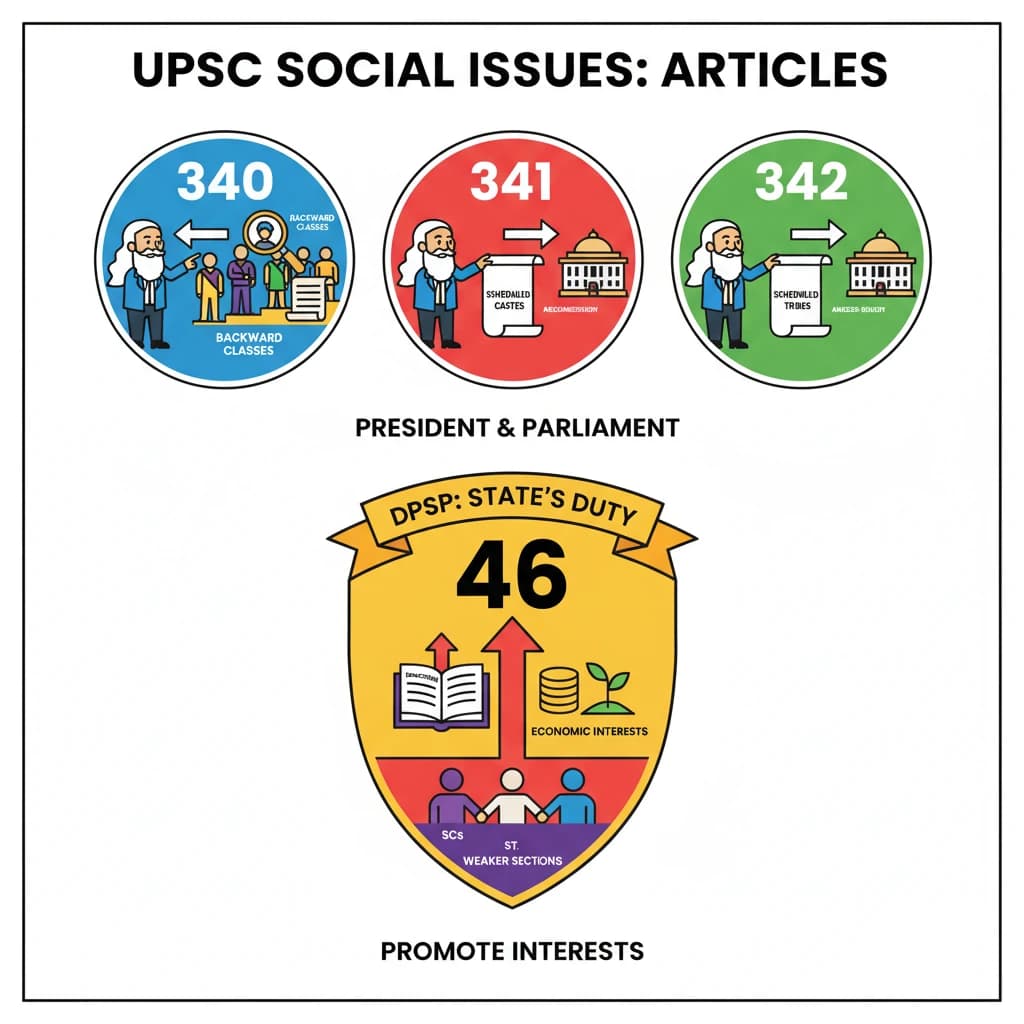
Article 46 is a Directive Principle of State Policy (DPSP). It directs the State to promote with special care the educational and economic interests of the Scheduled Castes, Scheduled Tribes, and other weaker sections of society.
This article also emphasizes the State's duty to protect these groups from social injustice and all forms of exploitation. It serves as a guiding principle for policy formulation.
UPSC Insight: Article 46 is a DPSP, highlighting the State's responsibility, while Articles 340-342 are specific powers related to identification.
Constitutional Bodies: NCSC, NCST, and NCBC
Article 338 establishes the National Commission for Scheduled Castes (NCSC), and Article 338A establishes the National Commission for Scheduled Tribes (NCST).
These commissions are constitutional bodies designed to safeguard the interests and rights of SCs and STs, respectively. They monitor the implementation of safeguards and inquire into specific complaints.
The National Commission for Backward Classes (NCBC) was established through the 102nd Constitutional Amendment Act of 2018. It is now a constitutional body under Article 338B.
NCSC: Article 338
NCST: Article 338A
NCBC: Article 338B (102nd Amendment, 2018)
Special Administration for Scheduled Tribes: Fifth and Sixth Schedules
The Constitution provides special administrative provisions for tribal areas to protect the unique culture and way of life of Scheduled Tribes.
The Fifth Schedule deals with the administration and control of Scheduled Areas and Scheduled Tribes in any state except Assam, Meghalaya, Tripura, and Mizoram.
The Sixth Schedule contains provisions for the administration of tribal areas in the states of Assam, Meghalaya, Tripura, and Mizoram, granting them significant autonomy through Autonomous District Councils.
💡 Key Takeaways
- •Article 340: President appoints commission for backward classes (investigate & recommend).
- •Article 341: President specifies Scheduled Castes (Parliament amends list).
- •Article 342: President specifies Scheduled Tribes (Parliament amends list).
- •Article 46: DPSP directing State to promote educational/economic interests of SCs, STs, and weaker sections.
- •Articles 338, 338A, 338B: Establish NCSC, NCST, and NCBC (102nd Amendment) respectively.
- •Fifth & Sixth Schedules: Special administration for ST areas.
🧠 Memory Techniques
98% Verified Content
📚 Reference Sources
•The Constitution of India (Bare Act)
•Laxmikanth's Indian Polity