Loading page, please wait…
Vaidra Logo
Vaidra

Top 4 items + smart groups

UPSC GPT
New
Current Affairs
Daily Solutions
Daily Puzzle
Mains Evaluator

Version 2.0.0 • Built with ❤️ for UPSC aspirants

Loading...
Loading...
Loading...
Loading...
Loading...
Loading...
Loading...
Loading...
Loading...
Loading...
Loading...
Loading...
Loading...
Back
All Subjects

Topics

0 topics • 0 completed

Loading topics...
Loading...
Loading...
Loading...
Loading...
Loading...
Overall Progress0%

Multidimensional Poverty Index: NITI Ayog - UPSC Social Issues

What is Multidimensional Poverty Index: NITI Ayog in UPSC Social Issues?

Multidimensional Poverty Index: NITI Ayog is a key topic under Social Issues for UPSC Civil Services Examination. Key points include: NITI Aayog's recent report highlights 24.82 crore people escaped multidimensional poverty in India (2013-14 to 2022-23).. The National MPI measures deprivations across Health, Education, and Standard of Living using 12 SDG-aligned indicators.. India's MPI methodology is based on the global Alkire-Foster method but includes 12 indicators compared to global MPI's 10.. Understanding this topic is essential for both UPSC Prelims and Mains preparation.

Why is Multidimensional Poverty Index: NITI Ayog important for UPSC exam?

Multidimensional Poverty Index: NITI Ayog is a Medium-level topic in UPSC Social Issues. It is tested in both Prelims (factual MCQs) and Mains (analytical answer writing). Previous year UPSC questions have frequently covered aspects of Multidimensional Poverty Index: NITI Ayog, making it essential for comprehensive IAS preparation.

How to prepare Multidimensional Poverty Index: NITI Ayog for UPSC?

To prepare Multidimensional Poverty Index: NITI Ayog for UPSC: (1) Study the comprehensive notes covering all key concepts on Vaidra. (2) Practice previous year questions on this topic. (3) Connect it with current affairs using daily updates. (4) Revise using key takeaways and mind maps available for Social Issues. (5) Write practice answers linking Multidimensional Poverty Index: NITI Ayog to related GS Paper topics.

Key takeaways of Multidimensional Poverty Index: NITI Ayog for UPSC

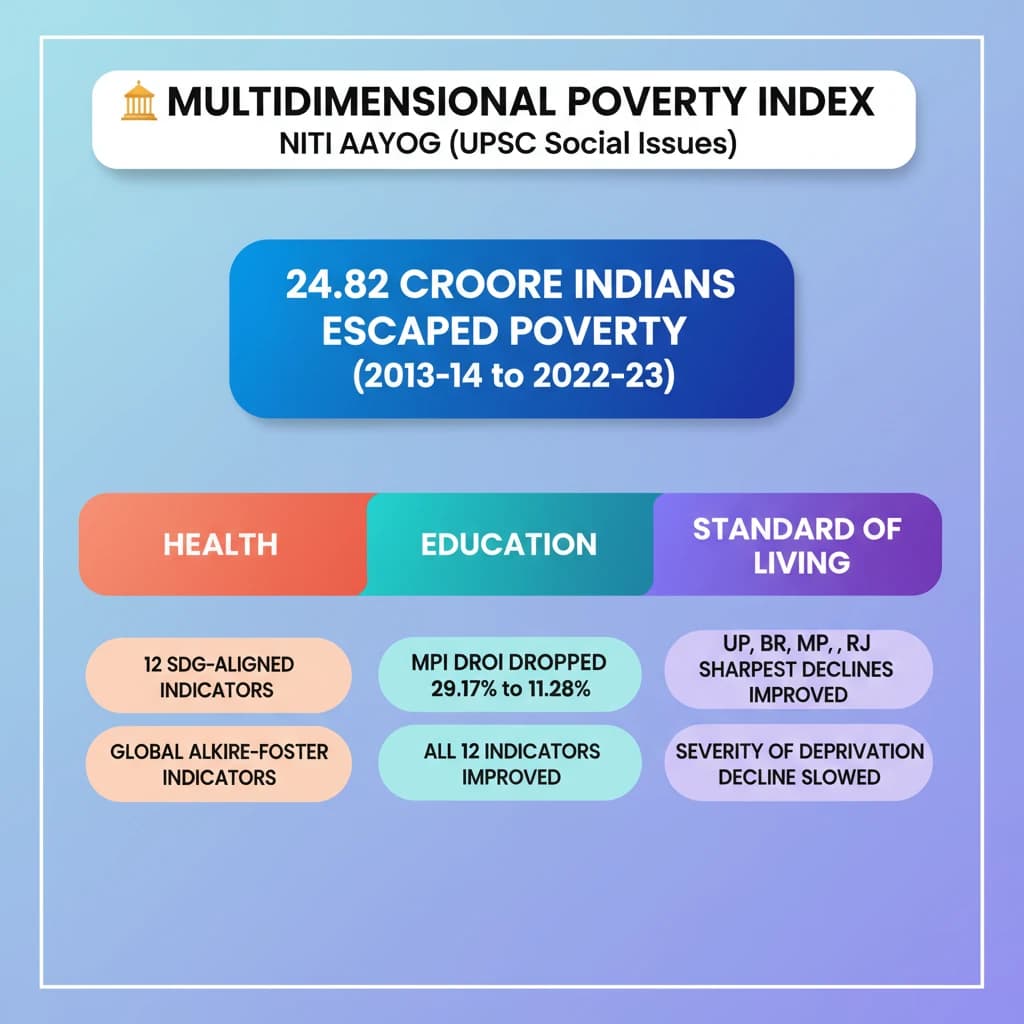
  • NITI Aayog's recent report highlights 24.82 crore people escaped multidimensional poverty in India (2013-14 to 2022-23).
  • The National MPI measures deprivations across Health, Education, and Standard of Living using 12 SDG-aligned indicators.
  • India's MPI methodology is based on the global Alkire-Foster method but includes 12 indicators compared to global MPI's 10.
  • Significant overall decline in MPI from 29.17% (2013-14) to 11.28% (2022-23), with Uttar Pradesh, Bihar, MP, and Rajasthan showing sharpest declines.
  • All 12 MPI indicators have shown improvement, but Severity of Deprivation (SoD) decline has slowed in recent years.
  • GDP growth alone is insufficient for reducing hunger/improving nutrition; pro-poor policies are crucial.
  • Key government initiatives like Poshan Abhiyan, PMGKAY, NFSA, and ICDS are vital in addressing multidimensional poverty.
Multidimensional Poverty Index: NITI Ayog

Multidimensional Poverty Index: NITI Ayog

Medium⏱️ 7 min read✓ 98% Verified
social issues

📖 Introduction

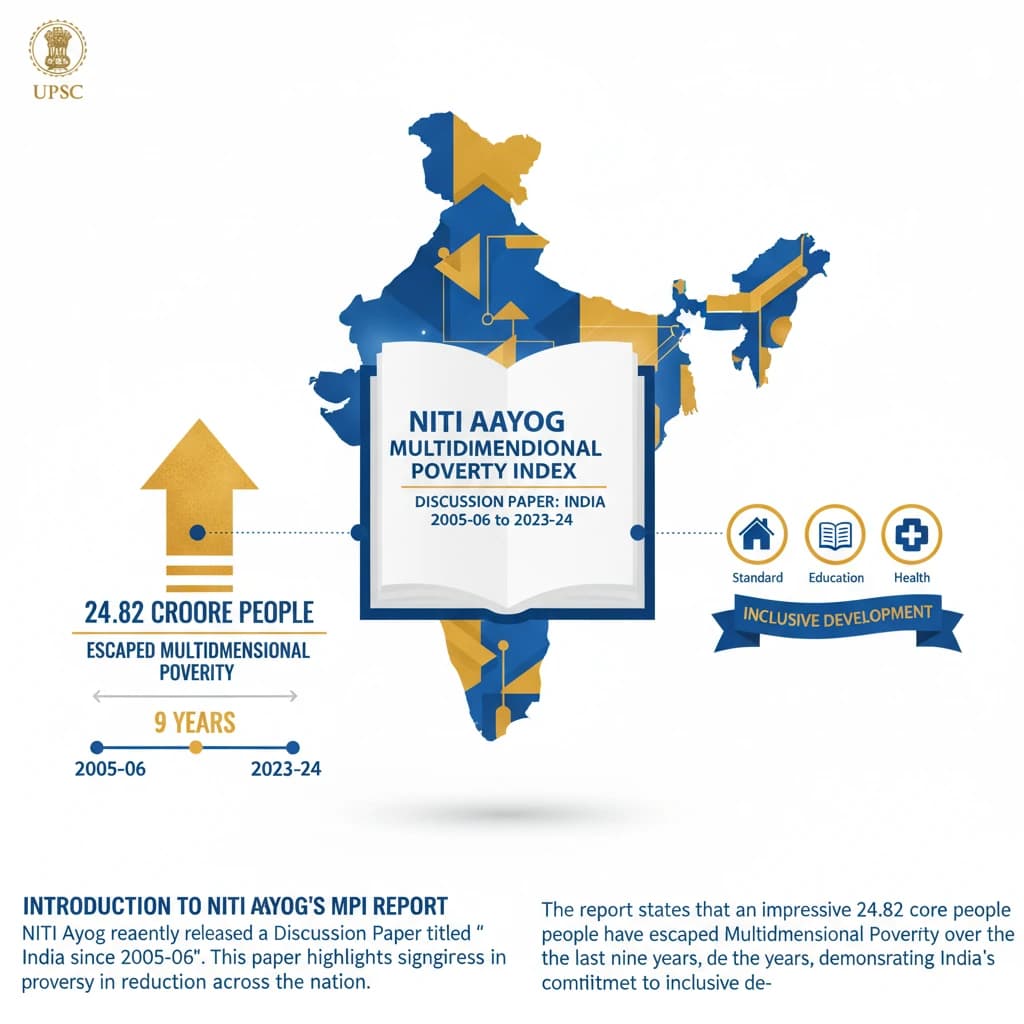
<h4>Introduction to NITI Aayog's MPI Report</h4><p>Recently, <strong>NITI Aayog</strong> released a <strong>Discussion Paper</strong> titled “<strong>Multidimensional Poverty in India since 2005-06</strong>”. This paper highlights significant progress in poverty reduction across the nation.</p><p>The report states that an impressive <strong>24.82 crore people</strong> have escaped <strong>Multidimensional Poverty</strong> over the last nine years, demonstrating India's commitment to inclusive development.</p><div class='info-box'><p><strong>Data Source:</strong> The discussion paper meticulously utilizes data from <strong>National Family Health Surveys (NFHS)</strong> conducted in <strong>2005-06</strong>, <strong>2015-16</strong>, and <strong>2019-21</strong> to analyze long-term poverty trends effectively.</p></div><h4>Understanding the National Multidimensional Poverty Index (MPI)</h4><p>The <strong>National Multidimensional Poverty Index (MPI)</strong> is a crucial tool designed to measure simultaneous deprivations faced by individuals. It moves beyond monetary income to capture a broader picture of poverty.</p><div class='key-point-box'><p>The <strong>National MPI</strong> measures deprivations across <strong>three equally weighted dimensions</strong>: <strong>Health</strong>, <strong>Education</strong>, and <strong>Standard of Living</strong>. These dimensions are aligned with the <strong>Sustainable Development Goals (SDGs)</strong>.</p></div><h4>Dimensions and Indicators of National MPI</h4><p>The three dimensions of the <strong>National MPI</strong> are represented by <strong>12 specific indicators</strong>, providing a comprehensive assessment of poverty. These indicators cover various aspects of human well-being.</p><ul><li><strong>Health Indicators:</strong> <strong>Nutrition</strong>, <strong>Child and Adolescent mortality</strong>, <strong>Maternal Health</strong>.</li><li><strong>Education Indicators:</strong> <strong>Years of schooling</strong>, <strong>School Attendance</strong>.</li><li><strong>Standard of Living Indicators:</strong> <strong>Cooking fuel</strong>, <strong>Sanitation</strong>, <strong>Drinking water</strong>, <strong>Electricity</strong>, <strong>Housing</strong>, <strong>Assets</strong>, and <strong>Bank Accounts</strong>.</li></ul><h4>Global MPI vs. National MPI</h4><p>The methodology for India's MPI is based on the robust <strong>Alkire and Foster (AF) method</strong>, which is globally recognized for identifying people as poor based on universally acknowledged metrics.</p><div class='info-box'><p>While the <strong>global MPI</strong> typically covers <strong>10 indicators</strong>, the <strong>National MPI</strong> in India expands this to include <strong>12 indicators</strong>, offering a more nuanced and context-specific assessment of poverty.</p></div><h4>Key Highlights of Multidimensional Poverty Index in India (2005-2023)</h4><p>India has achieved remarkable progress in reducing multidimensional poverty over the past decade, as highlighted by the NITI Aayog report.</p><h4>Overall Decline in Multidimensional Poverty</h4><p>The country has witnessed a significant reduction in <strong>multidimensional poverty</strong>, decreasing from <strong>29.17%</strong> in <strong>2013-14</strong> to <strong>11.28%</strong> in <strong>2022-23</strong>. This marks a substantial decline of <strong>17.89 percentage points</strong>.</p><p>This positive trend indicates that approximately <strong>24.82 crore people</strong> have successfully exited multidimensional poverty within this nine-year period (<strong>2013-14 to 2022-23</strong>), largely due to various government initiatives.</p><h4>State-wise Progress</h4><p>Several states have shown exceptional performance in reducing poverty. <strong>Uttar Pradesh</strong>, <strong>Bihar</strong>, <strong>Madhya Pradesh</strong>, and <strong>Rajasthan</strong> have recorded the sharpest declines in the number of people classified as poor.</p><ul><li><strong>Uttar Pradesh:</strong> Saw the largest decline, with <strong>5.94 crore people</strong> escaping multidimensional poverty.</li><li><strong>Bihar:</strong> Followed with <strong>3.77 crore people</strong> escaping poverty.</li><li><strong>Madhya Pradesh</strong> and <strong>Rajasthan:</strong> Also demonstrated significant reductions.</li></ul><h4>Improvement Across All Indicators</h4><p>The progress is comprehensive, with <strong>all 12 indicators</strong> of the <strong>MPI</strong> showing significant improvement. This reflects holistic progress across the <strong>Health</strong>, <strong>Education</strong>, and <strong>Standard of Living</strong> dimensions.</p><h4>Severity of Deprivation</h4><p>The <strong>Severity of Deprivation (SoD)</strong>, which measures the average deprivations suffered by multidimensionally poor individuals, also declined.</p><div class='info-box'><p>The <strong>SoD</strong> declined at a slightly lower rate between <strong>2015-16</strong> and <strong>2019-21</strong> compared to the earlier period of <strong>2005-06</strong> and <strong>2013-14</strong>, indicating that addressing the deepest forms of deprivation remains a challenge.</p></div><h4>Government Efforts and Policy Implications</h4><p>The report acknowledges India’s significant efforts to improve the food and nutrition landscape through various initiatives. These programs have played a vital role in poverty reduction.</p><div class='exam-tip-box'><p><strong>UPSC Insight:</strong> While <strong>GDP growth</strong> is important, the report highlights that it <strong>does not guarantee reduced hunger or improved nutrition</strong>. This underscores the critical need for <strong>pro-poor development policies</strong> and targeted interventions to address <strong>social and economic inequalities</strong>.</p></div>
Concept Diagram

💡 Key Takeaways

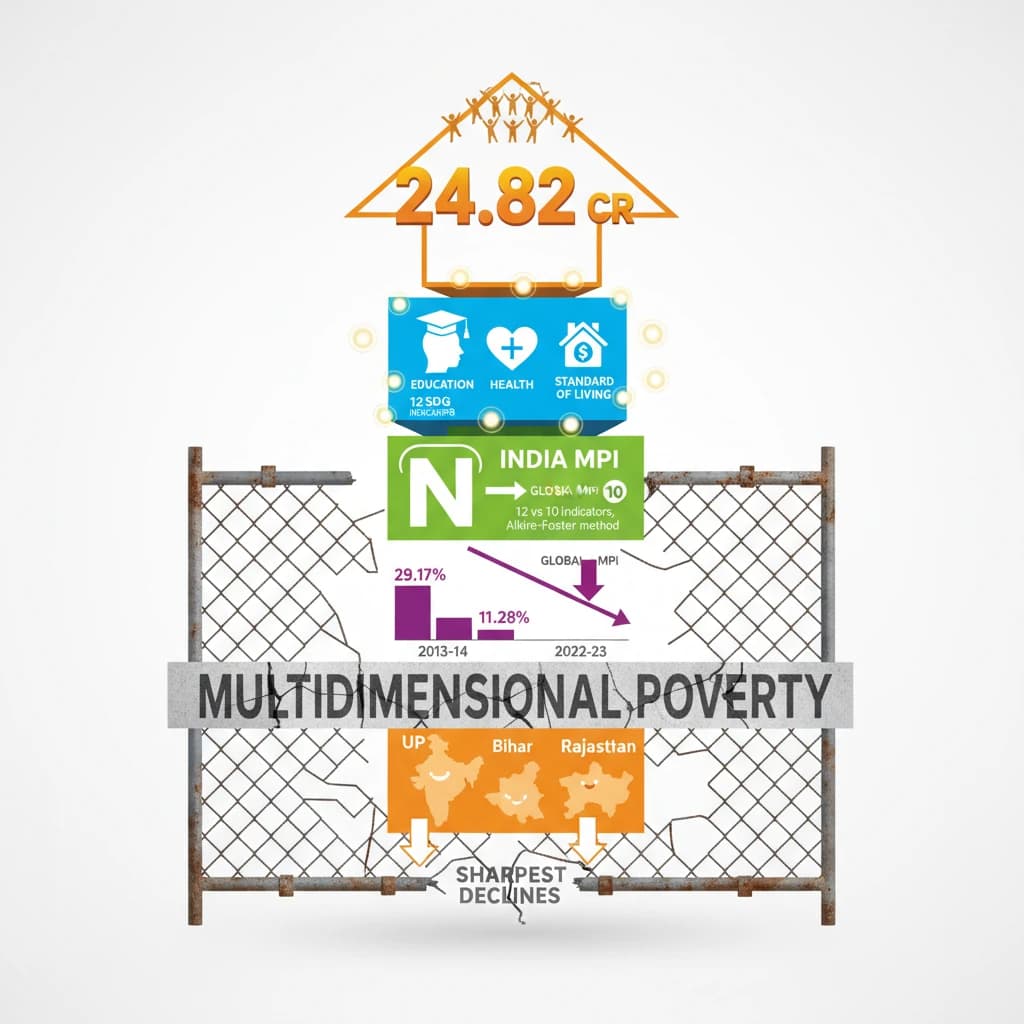
  • •NITI Aayog's recent report highlights 24.82 crore people escaped multidimensional poverty in India (2013-14 to 2022-23).
  • •The National MPI measures deprivations across Health, Education, and Standard of Living using 12 SDG-aligned indicators.
  • •India's MPI methodology is based on the global Alkire-Foster method but includes 12 indicators compared to global MPI's 10.
  • •Significant overall decline in MPI from 29.17% (2013-14) to 11.28% (2022-23), with Uttar Pradesh, Bihar, MP, and Rajasthan showing sharpest declines.
  • •All 12 MPI indicators have shown improvement, but Severity of Deprivation (SoD) decline has slowed in recent years.
  • •GDP growth alone is insufficient for reducing hunger/improving nutrition; pro-poor policies are crucial.
  • •Key government initiatives like Poshan Abhiyan, PMGKAY, NFSA, and ICDS are vital in addressing multidimensional poverty.

🧠 Memory Techniques
Memory Aid
98% Verified Content

📚 Reference Sources

•NITI Aayog Discussion Paper: 'Multidimensional Poverty in India since 2005-06'
•National Family Health Surveys (NFHS) data (2005-06, 2015-16, 2019-21)
•Official government reports and press releases related to Poshan Abhiyan, PMGKAY, NFSA, etc.

Related Topics

Loading related topics...
Explore:Social Issues Topics·All Subjects·Daily Current Affairs·Editorial Analysis·Previous Year Questions·UPSC GPT
Multidimensional Poverty Index: NITI Ayog - UPSC Social Issues