📖 Introduction
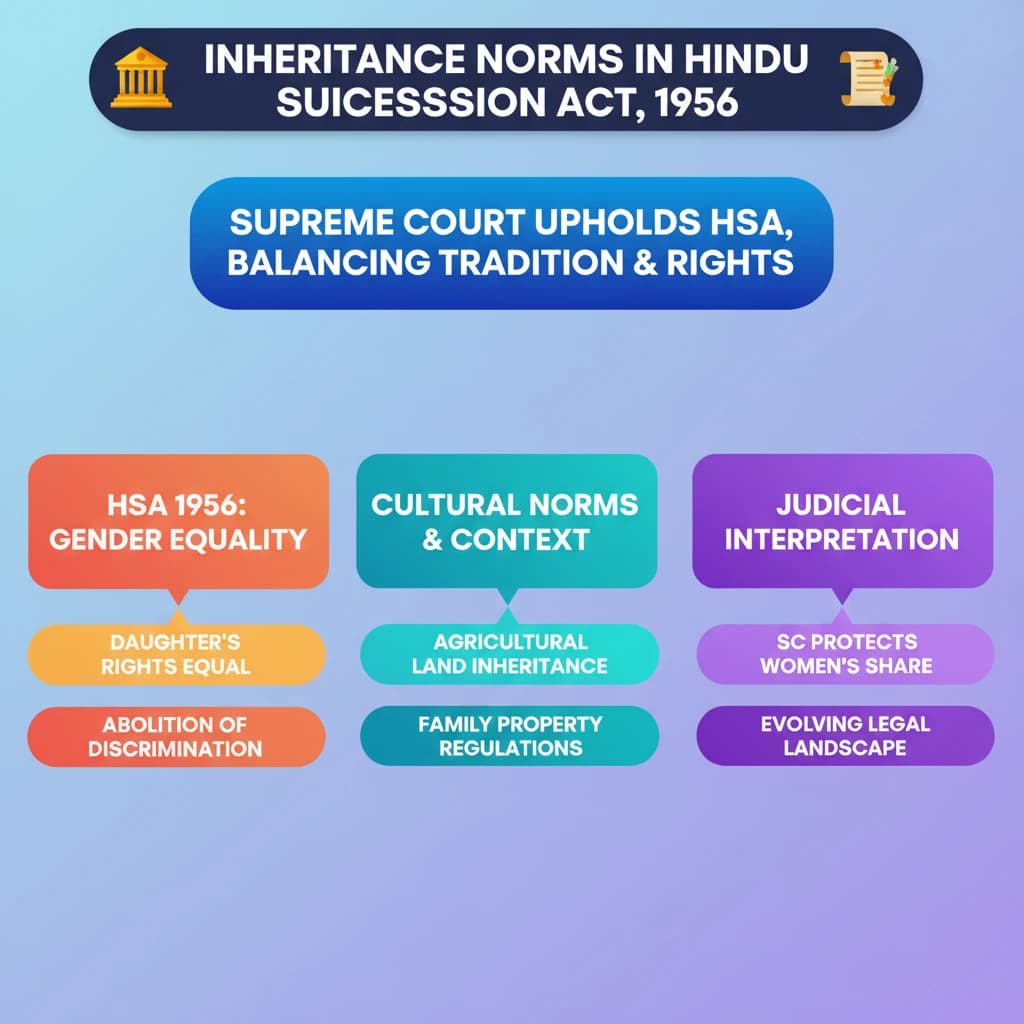
<h4>Introduction to Hindu Succession Act, 1956 and Recent Observations</h4><p>The <strong>Hindu Succession Act, 1956 (HSA)</strong> is a significant law governing the inheritance and succession of property among Hindus, Buddhists, Jains, and Sikhs in India. It aims to codify the law relating to intestate succession.</p><p>Recently, the <strong>Supreme Court</strong> upheld certain inheritance provisions under the <strong>HSA, 1956</strong>. The court's emphasis was on <strong>cultural norms</strong> and <strong>legislative consistency</strong>, rather than solely viewing inheritance through the lens of gender inequality.</p><div class='key-point-box'><p>Several <strong>petitions challenged</strong> the validity of these provisions. These challenges argued for more <strong>equitable treatment</strong> of men and women in inheritance matters, seeking to address perceived gender disparities.</p></div><h4>Supreme Court's Stance on Inheritance and Gender Justice</h4><p>The <strong>Supreme Court's judgment</strong> articulated a specific view on gender justice in this context. It highlighted that after marriage, a woman typically becomes an integral part of her <strong>husband’s family</strong>.</p><p>Consequently, the court observed that a married woman acquires corresponding <strong>rights to inheritance</strong> within her husband’s family. This perspective underpinned the court's decision to uphold the existing provisions.</p><div class='exam-tip-box'><p>UPSC candidates should note the distinction: the court's ruling did not frame inheritance primarily as a matter of <strong>gender equality</strong> in the traditional sense, but rather within the framework of familial integration post-marriage.</p></div><h4>Retroactive Application of Bail Provisions under BNSS</h4><p>In a separate significant ruling, the <strong>Supreme Court</strong> addressed the <strong>Bharatiya Nagarik Suraksha Sanhita (BNSS)</strong>. The court declared that the relaxed bail provisions introduced under <strong>BNSS</strong> would apply <strong>retrospectively</strong>.</p><p>This means these provisions are applicable to cases that were filed even before the official enactment of <strong>BNSS</strong>. This ruling aims to benefit undertrials whose cases predated the new law.</p><div class='info-box'><p><strong>Retrospective Application:</strong> Applying a new law or provision to events or cases that occurred before its enactment. This is a crucial principle in legal interpretation.</p></div><h4>Speedy Trial as a Fundamental Right</h4><p>The Supreme Court has consistently underscored the importance of <strong>speedy trial</strong>. It affirmed that a speedy trial is a <strong>fundamental right</strong> guaranteed under <strong>Article 21</strong> of the <strong>Constitution of India</strong>.</p><p>Any <strong>unjustified delay</strong> in the trial process could potentially lead to the granting of <strong>bail</strong>. This emphasizes the judiciary's commitment to protecting individual liberty and ensuring timely justice.</p><div class='key-point-box'><p><strong>Article 21:</strong> Guarantees the <strong>Right to Life and Personal Liberty</strong>. This broad right has been interpreted by the judiciary to include various aspects of human dignity and fair treatment, including speedy trial.</p></div><h4>Regulation of Prisons in India: Constitutional Provisions</h4><p>Prisons in India are regulated by a combination of constitutional provisions and specific legal frameworks. The <strong>Indian Constitution</strong> provides fundamental safeguards for prisoners' rights.</p><ul><li><strong>Article 21:</strong> Protects prisoners against <strong>torture</strong> and <strong>inhuman treatment</strong>. It also explicitly ensures <strong>timely trials</strong> for prisoners, reinforcing the right to speedy justice.</li><li><strong>Article 22:</strong> Mandates that an arrested person must be <strong>promptly informed</strong> of the reasons for their arrest. It also grants them the fundamental right to <strong>consult and be defended by a lawyer</strong> of their choice.</li><li><strong>Article 39A:</strong> Ensures the provision of <strong>free legal aid</strong>. This is crucial to ensure that justice is accessible to those who are unable to afford legal representation, promoting equality before the law.</li></ul><h4>Legal Framework for Prison Management</h4><p>India's prison system operates under a legal framework that has evolved over time, with some foundational laws dating back to the colonial era.</p><div class='info-box'><ul><li><strong>Prisons Act, 1894:</strong> This Act, enacted during <strong>British rule</strong>, serves as the primary and foundational legal framework for <strong>prison management</strong> in India.</li><li>It primarily focuses on the <strong>custody and discipline</strong> of prisoners. However, a key criticism is its lack of explicit provisions for <strong>rehabilitation and reform</strong>, reflecting its colonial origins.</li></ul></div><div class='info-box'><ul><li><strong>The Identification of Prisoners Act, 1920:</strong> This legislation governs the process for <strong>identifying prisoners</strong>. It also enables the collection of various forms of <strong>biometric data</strong> for record-keeping and investigative purposes.</li></ul></div><div class='info-box'><ul><li><strong>The Transfer of Prisoners Act, 1950:</strong> This Act provides comprehensive guidelines for the <strong>transfer of prisoners</strong>. It facilitates movement between different <strong>states and jurisdictions</strong> within India, ensuring legal and administrative protocols are followed.</li></ul></div><h4>Oversight Mechanism: Judicial Scrutiny of Prisons</h4><p>The <strong>Indian judiciary</strong> plays a vital and active role in overseeing prison conditions and safeguarding inmate rights. This oversight is primarily exercised through various legal mechanisms.</p><p><strong>Public Interest Litigations (PILs)</strong> are frequently used to bring attention to systemic issues within prisons. Additionally, specific cases directly address the rights and treatment of inmates, leading to landmark judgments.</p><div class='exam-tip-box'><p>A notable example is the <strong>Supreme Court's</strong> ruling in <strong>D.K. Basu vs. State of West Bengal (1997)</strong>. This judgment mandated strict protocols for <strong>arrest and detention</strong>, significantly impacting police procedures and protecting fundamental rights.</p></div>