Loading page, please wait…
Definitions: Manual Scavenging & Sanitation Workers - UPSC Social Issues
What is Definitions: Manual Scavenging & Sanitation Workers in UPSC Social Issues?
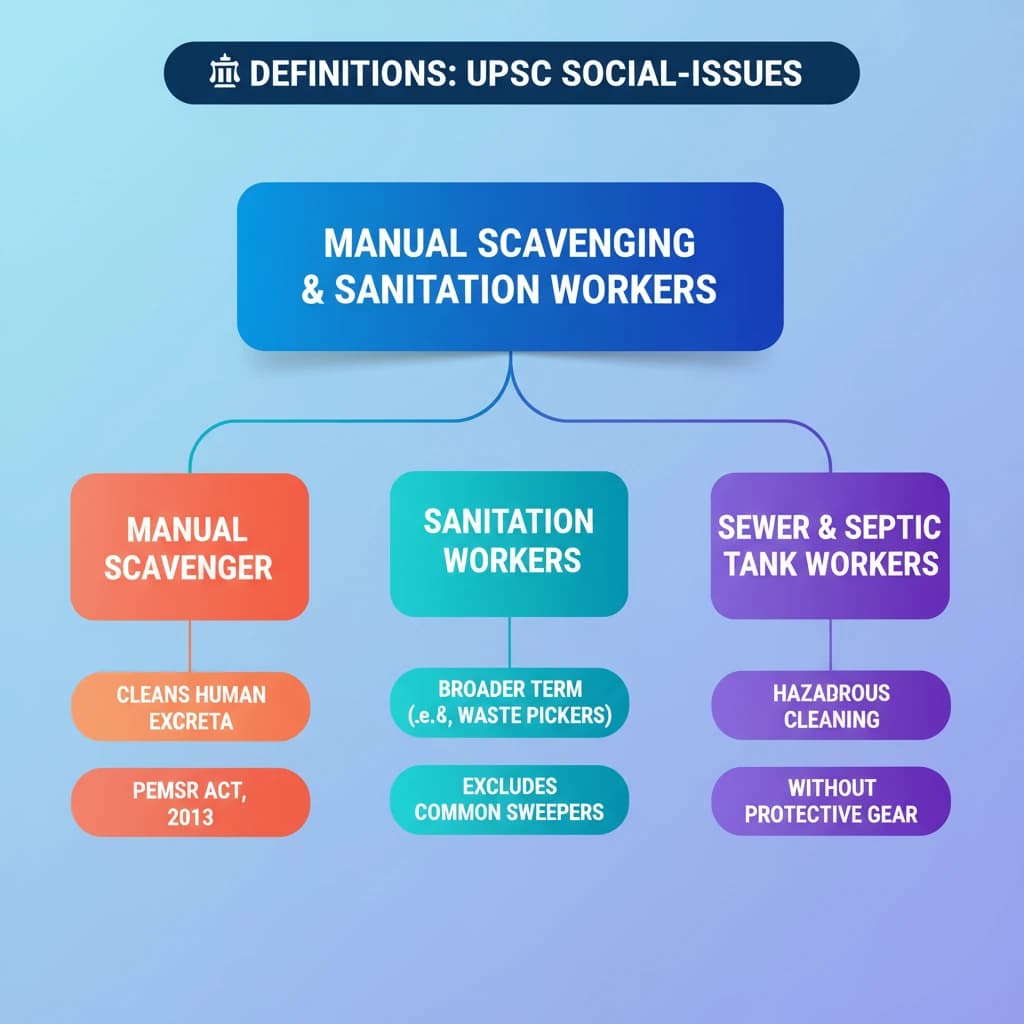
Definitions: Manual Scavenging & Sanitation Workers is a key topic under Social Issues for UPSC Civil Services Examination. Key points include: Manual Scavenger: Cleans undecomposed human excreta from insanitary latrines, open drains, pits, or railway tracks (PEMSR Act, 2013).. Hazardous Cleaning: Manual cleaning of sewers/septic tanks without adequate protective gear.. Sanitation Workers/Safai Karamcharis: Broader term including waste pickers and sewer/septic tank cleaners, excluding common sweepers.. Understanding this topic is essential for both UPSC Prelims and Mains preparation.
Why is Definitions: Manual Scavenging & Sanitation Workers important for UPSC exam?
Definitions: Manual Scavenging & Sanitation Workers is a Easy-level topic in UPSC Social Issues. It is tested in both Prelims (factual MCQs) and Mains (analytical answer writing). Previous year UPSC questions have frequently covered aspects of Definitions: Manual Scavenging & Sanitation Workers, making it essential for comprehensive IAS preparation.
How to prepare Definitions: Manual Scavenging & Sanitation Workers for UPSC?
To prepare Definitions: Manual Scavenging & Sanitation Workers for UPSC: (1) Study the comprehensive notes covering all key concepts on Vaidra. (2) Practice previous year questions on this topic. (3) Connect it with current affairs using daily updates. (4) Revise using key takeaways and mind maps available for Social Issues. (5) Write practice answers linking Definitions: Manual Scavenging & Sanitation Workers to related GS Paper topics.
Key takeaways of Definitions: Manual Scavenging & Sanitation Workers for UPSC
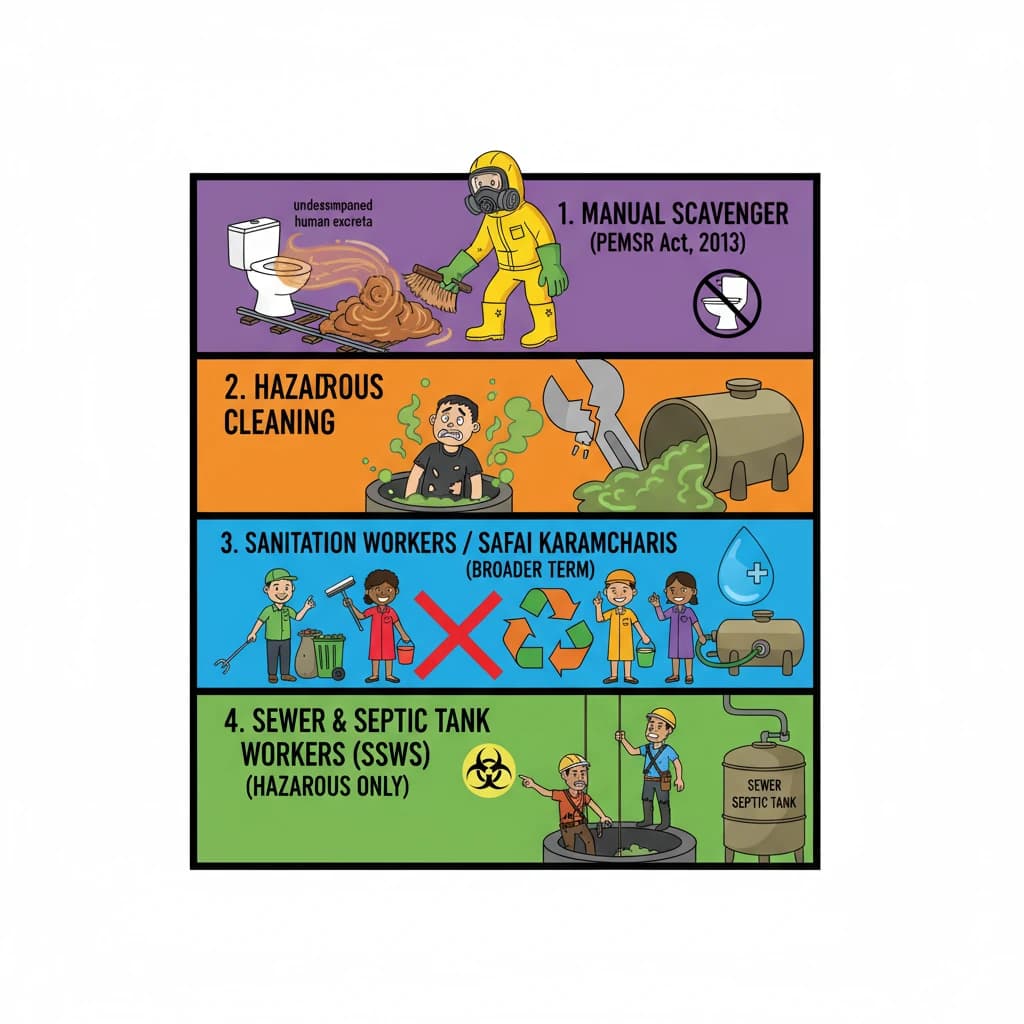
- Manual Scavenger: Cleans undecomposed human excreta from insanitary latrines, open drains, pits, or railway tracks (PEMSR Act, 2013).
- Hazardous Cleaning: Manual cleaning of sewers/septic tanks without adequate protective gear.
- Sanitation Workers/Safai Karamcharis: Broader term including waste pickers and sewer/septic tank cleaners, excluding common sweepers.
- Sewer and Septic Tank Workers (SSWs): Specific category engaged in hazardous cleaning of sewers and septic tanks.
- PEMSR Act, 2013: Key legislation prohibiting manual scavenging and focusing on rehabilitation.
- NAMASTE Scheme: Latest government initiative for mechanization and safety in sanitation work.
Definitions: Manual Scavenging & Sanitation Workers
Easy⏱️ 6 min read
social issues
📖 Introduction
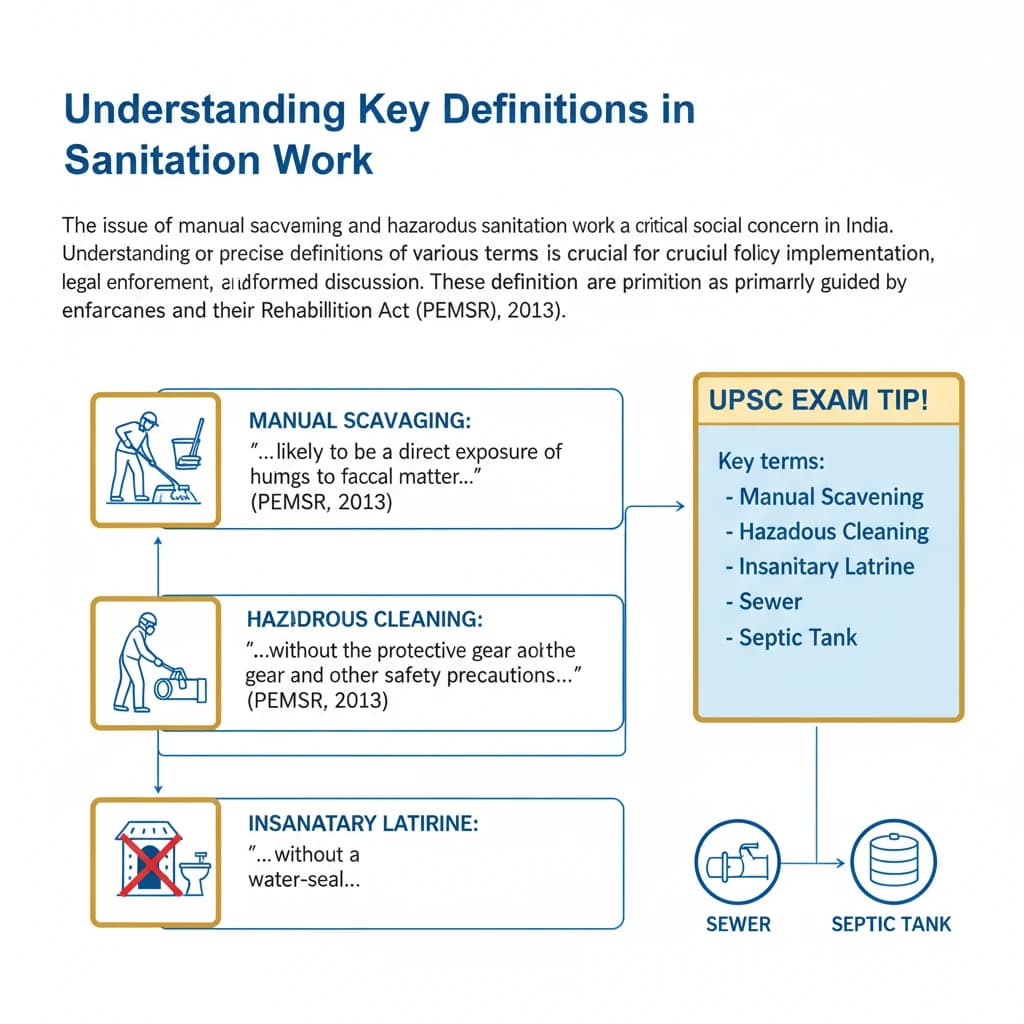
Understanding Key Definitions in Sanitation Work
The issue of manual scavenging and hazardous sanitation work remains a critical social concern in India. Understanding the precise definitions of various terms is crucial for policy implementation, legal enforcement, and informed discussion. These definitions are primarily guided by the Prohibition of Employment as Manual Scavengers and their Rehabilitation Act (PEMSR), 2013.
UPSC Insight: Precise definitions are vital for Mains answers, especially in GS-I (Social Issues) and GS-II (Governance, Social Justice). Misinterpreting these terms can lead to incorrect analysis of government policies and their impact.
Manual Scavenger
A manual scavenger is defined as any individual employed to manually clean, carry, or handle human excreta. This activity must occur from insanitary latrines, open drains, pits, or railway tracks.
Crucially, this definition applies specifically to excreta that has not fully decomposed. This distinction is important for legal interpretation and identifying the hazardous nature of the work.
Definition: As per the PEMSR Act, 2013, a manual scavenger is someone engaged in manually cleaning, carrying, or handling human excreta before its full decomposition, from specified locations.
Hazardous Cleaning
The term hazardous cleaning specifically refers to the manual cleaning of sewers or septic tanks. The key condition for it to be considered hazardous is the absence of adequate protective gear for the worker.
This highlights the inherent dangers involved when proper safety measures and equipment are not provided. It underscores the need for mechanization and strict safety protocols.
Definition: Hazardous cleaning involves the manual cleaning of sewers or septic tanks without the provision of adequate protective gear to the worker.
Sanitation Workers/Safai Karamcharis
This is a broader category encompassing individuals employed in various aspects of sanitation work. It includes diverse roles essential for maintaining public hygiene and waste management.
The group specifically includes waste pickers and those involved in cleaning sewers and septic tanks. However, it explicitly excludes common sweepers, who perform less hazardous tasks.
Definition: Sanitation Workers or Safai Karamcharis are individuals engaged in sanitation work, including waste pickers and those cleaning sewers/septic tanks, but excluding common sweepers.
Sewer and Septic Tank Workers (SSWs)
The term Sewer and Septic Tank Workers (SSWs) specifically designates those individuals who are involved in the hazardous cleaning of sewers and septic tanks. This group faces some of the most severe risks.
Their work often exposes them to toxic gases, pathogens, and physical dangers due to confined spaces and lack of safety equipment. This category is central to discussions on occupational safety and health.
Definition: Sewer and Septic Tank Workers (SSWs) are those specifically engaged in the hazardous manual cleaning of sewers and septic tanks.
💡 Key Takeaways
- •Manual Scavenger: Cleans undecomposed human excreta from insanitary latrines, open drains, pits, or railway tracks (PEMSR Act, 2013).
- •Hazardous Cleaning: Manual cleaning of sewers/septic tanks without adequate protective gear.
- •Sanitation Workers/Safai Karamcharis: Broader term including waste pickers and sewer/septic tank cleaners, excluding common sweepers.
- •Sewer and Septic Tank Workers (SSWs): Specific category engaged in hazardous cleaning of sewers and septic tanks.
- •PEMSR Act, 2013: Key legislation prohibiting manual scavenging and focusing on rehabilitation.
- •NAMASTE Scheme: Latest government initiative for mechanization and safety in sanitation work.
🧠 Memory Techniques
98% Verified Content
📚 Reference Sources
•Drishti IAS Study Material (Summary on Definitions)
•Ministry of Social Justice and Empowerment, Government of India (for schemes like NAMASTE, SRMS)