Loading page, please wait…
Vaidra Logo
Vaidra

Top 4 items + smart groups

UPSC GPT
New
Current Affairs
Daily Solutions
Daily Puzzle
Mains Evaluator

Version 2.0.0 • Built with ❤️ for UPSC aspirants

Loading...
Loading...
Loading...
Loading...
Loading...
Loading...
Loading...
Loading...
Loading...
Loading...
Loading...
Loading...
Loading...
Back
All Subjects

Topics

0 topics • 0 completed

Loading topics...
Loading...
Loading...
Loading...
Loading...
Loading...
Overall Progress0%

Political Representation of Women - UPSC Social Issues

What is Political Representation of Women in UPSC Social Issues?

Political Representation of Women is a key topic under Social Issues for UPSC Civil Services Examination. Key points include: Women's representation in Lok Sabha increased from 45 candidates in 1957 to 799 in 2024 (9.5% of total).. India ranks 143 out of 185 countries in women's representation in the lower house, lagging behind many nations.. West Bengal leads in electing women MPs (11), and Trinamool Congress has the highest proportion (38%) among its MPs.. Understanding this topic is essential for both UPSC Prelims and Mains preparation.

Why is Political Representation of Women important for UPSC exam?

Political Representation of Women is a Medium-level topic in UPSC Social Issues. It is tested in both Prelims (factual MCQs) and Mains (analytical answer writing). Previous year UPSC questions have frequently covered aspects of Political Representation of Women, making it essential for comprehensive IAS preparation.

How to prepare Political Representation of Women for UPSC?

To prepare Political Representation of Women for UPSC: (1) Study the comprehensive notes covering all key concepts on Vaidra. (2) Practice previous year questions on this topic. (3) Connect it with current affairs using daily updates. (4) Revise using key takeaways and mind maps available for Social Issues. (5) Write practice answers linking Political Representation of Women to related GS Paper topics.

Key takeaways of Political Representation of Women for UPSC

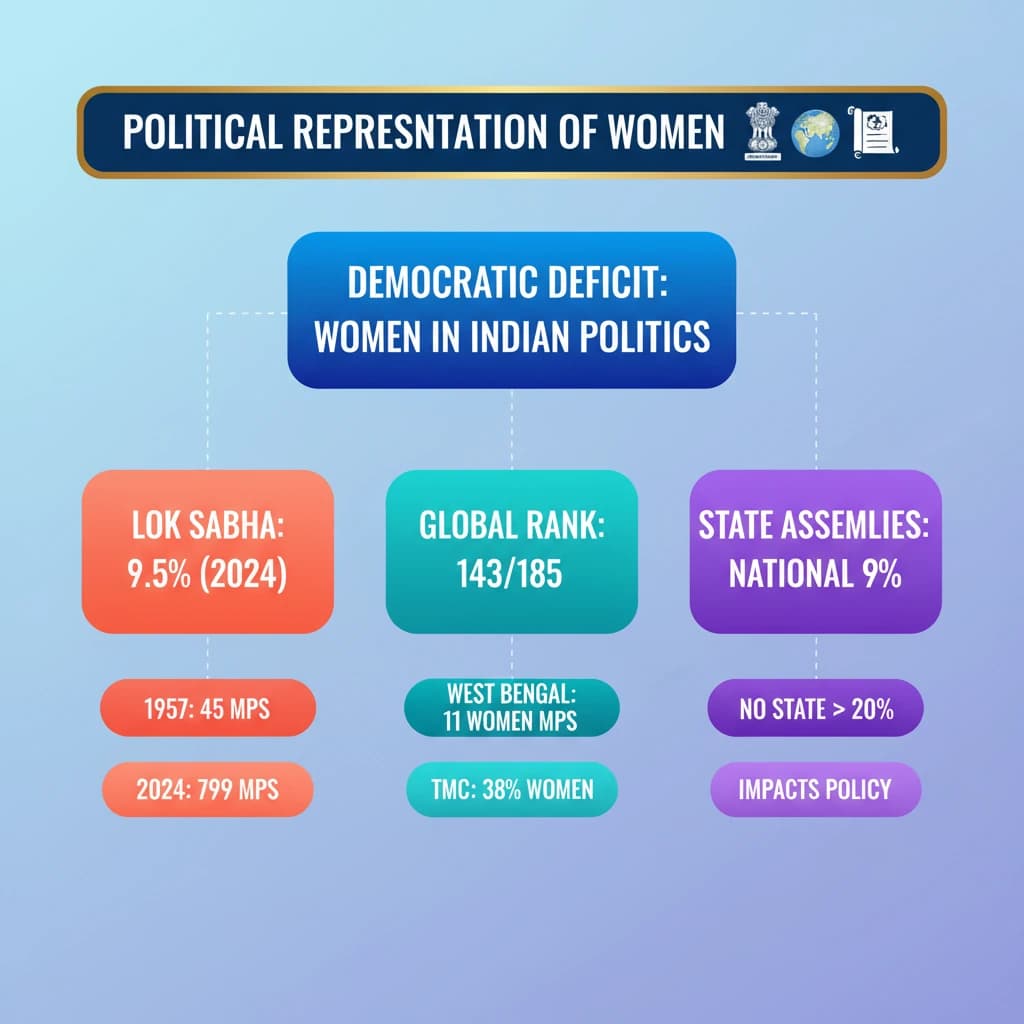
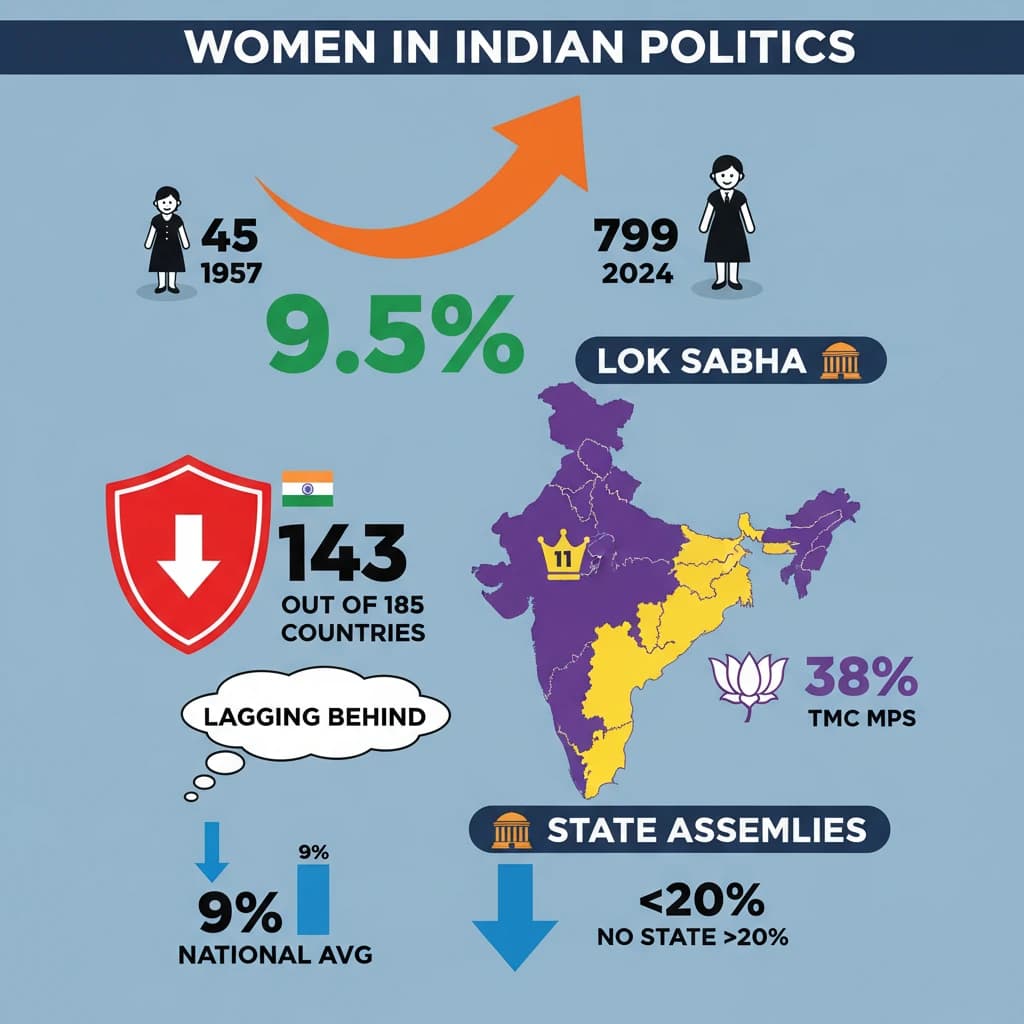
  • Women's representation in Lok Sabha increased from 45 candidates in 1957 to 799 in 2024 (9.5% of total).
  • India ranks 143 out of 185 countries in women's representation in the lower house, lagging behind many nations.
  • West Bengal leads in electing women MPs (11), and Trinamool Congress has the highest proportion (38%) among its MPs.
  • Representation in State Legislative Assemblies is even lower, with a national average of 9% and no state above 20%.
  • Low representation creates a democratic deficit and impacts gender-sensitive policy-making.
Political Representation of Women

Political Representation of Women

Medium⏱️ 8 min read✓ 95% Verified
social issues

📖 Introduction

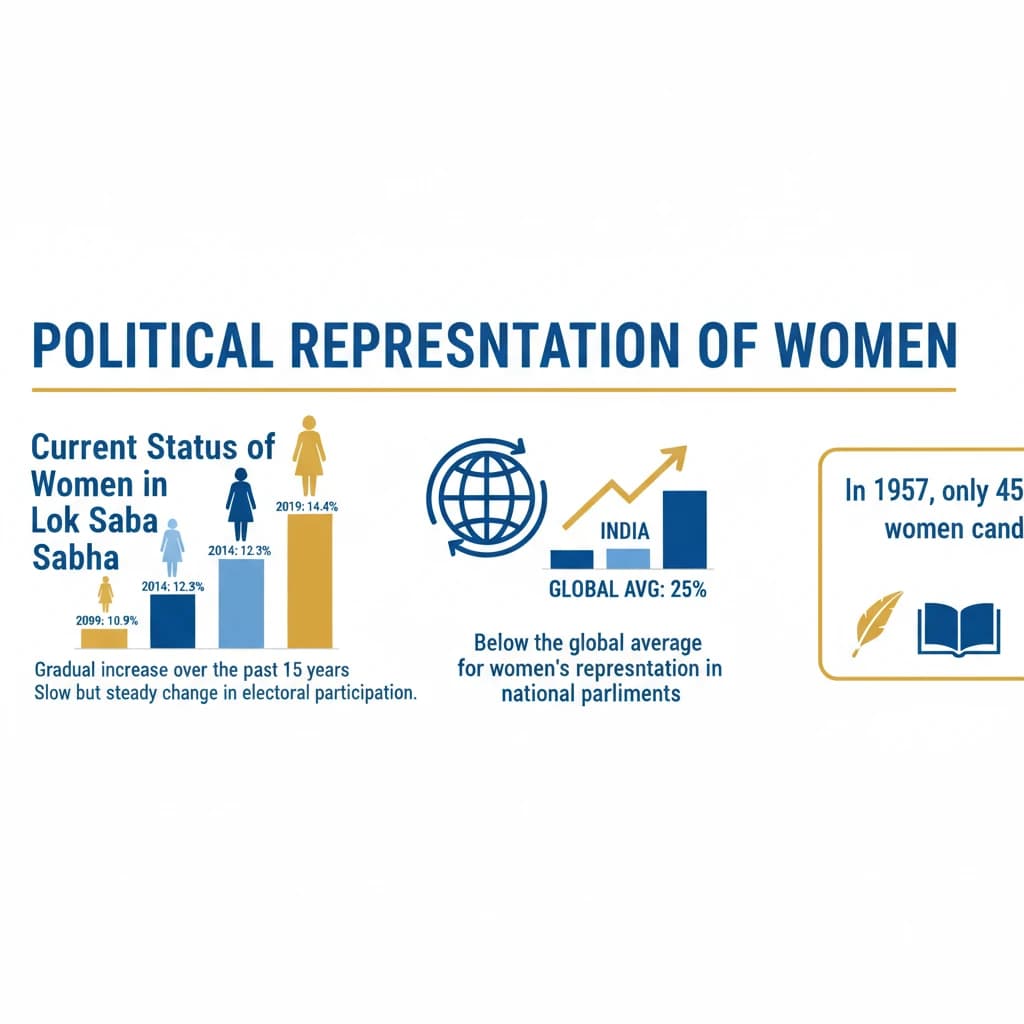
<h4>Current Status of Women in Lok Sabha</h4><p>The <strong>political representation of women</strong> in India's Lok Sabha has shown a <strong>gradual increase</strong> over the past 15 years, reflecting a slow but steady change in electoral participation.</p><p>Despite this rise, India's performance remains significantly <strong>below the global average</strong> for women's representation in national parliaments.</p><div class='info-box'><p>In <strong>1957</strong>, only <strong>45 women candidates</strong> contested the Lok Sabha election. By <strong>2024</strong>, this number surged to <strong>799 women candidates</strong>, constituting <strong>9.5%</strong> of the total candidates contested.</p></div><div class='key-point-box'><p>While the number of contesting women has grown, their overall proportion remains modest compared to the total pool of candidates.</p></div><h4>Leading States and Parties in Women's Representation</h4><p>Certain states and political parties have demonstrated better performance in electing women representatives to the Parliament.</p><p>This indicates that regional political dynamics and party ideologies can influence the extent of women's political empowerment.</p><div class='info-box'><p><strong>West Bengal</strong> leads among Indian states by electing the most women MPs, with <strong>11 representatives</strong> in the Lok Sabha.</p><p>The <strong>Trinamool Congress</strong> party stands out with the highest proportion of women among its Lok Sabha MPs, reaching <strong>38%</strong> in the <strong>18th Lok Sabha</strong>.</p></div><h4>Global Comparison of Women's Representation</h4><p>India's standing in global rankings for women's representation in the lower house of Parliament highlights a significant gap compared to many other nations.</p><p>This global perspective underscores the need for more concerted efforts to enhance gender parity in political spheres.</p><div class='info-box'><p>India ranks <strong>143 out of 185 countries</strong> in terms of women’s representation in its lower house of Parliament.</p><ul><li><strong>Sweden</strong> boasts <strong>46%</strong> female MPs.</li><li><strong>South Africa</strong> has <strong>45%</strong> female MPs.</li><li>The <strong>UK</strong> records <strong>40%</strong> female MPs.</li><li>The <strong>US</strong> has <strong>29%</strong> female MPs.</li></ul><p>India lags behind several developing nations, including <strong>Vietnam</strong>, the <strong>Philippines</strong>, <strong>Pakistan</strong>, and <strong>China</strong>, in gender representation.</p></div><div class='exam-tip-box'><p>Understanding these statistics is crucial for <strong>UPSC Mains GS Paper 1 (Social Issues)</strong> and <strong>GS Paper 2 (Polity)</strong>, especially when discussing gender justice, democratic deficits, and electoral reforms.</p></div><h4>Women’s Representation in State Legislatures</h4><p>The scenario of women's representation at the state level is even more concerning than at the national level, indicating deeper structural challenges.</p><p>The low numbers in State Legislative Assemblies reflect a broader issue of gender imbalance in regional politics.</p><div class='info-box'><p>The <strong>national average</strong> of women’s representation in <strong>State Legislative Assemblies</strong> is a mere <strong>9%</strong>.</p><p>No Indian state has more than <strong>20%</strong> women legislators. Even <strong>Chhattisgarh</strong>, the state with the highest representation, has only <strong>18%</strong> women MLAs.</p></div><div class='key-point-box'><p>This consistent underrepresentation across both national and state legislatures points to systemic barriers preventing women from entering and succeeding in political careers.</p></div>
Concept Diagram

💡 Key Takeaways

  • •Women's representation in Lok Sabha increased from 45 candidates in 1957 to 799 in 2024 (9.5% of total).
  • •India ranks 143 out of 185 countries in women's representation in the lower house, lagging behind many nations.
  • •West Bengal leads in electing women MPs (11), and Trinamool Congress has the highest proportion (38%) among its MPs.
  • •Representation in State Legislative Assemblies is even lower, with a national average of 9% and no state above 20%.
  • •Low representation creates a democratic deficit and impacts gender-sensitive policy-making.

🧠 Memory Techniques
Memory Aid
95% Verified Content

Related Topics

Loading related topics...
Explore:Social Issues Topics·All Subjects·Daily Current Affairs·Editorial Analysis·Previous Year Questions·UPSC GPT
Political Representation of Women - UPSC Social Issues