Loading page, please wait…
Vaidra Logo
Vaidra

Top 4 items + smart groups

UPSC GPT
New
Current Affairs
Daily Solutions
Daily Puzzle
Mains Evaluator

Version 2.0.0 • Built with ❤️ for UPSC aspirants

Loading...
Loading...
Loading...
Loading...
Loading...
Loading...
Loading...
Loading...
Loading...
Loading...
Loading...
Loading...
Loading...
Back
All Subjects

Topics

0 topics • 0 completed

Loading topics...
Loading...
Loading...
Loading...
Loading...
Loading...
Overall Progress0%

Chenchu Tribe: MGNREGS Impact, Livelihoods, and Vulnerable Status - UPSC Social Issues

What is Chenchu Tribe: MGNREGS Impact, Livelihoods, and Vulnerable Status in UPSC Social Issues?

Chenchu Tribe: MGNREGS Impact, Livelihoods, and Vulnerable Status is a key topic under Social Issues for UPSC Civil Services Examination. Key points include: The Chenchu tribe, a PVTG in Andhra Pradesh, faces severe livelihood, food security, healthcare, and education challenges due to the discontinuation of the MGNREGS Chenchu Special Project.. Known as 'Chenchuvaru' or 'Chenchwar', they are one of the oldest Telugu-speaking tribes, traditionally relying on hunting and food gathering.. PVTGs are classified by low literacy, stagnant population, and limited access to development, indicating extreme vulnerability.. Understanding this topic is essential for both UPSC Prelims and Mains preparation.

Why is Chenchu Tribe: MGNREGS Impact, Livelihoods, and Vulnerable Status important for UPSC exam?

Chenchu Tribe: MGNREGS Impact, Livelihoods, and Vulnerable Status is a Medium-level topic in UPSC Social Issues. It is tested in both Prelims (factual MCQs) and Mains (analytical answer writing). Previous year UPSC questions have frequently covered aspects of Chenchu Tribe: MGNREGS Impact, Livelihoods, and Vulnerable Status, making it essential for comprehensive IAS preparation.

How to prepare Chenchu Tribe: MGNREGS Impact, Livelihoods, and Vulnerable Status for UPSC?

To prepare Chenchu Tribe: MGNREGS Impact, Livelihoods, and Vulnerable Status for UPSC: (1) Study the comprehensive notes covering all key concepts on Vaidra. (2) Practice previous year questions on this topic. (3) Connect it with current affairs using daily updates. (4) Revise using key takeaways and mind maps available for Social Issues. (5) Write practice answers linking Chenchu Tribe: MGNREGS Impact, Livelihoods, and Vulnerable Status to related GS Paper topics.

Key takeaways of Chenchu Tribe: MGNREGS Impact, Livelihoods, and Vulnerable Status for UPSC

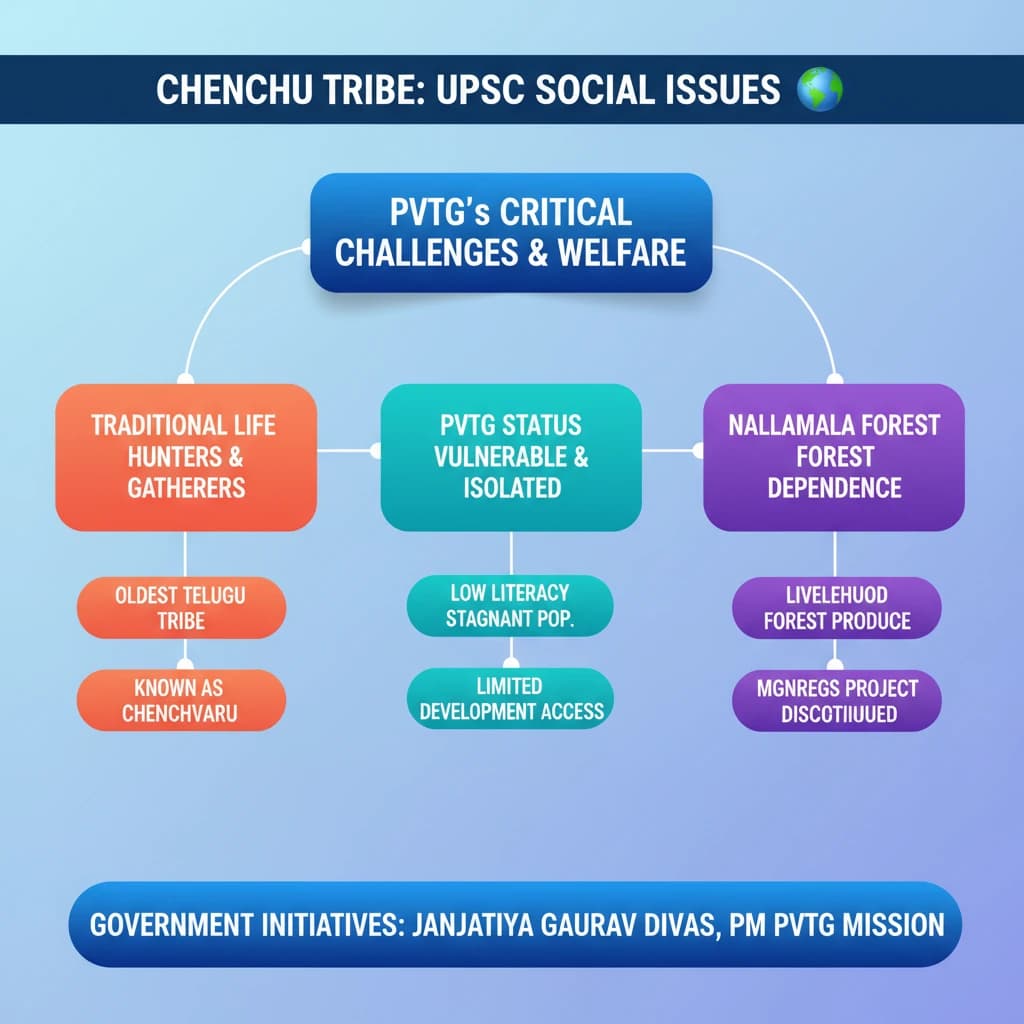
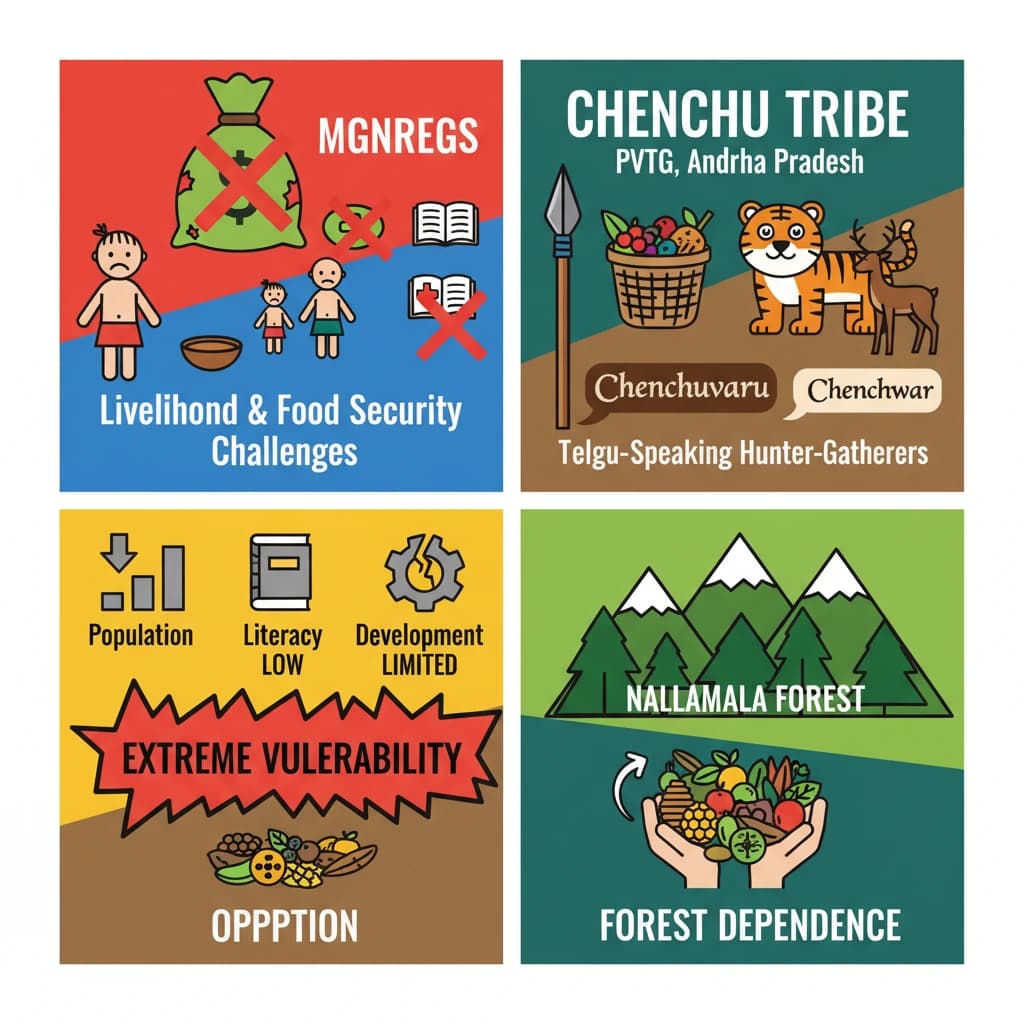
  • The Chenchu tribe, a PVTG in Andhra Pradesh, faces severe livelihood, food security, healthcare, and education challenges due to the discontinuation of the MGNREGS Chenchu Special Project.
  • Known as 'Chenchuvaru' or 'Chenchwar', they are one of the oldest Telugu-speaking tribes, traditionally relying on hunting and food gathering.
  • PVTGs are classified by low literacy, stagnant population, and limited access to development, indicating extreme vulnerability.
  • They primarily reside in the Nallamala forest, with their livelihood deeply dependent on forest produce.
  • Government initiatives like Janajatiya Gaurav Divas, Viksit Bharat Sankalp Yatra, and the PM PVTG Mission aim to address the welfare and development needs of PVTGs.
Chenchu Tribe: MGNREGS Impact, Livelihoods, and Vulnerable Status

Chenchu Tribe: MGNREGS Impact, Livelihoods, and Vulnerable Status

Medium⏱️ 6 min read✓ 95% Verified
social issues

📖 Introduction

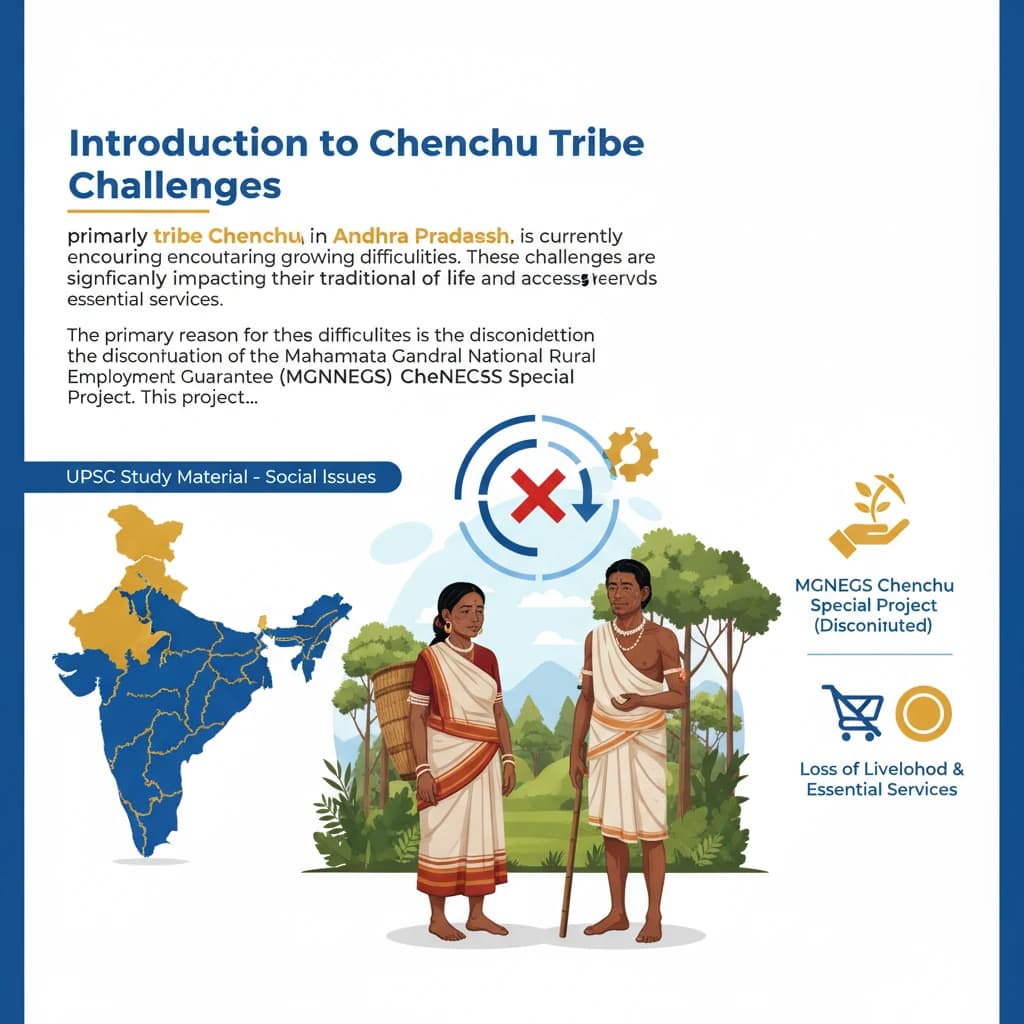
<h4>Introduction to Chenchu Tribe Challenges</h4><p>The <strong>Chenchu tribe</strong>, primarily residing in <strong>Andhra Pradesh</strong>, is currently encountering growing difficulties. These challenges are significantly impacting their traditional way of life and access to essential services.</p><p>The primary reason for these difficulties is the discontinuation of the <strong>Mahatma Gandhi National Rural Employment Guarantee Scheme (MGNREGS) Chenchu Special Project</strong>. This project was a vital source of support for the community.</p><p>The cessation of the project has negatively affected their <strong>livelihoods</strong>, compromised their <strong>food security</strong>, and limited their access to crucial services such as <strong>healthcare</strong> and <strong>education</strong>.</p><h4>Who are the Chenchus?</h4><p>The <strong>Chenchus</strong> are also known by the names <strong>‘Chenchuvaru’</strong> or <strong>‘Chenchwar’</strong>. They represent a unique tribal community with distinct cultural and linguistic characteristics.</p><div class='info-box'><p>While primarily associated with <strong>Andhra Pradesh</strong>, the <strong>Chenchus</strong> are numerically the <strong>smallest Scheduled Tribe of Odisha</strong>. This highlights their presence across different states.</p></div><p>Their traditional way of life has historically been based on practices of <strong>hunting</strong> and <strong>food gathering</strong>, showcasing a deep connection to their natural environment.</p><p>They are considered one of the oldest <strong>Telugu-speaking tribes</strong>, indicating a long historical presence and linguistic heritage in the region.</p><h4>Particularly Vulnerable Tribal Groups (PVTGs) Classification</h4><p>The <strong>Chenchus</strong> are classified as one of the <strong>12 Particularly Vulnerable Tribal Groups (PVTGs)</strong> in <strong>Andhra Pradesh</strong>. This classification recognizes their heightened vulnerability.</p><div class='key-point-box'><p>The <strong>PVTG</strong> classification is assigned to tribes exhibiting specific indicators: <strong>low literacy rates</strong>, <strong>stagnant population growth</strong>, and <strong>limited access to development</strong> and its benefits.</p></div><h4>Habitat and Livelihood</h4><p>The tribe mainly resides in <strong>forested regions</strong>, with a significant presence in the <strong>Nallamala forest</strong> and its surrounding areas. These forests are central to their existence.</p><p>Their livelihood is intrinsically linked to the forest ecosystem, as they heavily rely on <strong>forest produce</strong> for sustenance and economic activities.</p><h4>Major Government Initiatives for PVTGs</h4><p>The Government of India has launched several initiatives specifically aimed at the welfare and comprehensive development of <strong>PVTGs</strong> across the country.</p><ul><li><strong>Janajatiya Gaurav Divas</strong>: Celebrated to honor tribal cultures, histories, and contributions to national development.</li><li><strong>Viksit Bharat Sankalp Yatra</strong>: A nationwide outreach initiative to ensure the saturation of various government welfare schemes, including those for tribal communities.</li><li><strong>PM PVTG Mission</strong>: A dedicated mission focused on the holistic development and upliftment of <strong>Particularly Vulnerable Tribal Groups</strong>.</li></ul>
Concept Diagram

💡 Key Takeaways

  • •The Chenchu tribe, a PVTG in Andhra Pradesh, faces severe livelihood, food security, healthcare, and education challenges due to the discontinuation of the MGNREGS Chenchu Special Project.
  • •Known as 'Chenchuvaru' or 'Chenchwar', they are one of the oldest Telugu-speaking tribes, traditionally relying on hunting and food gathering.
  • •PVTGs are classified by low literacy, stagnant population, and limited access to development, indicating extreme vulnerability.
  • •They primarily reside in the Nallamala forest, with their livelihood deeply dependent on forest produce.
  • •Government initiatives like Janajatiya Gaurav Divas, Viksit Bharat Sankalp Yatra, and the PM PVTG Mission aim to address the welfare and development needs of PVTGs.

🧠 Memory Techniques
Memory Aid
95% Verified Content

Related Topics

Loading related topics...
Explore:Social Issues Topics·All Subjects·Daily Current Affairs·Editorial Analysis·Previous Year Questions·UPSC GPT
Chenchu Tribe: MGNREGS Impact, Livelihoods, and Vulnerable Status - UPSC Social Issues