Loading page, please wait…
Vaidra Logo
Vaidra

Top 4 items + smart groups

UPSC GPT
New
Current Affairs
Daily Solutions
Daily Puzzle
Mains Evaluator

Version 2.0.0 • Built with ❤️ for UPSC aspirants

Loading...
Loading...
Loading...
Loading...
Loading...
Loading...
Loading...
Loading...
Loading...
Loading...
Loading...
Loading...
Loading...
Back
All Subjects

Topics

0 topics • 0 completed

Loading topics...
Loading...
Loading...
Loading...
Loading...
Loading...
Overall Progress0%
What is India’s Progress on Hunger and Poverty Alleviation? - UPSC Social Issues

What is India’s Progress on Hunger and Poverty Alleviation? - UPSC Social Issues

What is What is India’s Progress on Hunger and Poverty Alleviation? in UPSC Social Issues?

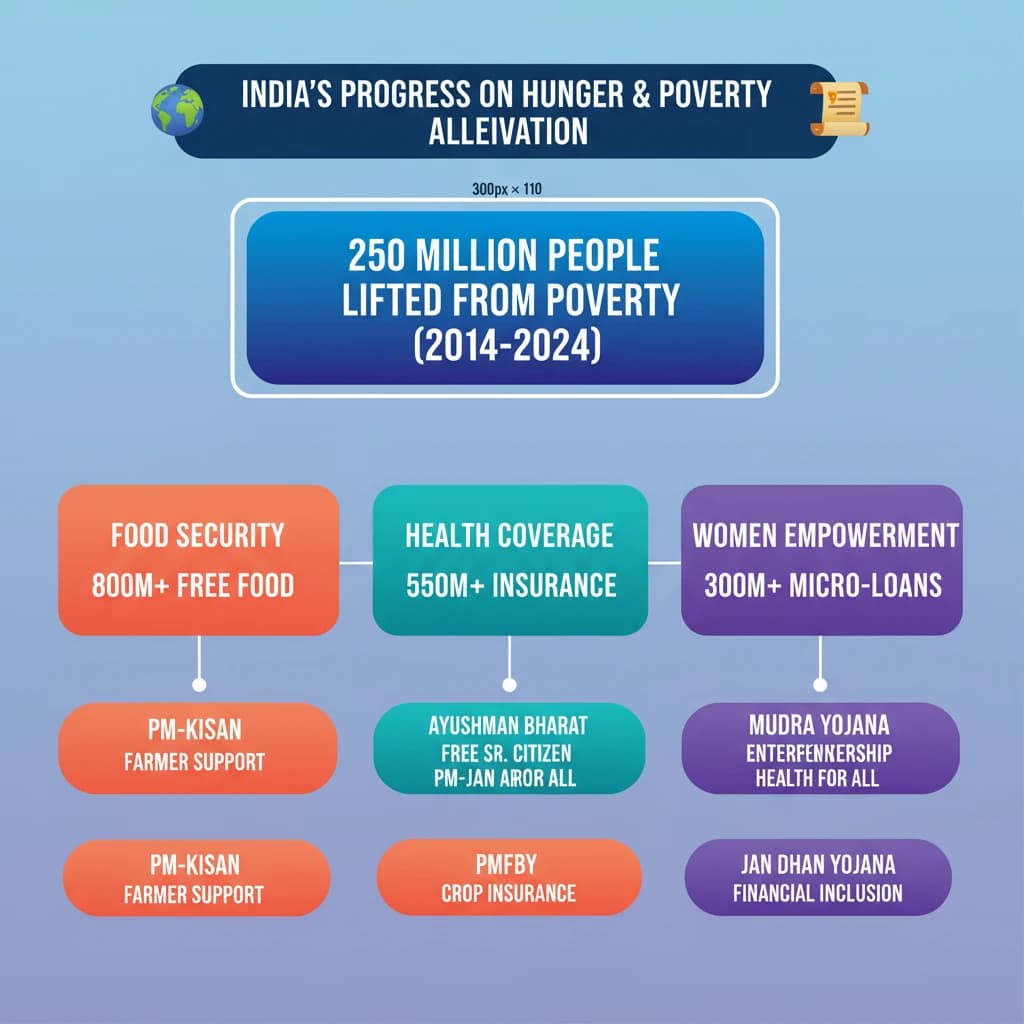
What is India’s Progress on Hunger and Poverty Alleviation? is a key topic under Social Issues for UPSC Civil Services Examination. Key points include: India lifted 250 million people out of poverty between 2014-2024, a significant achievement.. Over 800 million people receive free food grains, ensuring widespread food security.. Ayushman Bharat-PMJAY provides health insurance to 550 million, including free cover for senior citizens over 70.. Understanding this topic is essential for both UPSC Prelims and Mains preparation.

Why is What is India’s Progress on Hunger and Poverty Alleviation? important for UPSC exam?

What is India’s Progress on Hunger and Poverty Alleviation? is a Medium-level topic in UPSC Social Issues. It is tested in both Prelims (factual MCQs) and Mains (analytical answer writing). Previous year UPSC questions have frequently covered aspects of What is India’s Progress on Hunger and Poverty Alleviation?, making it essential for comprehensive IAS preparation.

How to prepare What is India’s Progress on Hunger and Poverty Alleviation? for UPSC?

To prepare What is India’s Progress on Hunger and Poverty Alleviation? for UPSC: (1) Study the comprehensive notes covering all key concepts on Vaidra. (2) Practice previous year questions on this topic. (3) Connect it with current affairs using daily updates. (4) Revise using key takeaways and mind maps available for Social Issues. (5) Write practice answers linking What is India’s Progress on Hunger and Poverty Alleviation? to related GS Paper topics.

Key takeaways of What is India’s Progress on Hunger and Poverty Alleviation? for UPSC

  • India lifted 250 million people out of poverty between 2014-2024, a significant achievement.
  • Over 800 million people receive free food grains, ensuring widespread food security.
  • Ayushman Bharat-PMJAY provides health insurance to 550 million, including free cover for senior citizens over 70.
  • 300 million women micro-entrepreneurs linked to banks, promoting financial and social inclusion.
  • PM-KISAN and PMFBY offer substantial financial support and risk coverage to over 100 million farmers.
  • Saksham Anganwadi and Poshan 2.0 focus on comprehensive nutrition for vulnerable groups, including children and pregnant women.
What is India’s Progress on Hunger and Poverty Alleviation?

What is India’s Progress on Hunger and Poverty Alleviation?

Medium⏱️ 8 min read✓ 95% Verified
social issues

📖 Introduction

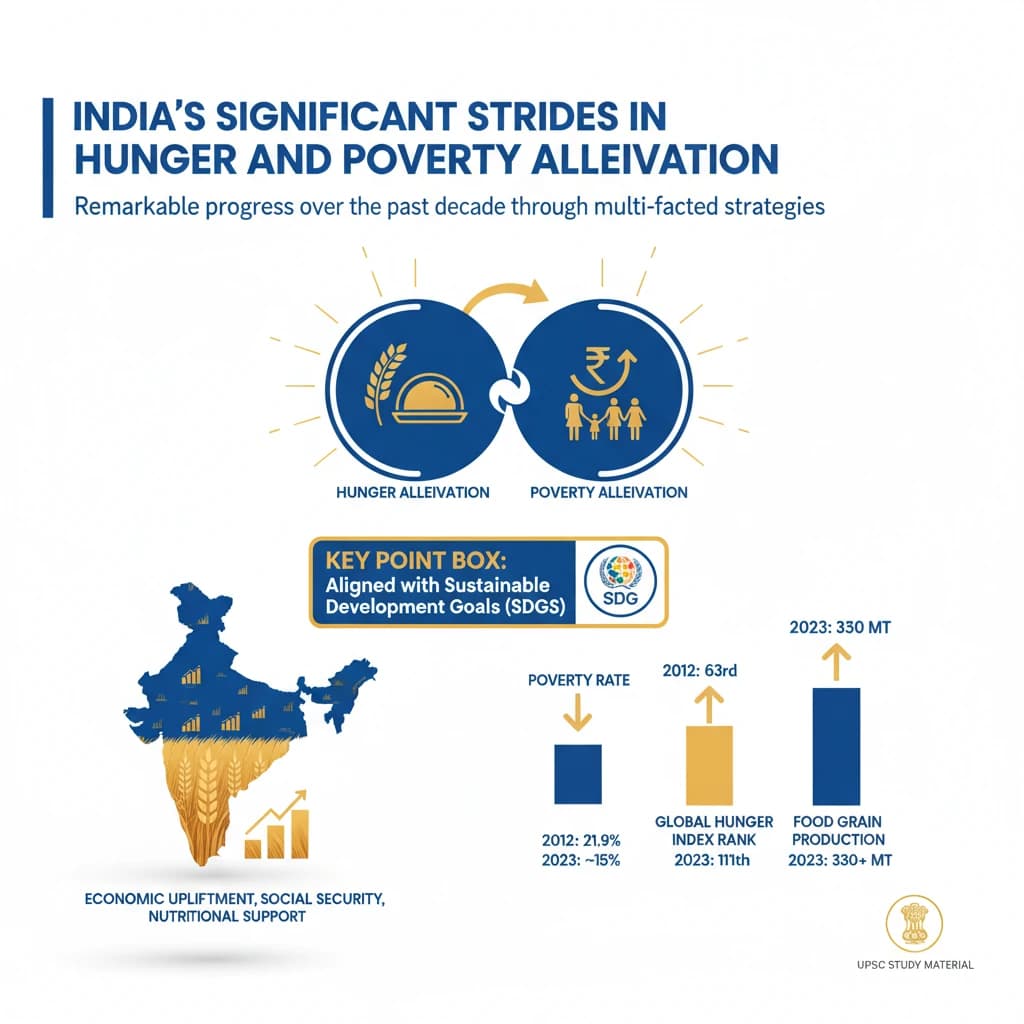
<h4>India's Significant Strides in Hunger and Poverty Alleviation</h4><p>India has demonstrated remarkable progress in addressing the critical issues of <strong>hunger</strong> and <strong>poverty alleviation</strong> over the past decade. This progress is a result of multi-faceted strategies focusing on economic upliftment, social security, and nutritional support.</p><div class='key-point-box'><p>The nation's commitment to these goals aligns with the <strong>Sustainable Development Goals (SDGs)</strong>, particularly <strong>SDG 1 (No Poverty)</strong> and <strong>SDG 2 (Zero Hunger)</strong>.</p></div><h4>Poverty Alleviation Efforts</h4><p>A major achievement in recent years has been the substantial reduction in the number of people living in poverty. This indicates the effectiveness of various targeted interventions.</p><div class='info-box'><p>Between <strong>2014</strong> and <strong>2024</strong>, India successfully lifted approximately <strong>250 million people</strong> out of <strong>poverty</strong>, marking a significant milestone in its development journey.</p></div><h4>Ensuring Food Security for All</h4><p>Food security remains a cornerstone of India's welfare agenda, ensuring that vulnerable populations have access to adequate and nutritious food. Large-scale public distribution programs play a crucial role.</p><div class='info-box'><p>Currently, over <strong>800 million people</strong> across the country are provided with <strong>food grains free of cost</strong>, reinforcing the commitment to eliminate hunger.</p></div><h4>Expanding Health Insurance Coverage</h4><p>Access to affordable healthcare is vital for preventing catastrophic health expenditures that can push families into poverty. India has implemented one of the world's largest health assurance schemes.</p><div class='info-box'><p>The <strong>Ayushman Bharat-Pradhan Mantri Jan Arogya Yojna (PM-JAY)</strong> benefits <strong>550 million people</strong>, providing comprehensive health coverage. Additionally, <strong>60 million senior citizens</strong>, aged over <strong>70</strong>, are now eligible for <strong>free health insurance</strong>.</p></div><h4>Financial and Social Inclusion Initiatives</h4><p>Empowering women through financial independence and entrepreneurship is a key strategy for inclusive growth and poverty reduction. Connecting them to formal financial systems is paramount.</p><div class='info-box'><p>Over <strong>300 million women micro-entrepreneurs</strong> have been successfully linked to banks, gaining access to essential <strong>credit facilities</strong> to foster their businesses and livelihoods.</p></div><h4>Comprehensive Farmer Support</h4><p>The agricultural sector is critical for both food security and rural livelihoods. Government schemes provide financial assistance and risk mitigation to farmers, enhancing their resilience.</p><ul><li>Under the <strong>Pradhan Mantri Fasal Bima Yojana (PMFBY)</strong>, more than <strong>40 million farmers</strong> have received benefits totaling over <strong>20 billion US dollars</strong>, safeguarding them against crop losses.</li><li>The <strong>PM-KISAN</strong> scheme has disbursed assistance worth over <strong>40 billion dollars</strong> to <strong>110 million farmers</strong>, providing direct income support.</li><li>India has also focused on agricultural innovation, developing over <strong>2000 climate-resilient crop varieties</strong> to combat environmental challenges.</li></ul><h4>Focused Nutritional Programs</h4><p>Addressing malnutrition, especially among vulnerable groups like women and children, is crucial for long-term human development. Integrated programs are designed to provide comprehensive nutritional support.</p><ul><li>The <strong>Saksham Anganwadi and Poshan 2.0</strong> campaign targets the nutritional needs of <strong>pregnant women</strong>, <strong>newborn babies</strong>, <strong>children under the age of 6</strong>, and <strong>adolescent girls</strong>.</li><li>The long-standing <strong>Mid-Day Meal scheme</strong> continues to pay special attention to the nutritional requirements of <strong>school-going children</strong>, improving health and educational outcomes.</li></ul><div class='exam-tip-box'><p><strong>UPSC Insight:</strong> When discussing India's progress, always cite specific schemes and statistics. This adds credibility and depth to your answers in <strong>GS-I (Social Issues)</strong> and <strong>GS-II (Government Policies)</strong>. Remember to mention both the scale and the impact.</p></div>
Concept Diagram

💡 Key Takeaways

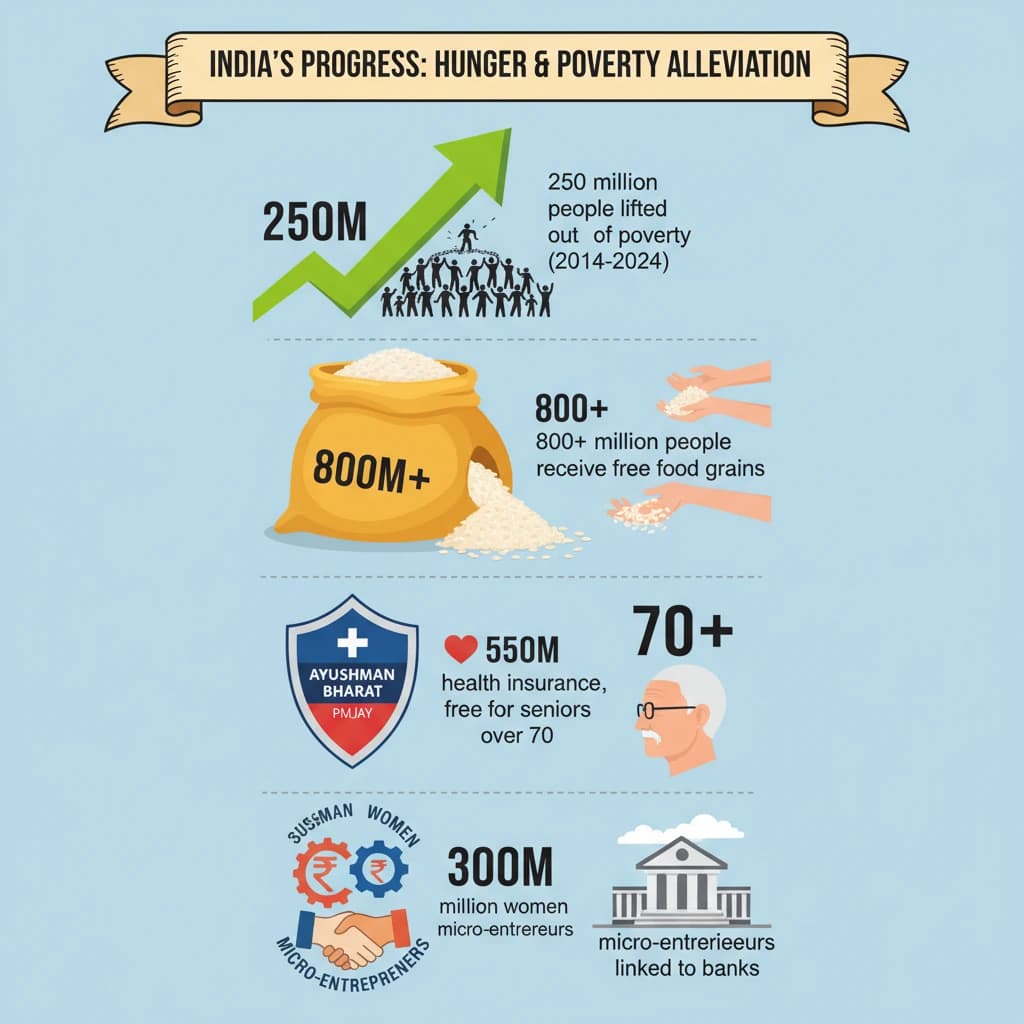
  • •India lifted 250 million people out of poverty between 2014-2024, a significant achievement.
  • •Over 800 million people receive free food grains, ensuring widespread food security.
  • •Ayushman Bharat-PMJAY provides health insurance to 550 million, including free cover for senior citizens over 70.
  • •300 million women micro-entrepreneurs linked to banks, promoting financial and social inclusion.
  • •PM-KISAN and PMFBY offer substantial financial support and risk coverage to over 100 million farmers.
  • •Saksham Anganwadi and Poshan 2.0 focus on comprehensive nutrition for vulnerable groups, including children and pregnant women.

🧠 Memory Techniques
Memory Aid
95% Verified Content

📚 Reference Sources

•NITI Aayog Reports on Poverty and Development
•Ministry of Rural Development, Government of India
•Ministry of Health & Family Welfare, Government of India
•Ministry of Agriculture & Farmers Welfare, Government of India
•National Family Health Survey (NFHS) data

Related Topics

Loading related topics...
Explore:Social Issues Topics·All Subjects·Daily Current Affairs·Editorial Analysis·Previous Year Questions·UPSC GPT