Loading page, please wait…
Vaidra Logo
Vaidra

Top 4 items + smart groups

UPSC GPT
New
Current Affairs
Daily Solutions
Daily Puzzle
Mains Evaluator

Version 2.0.0 • Built with ❤️ for UPSC aspirants

Loading...
Loading...
Loading...
Loading...
Loading...
Loading...
Loading...
Loading...
Loading...
Loading...
Loading...
Loading...
Loading...
Back
All Subjects

Topics

0 topics • 0 completed

Loading topics...
Loading...
Loading...
Loading...
Loading...
Loading...
Overall Progress0%
WHO and UNICEF Estimates of National Immunisation Coverage (WUENIC) - UPSC Social Issues

WHO and UNICEF Estimates of National Immunisation Coverage (WUENIC) - UPSC Social Issues

What is WHO and UNICEF Estimates of National Immunisation Coverage (WUENIC) in UPSC Social Issues?

WHO and UNICEF Estimates of National Immunisation Coverage (WUENIC) is a key topic under Social Issues for UPSC Civil Services Examination. Key points include: WUENIC is a joint WHO and UNICEF report estimating national immunisation coverage.. The 2023 WUENIC report showed a slight global dip in childhood immunisation, leaving 2.7 million more children unvaccinated.. WUENIC data is compiled from Member State reports, survey findings, and published literature.. Understanding this topic is essential for both UPSC Prelims and Mains preparation.

Why is WHO and UNICEF Estimates of National Immunisation Coverage (WUENIC) important for UPSC exam?

WHO and UNICEF Estimates of National Immunisation Coverage (WUENIC) is a Medium-level topic in UPSC Social Issues. It is tested in both Prelims (factual MCQs) and Mains (analytical answer writing). Previous year UPSC questions have frequently covered aspects of WHO and UNICEF Estimates of National Immunisation Coverage (WUENIC), making it essential for comprehensive IAS preparation.

How to prepare WHO and UNICEF Estimates of National Immunisation Coverage (WUENIC) for UPSC?

To prepare WHO and UNICEF Estimates of National Immunisation Coverage (WUENIC) for UPSC: (1) Study the comprehensive notes covering all key concepts on Vaidra. (2) Practice previous year questions on this topic. (3) Connect it with current affairs using daily updates. (4) Revise using key takeaways and mind maps available for Social Issues. (5) Write practice answers linking WHO and UNICEF Estimates of National Immunisation Coverage (WUENIC) to related GS Paper topics.

Key takeaways of WHO and UNICEF Estimates of National Immunisation Coverage (WUENIC) for UPSC

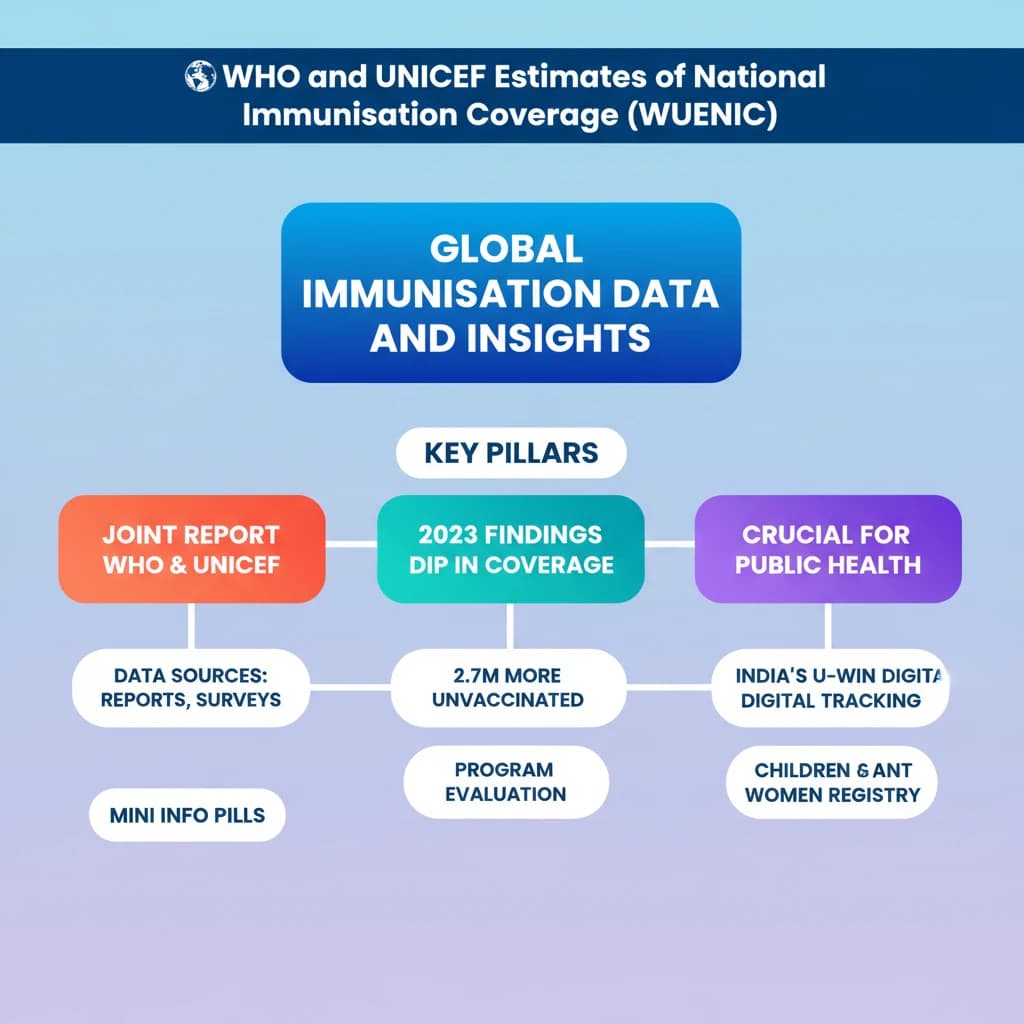
  • WUENIC is a joint WHO and UNICEF report estimating national immunisation coverage.
  • The 2023 WUENIC report showed a slight global dip in childhood immunisation, leaving 2.7 million more children unvaccinated.
  • WUENIC data is compiled from Member State reports, survey findings, and published literature.
  • India's U-Win is a pilot digital project for registering pregnant women and children for immunisation tracking.
  • WUENIC reports are crucial for informing public health policies, evaluating programs, and guiding global health strategies.
WHO and UNICEF Estimates of National Immunisation Coverage (WUENIC)

WHO and UNICEF Estimates of National Immunisation Coverage (WUENIC)

Medium⏱️ 7 min read✓ 95% Verified
social issues

📖 Introduction

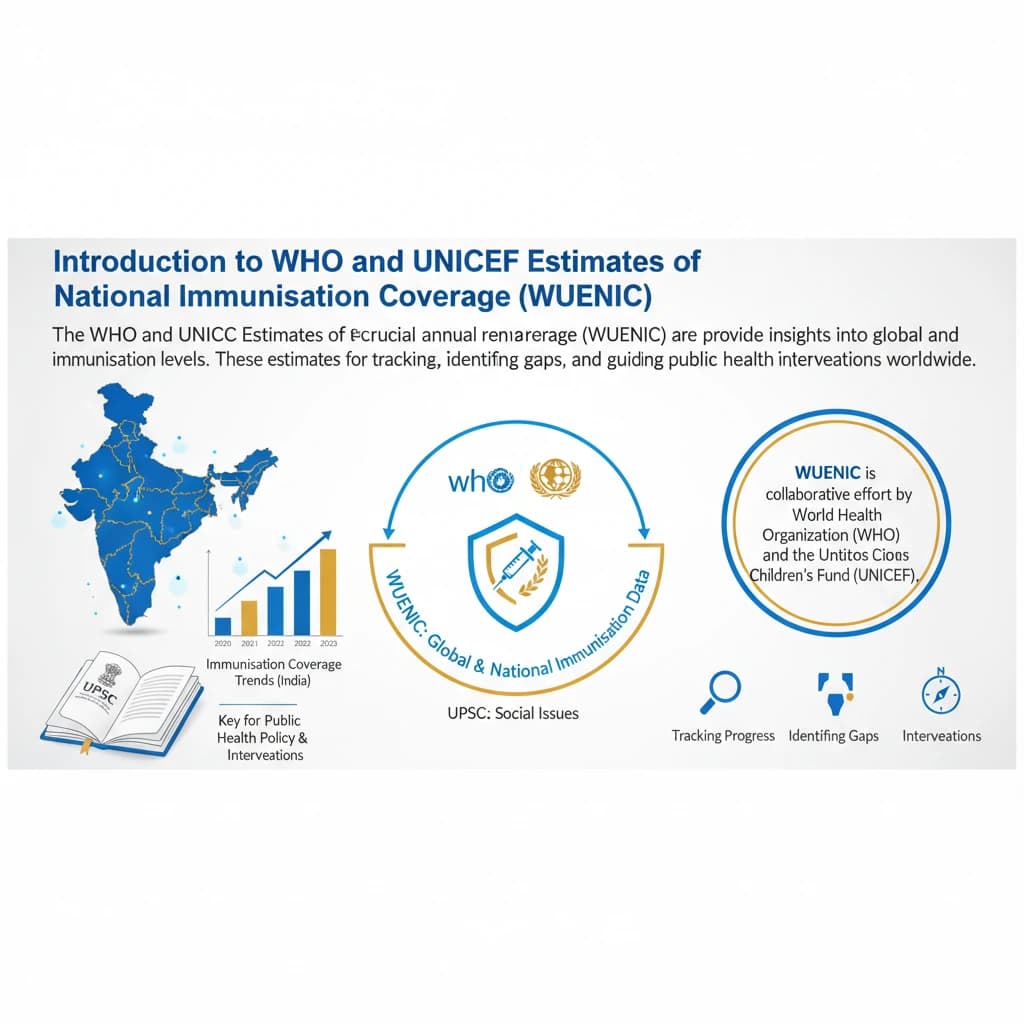
<h4>Introduction to WHO and UNICEF Estimates of National Immunisation Coverage (WUENIC)</h4><p>The <strong>WHO and UNICEF Estimates of National Immunisation Coverage (WUENIC)</strong> are crucial annual reports that provide insights into global and national immunisation levels.</p><p>These estimates are vital for tracking progress, identifying gaps, and guiding public health interventions worldwide.</p><div class='info-box'><p><strong>WUENIC</strong> is a collaborative effort by the <strong>World Health Organization (WHO)</strong> and the <strong>United Nations Children's Fund (UNICEF)</strong>.</p><p>It synthesizes data from various sources to present a comprehensive picture of immunisation coverage.</p></div><h4>Key Findings from WUENIC 2023</h4><p>The recently released <strong>WUENIC</strong> report for <strong>2023</strong> revealed a concerning trend: a <strong>slight dip</strong> in <strong>childhood immunisation</strong> coverage compared to <strong>2022</strong>.</p><div class='key-point-box'><p>Globally, immunisation efforts faced significant challenges in <strong>2023</strong>, resulting in an estimated <strong>2.7 million additional children</strong> either <strong>unvaccinated</strong> or under-vaccinated.</p></div><h4>Methodology and Data Sources of WUENIC</h4><p>Each year, <strong>WHO</strong> and <strong>UNICEF</strong> undertake a rigorous process to compile these estimates.</p><p>They jointly review a wide array of information to ensure accuracy and comprehensiveness.</p><ul><li><strong>Reports from Member States</strong>: National immunisation coverage data submitted by individual countries.</li><li><strong>Finalized Survey Reports</strong>: Results from national and sub-national health surveys.</li><li><strong>Published and Grey Literature</strong>: Data from academic publications, reports, and other non-peer-reviewed sources.</li></ul><h4>India's Digital Revolution: The U-Win Initiative</h4><p>Alongside global trends, a significant domestic development is the unfolding of a <strong>quiet digital revolution</strong> in India's health sector.</p><p>This is part of a government <strong>pilot project</strong> aimed at enhancing immunisation tracking and management.</p><div class='info-box'><p>The <strong>U-Win</strong> platform is designed for the digital registration of <strong>pregnant women</strong> and <strong>children</strong>, facilitating real-time tracking of their immunisation status.</p></div><div class='exam-tip-box'><p>The <strong>U-Win initiative</strong> is a prime example of how digital public goods are being leveraged to strengthen health systems, a key theme for <strong>UPSC GS2 (Governance)</strong> and <strong>GS3 (Science & Technology)</strong>.</p></div><h4>Other Social Sector Legislation Mentioned in Source Material</h4><p>The provided source material also briefly touched upon several other important social sector legislations, though not directly related to WUENIC.</p><h5>Real Estate (Regulation and Development) Act, 2016 (RERA)</h5><ul><li><strong>Regulation and Transparency</strong>: It regulates the <strong>real estate sector</strong> to ensure <strong>transparency</strong>, <strong>accountability</strong>, and <strong>timely delivery</strong> of housing projects.</li><li><strong>Homebuyer Protection</strong>: Protects <strong>homebuyers</strong> by mandating <strong>registration of projects</strong> and providing a <strong>grievance redressal mechanism</strong>.</li></ul><h5>Right to Fair Compensation and Transparency in Land Acquisition, Rehabilitation and Resettlement Act, 2013</h5><ul><li><strong>Resettlement and Rehabilitation</strong>: Includes detailed provisions for the <strong>resettlement</strong> and <strong>rehabilitation</strong> of those affected by <strong>land acquisition</strong>.</li><li><strong>Support for Displaced Families</strong>: Ensures <strong>displaced families</strong> receive support to <strong>rebuild their lives</strong>, including provisions for housing.</li></ul><h5>Model Tenancy Act, 2021</h5><ul><li><strong>Dispute Resolution</strong>: Seeks to establish a <strong>speedy adjudication mechanism</strong> for <strong>dispute resolution</strong> between landlords and tenants.</li><li><strong>Regulation of Renting</strong>: Regulates the <strong>renting of premises</strong> and aims to protect the interests of both <strong>landlords</strong> and <strong>tenants</strong>.</li></ul>
Concept Diagram

💡 Key Takeaways

  • •WUENIC is a joint WHO and UNICEF report estimating national immunisation coverage.
  • •The 2023 WUENIC report showed a slight global dip in childhood immunisation, leaving 2.7 million more children unvaccinated.
  • •WUENIC data is compiled from Member State reports, survey findings, and published literature.
  • •India's U-Win is a pilot digital project for registering pregnant women and children for immunisation tracking.
  • •WUENIC reports are crucial for informing public health policies, evaluating programs, and guiding global health strategies.

🧠 Memory Techniques

Memory Aid
95% Verified Content

📚 Reference Sources

•WHO (World Health Organization) official reports on immunisation
•UNICEF (United Nations Children's Fund) official reports on immunisation

Related Topics

Loading related topics...
Explore:Social Issues Topics·All Subjects·Daily Current Affairs·Editorial Analysis·Previous Year Questions·UPSC GPT