Loading page, please wait…
Vaidra Logo
Vaidra

Top 4 items + smart groups

UPSC GPT
New
Current Affairs
Daily Solutions
Daily Puzzle
Mains Evaluator

Version 2.0.0 • Built with ❤️ for UPSC aspirants

Loading...
Loading...
Loading...
Loading...
Loading...
Loading...
Loading...
Loading...
Loading...
Loading...
Loading...
Loading...
Loading...
Back
All Subjects

Topics

0 topics • 0 completed

Loading topics...
Loading...
Loading...
Loading...
Loading...
Loading...
Overall Progress0%

What are the Key Highlights of the Study on Denotified, Nomadic, and Semi-Nomadic Tribes? - UPSC Social Issues

What is What are the Key Highlights of the Study on Denotified, Nomadic, and Semi-Nomadic Tribes? in UPSC Social Issues?

What are the Key Highlights of the Study on Denotified, Nomadic, and Semi-Nomadic Tribes? is a key topic under Social Issues for UPSC Civil Services Examination. Key points include: Study proposes 179 new community additions: 46 OBC, 29 SC, 10 ST.. Uttar Pradesh, Andhra Pradesh, Tamil Nadu, Madhya Pradesh, Rajasthan are most impacted states.. 63 communities found 'non-traceable' due to assimilation, name change, or migration.. Understanding this topic is essential for both UPSC Prelims and Mains preparation.

Why is What are the Key Highlights of the Study on Denotified, Nomadic, and Semi-Nomadic Tribes? important for UPSC exam?

What are the Key Highlights of the Study on Denotified, Nomadic, and Semi-Nomadic Tribes? is a Medium-level topic in UPSC Social Issues. It is tested in both Prelims (factual MCQs) and Mains (analytical answer writing). Previous year UPSC questions have frequently covered aspects of What are the Key Highlights of the Study on Denotified, Nomadic, and Semi-Nomadic Tribes?, making it essential for comprehensive IAS preparation.

How to prepare What are the Key Highlights of the Study on Denotified, Nomadic, and Semi-Nomadic Tribes? for UPSC?

To prepare What are the Key Highlights of the Study on Denotified, Nomadic, and Semi-Nomadic Tribes? for UPSC: (1) Study the comprehensive notes covering all key concepts on Vaidra. (2) Practice previous year questions on this topic. (3) Connect it with current affairs using daily updates. (4) Revise using key takeaways and mind maps available for Social Issues. (5) Write practice answers linking What are the Key Highlights of the Study on Denotified, Nomadic, and Semi-Nomadic Tribes? to related GS Paper topics.

Key takeaways of What are the Key Highlights of the Study on Denotified, Nomadic, and Semi-Nomadic Tribes? for UPSC

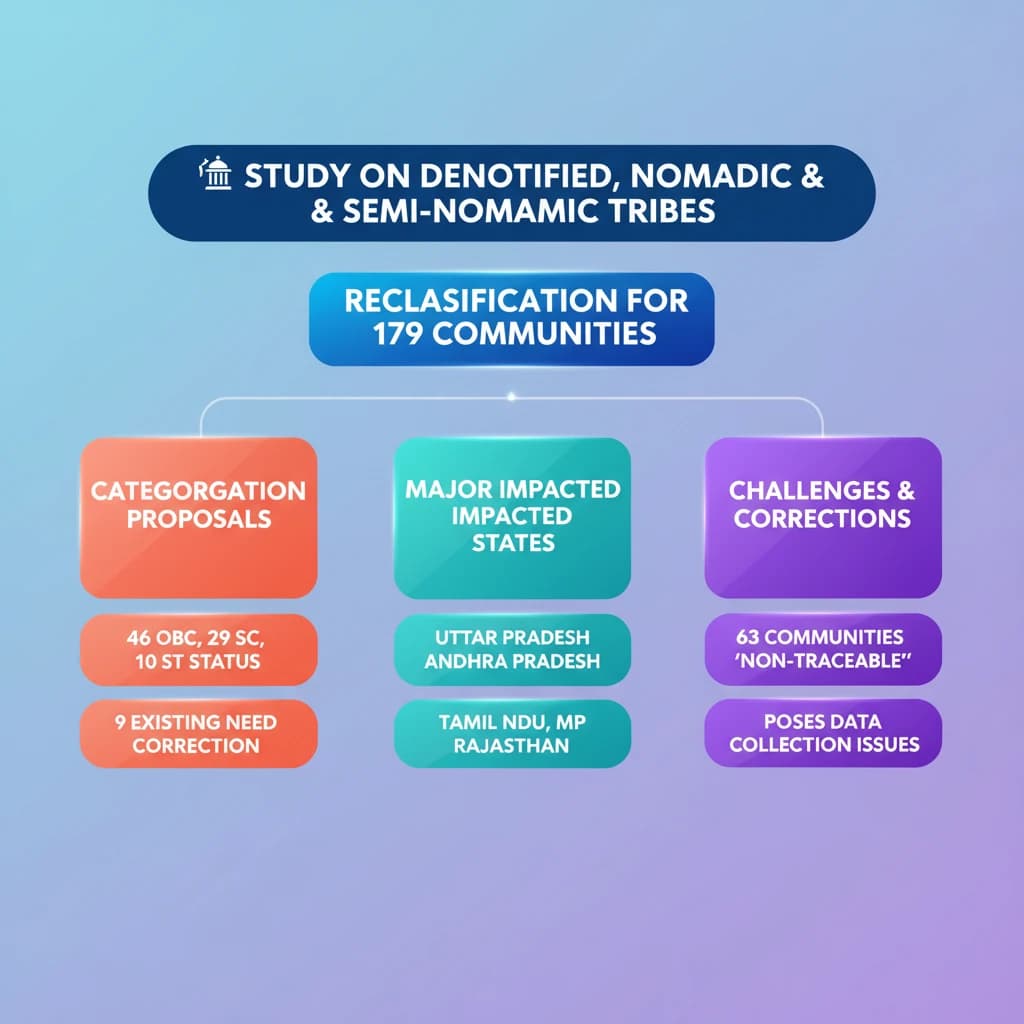
  • Study proposes 179 new community additions: 46 OBC, 29 SC, 10 ST.
  • Uttar Pradesh, Andhra Pradesh, Tamil Nadu, Madhya Pradesh, Rajasthan are most impacted states.
  • 63 communities found 'non-traceable' due to assimilation, name change, or migration.
  • Study recommends correcting categorization of 9 existing misclassified communities.
  • Highlights ongoing challenges in identifying and ensuring welfare for DNTs, NTs, SNTs.
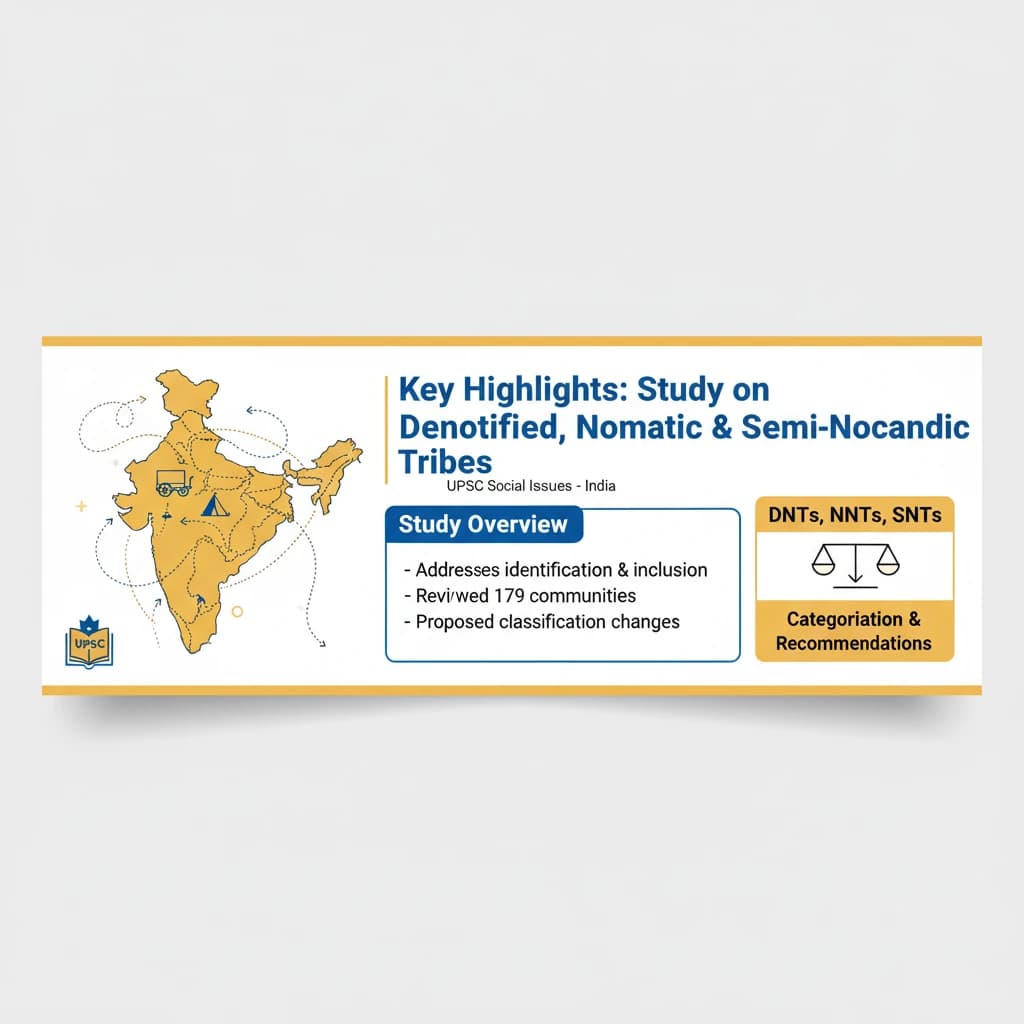
What are the Key Highlights of
the Study on Denotified,
Nomadic, and Semi-Nomadic Tribes?

What are the Key Highlights of the Study on Denotified, Nomadic, and Semi-Nomadic Tribes?

Medium⏱️ 6 min read✓ 95% Verified
social issues

📖 Introduction

<h4>Introduction to Denotified, Nomadic, and Semi-Nomadic Tribes Study</h4><p>A recent study has shed light on the complex issues surrounding <strong>Denotified, Nomadic, and Semi-Nomadic Tribes (DNTs, NTs, SNTs)</strong> in India. This comprehensive analysis proposes significant changes to their categorization and addresses challenges in identification.</p><div class='key-point-box'><p>The study aims to ensure better social justice and welfare for these historically marginalized communities by updating their official status.</p></div><h4>New Additions and Categorization Proposals</h4><p>The study recommends the inclusion of <strong>179 new communities</strong> into various reservation categories. This is a crucial step towards recognizing and addressing their unique socio-economic disadvantages.</p><div class='info-box'><ul><li><strong>46 communities</strong> are proposed for <strong>Other Backward Classes (OBC)</strong> status.</li><li><strong>29 communities</strong> are proposed for <strong>Scheduled Caste (SC)</strong> status.</li><li><strong>10 communities</strong> are proposed for <strong>Scheduled Tribe (ST)</strong> status.</li></ul></div><p>These proposed additions reflect a detailed assessment of their current socio-economic conditions and historical marginalization.</p><h4>Geographical Impact of Proposed Changes</h4><p>The study highlights that certain states will experience a more significant impact due to these proposed changes. These states have a higher concentration of the identified communities.</p><div class='info-box'><p>The states most impacted include <strong>Uttar Pradesh, Andhra Pradesh, Tamil Nadu, Madhya Pradesh, and Rajasthan</strong>.</p><p><strong>Uttar Pradesh</strong> is identified as the state with the highest number of proposed changes, indicating a substantial shift in its demographic and social welfare landscape.</p></div><p>Understanding this geographical distribution is vital for effective policy implementation and resource allocation.</p><h4>Issues of Non-Traceability</h4><p>A significant challenge identified by the study is the <strong>non-traceability</strong> of certain communities. This issue complicates the process of accurate categorization and targeted welfare.</p><div class='key-point-box'><p>The study found that <strong>63 communities</strong> were deemed <strong>“non-traceable.”</strong> This suggests several possible scenarios for these groups.</p></div><p>Reasons for non-traceability include assimilation into dominant communities, changes in community names over time, or migration to different regions.</p><p>This finding poses a challenge to the existing categorization process and raises concerns about effectively identifying communities that have undergone significant social integration or dispersal.</p><h4>Correction of Existing Communities' Categorization</h4><p>Beyond new additions, the study also addresses inaccuracies in the existing official lists. This ensures that communities are correctly recognized and receive appropriate benefits.</p><div class='info-box'><p>The study suggests correcting the categorization of <strong>9 existing communities</strong>. These communities were either misclassified or inadequately listed in state or central lists.</p></div><p>Such corrections are essential for rectifying historical errors and ensuring that welfare schemes reach their intended beneficiaries.</p>
Concept Diagram

💡 Key Takeaways

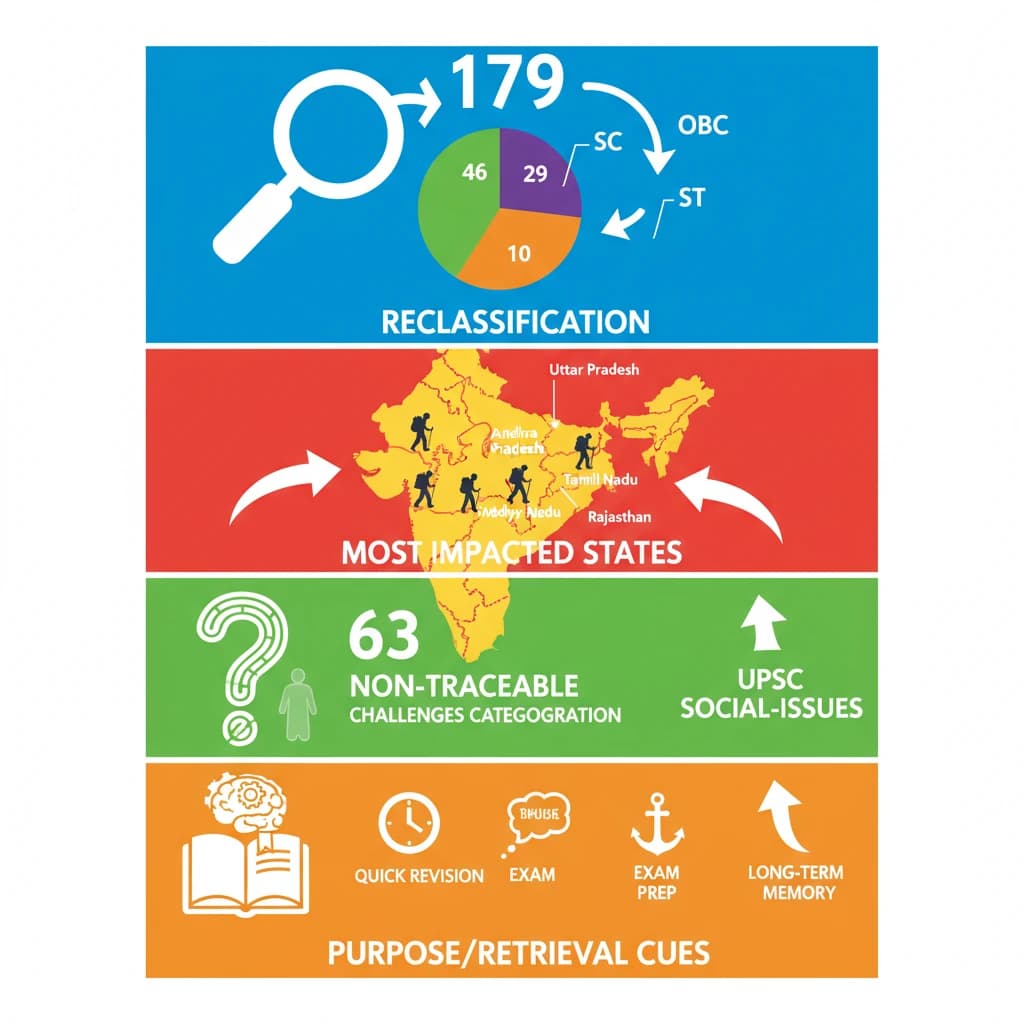
  • •Study proposes 179 new community additions: 46 OBC, 29 SC, 10 ST.
  • •Uttar Pradesh, Andhra Pradesh, Tamil Nadu, Madhya Pradesh, Rajasthan are most impacted states.
  • •63 communities found 'non-traceable' due to assimilation, name change, or migration.
  • •Study recommends correcting categorization of 9 existing misclassified communities.
  • •Highlights ongoing challenges in identifying and ensuring welfare for DNTs, NTs, SNTs.

🧠 Memory Techniques
Memory Aid
95% Verified Content

📚 Reference Sources

•Ministry of Social Justice and Empowerment (for general context on DNTs, NTs, SNTs)

Related Topics

Loading related topics...
Explore:Social Issues Topics·All Subjects·Daily Current Affairs·Editorial Analysis·Previous Year Questions·UPSC GPT
What are the Key Highlights of the Study on Denotified, Nomadic, and Semi-Nomadic Tribes? - UPSC Social Issues