Loading page, please wait…
Vaidra Logo
Vaidra

Top 4 items + smart groups

UPSC GPT
New
Current Affairs
Daily Solutions
Daily Puzzle
Mains Evaluator

Version 2.0.0 • Built with ❤️ for UPSC aspirants

Loading...
Loading...
Loading...
Loading...
Loading...
Loading...
Loading...
Loading...
Loading...
Loading...
Loading...
Loading...
Loading...
Back
All Subjects

Topics

0 topics • 0 completed

Loading topics...
Loading...
Loading...
Loading...
Loading...
Loading...
Overall Progress0%

Hindu Succession Act: Applicability and Scope - UPSC Social Issues

What is Hindu Succession Act: Applicability and Scope in UPSC Social Issues?

Hindu Succession Act: Applicability and Scope is a key topic under Social Issues for UPSC Civil Services Examination. Key points include: Hindu Succession Act, 1956, governs property inheritance for Hindus, Buddhists, Sikhs, and Jains.. It unifies inheritance rules previously governed by Mitakshara and Dayabhaga schools.. The Act does not automatically apply to Scheduled Tribes unless notified by the Central Government.. Understanding this topic is essential for both UPSC Prelims and Mains preparation.

Why is Hindu Succession Act: Applicability and Scope important for UPSC exam?

Hindu Succession Act: Applicability and Scope is a Medium-level topic in UPSC Social Issues. It is tested in both Prelims (factual MCQs) and Mains (analytical answer writing). Previous year UPSC questions have frequently covered aspects of Hindu Succession Act: Applicability and Scope, making it essential for comprehensive IAS preparation.

How to prepare Hindu Succession Act: Applicability and Scope for UPSC?

To prepare Hindu Succession Act: Applicability and Scope for UPSC: (1) Study the comprehensive notes covering all key concepts on Vaidra. (2) Practice previous year questions on this topic. (3) Connect it with current affairs using daily updates. (4) Revise using key takeaways and mind maps available for Social Issues. (5) Write practice answers linking Hindu Succession Act: Applicability and Scope to related GS Paper topics.

Key takeaways of Hindu Succession Act: Applicability and Scope for UPSC

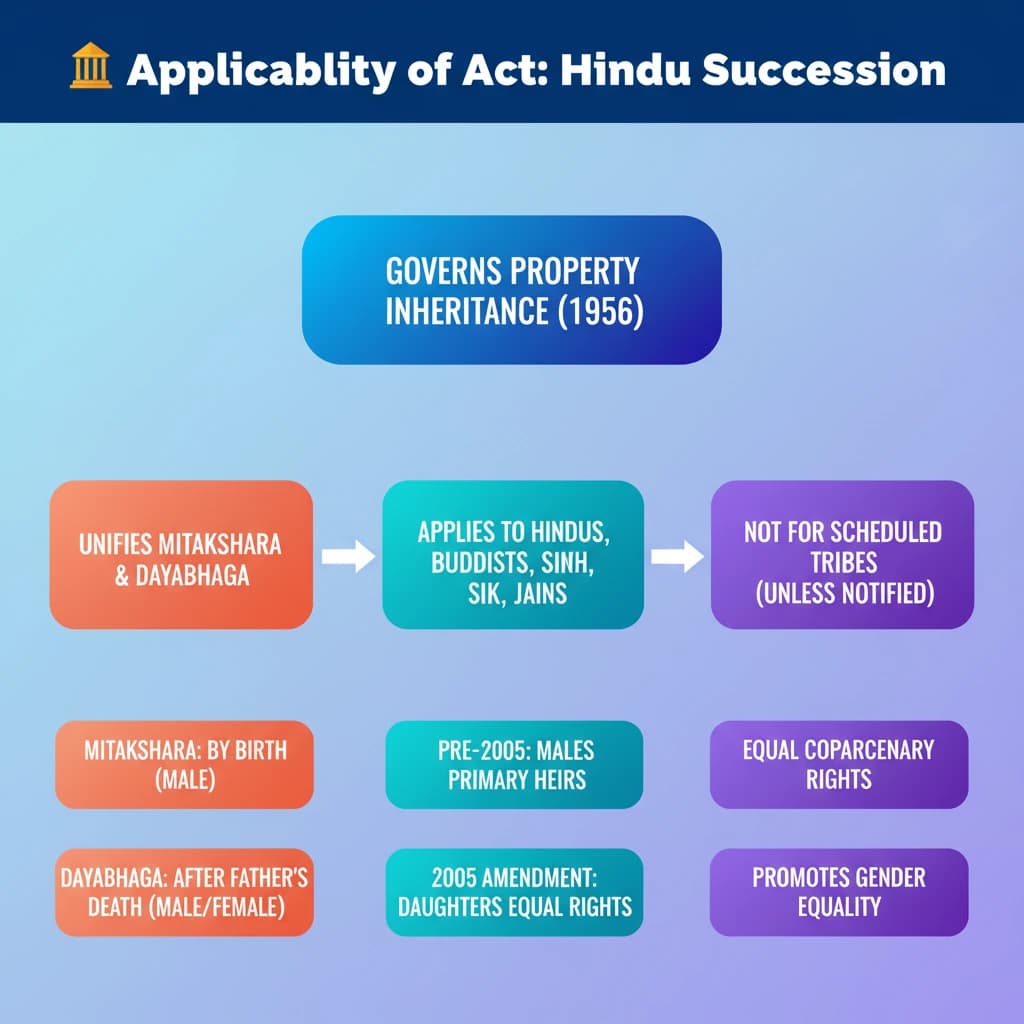
  • Hindu Succession Act, 1956, governs property inheritance for Hindus, Buddhists, Sikhs, and Jains.
  • It unifies inheritance rules previously governed by Mitakshara and Dayabhaga schools.
  • The Act does not automatically apply to Scheduled Tribes unless notified by the Central Government.
  • Mitakshara traditionally granted property rights by birth (males), Dayabhaga only after father's death (males/females as coparceners).
  • The 2005 amendment granted daughters equal coparcenary rights in ancestral property, significantly promoting gender equality.

Hindu Succession Act: Applicability and Scope

Hindu Succession Act: Applicability and Scope

Medium⏱️ 8 min read✓ 98% Verified
social issues

📖 Introduction

<h4>Introduction to the Hindu Succession Act</h4><p>The <strong>Hindu Succession Act</strong> establishes comprehensive rules for determining <strong>heirs</strong>, their respective <strong>rights</strong>, and the systematic <strong>division of property</strong>. This framework is crucial for ensuring clarity and fairness in inheritance matters.</p><p>It primarily governs the devolution of property based on the familial relationships of the deceased, aiming to create a uniform system across various communities.</p><h4>Applicability of the Act</h4><p>The Act's scope is broad, covering several religious groups within India. It is designed to provide a consistent legal framework for succession.</p><ul><li><strong>Hindus by religion</strong>, including specific sects such as <strong>Virashaivas</strong>, <strong>Lingayats</strong>, <strong>Brahmos</strong>, <strong>Prarthna Samajists</strong>, and <strong>Arya Samaj followers</strong>.</li><li><strong>Buddhists</strong>, <strong>Sikhs</strong>, and <strong>Jains by religion</strong> are also covered under the provisions of this Act.</li><li>The Act also applies to persons who are <strong>not Muslim, Christian, Parsi, or Jewish</strong>. However, this is conditional: it applies to them unless it can be proven that <strong>Hindu law or custom</strong> does not govern their inheritance.</li></ul><div class='info-box'><p>The <strong>Hindu Succession Act</strong> extends its jurisdiction <strong>across India</strong>. However, it does not automatically apply to <strong>Scheduled Tribes (STs)</strong> as per <strong>Article 366</strong> of the Constitution, unless specifically notified by the <strong>Central Government</strong>.</p></div><h4>Schools of Hindu Law and Unification</h4><p>Historically, Hindu law was governed by different schools, primarily <strong>Mitakshara</strong> and <strong>Dayabhaga</strong>. The Act plays a pivotal role in unifying these systems.</p><div class='key-point-box'><p>The <strong>Hindu Succession Act</strong> establishes a <strong>uniform system of inheritance</strong> and <strong>devolution of property</strong>. This system is equally applicable to areas traditionally governed by both the <strong>Mitakshara</strong> and <strong>Dayabhaga schools</strong> of Hindu Law, thereby harmonizing previous disparities.</p></div><h4>Distinction Between Mitakshara and Dayabhaga Schools</h4><p>Despite the unification, understanding the historical differences between these schools is crucial for contextualizing property rights.</p><ul><li>The <strong>Mitakshara Law</strong> traditionally applied to the <strong>whole of India</strong>, with the significant exceptions of <strong>West Bengal and Assam</strong>.</li><li>In contrast, the <strong>Dayabhaga Law</strong> was specifically applicable to the regions of <strong>West Bengal and Assam</strong>.</li></ul><div class='info-box'><p><strong>Key Differences:</strong></p><ul><li>Under <strong>Dayabhaga law</strong>, <strong>inheritance rights</strong> arise only <strong>after the father’s death</strong>.</li><li>Conversely, <strong>Mitakshara law</strong> grants <strong>property rights from birth</strong> itself.</li></ul></div><h4>Coparcenary Rights</h4><p>The concept of <strong>coparcenary</strong> is central to understanding property rights under these schools, particularly regarding ancestral property.</p><div class='info-box'><p>A <strong>coparcener</strong> is defined as a person who can claim a right over <strong>ancestral property</strong> by birth.</p></div><p>There is a significant distinction in coparcenary rights between the two schools:</p><ul><li>In the <strong>Dayabhaga system</strong>, both <strong>male and female family members</strong> can be <strong>coparceners</strong>.</li><li>However, the <strong>Mitakshara system</strong> traditionally restricted <strong>coparcenary rights</strong> exclusively to <strong>male members only</strong>. (Note: The 2005 amendment to the Hindu Succession Act significantly altered this for Mitakshara, granting equal rights to daughters).</li></ul><div class='exam-tip-box'><p>For <strong>UPSC Mains (GS-I/II)</strong>, understanding the historical context and the impact of the <strong>Hindu Succession Act, 1956</strong> (especially the <strong>2005 amendment</strong>) on <strong>gender equality</strong> in property rights is vital. Questions often focus on the evolution of personal laws and their social implications.</p></div>
Concept Diagram

💡 Key Takeaways

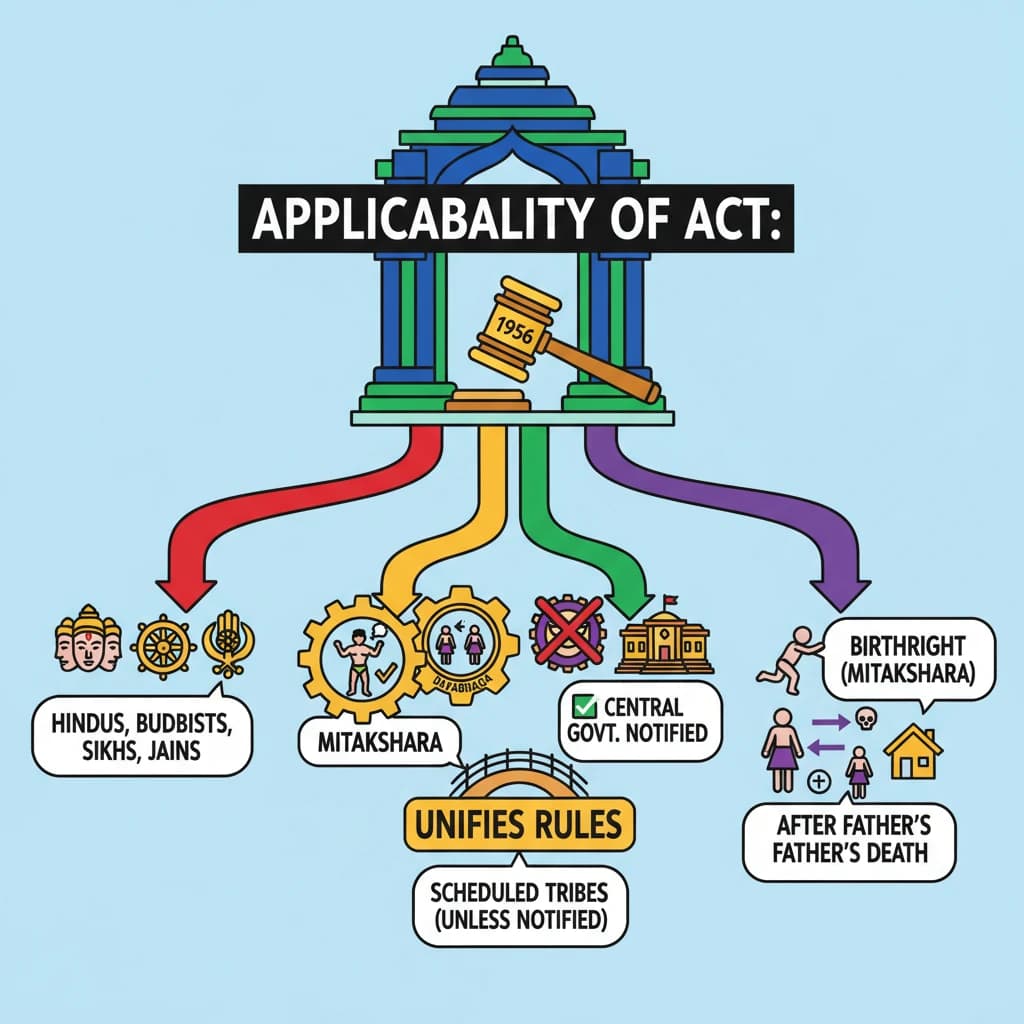
  • •Hindu Succession Act, 1956, governs property inheritance for Hindus, Buddhists, Sikhs, and Jains.
  • •It unifies inheritance rules previously governed by Mitakshara and Dayabhaga schools.
  • •The Act does not automatically apply to Scheduled Tribes unless notified by the Central Government.
  • •Mitakshara traditionally granted property rights by birth (males), Dayabhaga only after father's death (males/females as coparceners).
  • •The 2005 amendment granted daughters equal coparcenary rights in ancestral property, significantly promoting gender equality.

🧠 Memory Techniques
Memory Aid
98% Verified Content

📚 Reference Sources

•The Hindu Succession Act, 1956
•The Hindu Succession (Amendment) Act, 2005
•Constitution of India (Article 366)

Related Topics

Loading related topics...
Explore:Social Issues Topics·All Subjects·Daily Current Affairs·Editorial Analysis·Previous Year Questions·UPSC GPT
Hindu Succession Act: Applicability and Scope - UPSC Social Issues