Loading page, please wait…
Fundamental Rights: Sex Workers' Rights - Gaurav Jain Case - UPSC Social Issues
What is Fundamental Rights: Sex Workers' Rights - Gaurav Jain Case in UPSC Social Issues?
Fundamental Rights: Sex Workers' Rights - Gaurav Jain Case is a key topic under Social Issues for UPSC Civil Services Examination. Key points include: Gaurav Jain vs Union Of India (1997) recognized fundamental and human rights of sex workers.. The Supreme Court affirmed sex workers' rights to dignity and legal protection.. Children of sex workers have rights to equality, dignity, care, protection, and rehabilitation.. Understanding this topic is essential for both UPSC Prelims and Mains preparation.
Why is Fundamental Rights: Sex Workers' Rights - Gaurav Jain Case important for UPSC exam?
Fundamental Rights: Sex Workers' Rights - Gaurav Jain Case is a Medium-level topic in UPSC Social Issues. It is tested in both Prelims (factual MCQs) and Mains (analytical answer writing). Previous year UPSC questions have frequently covered aspects of Fundamental Rights: Sex Workers' Rights - Gaurav Jain Case, making it essential for comprehensive IAS preparation.
How to prepare Fundamental Rights: Sex Workers' Rights - Gaurav Jain Case for UPSC?
To prepare Fundamental Rights: Sex Workers' Rights - Gaurav Jain Case for UPSC: (1) Study the comprehensive notes covering all key concepts on Vaidra. (2) Practice previous year questions on this topic. (3) Connect it with current affairs using daily updates. (4) Revise using key takeaways and mind maps available for Social Issues. (5) Write practice answers linking Fundamental Rights: Sex Workers' Rights - Gaurav Jain Case to related GS Paper topics.
Key takeaways of Fundamental Rights: Sex Workers' Rights - Gaurav Jain Case for UPSC
- Gaurav Jain vs Union Of India (1997) recognized fundamental and human rights of sex workers.
- The Supreme Court affirmed sex workers' rights to dignity and legal protection.
- Children of sex workers have rights to equality, dignity, care, protection, and rehabilitation.
- Crucially, children must be part of the 'mainstream of social life' without 'pre-stigma'.
- The judgment exemplifies judicial activism in upholding rights for marginalized communities.

Fundamental Rights: Sex Workers' Rights - Gaurav Jain Case
Medium⏱️ 4 min read
social issues
📖 Introduction
Introduction to Rights of Sex Workers
The topic delves into the crucial intersection of Fundamental and Human Rights with the lives of sex workers and their families in India.
It highlights the judiciary's role in upholding the dignity and protection of often marginalized groups, ensuring their inclusion under the ambit of constitutional guarantees.
Supreme Court's Landmark Ruling: Gaurav Jain vs Union Of India (1997)
In a significant judgment delivered in 1997, the Supreme Court of India addressed the rights of sex workers.
The specific case was titled Gaurav Jain vs Union Of India And Ors, which became a pivotal moment in recognizing the rights of this vulnerable community.
The Court unequivocally recognized the fundamental and human rights of sex workers, asserting their entitlement to dignity and protection under the law.
This ruling was crucial as it challenged societal prejudices and affirmed that constitutional rights extend to all individuals, irrespective of their profession or social standing.
Rights of Children of Sex Workers
Beyond the rights of adult sex workers, the Supreme Court's judgment also focused extensively on their children.
The Court emphasized that these children have a right to equality of opportunity, ensuring they are not discriminated against due to their parents' occupation.
Key rights recognized for the children of sex workers included:
- Dignity and respect, free from societal judgment.
- Adequate care and protection from exploitation.
- Comprehensive rehabilitation to integrate them into society.
A core directive was for these children to be part of the 'mainstream of social life' without any attached 'pre-stigma', underscoring the need for social acceptance and non-discrimination.
This case is highly relevant for UPSC Mains GS-I (Social Issues) and GS-II (Polity & Governance), particularly concerning vulnerable sections, judicial activism, and the interpretation of Fundamental Rights.
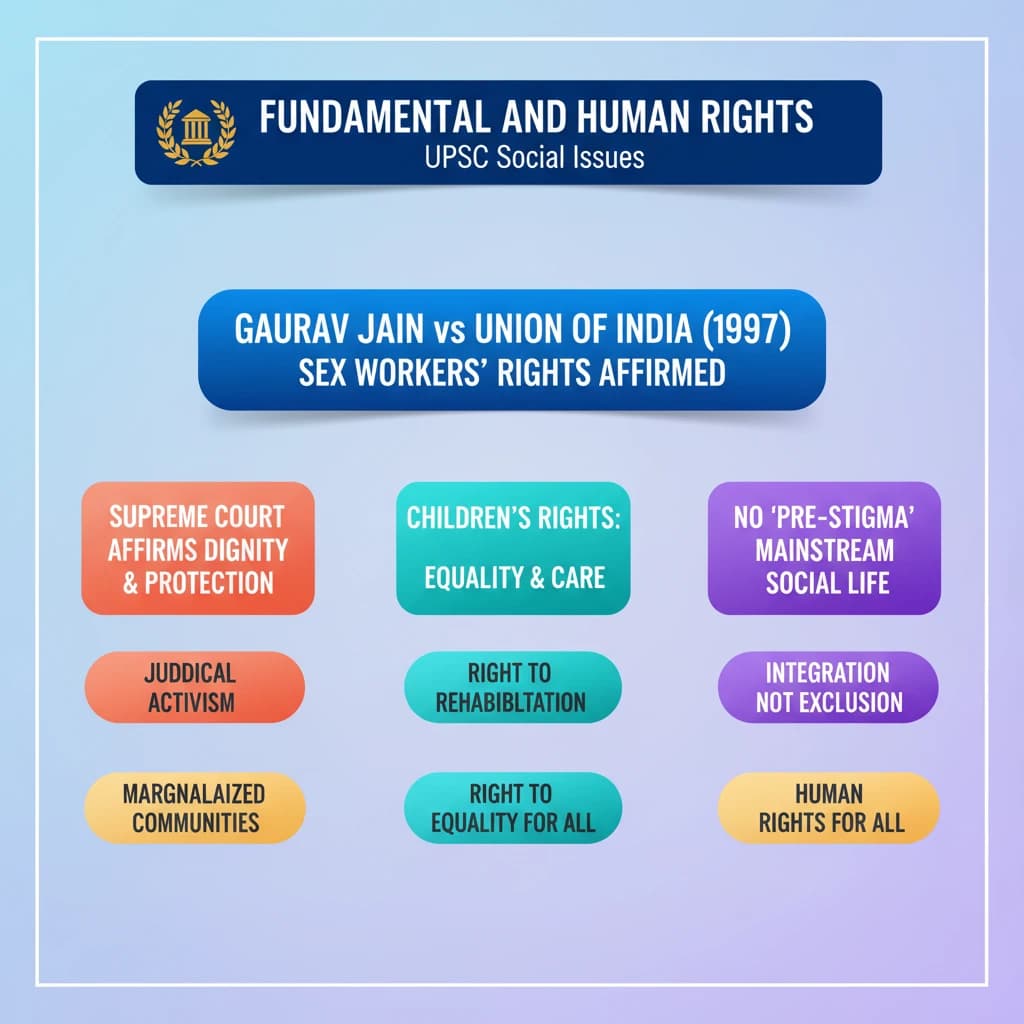
💡 Key Takeaways
- •Gaurav Jain vs Union Of India (1997) recognized fundamental and human rights of sex workers.
- •The Supreme Court affirmed sex workers' rights to dignity and legal protection.
- •Children of sex workers have rights to equality, dignity, care, protection, and rehabilitation.
- •Crucially, children must be part of the 'mainstream of social life' without 'pre-stigma'.
- •The judgment exemplifies judicial activism in upholding rights for marginalized communities.
🧠 Memory Techniques

98% Verified Content
📚 Reference Sources
•Gaurav Jain vs Union Of India And Ors, 1997 (6 SCC 241) - Supreme Court of India judgment
•Indian Constitution (Articles 14, 15, 21)