Loading page, please wait…
Global Polio Resurgence - UPSC Social Issues
What is Global Polio Resurgence in UPSC Social Issues?
Global Polio Resurgence is a key topic under Social Issues for UPSC Civil Services Examination. Key points include: Global polio resurgence is a critical concern, with recent detections in Pakistan, Cameroon, and European nations.. New research suggests poliovirus may be primarily transmitted via the respiratory route, challenging traditional understanding.. Oral Polio Vaccine (OPV) can lead to vaccine-derived poliovirus (cVDPV) outbreaks, complicating eradication efforts.. Understanding this topic is essential for both UPSC Prelims and Mains preparation.
Why is Global Polio Resurgence important for UPSC exam?
Global Polio Resurgence is a Medium-level topic in UPSC Social Issues. It is tested in both Prelims (factual MCQs) and Mains (analytical answer writing). Previous year UPSC questions have frequently covered aspects of Global Polio Resurgence, making it essential for comprehensive IAS preparation.
How to prepare Global Polio Resurgence for UPSC?
To prepare Global Polio Resurgence for UPSC: (1) Study the comprehensive notes covering all key concepts on Vaidra. (2) Practice previous year questions on this topic. (3) Connect it with current affairs using daily updates. (4) Revise using key takeaways and mind maps available for Social Issues. (5) Write practice answers linking Global Polio Resurgence to related GS Paper topics.
Key takeaways of Global Polio Resurgence for UPSC
- Global polio resurgence is a critical concern, with recent detections in Pakistan, Cameroon, and European nations.
- New research suggests poliovirus may be primarily transmitted via the respiratory route, challenging traditional understanding.
- Oral Polio Vaccine (OPV) can lead to vaccine-derived poliovirus (cVDPV) outbreaks, complicating eradication efforts.
- Inactivated Polio Vaccine (IPV) is non-transmissible and provides effective protection against paralysis, driving a global transition.
- The 'OPV Switch' in April 2016 replaced trivalent OPV (tOPV) with bivalent OPV (bOPV) to reduce cVDPV2 risks.
- Polio eradication requires sustained global vaccination efforts, robust surveillance, and addressing vaccine hesitancy.
- India's polio-free status highlights successful public health campaigns but also the need for continuous vigilance.
Global Polio Resurgence
Medium⏱️ 8 min read
social issues
📖 Introduction
Global Polio Resurgence: An Overview
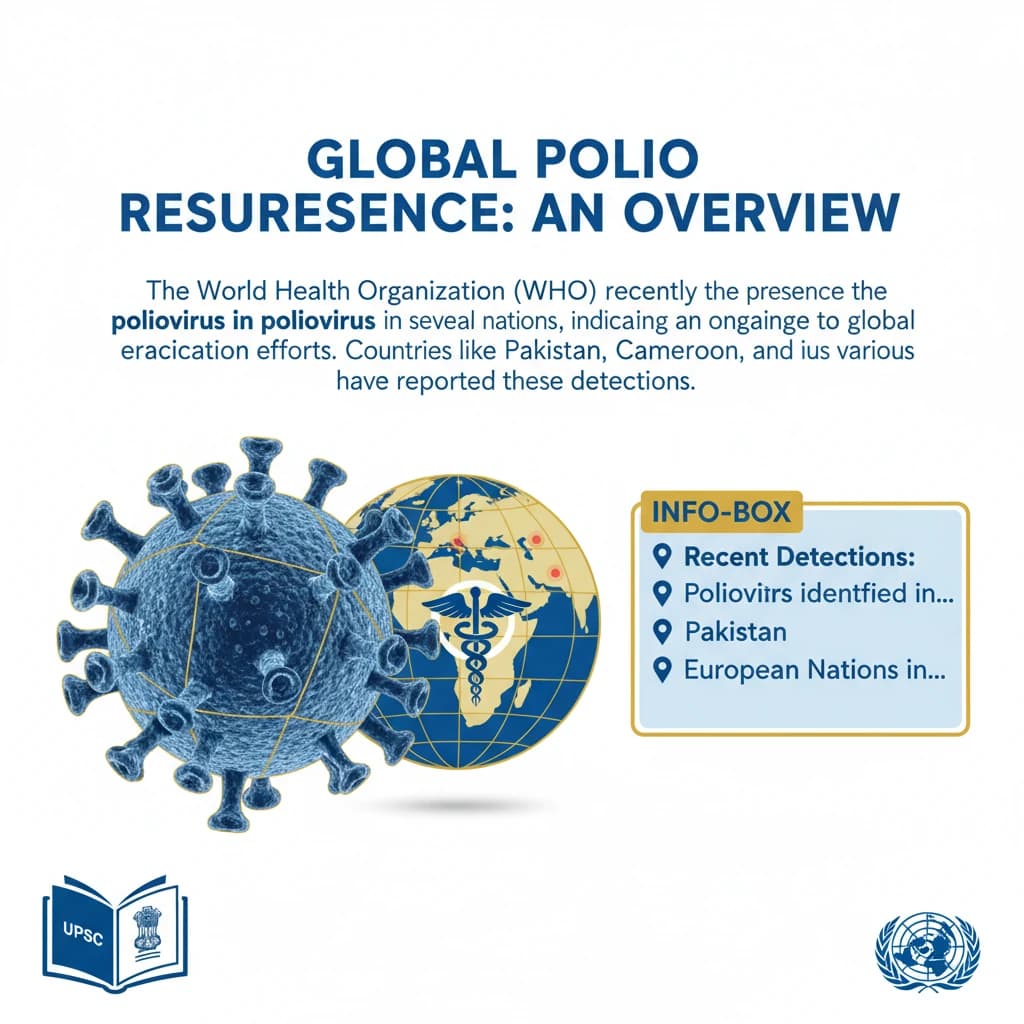
The World Health Organization (WHO) recently confirmed the presence of poliovirus in several nations, indicating an ongoing challenge to global eradication efforts. Countries like Pakistan, Cameroon, and various European nations have reported these detections.
📍 Recent Detections: Poliovirus identified in Pakistan, Cameroon, and several European nations by WHO, highlighting persistent circulation.
Evolving Understanding of Poliovirus Transmission
Traditional understanding suggested poliovirus primarily spreads via the faecal-oral route. However, recent research indicates a potential shift in the primary mode of transmission.
New findings suggest that the virus may be predominantly transmitted through the respiratory route. This challenges long-held assumptions and has implications for public health strategies.
💡 Key Shift: Poliovirus transmission may be primarily via the respiratory route, not just the traditional faecal-oral route, impacting containment strategies.
The Imperative for Vaccine Transition: IPV over OPV
Recent assessments underscore the critical need to transition towards the Inactivated Polio Vaccine (IPV). IPV is considered non-transmissible and offers robust protection against poliovirus-induced paralysis.
The Oral Polio Vaccine (OPV), while effective, has been associated with outbreaks of vaccine-derived poliovirus cases (cVDPV). These cases significantly complicate global eradication efforts by reintroducing the virus.
⚡ UPSC Insight: The shift from OPV to IPV and the challenges of cVDPV are crucial topics for GS Paper II (Health) and GS Paper III (Science & Technology), often appearing in questions on public health policy.
Understanding Polio (Poliomyelitis)
Polio, or poliomyelitis, is a highly contagious viral disease. It predominantly affects children under five years of age, making them particularly vulnerable.
The virus invades the nervous system, potentially leading to paralysis. It traditionally spreads through the faecal-oral route or via contaminated food and water.
🦠 Polio Definition: A highly contagious viral disease, mainly affecting children under five, capable of causing paralysis by invading the nervous system.
Types of Wild Poliovirus Strains
There are three distinct and immunologically individual wild poliovirus strains. These strains are categorized based on their antigenic properties.
- Wild Poliovirus type 1 (WPV1)
- Wild Poliovirus type 2 (WPV2)
- Wild Poliovirus type 3 (WPV3)
Types of Polio Vaccines
Several types of vaccines have been developed to combat polio, each with different characteristics and applications in eradication strategies.
- Inactivated Polio Vaccine (IPV): This vaccine protects against poliovirus types 1, 2, and 3. It uses an inactivated (killed) virus and is administered by injection.
- Trivalent Oral Polio Vaccine (tOPV): Historically, tOPV protected against poliovirus types 1, 2, and 3. It is no longer in use following the global “OPV Switch” in April 2016.
- Bivalent Oral Polio Vaccine (bOPV): This vaccine protects against poliovirus types 1 and 3. It replaced tOPV after the OPV Switch to reduce the risk of cVDPV2.
- Monovalent Oral Polio Vaccines (mOPV1, mOPV2, mOPV3): These vaccines protect against each individual type of poliovirus respectively. For example, mOPV1 targets WPV1.
📅 OPV Switch (April 2016): A global initiative to replace tOPV with bOPV. This was critical as WPV2 had been eradicated, and tOPV’s Type 2 component was the source of most cVDPV2 outbreaks.
IPV vs. OPV: A Comparative Analysis
| Feature | Inactivated Polio Vaccine (IPV) | Oral Polio Vaccine (OPV) |
|---|---|---|
| Virus Type | Contains inactivated (dead) virus particles. | Contains live, attenuated (weakened) poliovirus. |
| Risk of Vaccine-derived Polio | No risk of causing vaccine-induced polio. | Rare risk of reversion to a virulent form, causing cVDPV outbreaks. |
| Safety for Immunocompromised | Safe for individuals with weakened immune systems. | Not safe for immunocompromised individuals due to live virus. |
| Immunity Duration | Provides durable immunity, but requires multiple boosters. | Immunity may be shorter-lasting, potentially requiring additional doses. |
| Mucosal Immunity | Limited mucosal immunity, less effective at preventing virus transmission. | Strong mucosal immunity (especially in intestines), reducing virus transmission. |
| Cost | Higher cost to produce and administer. | Lower cost to produce and distribute, more accessible. |
| Doses Required | Typically requires 2-4 shots for full immunity. | Usually requires one or a few doses for effective immunity. |
💡 Key Takeaways
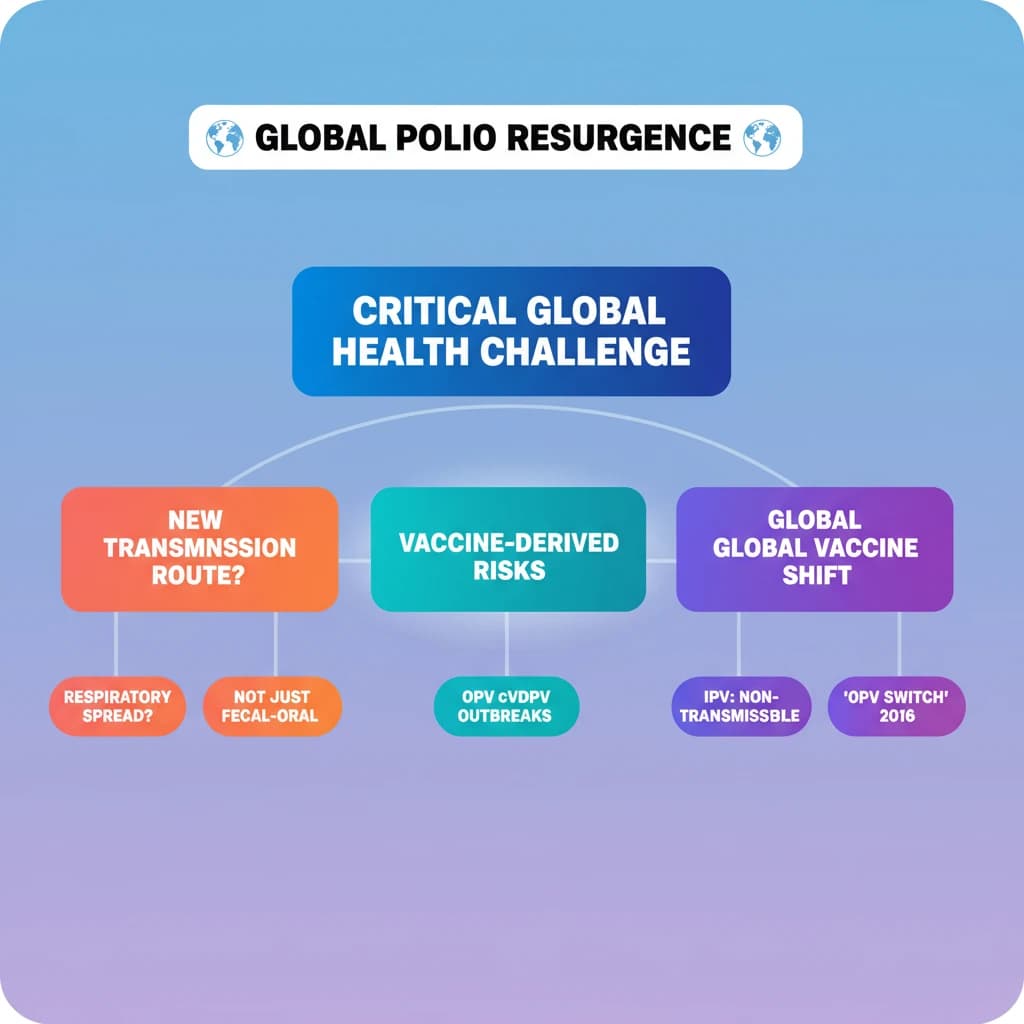
- •Global polio resurgence is a critical concern, with recent detections in Pakistan, Cameroon, and European nations.
- •New research suggests poliovirus may be primarily transmitted via the respiratory route, challenging traditional understanding.
- •Oral Polio Vaccine (OPV) can lead to vaccine-derived poliovirus (cVDPV) outbreaks, complicating eradication efforts.
- •Inactivated Polio Vaccine (IPV) is non-transmissible and provides effective protection against paralysis, driving a global transition.
- •The 'OPV Switch' in April 2016 replaced trivalent OPV (tOPV) with bivalent OPV (bOPV) to reduce cVDPV2 risks.
- •Polio eradication requires sustained global vaccination efforts, robust surveillance, and addressing vaccine hesitancy.
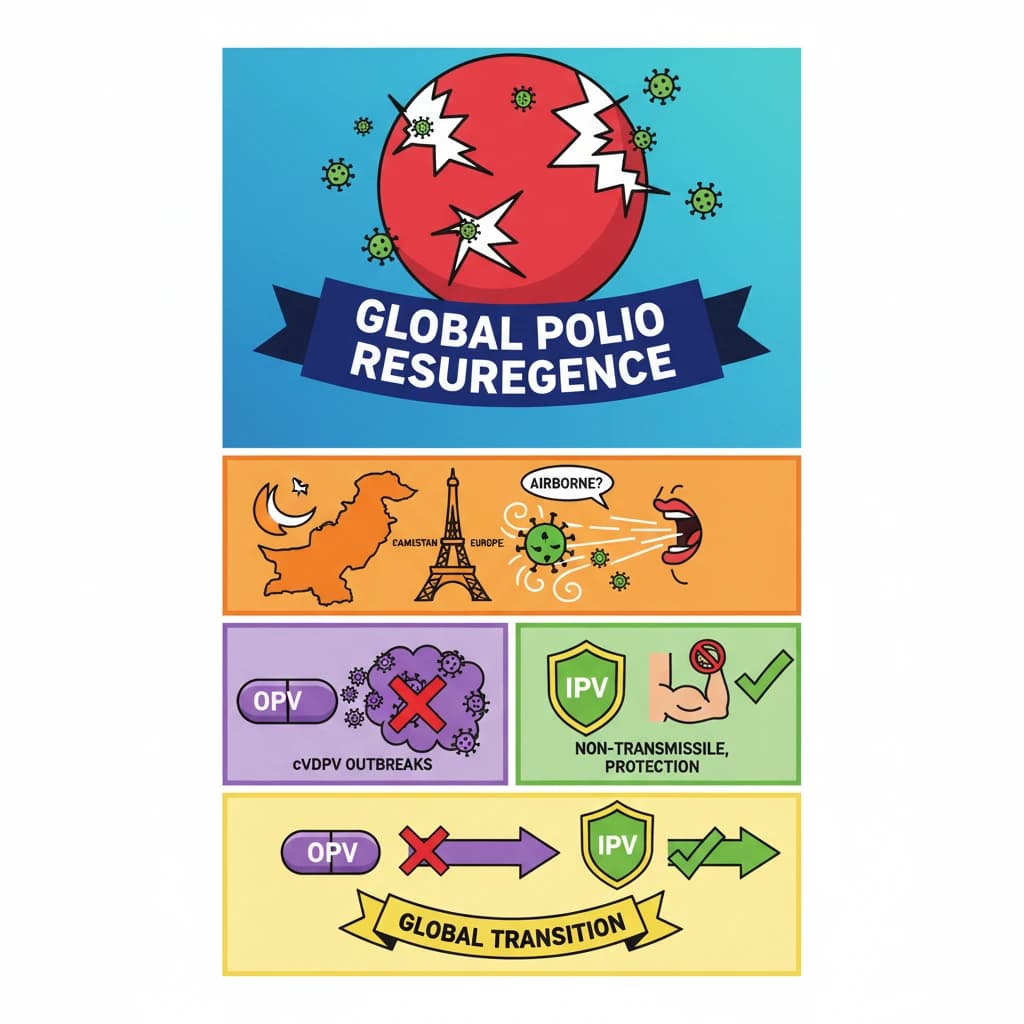
- •India's polio-free status highlights successful public health campaigns but also the need for continuous vigilance.
🧠 Memory Techniques
95% Verified Content
📚 Reference Sources
•World Health Organization (WHO) official reports and guidelines on Polio Eradication
•Global Polio Eradication Initiative (GPEI) publications