Loading page, please wait…
Health, Nutrition & Education - UPSC Social Issues
What is Health, Nutrition & Education in UPSC Social Issues?
Health, Nutrition & Education is a key topic under Social Issues for UPSC Civil Services Examination. Key points include: ASER 2024 highlights improving pre-primary enrollment and digital access but persistent learning gaps in rural elementary education.. Global Nutrition Targets (GNTs) show slow worldwide progress, with India facing static anaemia rates and rising childhood overweight.. Elementary education is foundational for holistic development but suffers from infrastructure, teacher, and social disparity challenges.. Understanding this topic is essential for both UPSC Prelims and Mains preparation.
Why is Health, Nutrition & Education important for UPSC exam?
Health, Nutrition & Education is a Medium-level topic in UPSC Social Issues. It is tested in both Prelims (factual MCQs) and Mains (analytical answer writing). Previous year UPSC questions have frequently covered aspects of Health, Nutrition & Education, making it essential for comprehensive IAS preparation.
How to prepare Health, Nutrition & Education for UPSC?
To prepare Health, Nutrition & Education for UPSC: (1) Study the comprehensive notes covering all key concepts on Vaidra. (2) Practice previous year questions on this topic. (3) Connect it with current affairs using daily updates. (4) Revise using key takeaways and mind maps available for Social Issues. (5) Write practice answers linking Health, Nutrition & Education to related GS Paper topics.
Key takeaways of Health, Nutrition & Education for UPSC
- ASER 2024 highlights improving pre-primary enrollment and digital access but persistent learning gaps in rural elementary education.
- Global Nutrition Targets (GNTs) show slow worldwide progress, with India facing static anaemia rates and rising childhood overweight.
- Elementary education is foundational for holistic development but suffers from infrastructure, teacher, and social disparity challenges.
- Malnutrition presents a dual burden: undernutrition (stunting, wasting) alongside overnutrition (obesity, metabolic overnutrition).
- Accurate data (e.g., venous vs. capillary blood for anaemia) is crucial for effective policy formulation and intervention.
- Government initiatives like NEP 2020, Mission Poshan 2.0, and PM SHRI schools are key to addressing these intertwined issues.
Health, Nutrition & Education
Medium⏱️ 15 min read
social issues
📖 Introduction
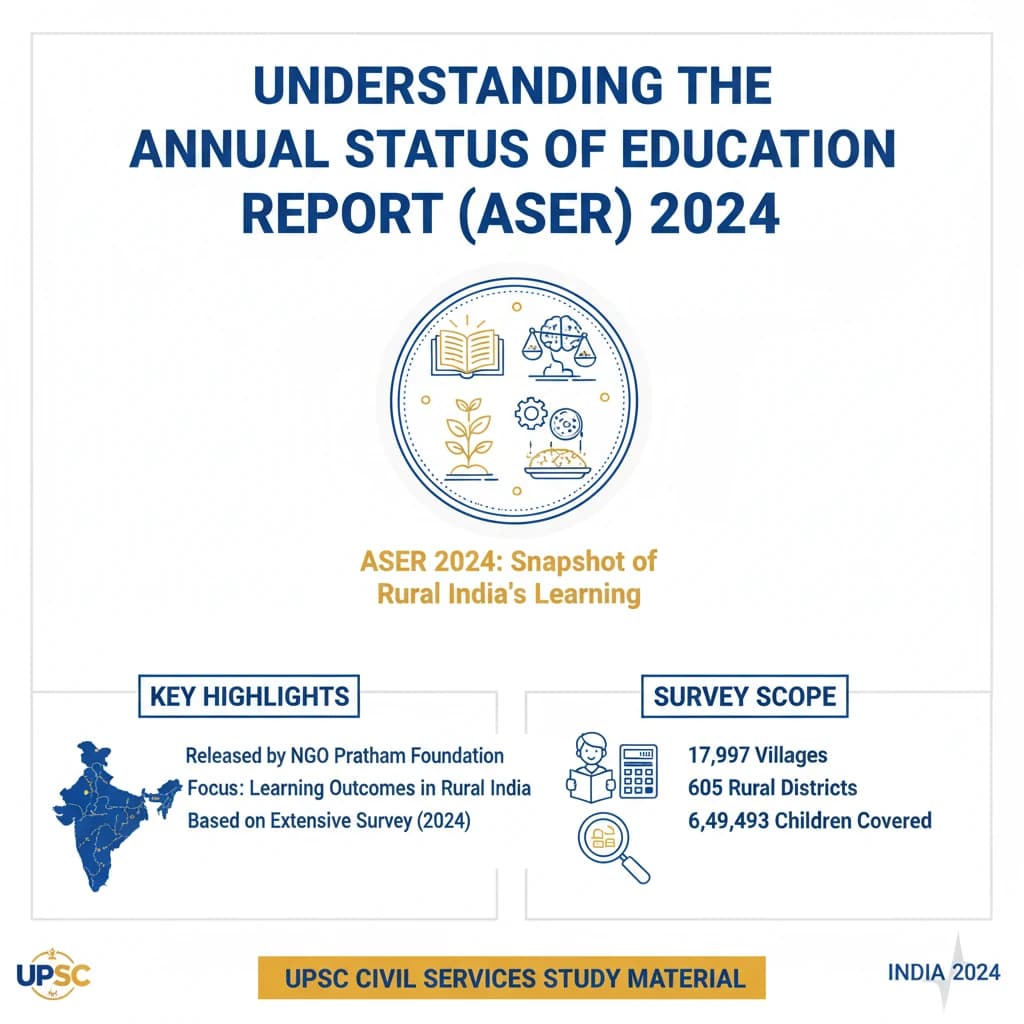
Understanding the Annual Status of Education Report (ASER) 2024
The Annual Status of Education Report (ASER) 2024, released by the NGO Pratham Foundation, provides a crucial snapshot of learning outcomes among school students in rural India.
This report is based on an extensive survey conducted in 17,997 villages across 605 rural districts in 2024. It covered 6,49,493 children aged 3-16 years and assessed the basic reading and arithmetic skills of over 500,000 children aged 5-16 years.
What is ASER?
- About: ASER is a nationwide, citizen-led household survey that offers an insightful snapshot of children’s schooling and learning in rural India.
- Launch: It was launched in 2005 and has since tracked educational trends and challenges, evolving in its coverage, focus, and frequency.
Key Focus Areas of ASER
- Enrollment: ASER meticulously tracks school and preschool enrollment trends, highlighting improvements and challenges across different states and age groups.
- Learning Outcomes: It assesses fundamental reading and arithmetic skills, demonstrating children's progress at both primary and secondary levels.
- Digital Literacy: The ASER 2024 report specifically evaluates older children’s smartphone skills, including practical tasks like creating albums, browsing, and messaging.
Key Findings of ASER 2024 Report
Pre-primary (Age Group 3-5 Years): Enrollment in pre-primary institutions (Anganwadi, government pre-primary classes, or private LKG/UKG) has shown a consistent increase since 2018.
- Enrollment Rise: For instance, the enrollment of 3-year-olds rose significantly from 68.1% in 2018 to 77.4% in 2024.
- Main Provider: Anganwadi centres remain the primary provider of pre-primary education, enrolling over half of 3-4-year-olds.
- Private Sector: Approximately one-third of 5-year-olds attend private schools or preschools.
Elementary (Age Group 6-14 Years): While overall enrollment saw a slight dip, there were notable shifts in learning outcomes.
- Overall Enrollment: Slightly decreased from 98.4% in 2022 to 98.1% in 2024.
- Government School Enrollment: Declined from 72.9% to 66.8%.
In terms of skills, arithmetic abilities showed more improvement than reading skills, with government schools making faster progress.
- Reading Skills (Std III): 23.4% of Standard III children in government schools could read Std II-level text in 2024, an increase from 16.3% in 2022.
- Arithmetic Skills (Std VIII): 45.6% of Std VIII students could solve basic arithmetic problems in 2024, indicating a slight improvement.
Older Children (Age Group 15-16 Years): The report highlights positive trends in enrollment and increasing smartphone access.
- Dropout Rate Decrease: The dropout rate for 15-16-year-olds decreased from 13.1% in 2018 to 7.9% in 2024.
- Gender Disparity: Girls still showed a slightly higher dropout rate at 8.1%.
Smartphone Access and Usage (Digital Literacy): Digital literacy is becoming increasingly prevalent among older children.
- Access: Nearly 90% of 14-16-year-olds have smartphone access, with boys (85.5%) using them more than girls (79.4%).
- Ownership: 27% of 14-year-olds and 37.8% of 16-year-olds own smartphones.
- Usage: 82.2% of children use smartphones, with 57% for education and 76% for social media.
- Digital Safety: 62% of children know how to block/report profiles, and 55.2% know how to make profiles private.
School Observations: Improvements were noted in various aspects of school functioning and facilities.
- Foundational Literacy and Numeracy (FLN): Over 80% of schools implemented FLN activities, and 75% of these schools had at least one teacher who received FLN training.
- Attendance: Student attendance increased from 72.1% in 2018 to 75.8% in 2024, while teacher attendance rose from 85.1% to 87.5%.
- School Facilities: There were slight improvements in basic school facilities:
- Usable girls’ toilets increased from 66.4% in 2018 to 72% in 2024.
- Drinking water availability rose from 74.8% to 77.7%.
- The use of non-textbook books (e.g., novels, short stories) by students increased from 36.9% to 51.3%.
- The percentage of schools with playgrounds remained stable at around 66%.
State-Level Differences in Outcomes: The report highlighted significant variations in learning outcomes and improvement across states, particularly in the post-Covid-19 pandemic period.
- In Std III, reading ability lagged behind 2018 levels in over half the states, although arithmetic improved in all but six.
- In Std V and Std VIII, many states did not reach pre-pandemic levels, even in arithmetic.
Understanding Elementary Education
Elementary Education forms the fundamental bedrock of the entire educational system, typically commencing around the age of six.
Definition: It marks the beginning of formal education and is crucial for a child’s holistic development, encompassing their physical, mental, emotional, intellectual, and social growth.
Significance of Elementary Education
- Foundation for Future Learning: It imparts core skills such as reading, writing, mathematics, and problem-solving, which are essential for higher education and future careers.
- Development of Social Skills: Children learn teamwork, communication, and empathy through interactions with peers and teachers.
- Personal and Emotional Growth: It helps build self-confidence and motivation, enabling children to explore their potential and creativity.
- Promotion of Motor Skills: Activities like sports and creative expression aid in the development of both fine and gross motor skills.
- Building Social Awareness: Children are introduced to concepts of hygiene, social responsibilities, and civic duties, fostering informed future citizens.
- Long-Term Economic Impact: Robust investment in elementary education is a key driver of economic growth, innovation, and productivity.
Challenges in Elementary Education
Despite progress, several significant challenges persist in the elementary education sector.
- Poor School Infrastructure:
- Of over 14.71 lakh schools in India, 1.52 lakh lack functional electricity, impeding the use of technology.
- 62,000 schools, including 46,000 government-run, lack functional toilets.
- Only 3.37 lakh government schools (33.2%) have disabled-friendly toilets, with less than a third being functional.
- Limited Access to Technology: Only 43.5% of government schools have computers for teaching, significantly lower than 70.9% in privately aided schools.
- Poor Teacher-Student Ratio: India has nearly 1 lakh schools with just one teacher each, impacting quality of instruction.
- Social Divides: Disparities based on caste-class, rural-urban, religious, and gender continue to affect educational quality.
- Language Barriers: A lack of textbooks and materials in regional languages limits education access for non-Hindi/English speakers.
UPSC Insight: Connecting ASER to Policy
The findings of ASER reports are critical for UPSC aspirants. They provide empirical data to support arguments on the state of education, challenges, and the effectiveness of government schemes. When discussing GS-II Social Justice (Education), referencing ASER data can significantly enhance your answer's credibility and analytical depth. Be prepared to cite specific statistics for mains answers.
Government Initiatives Related to Education
India has launched several flagship programs to address educational challenges and promote learning outcomes.
- National Programme on Technology Enhanced Learning (NPTEL)
- Sarva Shiksha Abhiyan (SSA)
- PRAGYATA Guidelines
- Mid Day Meal Scheme (PM-POSHAN)
- Beti Bachao Beti Padhao
- PM SHRI Schools
- National Education Policy (NEP) 2020
Global Nutrition Targets (GNTs) and India's Progress
A recent Lancet study evaluated global progress on Global Nutrition Targets (GNTs) from 2012 to 2021, revealing slow progress in tackling maternal and child malnutrition.
This study highlighted persistent issues of undernutrition, overweight, and other forms of malnutrition worldwide.
What are Global Nutrition Targets?
The World Health Assembly (WHA) Resolution in 2012 endorsed a Comprehensive Implementation Plan on maternal, infant, and young child nutrition. This plan established six global nutrition targets to be achieved by 2025.
The Six Global Nutrition Targets (GNTs)
- Achieve a 40% reduction in the number of children under-5 who are stunted.
- Achieve a 50% reduction in anaemia in women of reproductive age.
- Achieve a 30% reduction in low birth weight.
- Ensure that there is no increase in childhood overweight.
- Increase the rate of exclusive breastfeeding in the first 6 months to at least 50%.
- Reduce and maintain childhood wasting to less than 5%.
Key Terms in Nutrition
- Malnutrition: An imbalance between the nutrients the body needs and the nutrients it receives. It encompasses both undernutrition (stunting, wasting, underweight) and overnutrition (overweight and obesity), creating a dual burden on public health.
- Anaemia: A condition characterized by low red blood cells or haemoglobin, which reduces oxygen supply to tissues. It predominantly affects women and children.
Key Findings of the Lancet Study on GNTs
Slow and Insufficient Progress: The study found that across 204 countries, progress in meeting GNTs from 2012 to 2021 has been slow and insufficient. Projections up to 2050 show limited success.
- Few countries are expected to meet the targets for stunting in children under 5.
- None of the countries are projected to meet targets for low birth weight, anaemia, and childhood overweight by 2030.
Anaemia and India: India's fight against anaemia has seen minimal progress over two decades, with complex underlying causes.
- Static Prevalence: Anaemia in India has remained largely static for two decades.
- Beyond Iron Deficiency: While iron deficiency is often assumed to be the sole cause, it accounts for only about one-third of anaemia cases. A significant portion (another third) is due to unknown causes.
- Impact of COVID-19: Anaemia prevalence increased during the Covid-19 lockdown, partly due to the cessation of school meals (Midday Meal Scheme), highlighting the need for a broader nutrition approach.
- Measurement Discrepancies: The study found discrepancies in anaemia measurements. In India, venous blood-based anaemia prevalence (WHO recommended) was half that of capillary blood-based prevalence in national surveys.
Stunting: Stunting is a critical issue that develops early in a child's life.
- Early Onset: Stunting often develops within the first two years of life, increasing from 7–8% at birth to 40% by age two in India.
- Overfeeding Misconception: Overfeeding children after age 2 years may lead to them becoming overweight rather than correcting stunting.
- Fat Intake Deficiency: Indian children consume only 17 grams of fat per day, significantly below the required 30–40 grams.
Childhood Overweight: Childhood overweight is a growing global concern, including in India, leading to long-term health issues.
- Global Increase: Overweight among children is increasing globally.
- Metabolic Overnutrition: A significant portion of Indian children (50%) face metabolic overnutrition, which contributes to chronic health problems like non-communicable diseases (NCDs).
Recommendations for Addressing Malnutrition
The Lancet study provided key recommendations for more effective interventions.
- Diversify Diets: To address anaemia, diets need to be diversified, as it is not solely caused by iron deficiency.
- Early Stunting Prevention: Focus on preventing stunting specifically in the first two years of life.
- Improve Energy Intake: Enhance energy intake, particularly fat intake, for children under 3 years of age.
- Accurate Measurement: Adopt more accurate and context-specific methods for measuring anaemia and stunting.
- Holistic Policy: Address both undernutrition and overnutrition in policy frameworks to prevent non-communicable diseases.
UPSC Insight: Dual Burden of Malnutrition
The concept of the "dual burden of malnutrition" (undernutrition and overnutrition coexisting) is a frequently tested topic in GS-II Social Justice (Health). Understanding the nuances, such as discrepancies in anaemia measurement and the fat intake deficiency alongside rising childhood overweight, provides a comprehensive view for your answers. Always suggest multi-sectoral approaches in your solutions.
India’s Initiatives Related to Nutrition
The Indian government has implemented several schemes to combat malnutrition across various age groups.
- Mission Poshan 2.0
- Integrated Child Development Services (ICDS) Scheme
- Pradhan Mantri Matru Vandana Yojana (PMMVY)
- Mid-Day Meal Scheme (now PM-POSHAN)
- Scheme for Adolescent Girls (SAG)
- Mother’s Absolute Affection (MAA)
- Poshan Vatikas
💡 Key Takeaways
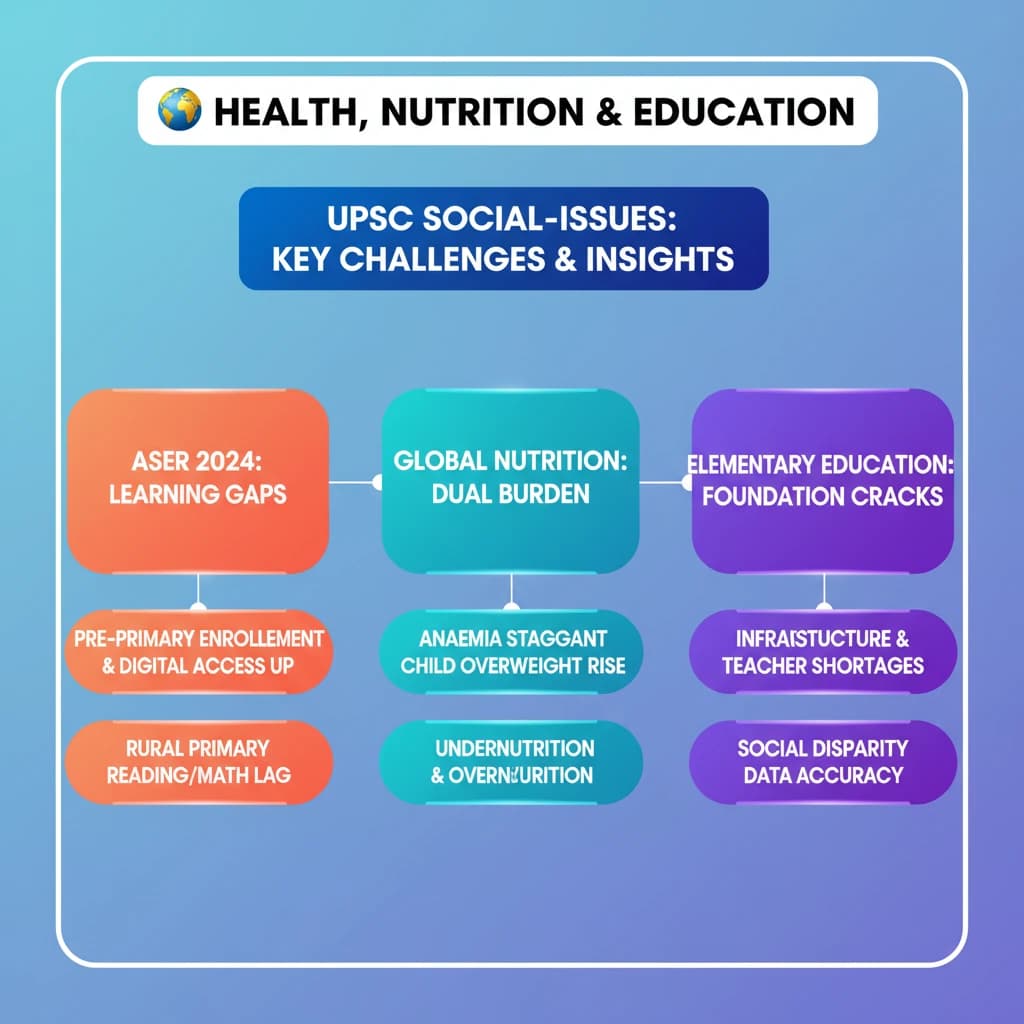
- •ASER 2024 highlights improving pre-primary enrollment and digital access but persistent learning gaps in rural elementary education.
- •Global Nutrition Targets (GNTs) show slow worldwide progress, with India facing static anaemia rates and rising childhood overweight.
- •Elementary education is foundational for holistic development but suffers from infrastructure, teacher, and social disparity challenges.
- •Malnutrition presents a dual burden: undernutrition (stunting, wasting) alongside overnutrition (obesity, metabolic overnutrition).
- •Accurate data (e.g., venous vs. capillary blood for anaemia) is crucial for effective policy formulation and intervention.
- •Government initiatives like NEP 2020, Mission Poshan 2.0, and PM SHRI schools are key to addressing these intertwined issues.
🧠 Memory Techniques
95% Verified Content
📚 Reference Sources
•Pratham Foundation - Annual Status of Education Report (ASER) 2024
•World Health Organization (WHO) - Global Nutrition Targets