Loading page, please wait…
Hindu Succession Act, 2005: Daughters' Inheritance Rights - UPSC Social Issues
What is Hindu Succession Act, 2005: Daughters' Inheritance Rights in UPSC Social Issues?
Hindu Succession Act, 2005: Daughters' Inheritance Rights is a key topic under Social Issues for UPSC Civil Services Examination. Key points include: The Hindu Succession (Amendment) Act, 2005, grants daughters equal coparcenary rights in ancestral property by birth, similar to sons.. It amended Section 6 of the Hindu Succession Act, 1956, removing gender discrimination in ancestral property inheritance.. Daughters now have the right to demand partition and receive an equal share in coparcenary property.. Understanding this topic is essential for both UPSC Prelims and Mains preparation.
Why is Hindu Succession Act, 2005: Daughters' Inheritance Rights important for UPSC exam?
Hindu Succession Act, 2005: Daughters' Inheritance Rights is a Medium-level topic in UPSC Social Issues. It is tested in both Prelims (factual MCQs) and Mains (analytical answer writing). Previous year UPSC questions have frequently covered aspects of Hindu Succession Act, 2005: Daughters' Inheritance Rights, making it essential for comprehensive IAS preparation.
How to prepare Hindu Succession Act, 2005: Daughters' Inheritance Rights for UPSC?
To prepare Hindu Succession Act, 2005: Daughters' Inheritance Rights for UPSC: (1) Study the comprehensive notes covering all key concepts on Vaidra. (2) Practice previous year questions on this topic. (3) Connect it with current affairs using daily updates. (4) Revise using key takeaways and mind maps available for Social Issues. (5) Write practice answers linking Hindu Succession Act, 2005: Daughters' Inheritance Rights to related GS Paper topics.
Key takeaways of Hindu Succession Act, 2005: Daughters' Inheritance Rights for UPSC
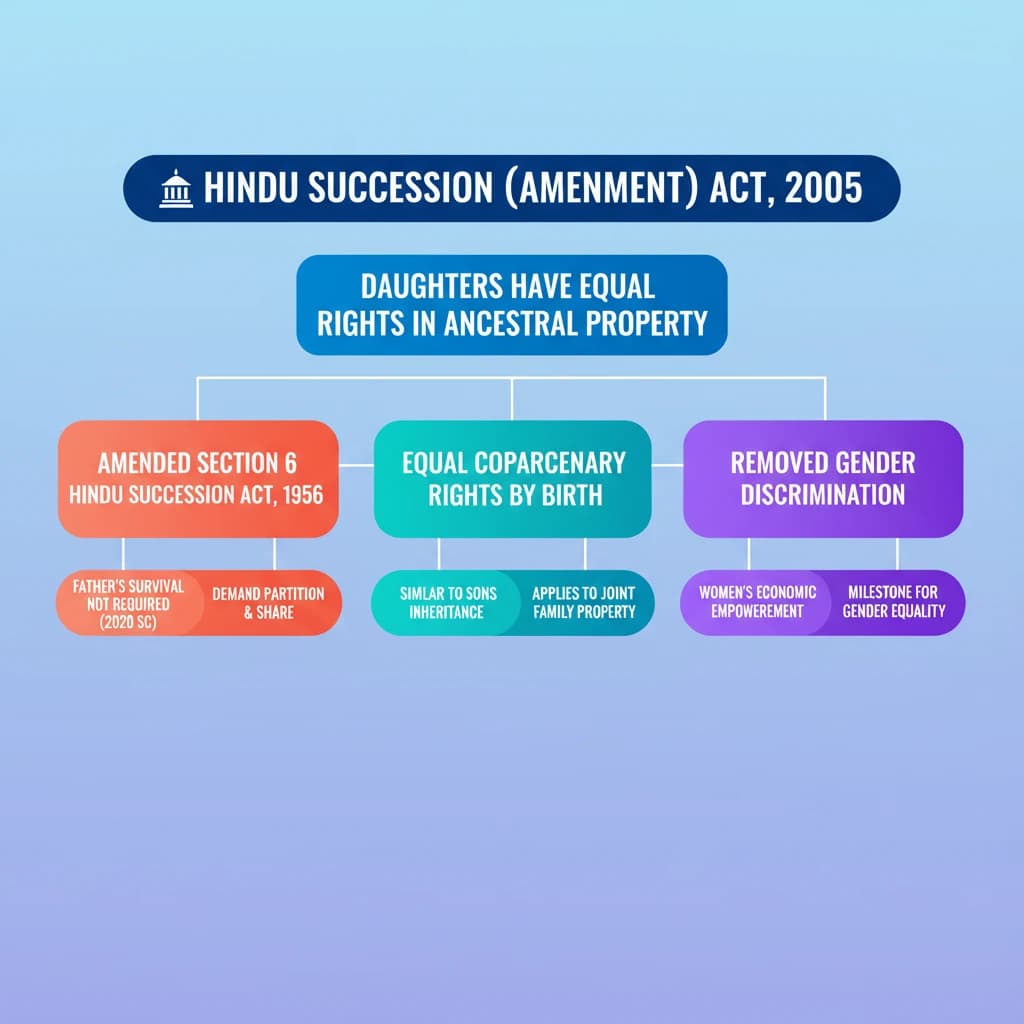
- The Hindu Succession (Amendment) Act, 2005, grants daughters equal coparcenary rights in ancestral property by birth, similar to sons.
- It amended Section 6 of the Hindu Succession Act, 1956, removing gender discrimination in ancestral property inheritance.
- Daughters now have the right to demand partition and receive an equal share in coparcenary property.
- The Supreme Court clarified in 2020 that a daughter's right is by birth and not dependent on the father's survival on the amendment date.
- The Act is a significant step towards women's economic empowerment and gender equality in India.

Hindu Succession Act, 2005: Daughters' Inheritance Rights
Medium⏱️ 8 min read
social issues
📖 Introduction
Introduction to the Hindu Succession (Amendment) Act, 2005
The Hindu Succession (Amendment) Act, 2005, represents a landmark reform in Indian family law. It brought about significant changes to the Hindu Succession Act, 1956, particularly concerning the property rights of women.
This amendment aimed to rectify historical gender inequalities in the inheritance of ancestral property among Hindus, ensuring a more equitable distribution of wealth and rights within families.
Key Provisions of the 2005 Amendment
The most pivotal change introduced by the Hindu Succession (Amendment) Act, 2005, was the amendment to Section 6 of the principal Act. This alteration fundamentally reshaped the concept of coparcenary property.
The 2005 amendment grants daughters equal coparcenary rights in ancestral property by birth, in the same manner as sons. This means a daughter is now considered a coparcener in her own right, with all the associated rights and liabilities.
Prior to this amendment, only male lineal descendants were recognized as coparceners, limiting daughters' rights primarily to a share in their father's self-acquired property, but not in the ancestral joint family property.
Impact on Property Rights
The amendment ensures that a daughter now has the same rights as a son in the coparcenary property. This includes the right to demand a partition of the ancestral property and to be allotted a share equal to that of a son.
The amendment specifies that the daughter's share in the coparcenary property is subject to the same obligations and liabilities in respect of the said property as that of a son.
UPSC Insight: This Act is crucial for understanding social justice, women's empowerment, and the evolution of personal laws in India. It often features in GS-I (Society) and GS-II (Polity/Governance) discussions.
💡 Key Takeaways
- •The Hindu Succession (Amendment) Act, 2005, grants daughters equal coparcenary rights in ancestral property by birth, similar to sons.
- •It amended Section 6 of the Hindu Succession Act, 1956, removing gender discrimination in ancestral property inheritance.
- •Daughters now have the right to demand partition and receive an equal share in coparcenary property.
- •The Supreme Court clarified in 2020 that a daughter's right is by birth and not dependent on the father's survival on the amendment date.
- •The Act is a significant step towards women's economic empowerment and gender equality in India.
🧠 Memory Techniques

100% Verified Content
📚 Reference Sources
•The Hindu Succession Act, 1956 (as amended by the 2005 Act)
•Ministry of Law and Justice, Government of India
•Supreme Court of India judgments (e.g., Vineeta Sharma v. Rakesh Sharma, 2020)
•Law Commission of India Reports (174th Report)