Loading page, please wait…
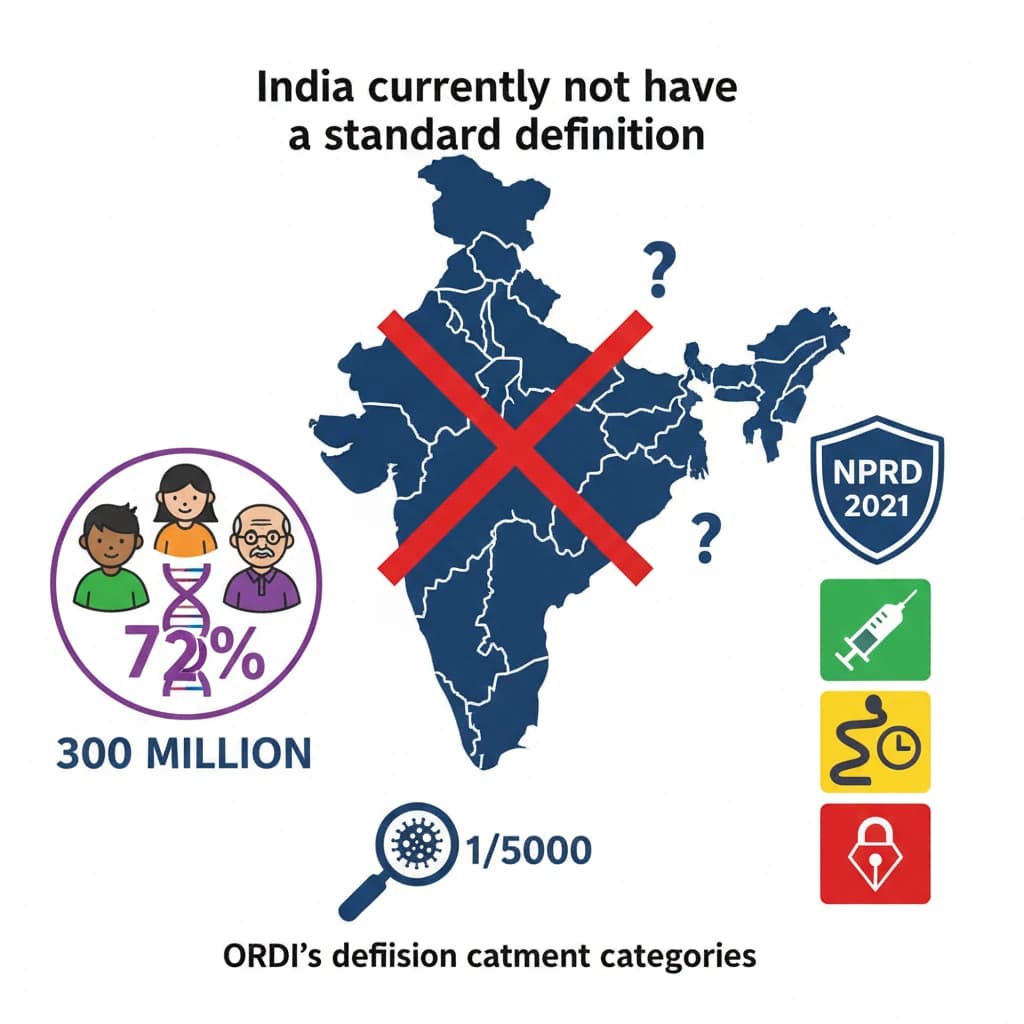
India currently does not have a standard definition - UPSC Social Issues
What is India currently does not have a standard definition in UPSC Social Issues?
India currently does not have a standard definition is a key topic under Social Issues for UPSC Civil Services Examination. Key points include: India lacks a standard definition for rare diseases; ORDI suggests affecting 1 in 5,000 people or less.. Globally, rare diseases affect 300 million people, with 72% being genetic and 75% affecting children.. The National Policy for Rare Diseases (NPRD), 2021, aims to reduce prevalence and incidence.. Understanding this topic is essential for both UPSC Prelims and Mains preparation.
Why is India currently does not have a standard definition important for UPSC exam?
India currently does not have a standard definition is a Medium-level topic in UPSC Social Issues. It is tested in both Prelims (factual MCQs) and Mains (analytical answer writing). Previous year UPSC questions have frequently covered aspects of India currently does not have a standard definition, making it essential for comprehensive IAS preparation.
How to prepare India currently does not have a standard definition for UPSC?
To prepare India currently does not have a standard definition for UPSC: (1) Study the comprehensive notes covering all key concepts on Vaidra. (2) Practice previous year questions on this topic. (3) Connect it with current affairs using daily updates. (4) Revise using key takeaways and mind maps available for Social Issues. (5) Write practice answers linking India currently does not have a standard definition to related GS Paper topics.
Key takeaways of India currently does not have a standard definition for UPSC
- India lacks a standard definition for rare diseases; ORDI suggests affecting 1 in 5,000 people or less.
- Globally, rare diseases affect 300 million people, with 72% being genetic and 75% affecting children.
- The National Policy for Rare Diseases (NPRD), 2021, aims to reduce prevalence and incidence.
- NPRD, 2021 categorizes rare diseases into three groups based on treatment requirements (one-time, long-term, high-cost with selection challenges).
- NPRD, 2021 provides up to Rs. 50 lakhs financial support for treatment in designated Centres of Excellence (CoE), outside RAN.
- Rashtriya Arogya Nidhi (RAN) offers a maximum financial assistance of Rs. 20 lakhs for specified rare diseases.
- Key challenges include diagnostic delays, high treatment costs, limited awareness, and the need for robust R&D.
India currently does not have a standard definition
Medium⏱️ 8 min read
social issues
📖 Introduction
Understanding Rare Diseases in India
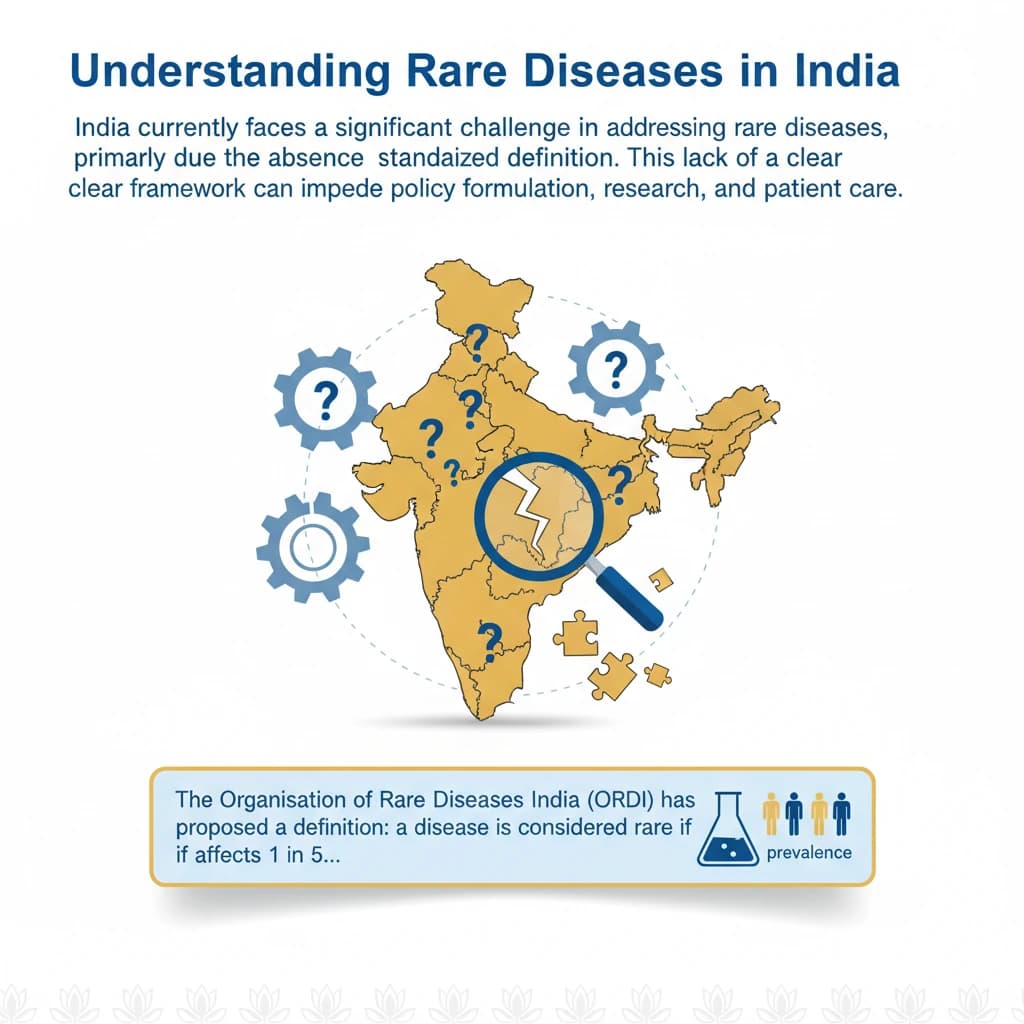
India currently faces a significant challenge in addressing rare diseases, primarily due to the absence of a standardized definition. This lack of a clear framework can impede policy formulation, research, and patient care.
The Organisation of Rare Diseases India (ORDI) has proposed a definition: a disease is considered rare if it affects 1 in 5,000 people or less. This benchmark helps in identifying and categorizing such conditions.
Global Burden of Rare Diseases
The impact of rare diseases extends globally, affecting a substantial portion of the world's population. These conditions present unique diagnostic and therapeutic challenges.
- Approximately 300 million people worldwide are affected by rare diseases.
- They impact roughly 3.5% to 5.9% of the global population.
- A staggering 72% of rare diseases are genetic in origin, encompassing over 7,000 distinct disorders with diverse symptoms.
- Notably, 75% of rare diseases affect children, with 70% having their onset during childhood.
National Policy for Rare Diseases (NPRD), 2021
Recognizing the urgent need for a structured approach, the Indian government introduced the National Policy for Rare Diseases (NPRD), 2021. This policy aims to streamline efforts in managing and treating rare conditions.
The primary objective of the NPRD, 2021 is to reduce the prevalence and incidence of rare diseases in India, thereby improving patient outcomes and quality of life.
Categorization of Rare Diseases under NPRD, 2021
The policy categorizes rare diseases into three distinct groups based on their treatment requirements and associated costs. This classification helps in tailoring appropriate interventions and financial support.
- Group 1: Disorders amenable to one-time curative treatment. These conditions often require a single, definitive medical intervention.
- Group 2: Diseases requiring long-term/lifelong treatment, typically associated with relatively lower treatment costs. Management often involves continuous medication or therapy.
- Group 3: Diseases for which definitive treatment is available, but significant challenges persist in patient selection and are characterized by high treatment costs.
Financial Support under NPRD, 2021
To alleviate the financial burden on patients and their families, the NPRD, 2021 includes provisions for substantial financial assistance. This support is crucial given the often exorbitant costs associated with rare disease treatments.
The policy provides financial support of up to Rs. 50 lakhs for patients suffering from any category of rare diseases. This assistance is specifically for treatment received in designated Centres of Excellence (CoE) mentioned in the NPRD-2021.
It is important to note that this financial aid is provided outside the umbrella scheme of Rashtriya Arogya Nidhi (RAN), indicating a distinct allocation for rare diseases.
Rashtriya Arogya Nidhi (RAN)
Prior to or alongside NPRD, Rashtriya Arogya Nidhi (RAN) has also played a role in providing financial assistance for certain medical conditions, including some rare diseases.
Under RAN, a maximum financial assistance of Rs. 20 lakh is offered to patients suffering from specified rare diseases. This scheme serves as another avenue for support for those in need.
UPSC Insight: Differentiate between the financial provisions of NPRD, 2021 (up to Rs. 50 lakhs for treatment in CoE, outside RAN) and RAN (up to Rs. 20 lakhs for specified rare diseases). Understanding these nuances is crucial for Mains answers, especially in GS Paper 2: Social Justice.
💡 Key Takeaways
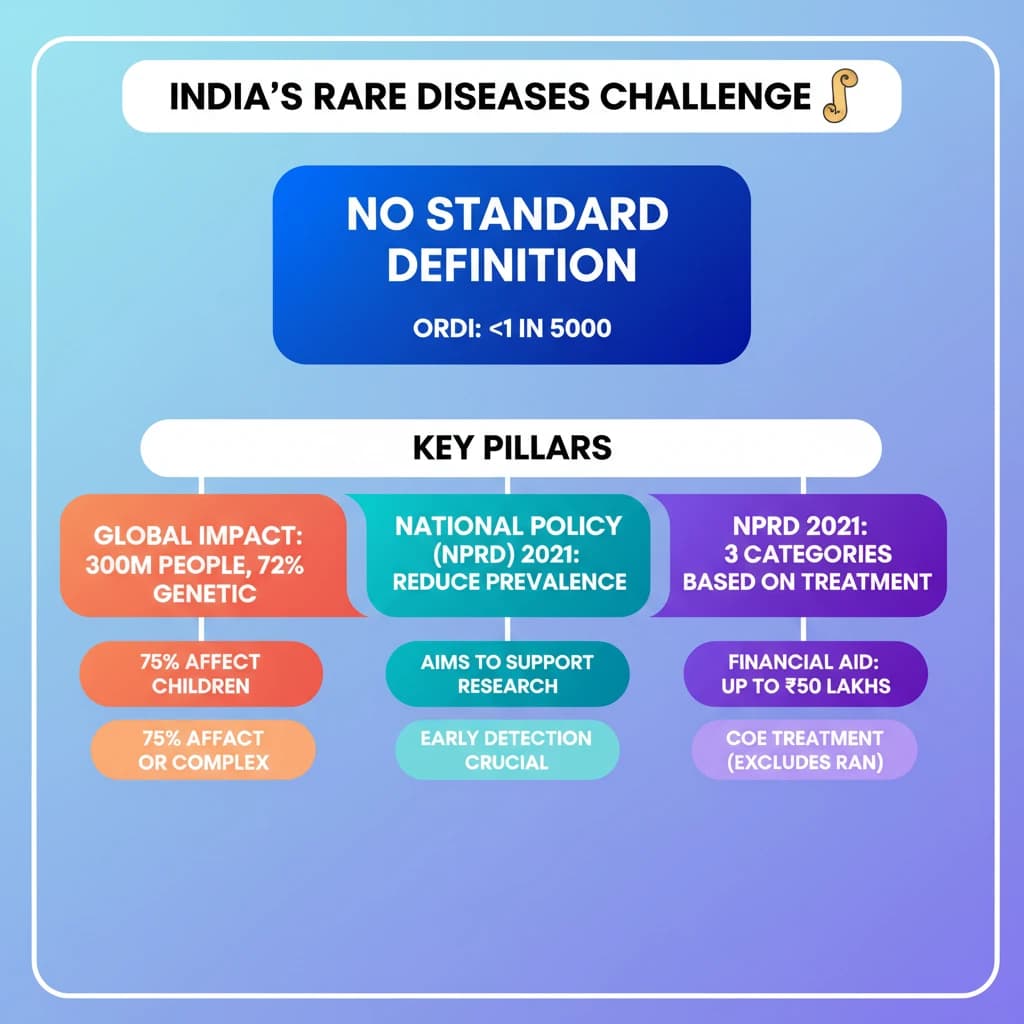
- •India lacks a standard definition for rare diseases; ORDI suggests affecting 1 in 5,000 people or less.
- •Globally, rare diseases affect 300 million people, with 72% being genetic and 75% affecting children.
- •The National Policy for Rare Diseases (NPRD), 2021, aims to reduce prevalence and incidence.
- •NPRD, 2021 categorizes rare diseases into three groups based on treatment requirements (one-time, long-term, high-cost with selection challenges).
- •NPRD, 2021 provides up to Rs. 50 lakhs financial support for treatment in designated Centres of Excellence (CoE), outside RAN.
- •Rashtriya Arogya Nidhi (RAN) offers a maximum financial assistance of Rs. 20 lakhs for specified rare diseases.
- •Key challenges include diagnostic delays, high treatment costs, limited awareness, and the need for robust R&D.
🧠 Memory Techniques
95% Verified Content