Loading page, please wait…
Multidimensional Poverty Index: NITI Aayog - UPSC Social Issues
What is Multidimensional Poverty Index: NITI Aayog in UPSC Social Issues?
Multidimensional Poverty Index: NITI Aayog is a key topic under Social Issues for UPSC Civil Services Examination. Key points include: NITI Aayog's Discussion Paper: "Multidimensional Poverty in India since 2005-06" released.. Key finding: 24.82 crore people escaped multidimensional poverty in 9 years.. Data source: National Family Health Surveys (NFHS) 2005-06, 2015-16, 2019-21.. Understanding this topic is essential for both UPSC Prelims and Mains preparation.
Why is Multidimensional Poverty Index: NITI Aayog important for UPSC exam?
Multidimensional Poverty Index: NITI Aayog is a Medium-level topic in UPSC Social Issues. It is tested in both Prelims (factual MCQs) and Mains (analytical answer writing). Previous year UPSC questions have frequently covered aspects of Multidimensional Poverty Index: NITI Aayog, making it essential for comprehensive IAS preparation.
How to prepare Multidimensional Poverty Index: NITI Aayog for UPSC?
To prepare Multidimensional Poverty Index: NITI Aayog for UPSC: (1) Study the comprehensive notes covering all key concepts on Vaidra. (2) Practice previous year questions on this topic. (3) Connect it with current affairs using daily updates. (4) Revise using key takeaways and mind maps available for Social Issues. (5) Write practice answers linking Multidimensional Poverty Index: NITI Aayog to related GS Paper topics.
Key takeaways of Multidimensional Poverty Index: NITI Aayog for UPSC
- NITI Aayog's Discussion Paper: "Multidimensional Poverty in India since 2005-06" released.
- Key finding: 24.82 crore people escaped multidimensional poverty in 9 years.
- Data source: National Family Health Surveys (NFHS) 2005-06, 2015-16, 2019-21.
- MPI measures deprivations in health, education, and living standards, offering a holistic view of poverty.
- The report validates the impact of government welfare schemes and aligns with SDG targets.
- Uttar Pradesh recorded the largest decline in the number of poor people (5.94 crore).

Multidimensional Poverty Index: NITI Aayog
Medium⏱️ 7 min read
social issues
📖 Introduction
Introduction to Multidimensional Poverty Index (MPI) by NITI Aayog
Recently, the NITI Aayog, a premier policy think tank of the Government of India, released a significant Discussion Paper. This paper focuses on the state of multidimensional poverty in India.
The title of this crucial document is “Multidimensional Poverty in India since 2005-06”. It provides a comprehensive overview of poverty trends over a substantial period.
Key Publication: NITI Aayog's Discussion Paper titled “Multidimensional Poverty in India since 2005-06”.
Key Findings of the Discussion Paper
The Discussion Paper highlights a remarkable achievement in India's fight against poverty. It states that a staggering 24.82 crore people have successfully escaped multidimensional poverty.
This significant reduction occurred over a period of nine years, demonstrating substantial progress in various social and economic indicators.
Major Achievement: Approximately 250 million people moved out of multidimensional poverty within the last decade.
Data Sources and Methodology
The analysis presented in the NITI Aayog Discussion Paper is based on robust data from the National Family Health Surveys (NFHS). These surveys are instrumental in understanding demographic and health indicators.
Specifically, the paper utilized data from three distinct rounds of the NFHS to track long-term poverty trends and changes.
NFHS Survey Rounds Utilized:
- NFHS 2005-06: Provided baseline data for long-term comparison.
- NFHS 2015-16: Offered an interim assessment of poverty reduction.
- NFHS 2019-21: Captured the most recent trends and progress.
Understanding the source data (NFHS) and the timeframe (2005-06 to 2019-21) is crucial for Mains answers, especially in GS Paper I (Social Issues) and GS Paper II (Government Policies).
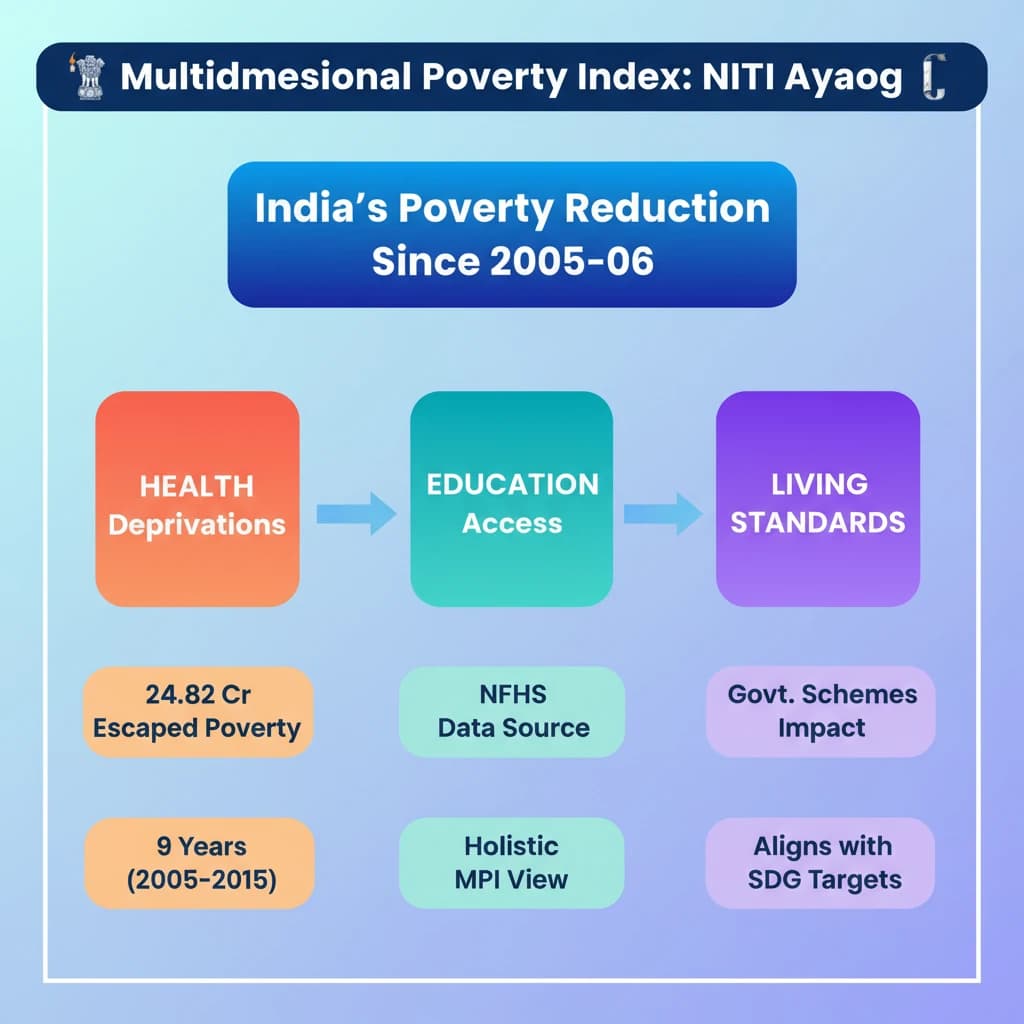
💡 Key Takeaways
- •NITI Aayog's Discussion Paper: "Multidimensional Poverty in India since 2005-06" released.
- •Key finding: 24.82 crore people escaped multidimensional poverty in 9 years.
- •Data source: National Family Health Surveys (NFHS) 2005-06, 2015-16, 2019-21.
- •MPI measures deprivations in health, education, and living standards, offering a holistic view of poverty.
- •The report validates the impact of government welfare schemes and aligns with SDG targets.
- •Uttar Pradesh recorded the largest decline in the number of poor people (5.94 crore).
🧠 Memory Techniques
98% Verified Content
📚 Reference Sources
•National Family Health Survey (NFHS) data (2005-06, 2015-16, 2019-21)
•Press Information Bureau (PIB) releases on NITI Aayog reports
•United Nations Development Programme (UNDP) & Oxford Poverty and Human Development Initiative (OPHI) publications on Global MPI