Loading page, please wait…
Porja, Bagata, and Konda Dora Tribes - UPSC Social Issues
What is Porja, Bagata, and Konda Dora Tribes in UPSC Social Issues?
Porja, Bagata, and Konda Dora Tribes is a key topic under Social Issues for UPSC Civil Services Examination. Key points include: Porja, Bagata, and Konda Dora tribes contributed significantly to the Lower Sileru Hydro-Electric Project in the 1970s.. Despite contributions, these tribes in Visakhapatnam still lack basic electricity and clean water.. Porjas practice Podu (shifting cultivation) and have a patriarchal system with cross-cousin marriages.. Understanding this topic is essential for both UPSC Prelims and Mains preparation.
Why is Porja, Bagata, and Konda Dora Tribes important for UPSC exam?
Porja, Bagata, and Konda Dora Tribes is a Medium-level topic in UPSC Social Issues. It is tested in both Prelims (factual MCQs) and Mains (analytical answer writing). Previous year UPSC questions have frequently covered aspects of Porja, Bagata, and Konda Dora Tribes, making it essential for comprehensive IAS preparation.
How to prepare Porja, Bagata, and Konda Dora Tribes for UPSC?
To prepare Porja, Bagata, and Konda Dora Tribes for UPSC: (1) Study the comprehensive notes covering all key concepts on Vaidra. (2) Practice previous year questions on this topic. (3) Connect it with current affairs using daily updates. (4) Revise using key takeaways and mind maps available for Social Issues. (5) Write practice answers linking Porja, Bagata, and Konda Dora Tribes to related GS Paper topics.
Key takeaways of Porja, Bagata, and Konda Dora Tribes for UPSC
- Porja, Bagata, and Konda Dora tribes contributed significantly to the Lower Sileru Hydro-Electric Project in the 1970s.
- Despite contributions, these tribes in Visakhapatnam still lack basic electricity and clean water.
- Porjas practice Podu (shifting cultivation) and have a patriarchal system with cross-cousin marriages.
- Bagatas follow lineage exogamy, believe in supernaturalism, and have traditional headmen for dispute resolution.
- Konda Doras, 'Lords of the Hill,' have traditional Kulam Panchayats and prefer cross-cousin marriages.
- Their plight underscores the need for better tribal welfare, recognition, and equitable development.
Porja, Bagata, and Konda Dora Tribes
Medium⏱️ 10 min read
social issues
📖 Introduction
Context and Introduction
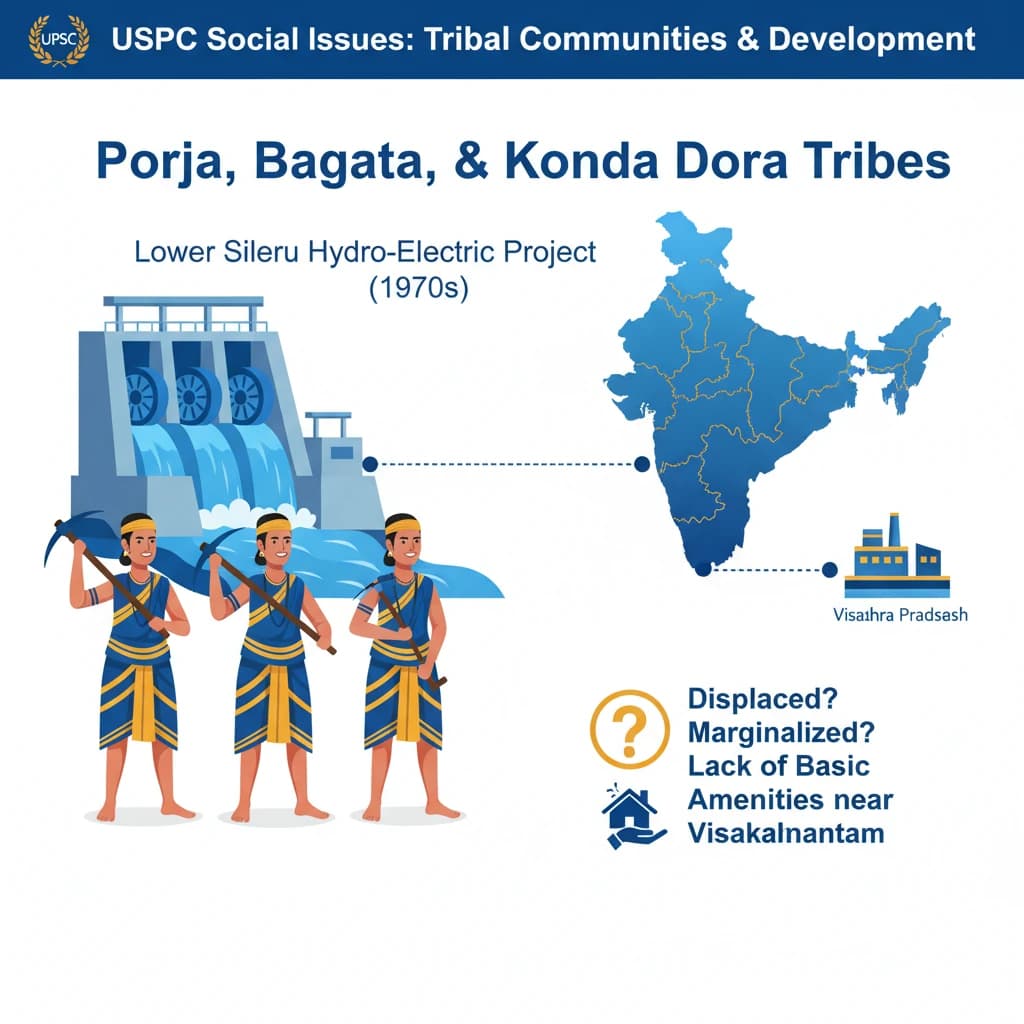
The situation of tribal communities in Andhra Pradesh has recently drawn significant attention. These communities, including the Porja, Bagata, and Konda Dora tribes, played a vital role in the construction of the Lower Sileru Hydro-Electric Project (LSP) in the 1970s.
Despite their crucial contributions, villages near Visakhapatnam, where these tribes reside, continue to suffer from severe shortages of basic amenities like electricity and clean water.
UPSC Relevance: This scenario highlights issues of tribal welfare, displacement, and the impact of development projects on indigenous populations, crucial for GS-I (Indian Society) and GS-II (Social Justice).
The Porja Tribe
The Porja tribe, with sub-groups such as Bondo Porja, Khondi Porja, and Parangi Porja, primarily resides in the Visakhapatnam area of Andhra Pradesh.
Population: Approximately 16,479 (as per Census, 1991).
Origin: They migrated from Odisha around 300 years ago in search of cultivable land.
Historically, the Porjas were employed as palanquin bearers and for other menial tasks. The term ‘Porja’ is derived from Oriya words meaning “son of a king,” reflecting their historical employment by the Jeypore rulers.
They inhabit hilly terrains and practice shifting cultivation, which is locally known as Podu.
Porja Social Structure and Customs
The Porjas follow a patriarchal system with patrilineal descent. Property inheritance and succession to hereditary offices adhere to this system, with the eldest son receiving an extra share.
- Marriage Practices: They practice cross-cousin marriages.
- Bride Price: A formal bride price system is in place.
- Pre/Post-Marital Relations: Acceptance of pre and post-marital relations.
- Tattooing: An integral part of their socio-religious culture.
The Porjas have endogamous sub-groups, each possessing unique customs, languages, and food habits. Most Porjas in Visakhapatnam belong to the Barang Jati group.
The Bagata Tribe
The Bagata are an aboriginal tribe predominantly found in the states of Andhra Pradesh and Odisha. They are also known by various names such as Bagatha, Bagat, Bagodi, Bogad, or Bhakta.
Bagata Social and Cultural Practices
Their marriage patterns strictly adhere to lineage exogamy, meaning marriage outside one’s own clan or kinship group. Marriages can be arranged through negotiation or elopement.
Social Norms: Divorce and remarriage are permitted within the community.
Dietary Shift: Their traditional staple food of millets has largely been replaced by rice.
The Bagathas hold strong beliefs in supernaturalism, magic, witchcraft, the evil eye, sorcery, luck, ghosts, and shapeless phantoms. They also practice nature worship, often in the form of totems and clans.
Traditional governance involves a tribal headman who resolves intra-family and inter-tribal disputes. A village headman addresses broader inter-tribal issues and violations of traditional customs.
The Konda Dora Tribe
The Konda Dora are a Scheduled Tribe primarily inhabiting the Kamberu range of the Eastern Ghats, spanning across south Odisha and Andhra Pradesh.
Name Origin: The name ‘Kondadora’ translates to ‘Lords of the Hill’, derived from ‘Konda’ (hill) and ‘Dora’ (lord).
Alternative Names: They are also known as ‘Konda Raju’, ‘Oja’, ‘Pandava Raju,’ and ‘Pandava Dora.’
Mythological Ancestry: They consider themselves descendants of the mythological Pandavas.
Their original language, Kubi/Konda, has largely been supplanted by Telugu, often mixed with Odia.
Konda Dora Settlements and Social Structure
Konda Dora settlements are typically homogeneous. In multi-ethnic villages, they reside in separate wards to maintain social distance and preserve their ethnic identity.
- Marriage Practices: While polygyny and child marriages are not prohibited, adult marriage and monogamy are the commonly practiced norms.
- Cousin Marriages: Cross-cousin marriages are preferred, whereas parallel-cousin marriages are strictly prohibited.
They operate a traditional village council known as the Kulam Panchayat, headed by a Kula Peda, who is assisted by a Pillalipandam. An inter-village community council also exists, with both councils managing customary affairs within their respective jurisdictions.
💡 Key Takeaways
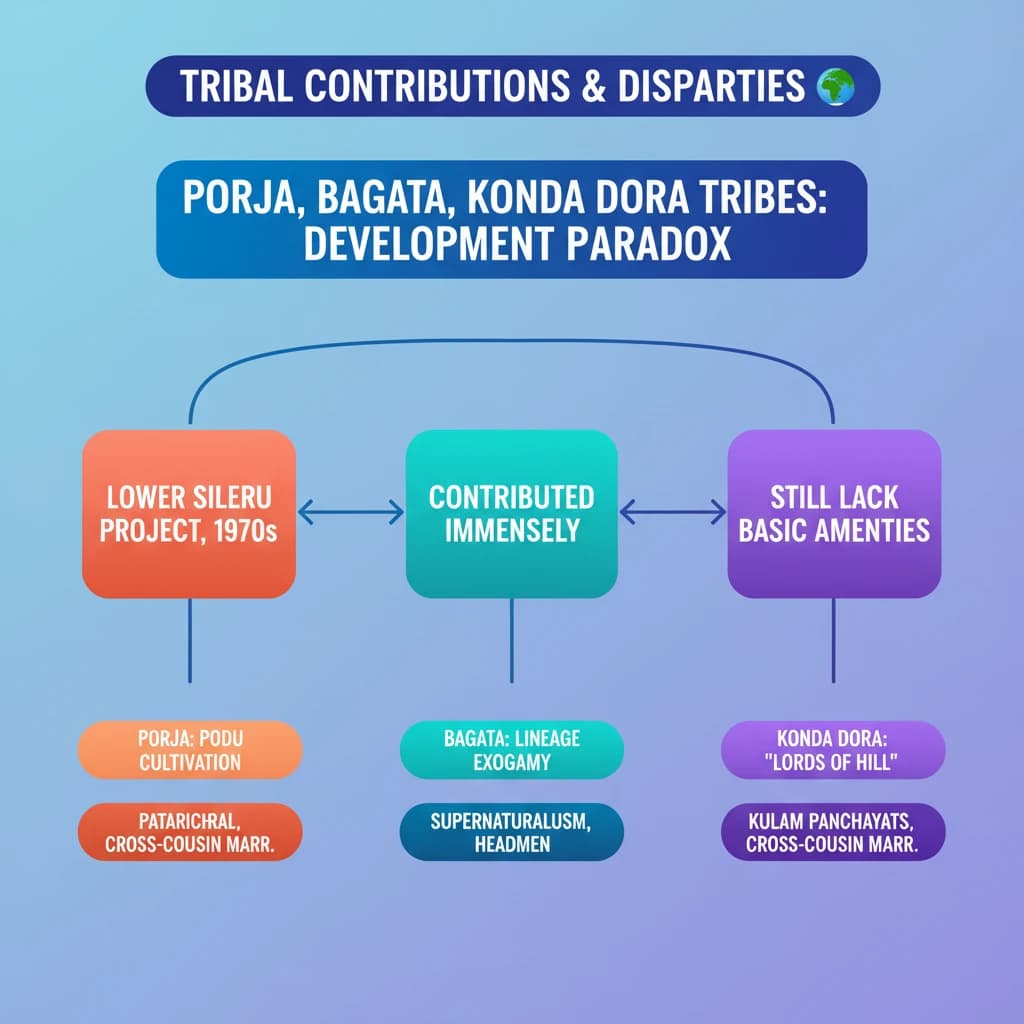
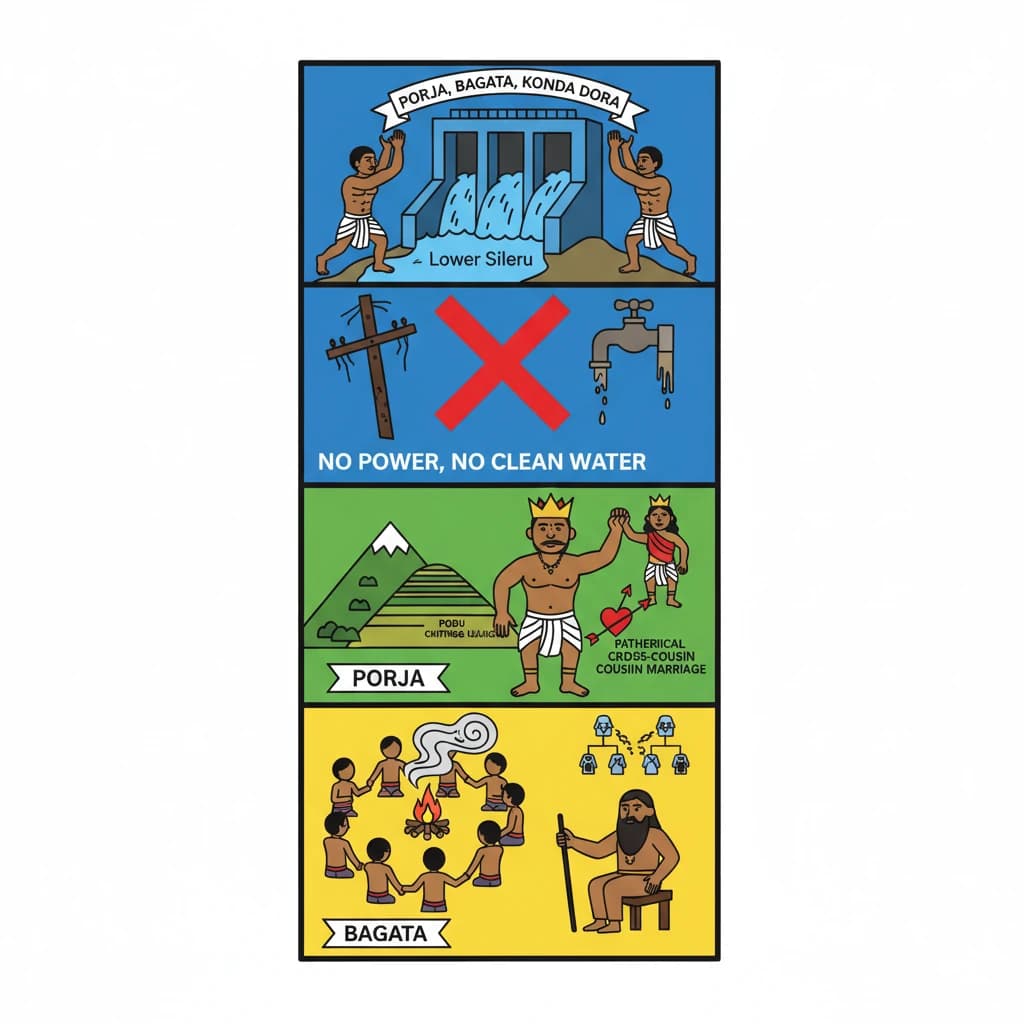
- •Porja, Bagata, and Konda Dora tribes contributed significantly to the Lower Sileru Hydro-Electric Project in the 1970s.
- •Despite contributions, these tribes in Visakhapatnam still lack basic electricity and clean water.
- •Porjas practice Podu (shifting cultivation) and have a patriarchal system with cross-cousin marriages.
- •Bagatas follow lineage exogamy, believe in supernaturalism, and have traditional headmen for dispute resolution.
- •Konda Doras, 'Lords of the Hill,' have traditional Kulam Panchayats and prefer cross-cousin marriages.
- •Their plight underscores the need for better tribal welfare, recognition, and equitable development.
🧠 Memory Techniques
95% Verified Content
📚 Reference Sources
•Census, 1991 (for Porja population data)