Loading page, please wait…
Rare Disease Day 2024 - UPSC Social Issues
What is Rare Disease Day 2024 in UPSC Social Issues?
Rare Disease Day 2024 is a key topic under Social Issues for UPSC Civil Services Examination. Key points include: Rare Disease Day, observed on the last day of February, raises global awareness for rare diseases and their impact.. The 2024 theme, 'Share Your Colours,' emphasizes collaboration and support.. Established in 2008, it's coordinated by EURORDIS and partner organizations.. Understanding this topic is essential for both UPSC Prelims and Mains preparation.
Why is Rare Disease Day 2024 important for UPSC exam?
Rare Disease Day 2024 is a Medium-level topic in UPSC Social Issues. It is tested in both Prelims (factual MCQs) and Mains (analytical answer writing). Previous year UPSC questions have frequently covered aspects of Rare Disease Day 2024, making it essential for comprehensive IAS preparation.
How to prepare Rare Disease Day 2024 for UPSC?
To prepare Rare Disease Day 2024 for UPSC: (1) Study the comprehensive notes covering all key concepts on Vaidra. (2) Practice previous year questions on this topic. (3) Connect it with current affairs using daily updates. (4) Revise using key takeaways and mind maps available for Social Issues. (5) Write practice answers linking Rare Disease Day 2024 to related GS Paper topics.
Key takeaways of Rare Disease Day 2024 for UPSC
- Rare Disease Day, observed on the last day of February, raises global awareness for rare diseases and their impact.
- The 2024 theme, 'Share Your Colours,' emphasizes collaboration and support.
- Established in 2008, it's coordinated by EURORDIS and partner organizations.
- Rare diseases are defined by infrequent occurrence, with varying prevalence thresholds globally (e.g., WHO: <1/1000, US: <200,000 patients).
- Advocacy focuses on equity in diagnosis, treatment, and social opportunities for affected individuals and families.
Rare Disease Day 2024
Medium⏱️ 8 min read
social issues
📖 Introduction
Introduction to Rare Disease Day 2024
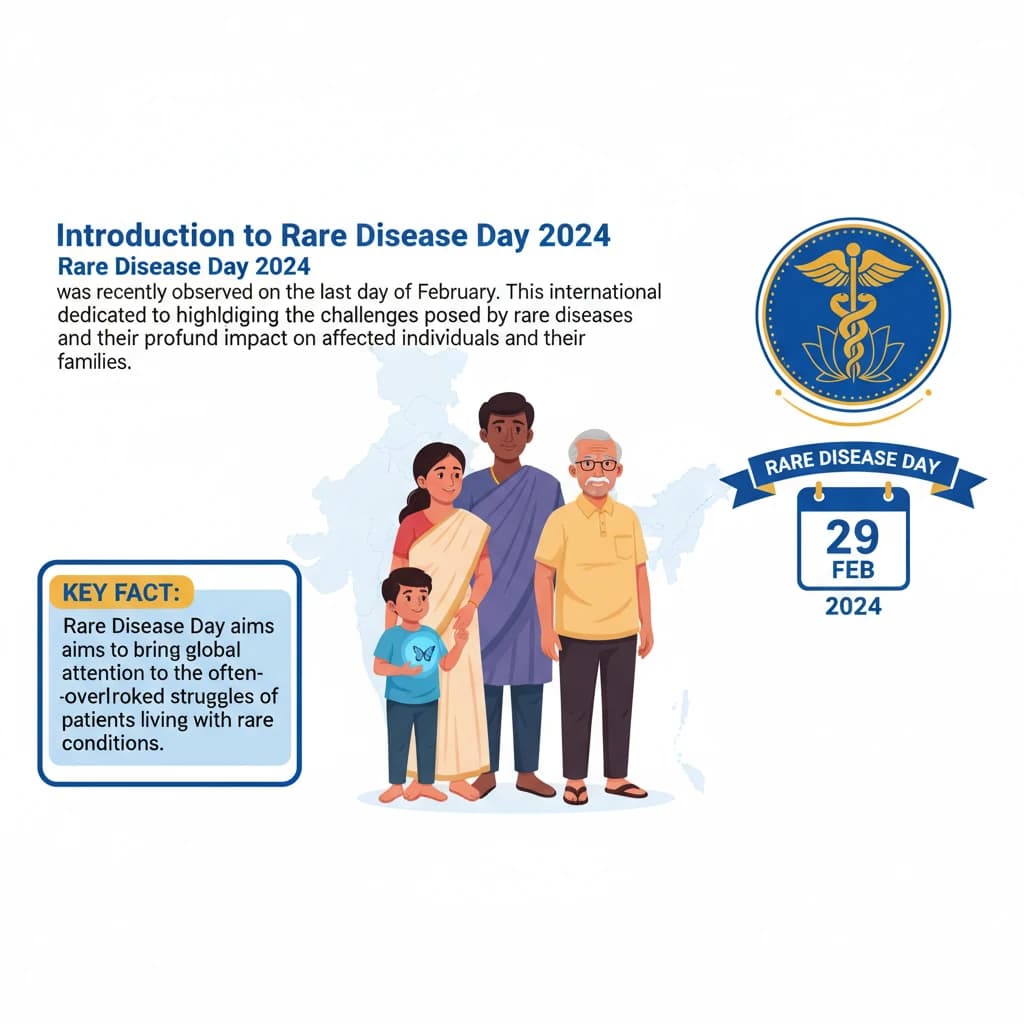
Rare Disease Day 2024 was recently observed on the last day of February. This international awareness day is dedicated to highlighting the challenges posed by rare diseases and their profound impact on affected individuals and their families.
Key Fact: Rare Disease Day aims to bring global attention to the often-overlooked struggles of patients living with uncommon medical conditions.
What is Rare Disease Day?
Rare Disease Day is a globally coordinated initiative focused on advocating for equity. This includes ensuring fair access to social opportunities, comprehensive healthcare, and timely diagnosis and therapies for those living with rare diseases.
Core Mission: To champion equal rights and opportunities for individuals affected by rare conditions worldwide.
Theme for Rare Disease Day 2024
The designated theme for Rare Disease Day 2024 is “Share Your Colours.” This theme strongly emphasizes the importance of collaboration and mutual support within the rare disease community and among all stakeholders.
Establishment and Coordination
The observance of Rare Disease Day was established in 2008. It is annually celebrated on the 28th or 29th of February, specifically on the 29th in leap years, symbolizing the 'rarity' of the date itself.
Coordinating Bodies: The initiative is primarily coordinated by the European Organisation for Rare Diseases (EURORDIS), in partnership with over 65 national alliance patient organization partners globally.
Role and Engagement
This day serves as a crucial focal point for advocacy work across local, national, and international levels. It actively engages a wide spectrum of participants to further its cause.
- Individuals and Families: Directly affected patients and their support networks.
- Caregivers: Those providing essential care and support.
- Healthcare Professionals: Doctors, nurses, and other medical staff.
- Researchers: Scientists working on understanding and treating rare diseases.
- Policymakers: Government officials influencing health policies.
- Industry Representatives: Pharmaceutical and biotech companies.
- General Public: Raising overall societal awareness.
Defining a Rare Disease
Rare diseases are generally characterized by their infrequent occurrence within the population. The exact prevalence threshold can vary significantly from one nation to another, reflecting diverse epidemiological contexts and healthcare systems.
World Health Organization (WHO) Definition: The WHO defines rare diseases as often debilitating lifelong conditions with a prevalence of 1 or less per 1000 population.
Country-Specific Definitions
Different countries have established their own specific criteria for defining a rare disease, which influences their national health policies and research priorities.
- United States (US): Considers diseases affecting fewer than 200,000 patients as rare.
- European Union (EU): Sets the limit at no more than 5 in 10,000 people.
UPSC Insight: Understanding the varying definitions of rare diseases across different global bodies and nations is crucial for Mains answers, especially in GS-II (Social Justice) and GS-III (Science & Technology), when discussing health policy and international comparisons.
💡 Key Takeaways
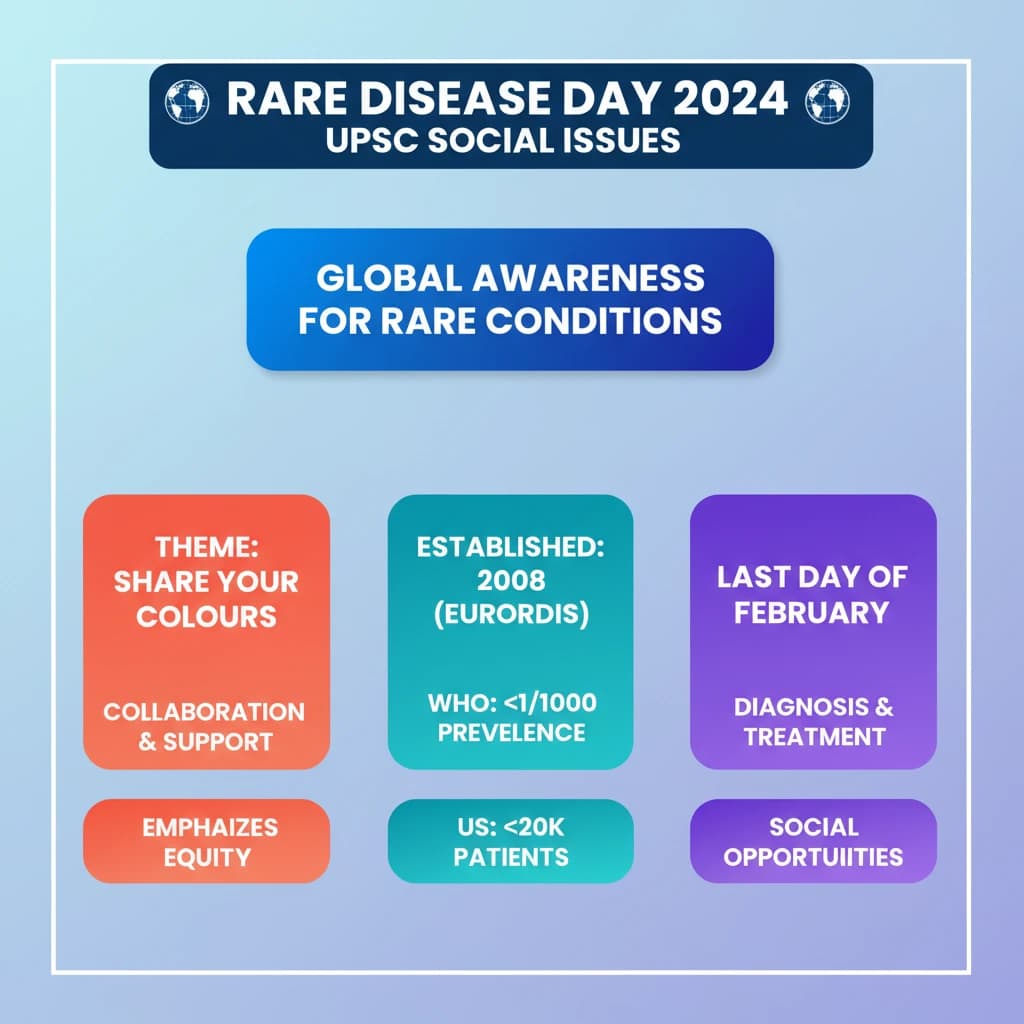
- •Rare Disease Day, observed on the last day of February, raises global awareness for rare diseases and their impact.
- •The 2024 theme, 'Share Your Colours,' emphasizes collaboration and support.
- •Established in 2008, it's coordinated by EURORDIS and partner organizations.
- •Rare diseases are defined by infrequent occurrence, with varying prevalence thresholds globally (e.g., WHO: <1/1000, US: <200,000 patients).
- •Advocacy focuses on equity in diagnosis, treatment, and social opportunities for affected individuals and families.
🧠 Memory Techniques
95% Verified Content
📚 Reference Sources
•European Organisation for Rare Diseases (EURORDIS) official website
•World Health Organization (WHO) publications on rare diseases
•Ministry of Health & Family Welfare, Government of India: National Policy for Rare Diseases 2021