Loading page, please wait…
Transgender Rights and Related Concerns - UPSC Social Issues
What is Transgender Rights and Related Concerns in UPSC Social Issues?
Transgender Rights and Related Concerns is a key topic under Social Issues for UPSC Civil Services Examination. Key points include: Karnataka HC ruled transgender persons can change name/gender on birth certificates.. The ruling prioritizes the Transgender Persons Act, 2019 (special law) over the Registration of Births and Deaths Act, 1969 (general law).. Principle: "generalia specialibus non-derogant" (special prevails over general).. Understanding this topic is essential for both UPSC Prelims and Mains preparation.
Why is Transgender Rights and Related Concerns important for UPSC exam?
Transgender Rights and Related Concerns is a Medium-level topic in UPSC Social Issues. It is tested in both Prelims (factual MCQs) and Mains (analytical answer writing). Previous year UPSC questions have frequently covered aspects of Transgender Rights and Related Concerns, making it essential for comprehensive IAS preparation.
How to prepare Transgender Rights and Related Concerns for UPSC?
To prepare Transgender Rights and Related Concerns for UPSC: (1) Study the comprehensive notes covering all key concepts on Vaidra. (2) Practice previous year questions on this topic. (3) Connect it with current affairs using daily updates. (4) Revise using key takeaways and mind maps available for Social Issues. (5) Write practice answers linking Transgender Rights and Related Concerns to related GS Paper topics.
Key takeaways of Transgender Rights and Related Concerns for UPSC
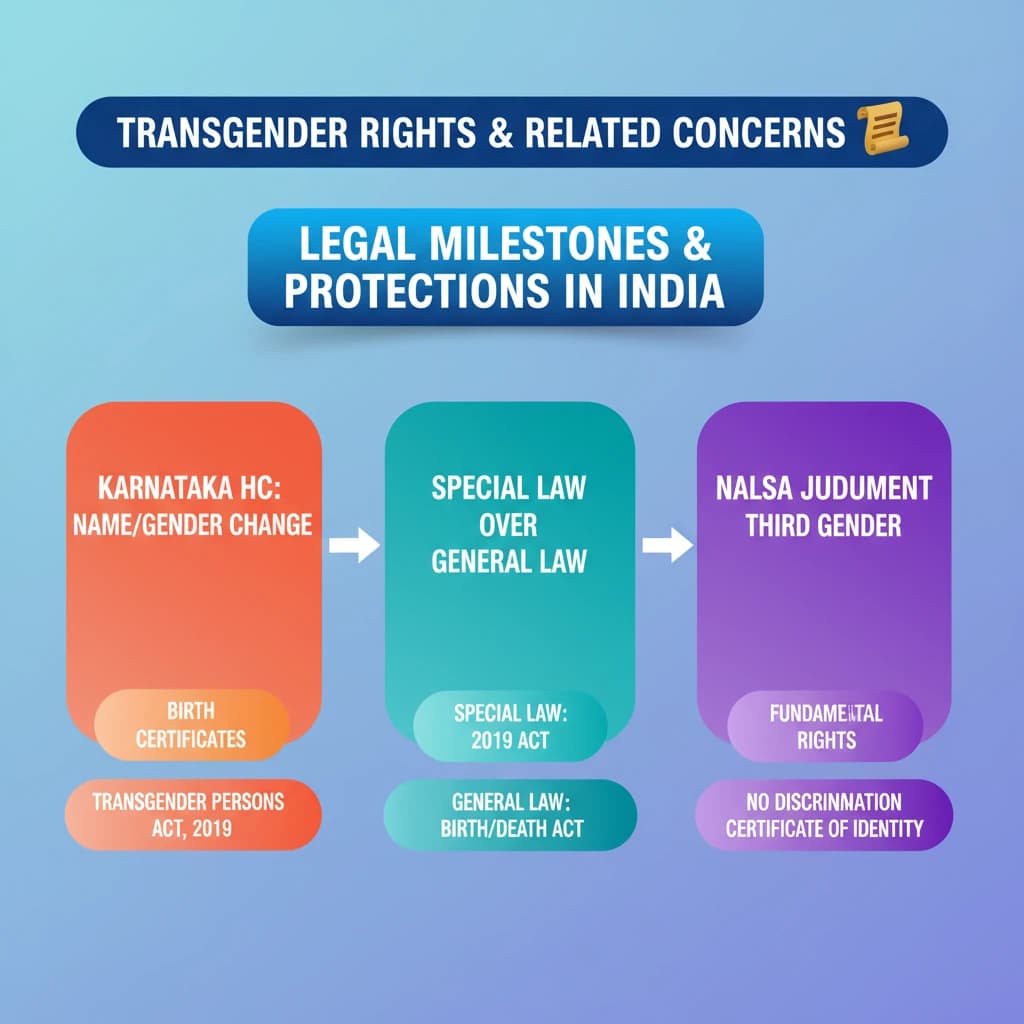
- Karnataka HC ruled transgender persons can change name/gender on birth certificates.
- The ruling prioritizes the Transgender Persons Act, 2019 (special law) over the Registration of Births and Deaths Act, 1969 (general law).
- Principle: "generalia specialibus non-derogant" (special prevails over general).
- Transgender Persons Act, 2019 defines transgender and prohibits discrimination, granting a Certificate of Identity.
- NALSA vs. Union of India (2014) recognized transgender as "Third Gender" and affirmed fundamental rights.
- This ensures recognition of self-perceived gender identity in all official documents, upholding dignity.

Transgender Rights and Related Concerns
Medium⏱️ 12 min read
social issues
📖 Introduction
Karnataka HC Ruling: Ms. X vs State of Karnataka Case, 2024
Background of the Case
The petitioner, diagnosed with gender dysphoria, underwent sex-reassignment surgery. She legally changed her name and gender identity on documents like Aadhaar card, driving license, and passport.
However, her request to change gender and name on her birth certificate was rejected.
Gender dysphoria refers to psychological distress occurring when a person’s sex assigned at birth does not match their gender identity.
Legal Objection and Petitioner's Argument
The rejection was based on Section 15 of the Registration of Births and Deaths Act, 1969.
The Registration of Births and Deaths Act, 1969 permits changes to birth certificates only if the information is erroneous, fraudulent, or incorrectly entered.
The petitioner argued that this restrictive nature violated her right to life with dignity under Article 21 of the Indian Constitution.
She highlighted that differing identities across documents lead to a dual identity, causing potential harassment and discrimination.
The Transgender Persons (Protection of Rights) Act, 2019
This Act allows transgender people to be issued a “certificate of identity” (Section 6). This certificate can be revised if they opt for sex-reassignment surgery (Section 7).
The law explicitly mandates that the gender of a transgender person “shall be recorded in all official documents” according to this certificate.
Karnataka High Court's Ruling
The HC held that the 1969 Act is a “general enactment”. It must comply with the Transgender Persons (Protection of Rights) Act, 2019, which is a “special enactment”.
The court invoked the legal principle: “generalia specialibus non-derogant”, meaning “the special shall prevail over the general”.
The ruling directed the Registrar to accept the transgender certificate and issue a corrected birth certificate under the 1969 Act, as amended by the special law.
General enactments apply broadly (e.g., 1969 Act), while special laws focus on specific issues (e.g., Transgender Persons Act).
Significance of the Judgment
This judgment underscores the supremacy of special laws designed to protect the rights of transgender individuals. It is a crucial step towards the recognition of gender identity in all official records for transgender persons.
As per the 2011 census, the total transgender population in India is around 4.88 Lakh. The top 3 states with the largest transgender population are Uttar Pradesh, Andhra Pradesh, and Maharashtra.
Key Facts About the Transgender Persons (Protection of Rights) Act, 2019
Definition of Transgender Person
A transgender person is defined as someone whose gender does not match the gender assigned at birth.
The Act clarifies terms like ‘person with intersex variation’ and ‘transgender person’ to include trans men and women, irrespective of surgery or therapy.
Prohibition of Discrimination
The Act explicitly prohibits discrimination against transgender persons in various spheres. This includes areas such as education, employment, healthcare, and access to public facilities.
It also affirms their rights to movement, property ownership, and holding public office.
Certificate of Identity
The Act grants transgender individuals the right to self-perceived gender identity. It mandates district magistrates to issue certificates of identity without requiring medical examinations.
Timeline of Reforms for Transgender Persons in India
- 2009: Election Commission's Directive - Registration forms were updated to include an “others” option, allowing transsexual individuals to avoid binary male or female identification.
- 2014: Supreme Court Ruling (NALSA vs. Union of India) - The Supreme Court recognized transgender people as the “Third Gender”, emphasizing their rights as a fundamental human rights issue.
- 2019: Legislative Efforts (Transgender Persons (Protection of Rights) Act) - This landmark Act was enacted to provide comprehensive protection of transgender rights.
💡 Key Takeaways
- •Karnataka HC ruled transgender persons can change name/gender on birth certificates.
- •The ruling prioritizes the Transgender Persons Act, 2019 (special law) over the Registration of Births and Deaths Act, 1969 (general law).
- •Principle: "generalia specialibus non-derogant" (special prevails over general).
- •Transgender Persons Act, 2019 defines transgender and prohibits discrimination, granting a Certificate of Identity.
- •NALSA vs. Union of India (2014) recognized transgender as "Third Gender" and affirmed fundamental rights.
- •This ensures recognition of self-perceived gender identity in all official documents, upholding dignity.
🧠 Memory Techniques

95% Verified Content