Loading page, please wait…
What are Developments Related to Reservations in India? - UPSC Social Issues
What is What are Developments Related to Reservations in India? in UPSC Social Issues?
What are Developments Related to Reservations in India? is a key topic under Social Issues for UPSC Civil Services Examination. Key points include: Reservations are constitutional provisions (Articles 16, 243D/T, 330, 332, 335) for positive discrimination.. Key amendments (77th, 81st, 85th) enabled reservation in promotion for SC/ST and the carry-forward rule.. Indra Sawhney Judgment (1992) established the 50% ceiling and the 'creamy layer' concept for OBCs.. Understanding this topic is essential for both UPSC Prelims and Mains preparation.
Why is What are Developments Related to Reservations in India? important for UPSC exam?
What are Developments Related to Reservations in India? is a Medium-level topic in UPSC Social Issues. It is tested in both Prelims (factual MCQs) and Mains (analytical answer writing). Previous year UPSC questions have frequently covered aspects of What are Developments Related to Reservations in India?, making it essential for comprehensive IAS preparation.
How to prepare What are Developments Related to Reservations in India? for UPSC?
To prepare What are Developments Related to Reservations in India? for UPSC: (1) Study the comprehensive notes covering all key concepts on Vaidra. (2) Practice previous year questions on this topic. (3) Connect it with current affairs using daily updates. (4) Revise using key takeaways and mind maps available for Social Issues. (5) Write practice answers linking What are Developments Related to Reservations in India? to related GS Paper topics.
Key takeaways of What are Developments Related to Reservations in India? for UPSC
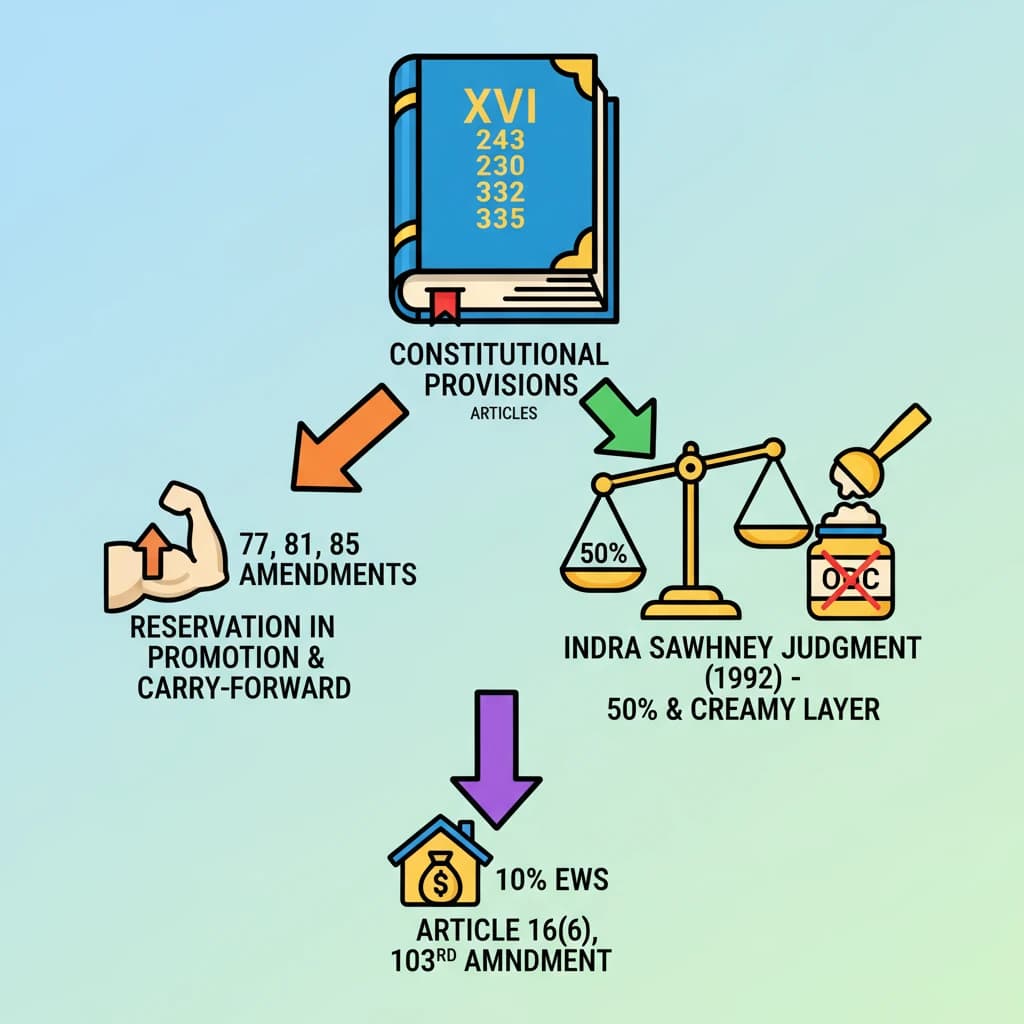
- Reservations are constitutional provisions (Articles 16, 243D/T, 330, 332, 335) for positive discrimination.
- Key amendments (77th, 81st, 85th) enabled reservation in promotion for SC/ST and the carry-forward rule.
- Indra Sawhney Judgment (1992) established the 50% ceiling and the 'creamy layer' concept for OBCs.
- Article 16(6) and the 103rd Amendment introduced 10% reservation for Economically Weaker Sections (EWS).
- Reservation policy balances social justice with the need for administrative efficiency (Article 335).
What are Developments Related to Reservations in India?
Medium⏱️ 8 min read
social issues
📖 Introduction
Introduction to Reservation Provisions
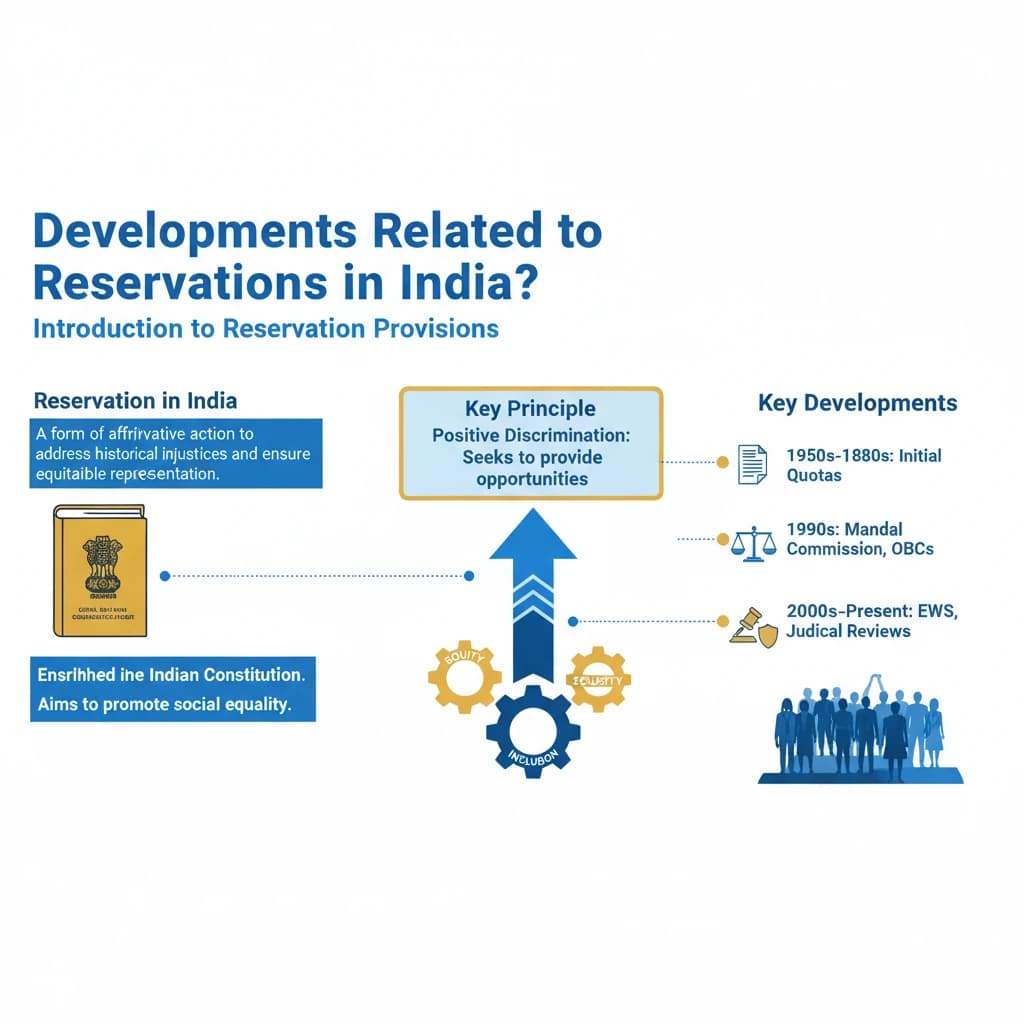
Reservation in India is a form of affirmative action designed to address historical injustices and ensure equitable representation for disadvantaged communities. It is primarily enshrined in the Indian Constitution, aiming to promote social equality.
The core principle behind reservations is positive discrimination, which seeks to provide opportunities to groups that have historically faced systemic discrimination and underrepresentation.
Article 16: Equality of Opportunity in Public Employment
Article 16 of the Indian Constitution guarantees equality of opportunity for all citizens in matters of public employment. However, it also provides for exceptions to enable the state to make special provisions for backward classes.
Article 16(4): Reservation for Backward Classes
Article 16(4) specifically empowers the state to make any provision for the reservation of appointments or posts in favour of any backward class of citizens. This is applicable if, in the opinion of the state, they are not adequately represented in the services under the state.
This clause forms the fundamental basis for reservations for Other Backward Classes (OBCs) in government jobs.
Article 16(4A): Reservation in Promotions
Article 16(4A) allows the state to provide for reservation in matters of promotion, with consequential seniority, to any class or classes of posts in the services under the state in favour of Scheduled Castes (SC) and Scheduled Tribes (ST). This provision addresses the historical disadvantage faced by these communities even after initial recruitment.
This clause was inserted by the Constitution (77th Amendment) Act, 1995, enabling the government to provide reservation in promotion for SCs and STs.
Later, Article 16(4A) was modified by the Constitution (85th Amendment) Act, 2001, to provide for consequential seniority to SC and ST candidates promoted by giving reservation. This ensured that their seniority was not affected by the reservation.
Article 16(4B): Carry-Forward Rule for Unfilled Vacancies
Article 16(4B) allows the state to consider any unfilled reserved vacancies from a previous year, meant for Scheduled Castes (SCs) and Scheduled Tribes (STs), as a separate class of vacancies to be filled in any succeeding year. This means these vacancies are not subject to the 50% ceiling limit on reservations for that year.
This clause was inserted by the 81st Constitutional Amendment Act, 2000, to ensure that reserved vacancies do not lapse and are carried forward effectively.
Article 16(6): Economically Weaker Sections (EWS)
Article 16(6) provides for the reservation of appointments or posts in favour of any Economically Weaker Sections (EWS) of citizens. This provision extends reservation benefits to those who are not covered under existing reservation schemes for SCs, STs, and OBCs.
This clause was introduced by the 103rd Constitutional Amendment Act, 2019, providing for up to 10% reservation for EWS.
Reservation in Local Self-Governments
The Constitution also mandates reservations in local self-governing bodies to ensure representation at the grassroots level.
- Article 243D provides for reservation of seats for Scheduled Castes (SCs) and Scheduled Tribes (STs) in every Panchayat.
- Article 243T provides for reservation of seats for Scheduled Castes (SCs) and Scheduled Tribes (STs) in every Municipality.
These articles are crucial for understanding the decentralized aspect of reservation policy and its impact on local governance, often asked in GS Paper II.
Administrative Efficiency and Legislative Representation
While ensuring representation, the Constitution also emphasizes the importance of administrative efficacy.
Article 335 states that the claims of SCs and STs shall be taken into consideration, consistently with the maintenance of efficiency of administration, in the making of appointments to services and posts in connection with the affairs of the Union or of a State.
Furthermore, specific provisions ensure their political representation:
- Article 330 provides for reservation of seats for SCs and STs in the Lok Sabha (Parliament).
- Article 332 provides for reservation of seats for SCs and STs in the State Legislative Assemblies.
💡 Key Takeaways
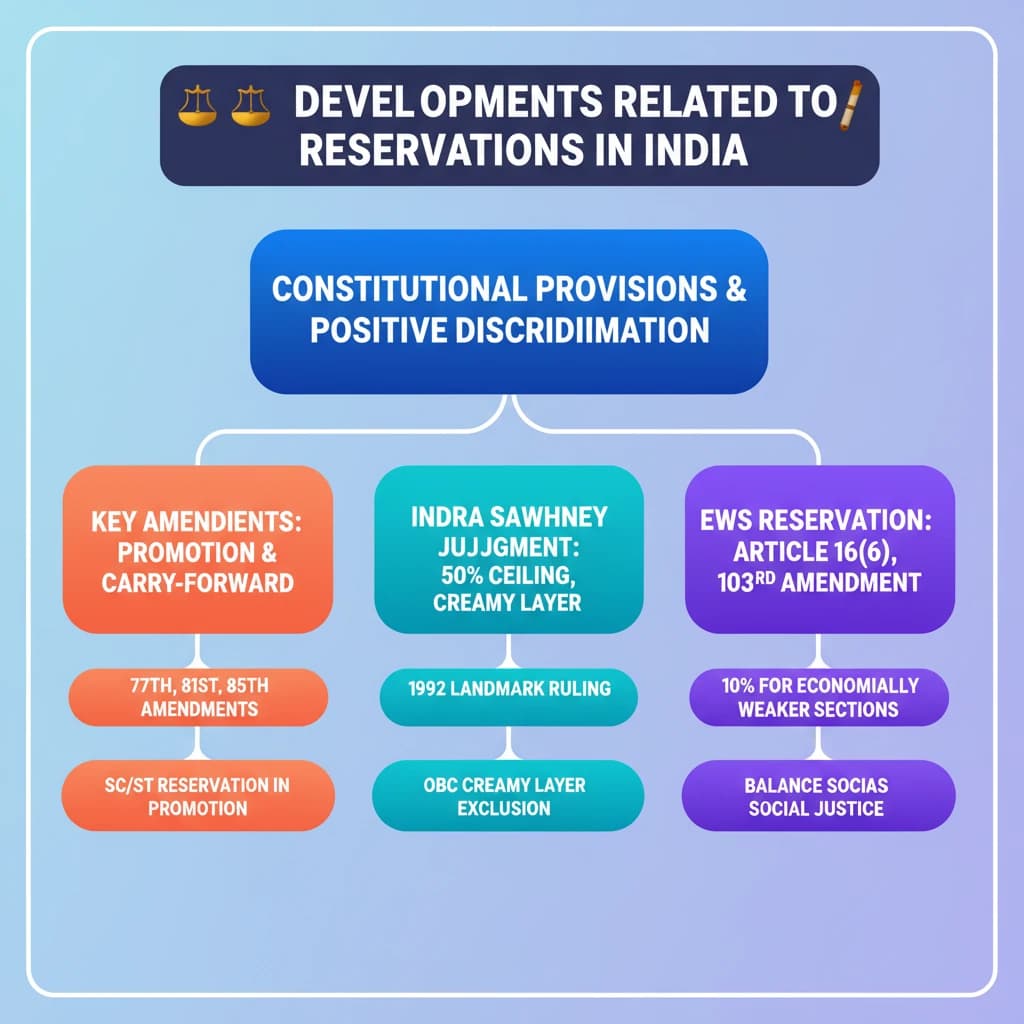
- •Reservations are constitutional provisions (Articles 16, 243D/T, 330, 332, 335) for positive discrimination.
- •Key amendments (77th, 81st, 85th) enabled reservation in promotion for SC/ST and the carry-forward rule.
- •Indra Sawhney Judgment (1992) established the 50% ceiling and the 'creamy layer' concept for OBCs.
- •Article 16(6) and the 103rd Amendment introduced 10% reservation for Economically Weaker Sections (EWS).
- •Reservation policy balances social justice with the need for administrative efficiency (Article 335).
🧠 Memory Techniques
98% Verified Content
📚 Reference Sources
•Supreme Court of India Judgments (Indra Sawhney vs. Union of India, 1992)
•Reports of the Mandal Commission
•Ministry of Social Justice and Empowerment, Government of India