Loading page, please wait…
What are India’s Initiatives to Curb Manual Scavenging? - UPSC Social Issues
What is What are India’s Initiatives to Curb Manual Scavenging? in UPSC Social Issues?
What are India’s Initiatives to Curb Manual Scavenging? is a key topic under Social Issues for UPSC Civil Services Examination. Key points include: Manual scavenging is a dehumanizing practice, legally prohibited but still prevalent in India.. Key initiatives include Safaimitra Suraksha Challenge, Swachhta Abhiyan App, and Rashtriya Garima Abhiyan.. NAMASTE scheme (MoSJE & MoHUA) aims for 'zero fatalities' in sanitation work through mechanization and worker safety.. Understanding this topic is essential for both UPSC Prelims and Mains preparation.
Why is What are India’s Initiatives to Curb Manual Scavenging? important for UPSC exam?
What are India’s Initiatives to Curb Manual Scavenging? is a Medium-level topic in UPSC Social Issues. It is tested in both Prelims (factual MCQs) and Mains (analytical answer writing). Previous year UPSC questions have frequently covered aspects of What are India’s Initiatives to Curb Manual Scavenging?, making it essential for comprehensive IAS preparation.
How to prepare What are India’s Initiatives to Curb Manual Scavenging? for UPSC?
To prepare What are India’s Initiatives to Curb Manual Scavenging? for UPSC: (1) Study the comprehensive notes covering all key concepts on Vaidra. (2) Practice previous year questions on this topic. (3) Connect it with current affairs using daily updates. (4) Revise using key takeaways and mind maps available for Social Issues. (5) Write practice answers linking What are India’s Initiatives to Curb Manual Scavenging? to related GS Paper topics.
Key takeaways of What are India’s Initiatives to Curb Manual Scavenging? for UPSC
- Manual scavenging is a dehumanizing practice, legally prohibited but still prevalent in India.
- Key initiatives include Safaimitra Suraksha Challenge, Swachhta Abhiyan App, and Rashtriya Garima Abhiyan.
- NAMASTE scheme (MoSJE & MoHUA) aims for 'zero fatalities' in sanitation work through mechanization and worker safety.
- Technological solutions like the Bandicoot Robot are crucial for eliminating human entry into hazardous sewers.
- Rehabilitation efforts like Swachhta Udyami Yojana (SUY) and Recognition of Prior Learning (RPL) provide alternative livelihoods.
- The National Commission for Safai Karamcharis (NCSK) monitors implementation of the 2013 Act and addresses grievances.
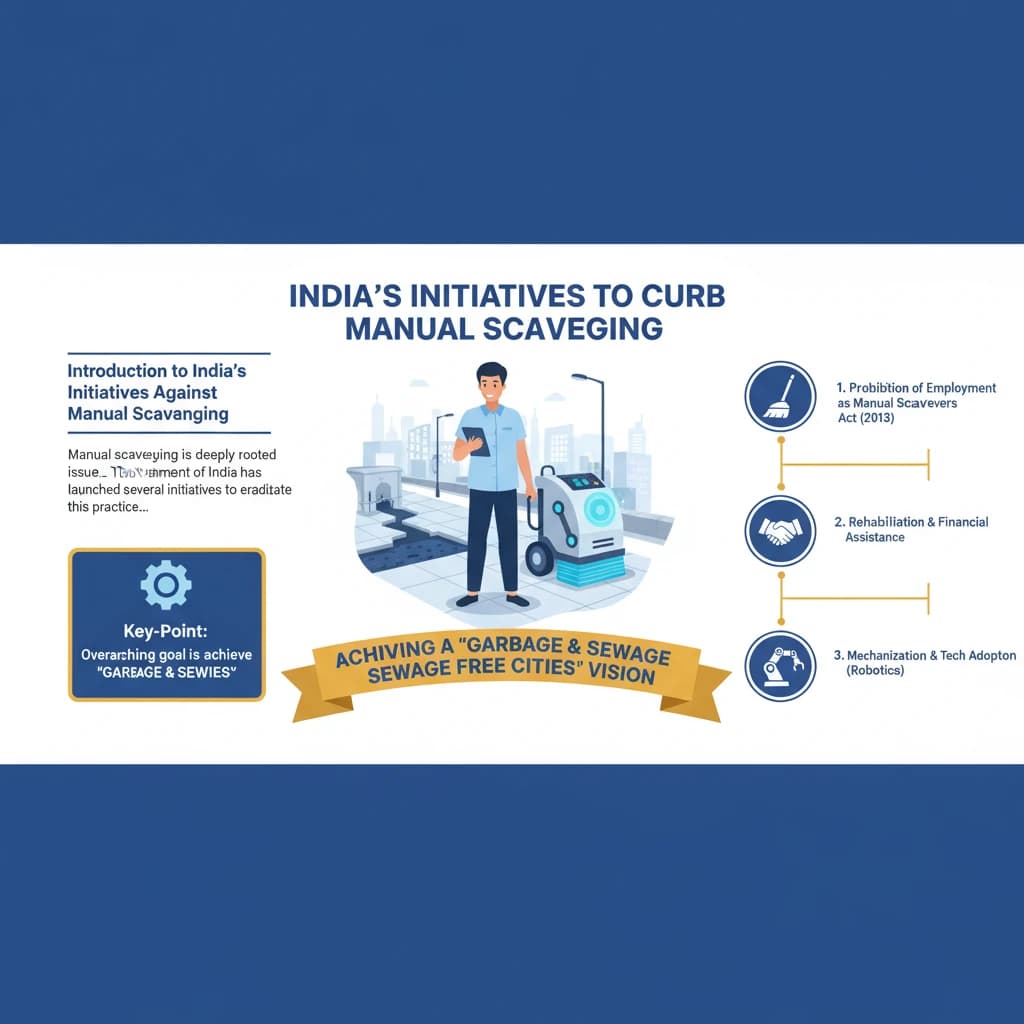
What are India’s Initiatives to Curb Manual Scavenging?
Medium⏱️ 8 min read
social issues
📖 Introduction
Introduction to India's Initiatives Against Manual Scavenging
Manual scavenging is a deeply rooted social issue in India, involving the manual cleaning of human excreta from dry latrines and sewers. The Government of India has launched several initiatives to eradicate this practice, ensure the dignity of sanitation workers, and provide them with alternative livelihoods.
The overarching goal of these initiatives is to achieve a 'zero fatality' rate in sanitation work and completely eliminate human entry into hazardous cleaning operations.
Safaimitra Suraksha Challenge
The Safaimitra Suraksha Challenge was launched to eliminate manual scavenging and promote the mechanization of sewer and septic tank cleaning operations. It emphasizes the safety and dignity of sanitation workers.
This challenge was launched by the Ministry of Housing and Urban Affairs (MoHUA). It encourages cities to adopt mechanized cleaning solutions and ensure proper safety equipment for workers.
Swachhta Abhiyan App
The Swachhta Abhiyan App serves as a crucial tool for identifying and geo-tagging manual scavengers across the country. This data helps in tracking and facilitating their rehabilitation.
The app aims to ensure that no manual scavenger remains unidentified, enabling targeted interventions and support for their transition to dignified work.
Rashtriya Garima Abhiyan
The Rashtriya Garima Abhiyan is a significant campaign aimed at eradicating manual scavenging and rehabilitating those engaged in it. It focuses on awareness generation and community mobilization.
This campaign is spearheaded by the National Campaign for Dignity and Eradication of Manual Scavenging (NACDEM), working at the grassroots level to bring about social change.
National Commission for Safai Karamcharis (NCSK)
The National Commission for Safai Karamcharis (NCSK) plays a vital role in monitoring the implementation of the Prohibition of Employment as Manual Scavengers and their Rehabilitation Act, 2013.
The commission also investigates specific grievances and takes necessary actions to protect the rights and dignity of sanitation workers.
Swachhta Udyami Yojana (SUY)
The Swachhta Udyami Yojana (SUY) is a scheme designed to provide financial assistance to manual scavengers and their dependents. It supports them in undertaking sanitation-related enterprises.
This scheme is implemented by the National Safai Karamcharis Finance and Development Corporation (NSKFDC), offering loans for viable projects to promote alternative livelihoods.
Recognition of Prior Learning (RPL)
Under the Pradhan Mantri Kaushal Vikas Yojana (PMKVY), the Recognition of Prior Learning (RPL) program aims to certify the existing skills of sanitation workers.
By formally recognizing their skills, RPL enhances their employability in other sectors, facilitating their rehabilitation and integration into the mainstream workforce.
NAMASTE (National Action for Mechanised Sanitation Ecosystem)
NAMASTE is a joint initiative launched by the Ministry of Social Justice & Empowerment (MoSJE) and the Ministry of Housing and Urban Affairs (MoHUA).
Its primary goal is to achieve zero fatalities in sanitation work across India. It focuses on mechanization, providing training, and ensuring the availability of safety gear for sanitation workers.
NAMASTE aims to provide alternative livelihoods and comprehensive safety to sanitation workers, thereby eliminating the need for human entry into hazardous cleaning environments.
Emergency Response Sanitation Units (ERSUs)
As part of the NAMASTE initiative, Emergency Response Sanitation Units (ERSUs) are being developed. These units comprise a professional, well-trained, and adequately equipped workforce.
ERSUs are designed to handle sanitation emergencies safely and efficiently, further reducing human exposure to hazardous conditions.
Technological Initiatives: Bandicoot Robot
Technological advancements are crucial in curbing manual scavenging. The Bandicoot Robot is a prime example of such an initiative.
The Bandicoot Robot is designed to autonomously or remotely clean, inspect, and remove blockages in sewer lines, eliminating the need for human entry.
UPSC Insight: Questions on social justice often require knowledge of specific government schemes and their impact. Understanding the synergy between technology and policy (e.g., Bandicoot Robot and NAMASTE) is crucial for comprehensive answers in GS Paper I and GS Paper II.
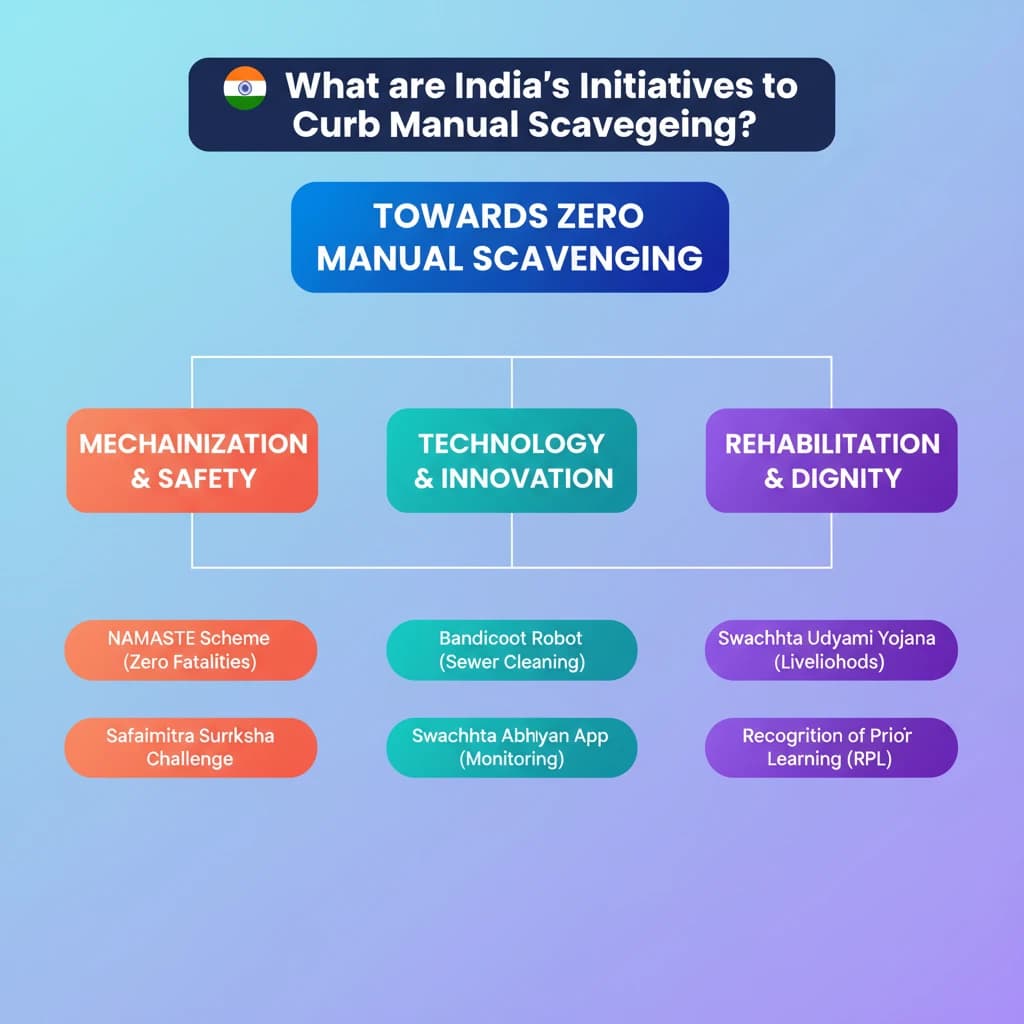
💡 Key Takeaways
- •Manual scavenging is a dehumanizing practice, legally prohibited but still prevalent in India.
- •Key initiatives include Safaimitra Suraksha Challenge, Swachhta Abhiyan App, and Rashtriya Garima Abhiyan.
- •NAMASTE scheme (MoSJE & MoHUA) aims for 'zero fatalities' in sanitation work through mechanization and worker safety.
- •Technological solutions like the Bandicoot Robot are crucial for eliminating human entry into hazardous sewers.
- •Rehabilitation efforts like Swachhta Udyami Yojana (SUY) and Recognition of Prior Learning (RPL) provide alternative livelihoods.
- •The National Commission for Safai Karamcharis (NCSK) monitors implementation of the 2013 Act and addresses grievances.
🧠 Memory Techniques

95% Verified Content
📚 Reference Sources
•Ministry of Social Justice & Empowerment (MoSJE) Annual Reports
•Ministry of Housing and Urban Affairs (MoHUA) Publications
•The Prohibition of Employment as Manual Scavengers and their Rehabilitation Act, 2013
•National Commission for Safai Karamcharis (NCSK) official website