Loading page, please wait…
What are Key Provisions for Intestate (Without a Will) Succession Under HSA, 1956? - UPSC Social Issues
What is What are Key Provisions for Intestate (Without a Will) Succession Under HSA, 1956? in UPSC Social Issues?
What are Key Provisions for Intestate (Without a Will) Succession Under HSA, 1956? is a key topic under Social Issues for UPSC Civil Services Examination. Key points include: HSA, 1956 governs intestate succession for Hindus, Buddhists, Jains, and Sikhs.. For Hindu women, property first goes to children and husband. If none, then husband's heirs, then her parents' heirs.. Property inherited by a woman from parents/in-laws returns to that source family if she dies intestate without direct heirs.. Understanding this topic is essential for both UPSC Prelims and Mains preparation.
Why is What are Key Provisions for Intestate (Without a Will) Succession Under HSA, 1956? important for UPSC exam?
What are Key Provisions for Intestate (Without a Will) Succession Under HSA, 1956? is a Medium-level topic in UPSC Social Issues. It is tested in both Prelims (factual MCQs) and Mains (analytical answer writing). Previous year UPSC questions have frequently covered aspects of What are Key Provisions for Intestate (Without a Will) Succession Under HSA, 1956?, making it essential for comprehensive IAS preparation.
How to prepare What are Key Provisions for Intestate (Without a Will) Succession Under HSA, 1956? for UPSC?
To prepare What are Key Provisions for Intestate (Without a Will) Succession Under HSA, 1956? for UPSC: (1) Study the comprehensive notes covering all key concepts on Vaidra. (2) Practice previous year questions on this topic. (3) Connect it with current affairs using daily updates. (4) Revise using key takeaways and mind maps available for Social Issues. (5) Write practice answers linking What are Key Provisions for Intestate (Without a Will) Succession Under HSA, 1956? to related GS Paper topics.
Key takeaways of What are Key Provisions for Intestate (Without a Will) Succession Under HSA, 1956? for UPSC
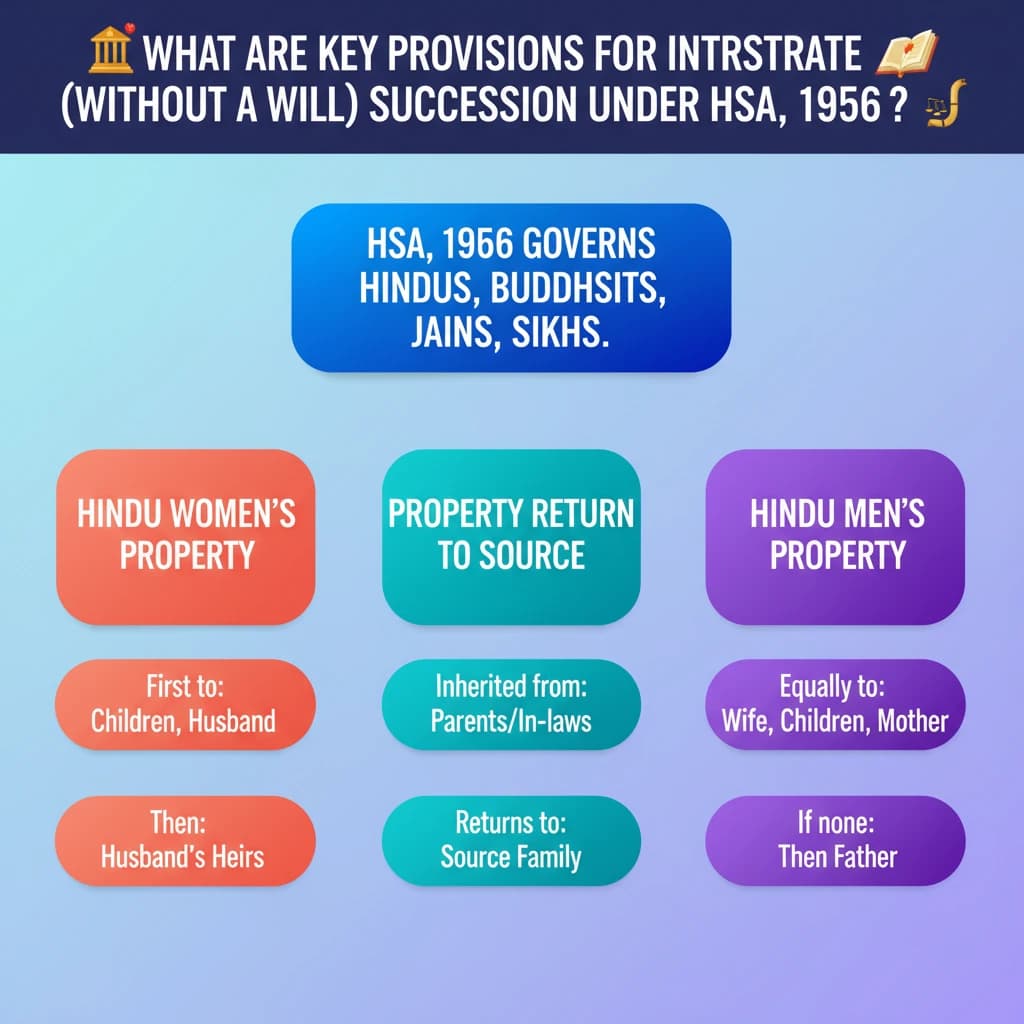
- HSA, 1956 governs intestate succession for Hindus, Buddhists, Jains, and Sikhs.
- For Hindu women, property first goes to children and husband. If none, then husband's heirs, then her parents' heirs.
- Property inherited by a woman from parents/in-laws returns to that source family if she dies intestate without direct heirs.
- For Hindu men, property is equally divided among wife, children, and mother. If none, then father.
- The Act codified and reformed traditional Hindu laws, promoting women's property rights and ensuring legal clarity.
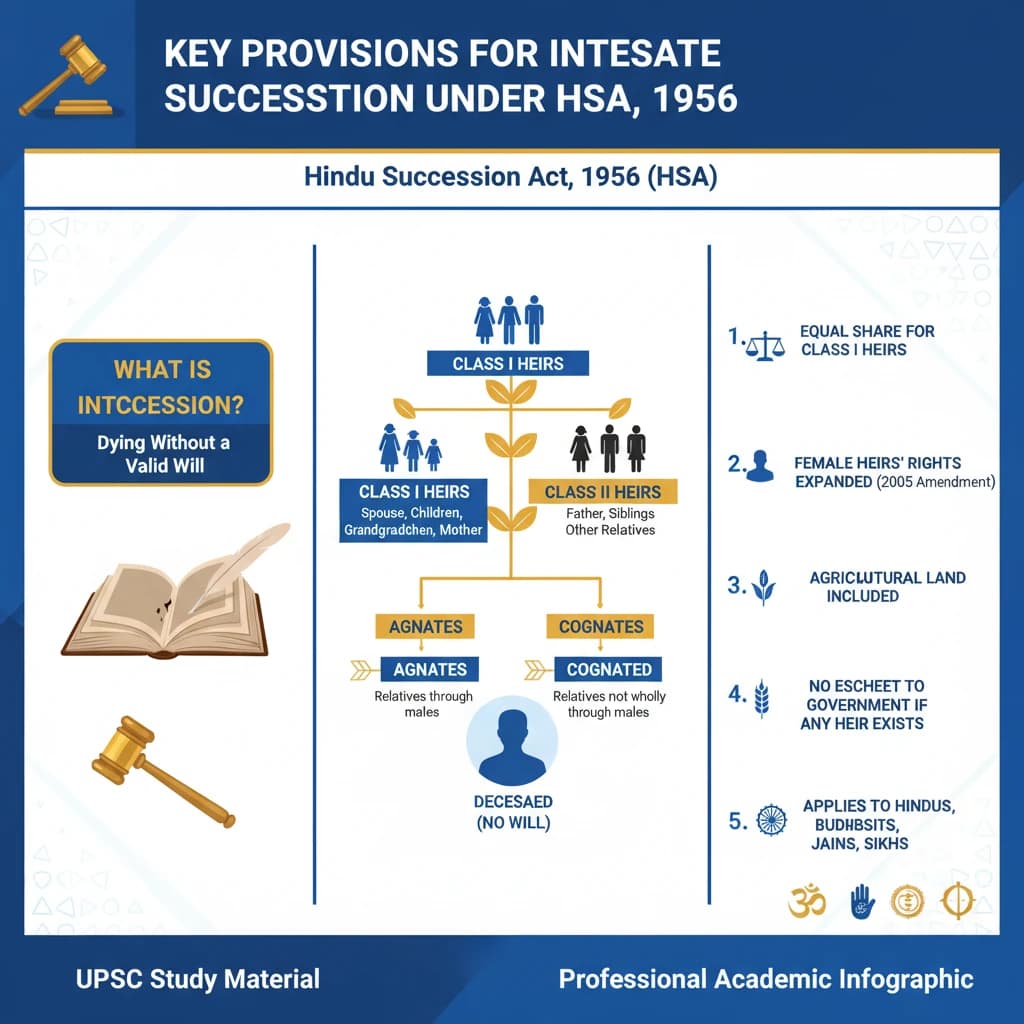
What are Key Provisions for Intestate (Without a Will) Succession Under HSA, 1956?
Medium⏱️ 6 min read
social issues
📖 Introduction
Understanding Intestate Succession under HSA, 1956
The Hindu Succession Act, 1956 (HSA) governs the distribution of property for Hindus, Buddhists, Jains, and Sikhs who die intestate, meaning without a valid will. This Act provides a clear framework for how assets are inherited by legal heirs.
Key Concept: Intestate Succession
Intestate succession refers to the legal process of distributing the property of a person who dies without leaving a will. The Hindu Succession Act, 1956, specifically lays down the rules for Hindus in such cases.
Provisions for Hindu Women Dying Intestate
When a Hindu woman passes away without a will, her property, including any self-acquired assets, is inherited according to a specific order of preference defined by the Act.
Order of Succession for Hindu Women:
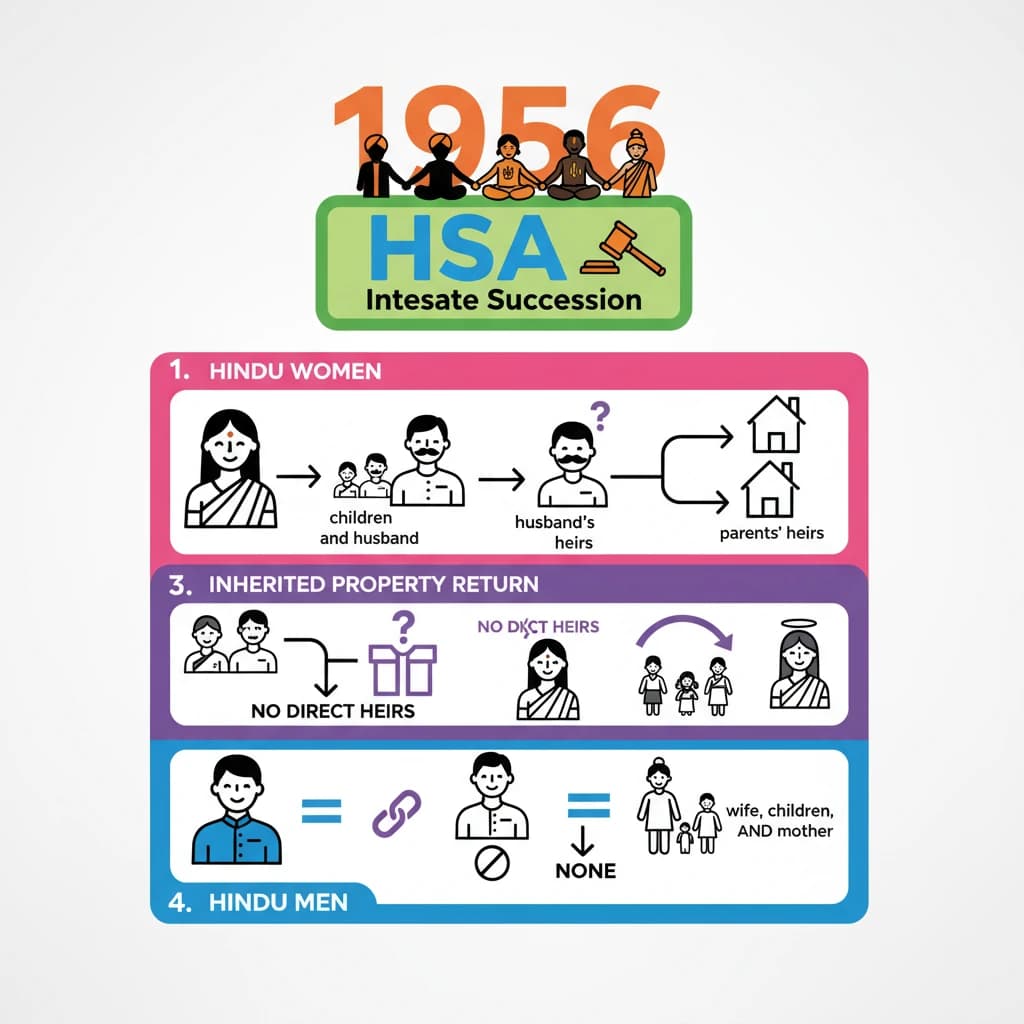
- Primary Heirs: Her children (including pre-deceased children's children) and her husband.
- Secondary Heirs (if no primary heirs): The heirs of her husband. This means the property would go to her husband's family.
- Tertiary Heirs (if no husband's heirs): Only in the absence of any heirs from her husband's side does the property pass to her own parents or their heirs.
A special provision exists for property inherited from specific sources. If the property was inherited by the woman from her parents or her husband's family (in-laws), it reverts to that original source family if she dies intestate and without direct heirs (children).
Provisions for Hindu Men Dying Intestate
In cases where a Hindu man dies without a will, his property is distributed among his immediate family members in equal shares.
Order of Succession for Hindu Men:
- Primary Heirs: His wife, his children (including pre-deceased children's children), and his mother. These individuals inherit simultaneously and equally.
- Secondary Heir (if no primary heirs): If none of the primary successors (wife, children, mother) exist, the property then devolves upon his father.
UPSC Insight: Understanding the nuances of intestate succession for both men and women under the HSA, 1956, is crucial for questions on Social Issues, Gender Justice, and Personal Laws. Note the distinct difference in the order of succession for women's property, especially regarding its return to the source family.
💡 Key Takeaways
- •HSA, 1956 governs intestate succession for Hindus, Buddhists, Jains, and Sikhs.
- •For Hindu women, property first goes to children and husband. If none, then husband's heirs, then her parents' heirs.
- •Property inherited by a woman from parents/in-laws returns to that source family if she dies intestate without direct heirs.
- •For Hindu men, property is equally divided among wife, children, and mother. If none, then father.
- •The Act codified and reformed traditional Hindu laws, promoting women's property rights and ensuring legal clarity.
🧠 Memory Techniques
98% Verified Content
📚 Reference Sources
•Hindu Succession Act, 1956 (Bare Act)