Loading page, please wait…
What are the Associated Judicial Verdicts Regarding Right to Shelter? - UPSC Social Issues
What is What are the Associated Judicial Verdicts Regarding Right to Shelter? in UPSC Social Issues?
What are the Associated Judicial Verdicts Regarding Right to Shelter? is a key topic under Social Issues for UPSC Civil Services Examination. Key points include: Right to Shelter is an implied fundamental right under Article 21 (Right to Life).. Judiciary has consistently linked shelter to livelihood and human dignity.. Forced evictions without due process or rehabilitation are unconstitutional.. Understanding this topic is essential for both UPSC Prelims and Mains preparation.
Why is What are the Associated Judicial Verdicts Regarding Right to Shelter? important for UPSC exam?
What are the Associated Judicial Verdicts Regarding Right to Shelter? is a Medium-level topic in UPSC Social Issues. It is tested in both Prelims (factual MCQs) and Mains (analytical answer writing). Previous year UPSC questions have frequently covered aspects of What are the Associated Judicial Verdicts Regarding Right to Shelter?, making it essential for comprehensive IAS preparation.
How to prepare What are the Associated Judicial Verdicts Regarding Right to Shelter? for UPSC?
To prepare What are the Associated Judicial Verdicts Regarding Right to Shelter? for UPSC: (1) Study the comprehensive notes covering all key concepts on Vaidra. (2) Practice previous year questions on this topic. (3) Connect it with current affairs using daily updates. (4) Revise using key takeaways and mind maps available for Social Issues. (5) Write practice answers linking What are the Associated Judicial Verdicts Regarding Right to Shelter? to related GS Paper topics.
Key takeaways of What are the Associated Judicial Verdicts Regarding Right to Shelter? for UPSC
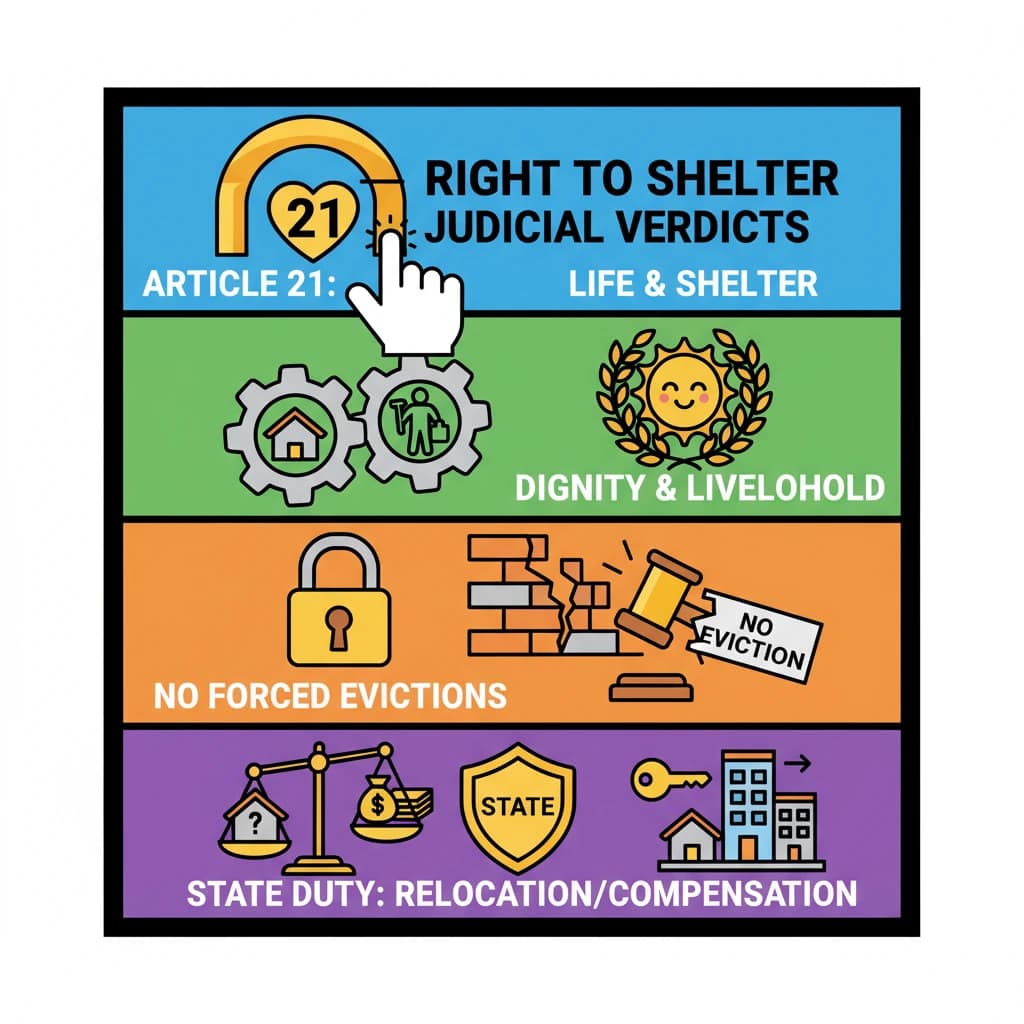
- Right to Shelter is an implied fundamental right under Article 21 (Right to Life).
- Judiciary has consistently linked shelter to livelihood and human dignity.
- Forced evictions without due process or rehabilitation are unconstitutional.
- State has a duty to provide alternative accommodation or compensation during evictions.
- Laws like Slum Areas Act and Forest Rights Act provide legislative support for shelter rights.
What are the Associated Judicial Verdicts Regarding Right to Shelter?
Medium⏱️ 10 min read
social issues
📖 Introduction
Introduction to Right to Shelter and Judicial Scrutiny
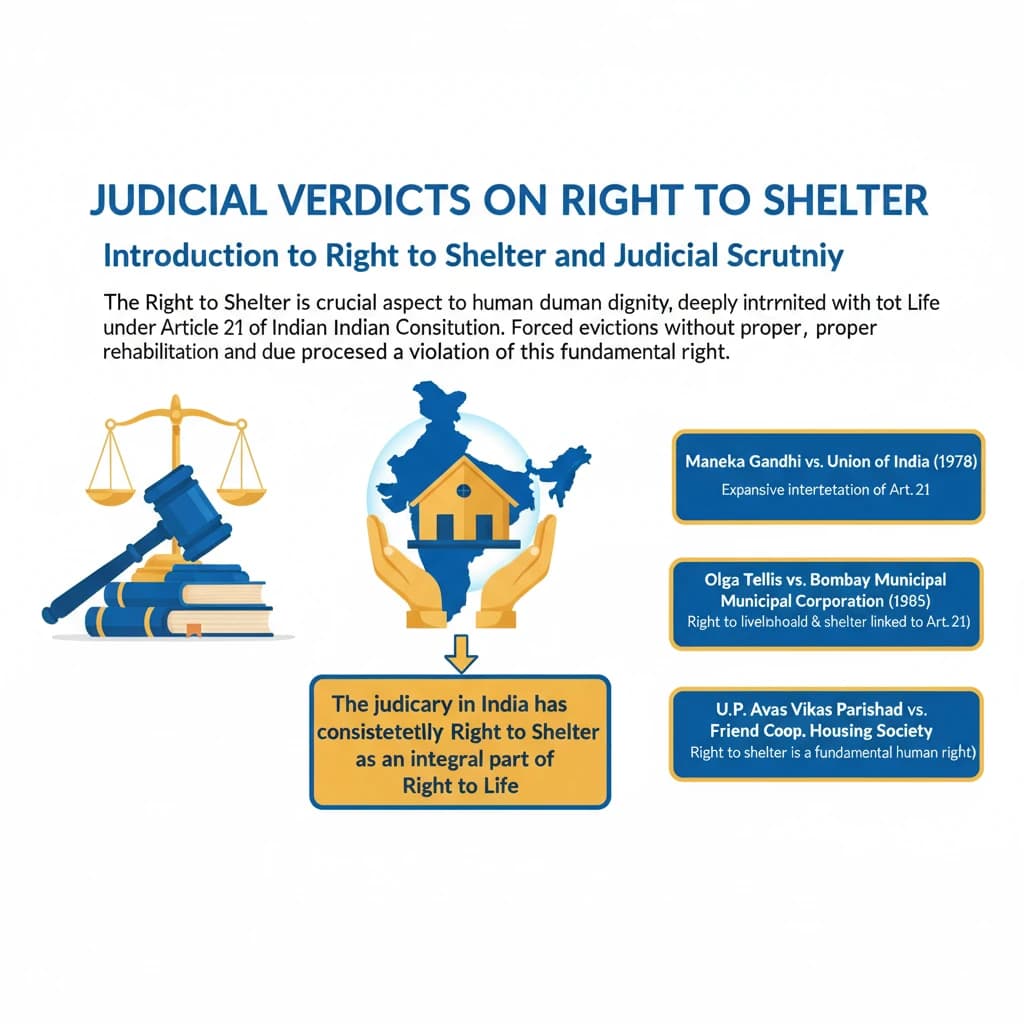
The Right to Shelter is a crucial aspect of human dignity, deeply intertwined with the Right to Life under Article 21 of the Indian Constitution. Forced evictions without proper rehabilitation and due process are considered a violation of this fundamental right.
The judiciary in India has consistently interpreted the Right to Shelter as an integral part of the Right to Life, emphasizing the State's obligation to provide adequate living conditions or rehabilitation.
Key Judicial Verdicts on Right to Shelter
Indian courts have delivered several landmark judgments, strengthening the recognition and enforcement of the Right to Shelter.
Case: Olga Tellis v. Bombay Municipal Corporation (1985)
Ruling: Slum dwellers filed a PIL against eviction without alternate accommodation. The Supreme Court held that eviction without due process breached the right to livelihood, which is part of the Right to Life. It stressed the State’s duty to secure adequate means of livelihood before depriving people of their rights.
Case: State of Maharashtra v. Basantibai Khetan (1986)
Ruling: The Supreme Court upheld land ceiling laws, affirming they do not violate fundamental rights. However, it clarified that the State is responsible for providing rehabilitation and resettlement to those affected by such laws.
Case: Chameli Singh v. State of UP (1995)
Ruling: Justice Ramaswamy explicitly held that the Right to Shelter is a fundamental right under Article 21 (Right to Life) and is also linked to the right to residence under Article 19(1)(e).
Case: Ahmedabad Municipal Corporation v. Ahmed Singh and Gulab Singh (1996)
Ruling: Similar to the Olga Tellis case, the court reiterated that eviction of pavement dwellers must be conditional upon them being provided with alternate accommodation.
Case: Sudama Singh and others v. State of Delhi and others (2010)
Ruling: Petitioners sought relocation from slum clusters. The Delhi High Court ruled that any eviction must include adequate compensation or alternate accommodation for the affected individuals.
Legislative Support for Right to Shelter
Beyond judicial pronouncements, specific laws have been enacted to support and regulate the Right to Shelter, particularly for vulnerable populations.
Slum Areas (Improvement and Clearance) Act, 1956: This act authorizes the government to clear slum areas deemed unfit for habitation due to health and safety risks. It mandates that redevelopment plans be formulated to replace substandard housing with better, more durable structures.
The Scheduled Tribes and Other Traditional Forest Dwellers (Recognition of Forest Rights) Act, 2006 (FRA): This crucial legislation provides the right to hold and live in forest land under individual or common occupation for habitation or self-cultivation for livelihood, thereby securing shelter for forest-dwelling communities.
UPSC Insight: Understanding these judicial verdicts and supporting laws is vital for questions on social justice, urbanization challenges, and fundamental rights in GS Paper I and II. Remember to quote specific cases to substantiate your arguments.
💡 Key Takeaways
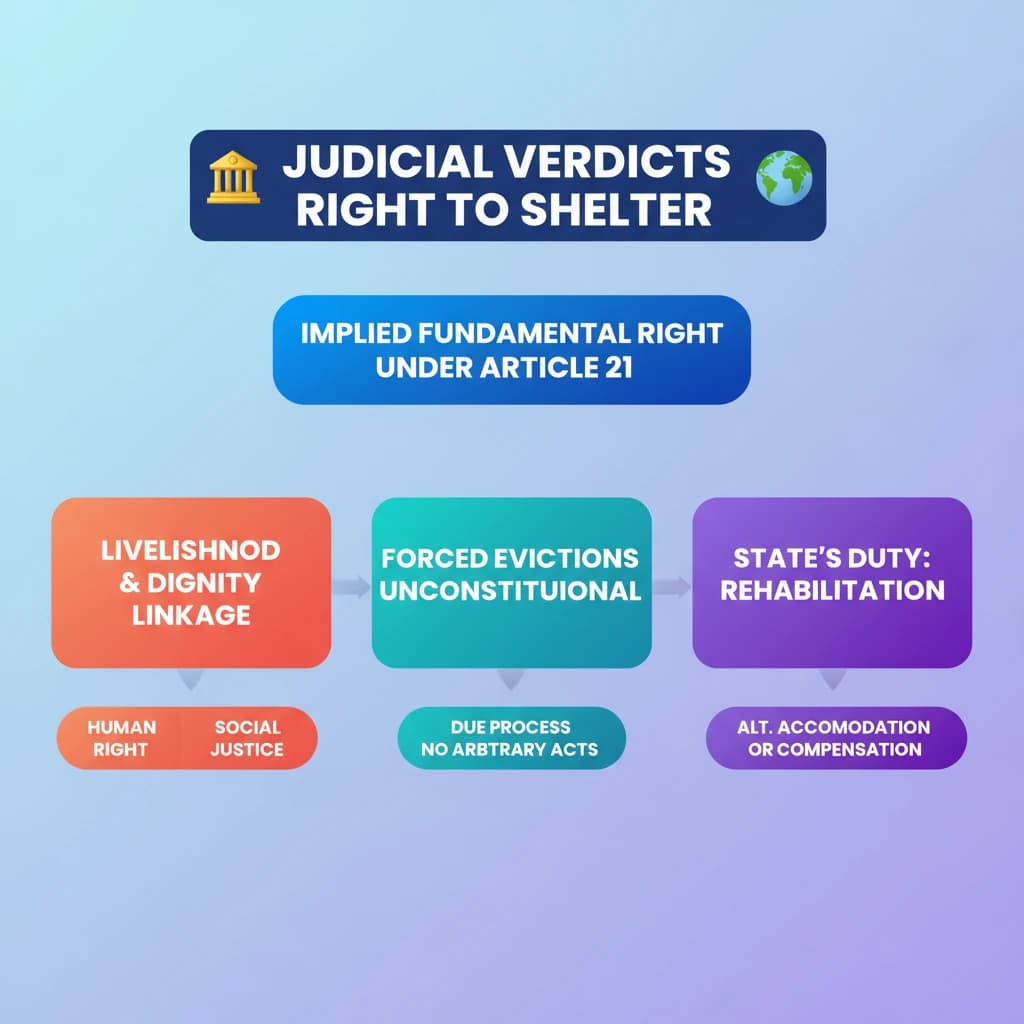
- •Right to Shelter is an implied fundamental right under Article 21 (Right to Life).
- •Judiciary has consistently linked shelter to livelihood and human dignity.
- •Forced evictions without due process or rehabilitation are unconstitutional.
- •State has a duty to provide alternative accommodation or compensation during evictions.
- •Laws like Slum Areas Act and Forest Rights Act provide legislative support for shelter rights.
🧠 Memory Techniques
98% Verified Content
📚 Reference Sources
•Supreme Court of India judgments (Olga Tellis, Chameli Singh, Basantibai Khetan, Ahmedabad Municipal Corporation, Sudama Singh)
•The Slum Areas (Improvement and Clearance) Act, 1956
•The Scheduled Tribes and Other Traditional Forest Dwellers (Recognition of Forest Rights) Act, 2006