Loading page, please wait…
What are the Government Schemes Related to Promotion of AYUSH in India? - UPSC Social Issues
What is What are the Government Schemes Related to Promotion of AYUSH in India? in UPSC Social Issues?
What are the Government Schemes Related to Promotion of AYUSH in India? is a key topic under Social Issues for UPSC Civil Services Examination. Key points include: Government promotes AYUSH via Centrally Sponsored (e.g., National Ayush Mission) and Central Sector Schemes (e.g., Ayur Gyan).. National Ayush Mission (2014) strengthens AYUSH infrastructure, education, manpower, and quality control.. Ayur Gyan (FY 2021-26) focuses on capacity building, CME for professionals, and research & innovation in AYUSH.. Understanding this topic is essential for both UPSC Prelims and Mains preparation.
Why is What are the Government Schemes Related to Promotion of AYUSH in India? important for UPSC exam?
What are the Government Schemes Related to Promotion of AYUSH in India? is a Medium-level topic in UPSC Social Issues. It is tested in both Prelims (factual MCQs) and Mains (analytical answer writing). Previous year UPSC questions have frequently covered aspects of What are the Government Schemes Related to Promotion of AYUSH in India?, making it essential for comprehensive IAS preparation.
How to prepare What are the Government Schemes Related to Promotion of AYUSH in India? for UPSC?
To prepare What are the Government Schemes Related to Promotion of AYUSH in India? for UPSC: (1) Study the comprehensive notes covering all key concepts on Vaidra. (2) Practice previous year questions on this topic. (3) Connect it with current affairs using daily updates. (4) Revise using key takeaways and mind maps available for Social Issues. (5) Write practice answers linking What are the Government Schemes Related to Promotion of AYUSH in India? to related GS Paper topics.
Key takeaways of What are the Government Schemes Related to Promotion of AYUSH in India? for UPSC
- Government promotes AYUSH via Centrally Sponsored (e.g., National Ayush Mission) and Central Sector Schemes (e.g., Ayur Gyan).
- National Ayush Mission (2014) strengthens AYUSH infrastructure, education, manpower, and quality control.
- Ayur Gyan (FY 2021-26) focuses on capacity building, CME for professionals, and research & innovation in AYUSH.
- AYURSWASHTHYA Yojana supports AYUSH institutions through its Centre of Excellence program for facility and research improvement.
- Champion Service Sector Scheme boosts medical tourism, promoting Ayurveda and Yoga to attract international patients.
- Promotion of International Cooperation in AYUSH aims for global awareness, development, and recognition of Indian traditional medicine.
What are the Government Schemes Related to Promotion of AYUSH in India?
Medium⏱️ 7 min read
social issues
📖 Introduction
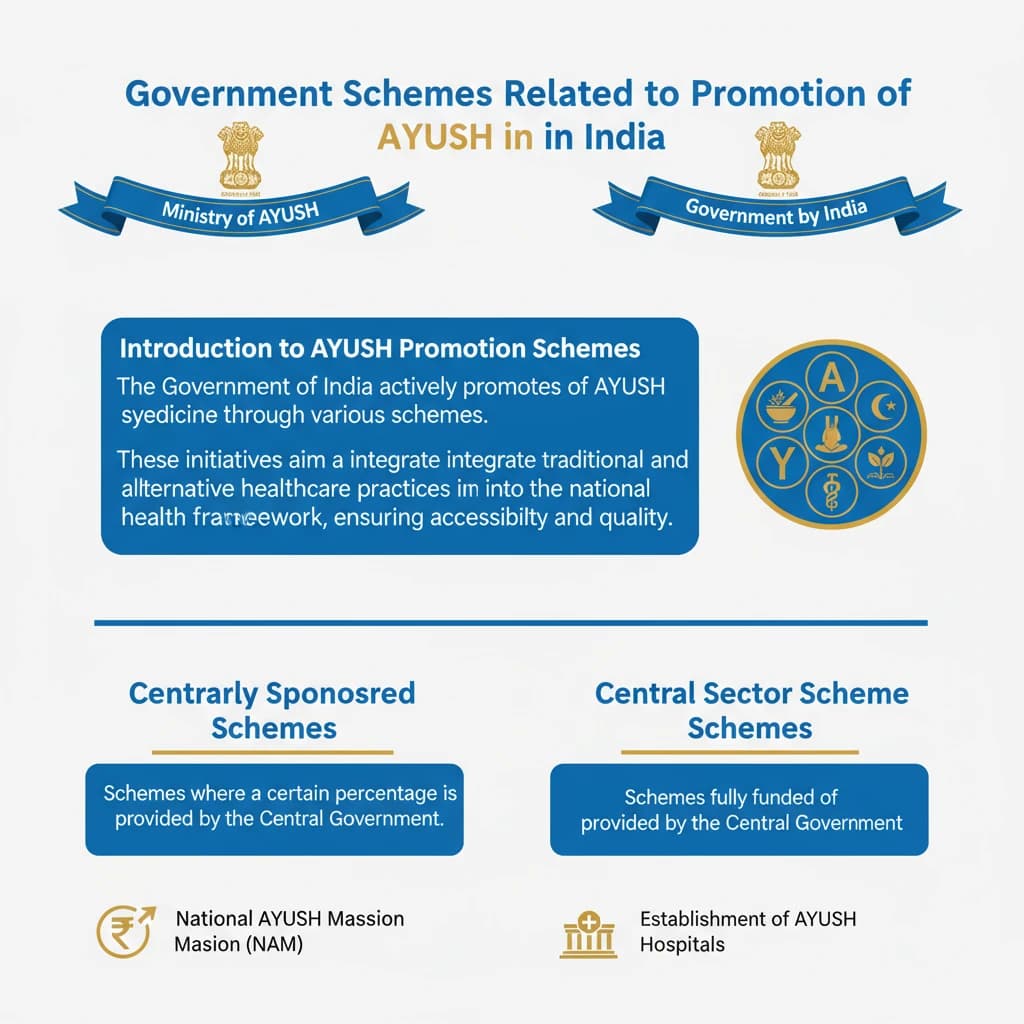
Introduction to AYUSH Promotion Schemes
The Government of India actively promotes the AYUSH systems of medicine through various schemes.
These initiatives aim to integrate traditional and alternative healthcare practices into the national health framework, ensuring accessibility and quality.
Centrally Sponsored Schemes
Centrally Sponsored Schemes are those where a certain percentage of funding is provided by the Central Government, and the rest is borne by the State Governments.
National Ayush Mission (NAM)
Launch Year: 2014
The National Ayush Mission (NAM) was launched to promote the traditional and cost-effective AYUSH system of medicine across India.
It emphasizes strengthening the overall infrastructure for AYUSH practices.
Key Focus Areas of NAM:
- Infrastructure Development: Enhancing facilities for AYUSH.
- Education and Research: Promoting academic and scientific advancements.
- Manpower Augmentation: Increasing the number of qualified AYUSH professionals.
- Quality Control: Ensuring high standards in AYUSH services and products.
UPSC Insight: NAM is crucial for understanding India's commitment to integrating traditional medicine into primary healthcare. It is often linked to discussions on public health and holistic wellness.
Central Sector Schemes
Central Sector Schemes are 100% funded by the Central Government and implemented by the Central Government machinery.
Ayur Gyan Scheme
Approval Period: FY 2021-22 to FY 2025-26
The Ayur Gyan scheme is designed to foster education, research, and innovation within the AYUSH sector.
It aims to bridge knowledge gaps and support scientific advancements in traditional medicine.
Components of Ayur Gyan:
- Capacity Building and Continuing Medical Education (CME) in AYUSH: Provides training to AYUSH Professionals to enhance their skills and knowledge.
- Research & Innovation in AYUSH: Supports research activities, particularly in areas aligned with national health programs.
UPSC Insight: This scheme highlights the government's focus on professional development and evidence-based research in AYUSH, crucial for its mainstream acceptance.
AYURSWASHTHYA Yojana
The AYURSWASHTHYA Yojana focuses on granting financial assistance to organizations and institutes working in AYUSH.
This funding is primarily channeled through its Centre of Excellence program.
Objective: To improve facilities, research capabilities, and overall operational efficiency of AYUSH institutions.
UPSC Insight: This scheme is vital for understanding how the government supports institutional growth and quality enhancement in the AYUSH sector, impacting both education and service delivery.
Champion Service Sector Scheme
The Champion Service Sector Scheme has a broader objective of boosting medical tourism in India.
It specifically promotes traditional medicine systems like Ayurveda and Yoga as key attractions.
Goal: To attract a significant number of international patients, tourists, and visitors seeking unique healthcare options in India, leveraging its rich traditional medical heritage.
UPSC Insight: This scheme connects AYUSH with economic development, specifically the service sector and tourism. It's relevant for discussions on soft power and economic diversification.
Promotion of International Cooperation in AYUSH
This scheme is dedicated to enhancing the global footprint of AYUSH Systems of Medicine.
It aims to foster greater awareness and interest in traditional Indian healthcare practices worldwide.
Key Objectives:
- To promote and strengthen awareness and interest about AYUSH Systems of Medicine.
- To facilitate the international promotion, development, and recognition of AYUSH.
UPSC Insight: This scheme is important for understanding India's efforts in cultural diplomacy and projecting its traditional knowledge globally, relevant for International Relations (GS-II).
💡 Key Takeaways
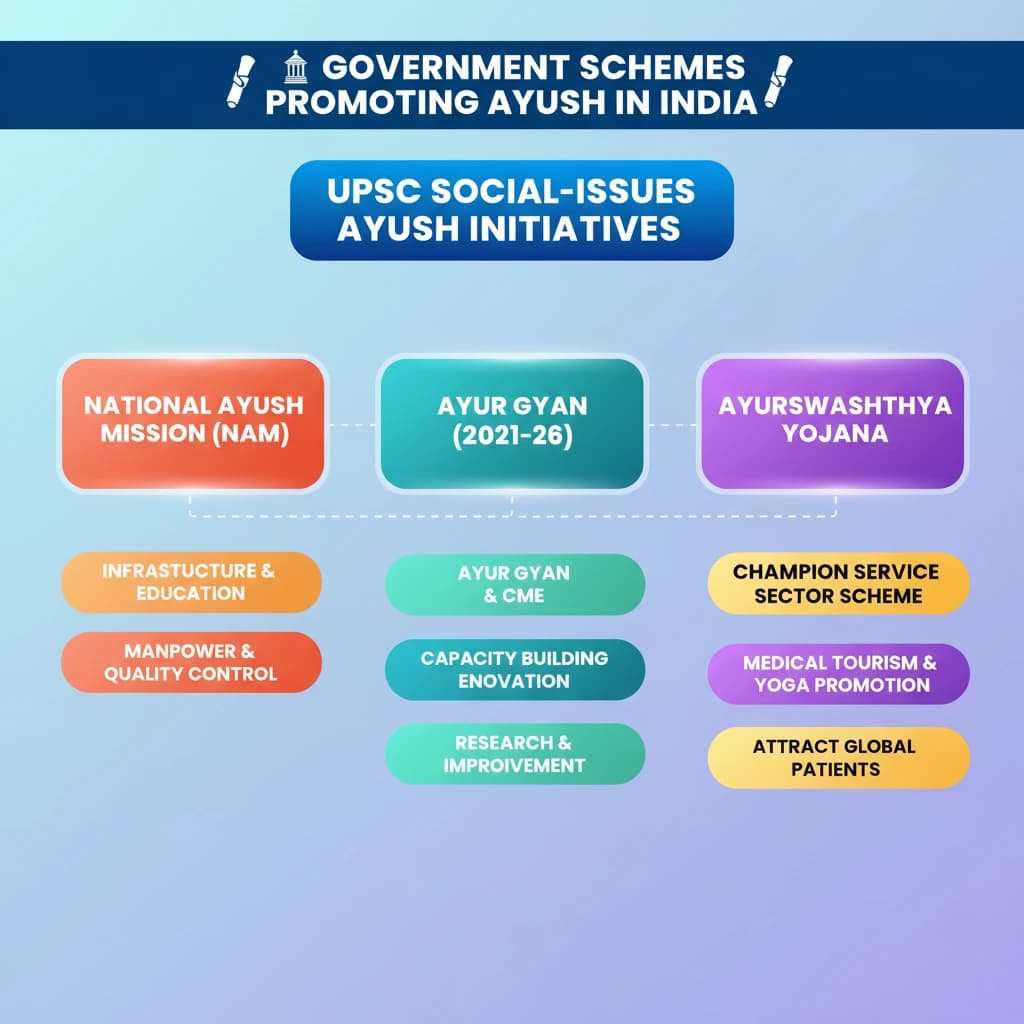
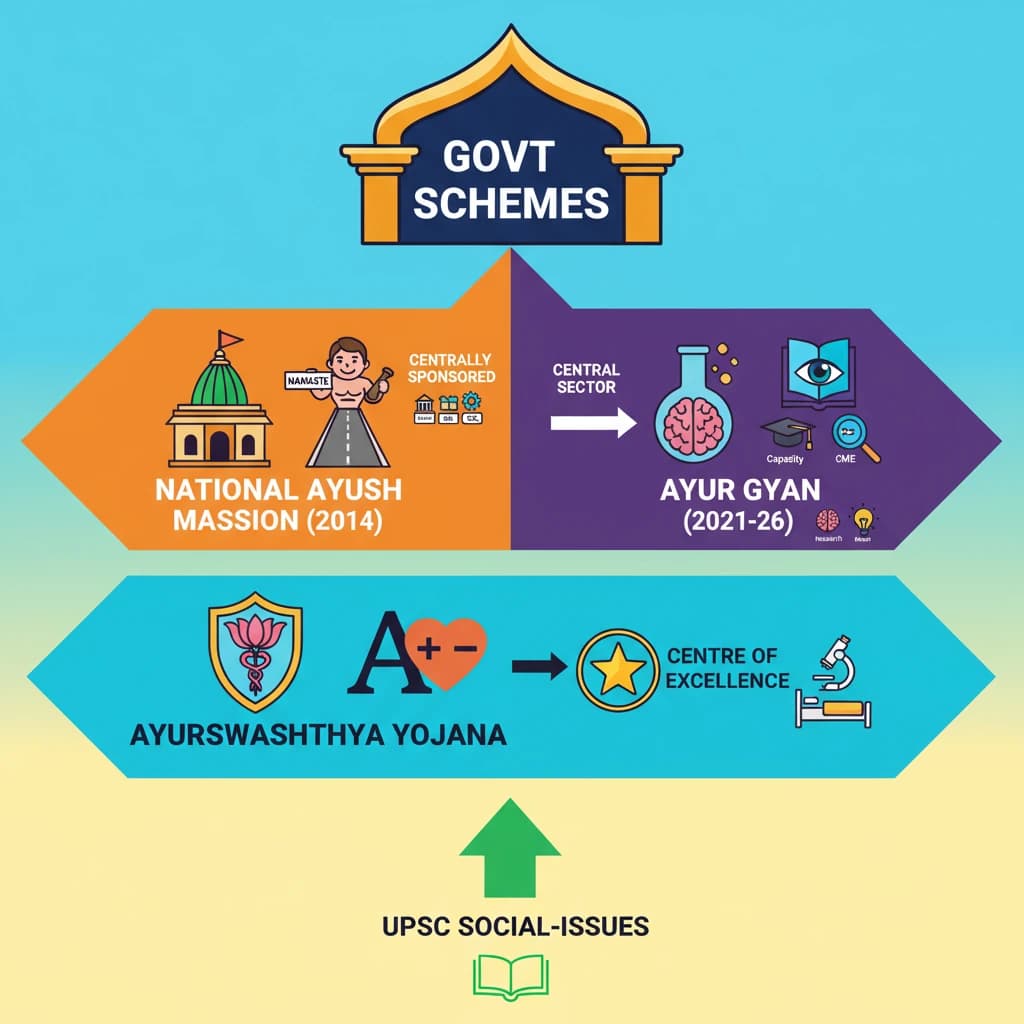
- •Government promotes AYUSH via Centrally Sponsored (e.g., National Ayush Mission) and Central Sector Schemes (e.g., Ayur Gyan).
- •National Ayush Mission (2014) strengthens AYUSH infrastructure, education, manpower, and quality control.
- •Ayur Gyan (FY 2021-26) focuses on capacity building, CME for professionals, and research & innovation in AYUSH.
- •AYURSWASHTHYA Yojana supports AYUSH institutions through its Centre of Excellence program for facility and research improvement.
- •Champion Service Sector Scheme boosts medical tourism, promoting Ayurveda and Yoga to attract international patients.
- •Promotion of International Cooperation in AYUSH aims for global awareness, development, and recognition of Indian traditional medicine.
🧠 Memory Techniques
95% Verified Content