Loading page, please wait…
What are the Other Provisions Related to Surrogacy in India? - UPSC Social Issues
What is What are the Other Provisions Related to Surrogacy in India? in UPSC Social Issues?
What are the Other Provisions Related to Surrogacy in India? is a key topic under Social Issues for UPSC Civil Services Examination. Key points include: Surrogacy in India is strictly permitted only for <strong>altruistic purposes</strong> under the 2021 Act.. <strong>Commercial surrogacy</strong> is completely <strong>prohibited</strong> to prevent exploitation.. Intending couples must meet strict criteria: <strong>5 years married</strong>, specific <strong>age limits</strong>, and generally <strong>no living child</strong> (with exceptions).. Understanding this topic is essential for both UPSC Prelims and Mains preparation.
Why is What are the Other Provisions Related to Surrogacy in India? important for UPSC exam?
What are the Other Provisions Related to Surrogacy in India? is a Medium-level topic in UPSC Social Issues. It is tested in both Prelims (factual MCQs) and Mains (analytical answer writing). Previous year UPSC questions have frequently covered aspects of What are the Other Provisions Related to Surrogacy in India?, making it essential for comprehensive IAS preparation.
How to prepare What are the Other Provisions Related to Surrogacy in India? for UPSC?
To prepare What are the Other Provisions Related to Surrogacy in India? for UPSC: (1) Study the comprehensive notes covering all key concepts on Vaidra. (2) Practice previous year questions on this topic. (3) Connect it with current affairs using daily updates. (4) Revise using key takeaways and mind maps available for Social Issues. (5) Write practice answers linking What are the Other Provisions Related to Surrogacy in India? to related GS Paper topics.
Key takeaways of What are the Other Provisions Related to Surrogacy in India? for UPSC
- Surrogacy in India is strictly permitted only for <strong>altruistic purposes</strong> under the 2021 Act.
- <strong>Commercial surrogacy</strong> is completely <strong>prohibited</strong> to prevent exploitation.
- Intending couples must meet strict criteria: <strong>5 years married</strong>, specific <strong>age limits</strong>, and generally <strong>no living child</strong> (with exceptions).
- Surrogate mothers must be a <strong>close relative</strong>, married, have their own child, be aged <strong>25-35 years</strong>, and can only be a surrogate <strong>once</strong>.
- The child born through surrogacy is legally recognized as the <strong>biological child of the intending couple</strong>.
What are the Other Provisions Related to Surrogacy in India?
Medium⏱️ 8 min read
social issues
📖 Introduction
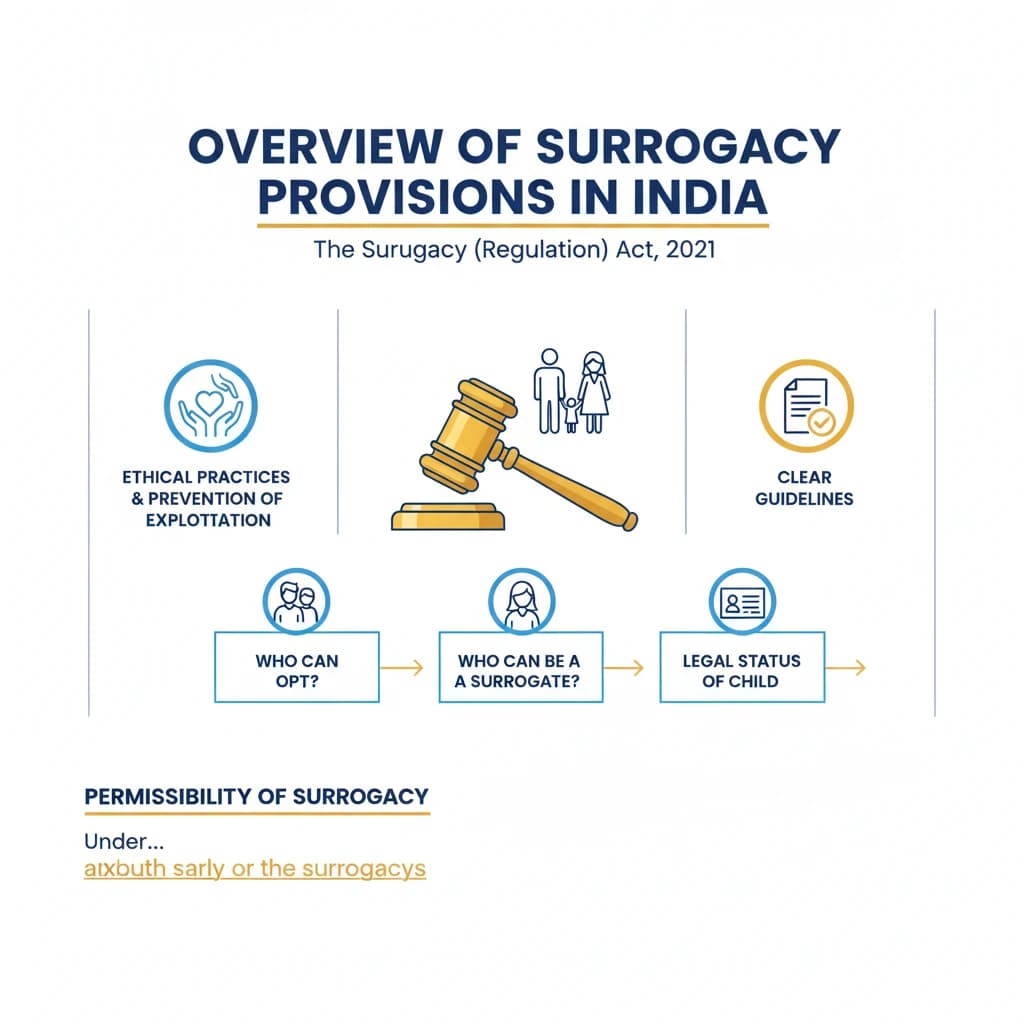
Overview of Surrogacy Provisions in India
The Surrogacy (Regulation) Act, 2021, governs the practice of surrogacy in India. This legislation aims to regulate the procedure, ensuring ethical practices and preventing exploitation of surrogate mothers and children.
It establishes clear guidelines for who can opt for surrogacy, who can be a surrogate mother, and the legal status of the child born through this process.
Permissibility of Surrogacy
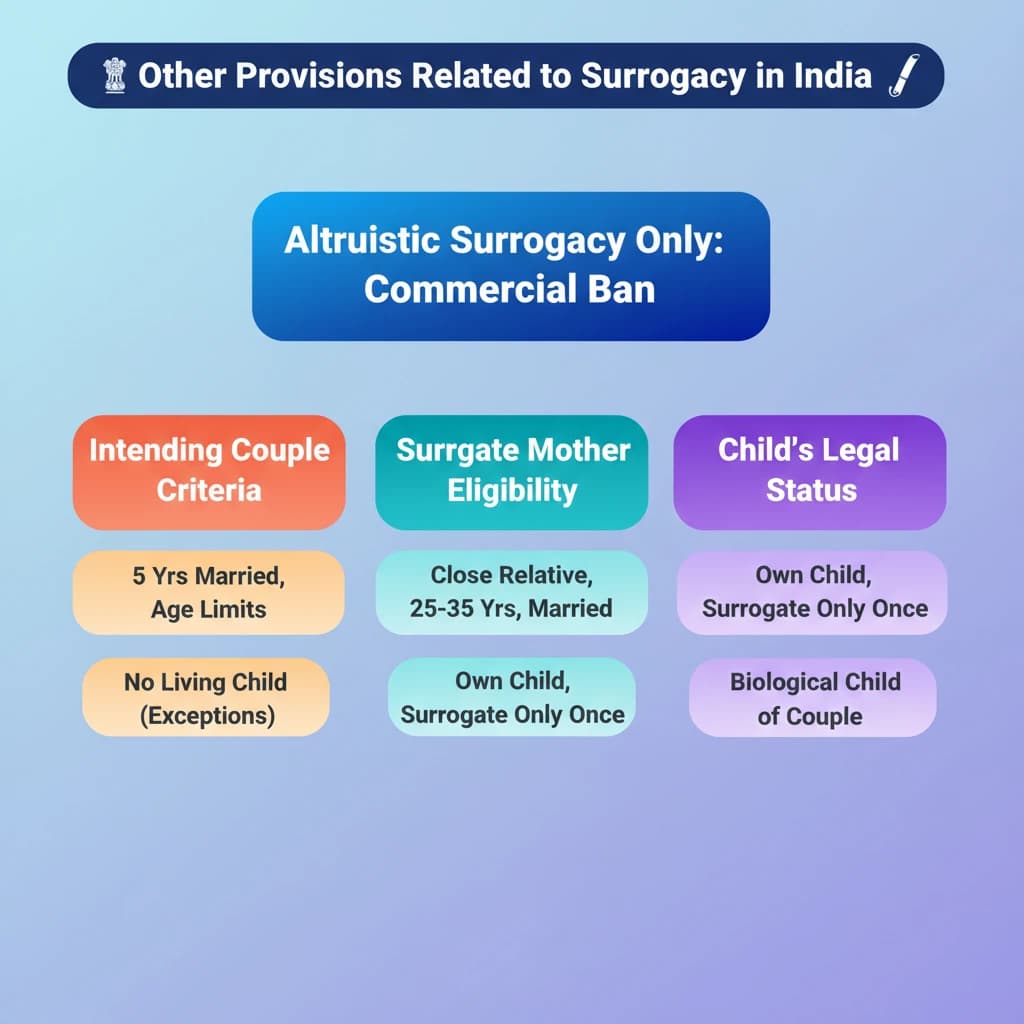
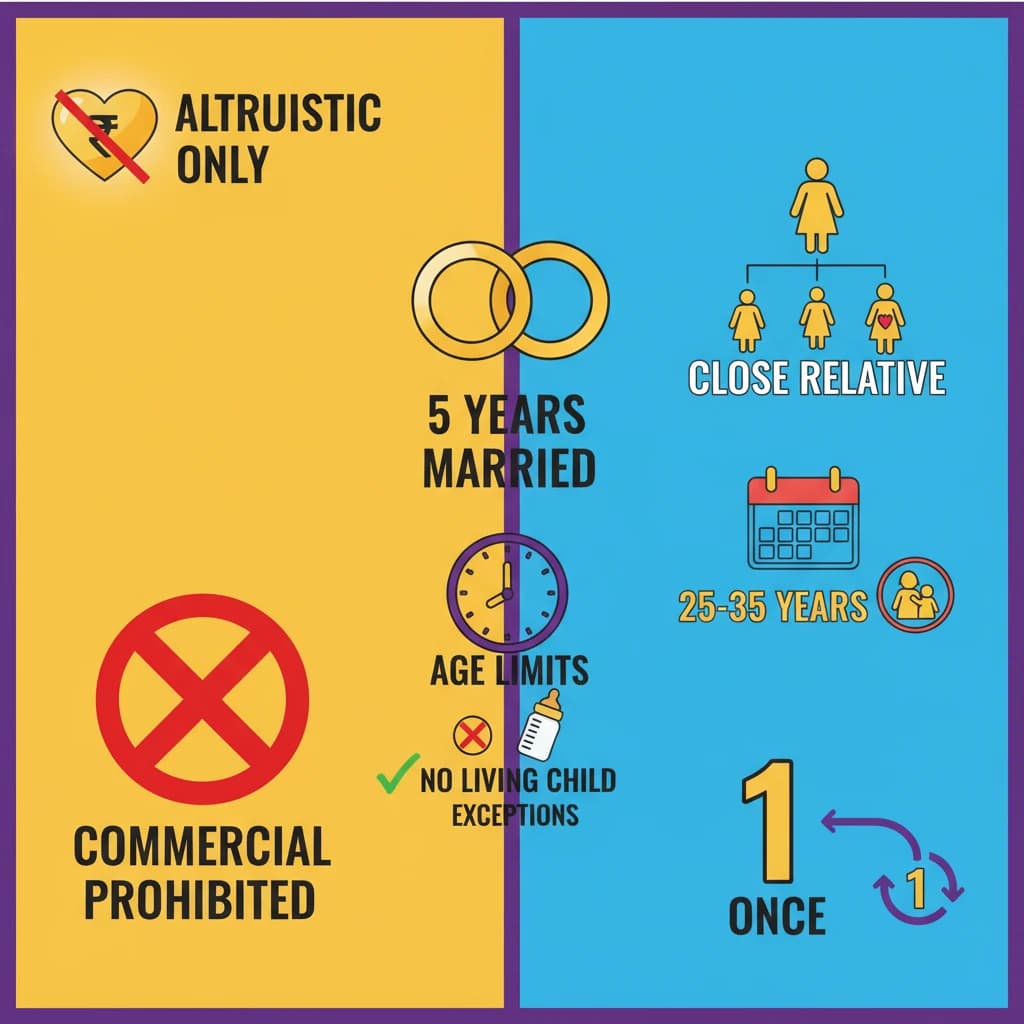
Under the Surrogacy (Regulation) Act, 2021, surrogacy is permitted strictly for altruistic purposes. This means that the surrogate mother cannot receive any monetary compensation beyond medical expenses and insurance coverage.
It is allowed only for couples who have proven infertility or a disease that prevents them from conceiving a child naturally or carrying a pregnancy to term.
Commercial surrogacy is unequivocally prohibited in India. This includes any surrogacy arrangement involving payment, sale, or exploitation of the surrogate mother.
Eligibility Criteria for Intending Couples
Specific conditions must be met by couples wishing to opt for surrogacy. These criteria ensure that the process is undertaken by genuine cases of need and prevents misuse.
- The couple must be legally married for at least five years.
- The wife's age must be between 25 and 50 years.
- The husband's age must be between 26 and 55 years.
A crucial provision states that the couple must not have any living child. This includes biological, adopted, or previously born through surrogacy. However, there is an important exception.
The 'no living child' rule has an exception: if the existing child suffers from a disability or a life-threatening disorder, the couple may still be eligible for surrogacy.
Criteria for Surrogate Mother
The Act lays down stringent requirements for a woman to be eligible as a surrogate mother, primarily to safeguard her health and prevent exploitation.
- She must be a close relative of the intending couple.
- She must be a married woman and have at least one child of her own.
- Her age must be between 25 and 35 years.
A woman can only be a surrogate mother once in her lifetime. This provision is designed to protect the health and well-being of the surrogate.
Legal Parental Status of the Child
Upon the birth of the child through surrogacy, the legal status is clear and unambiguous. The child is immediately recognized as belonging to the intending parents.
The child born out of a surrogacy procedure is legally recognized as the biological child of the intending couple. This ensures their parental rights and responsibilities are established from birth.
💡 Key Takeaways
- •Surrogacy in India is strictly permitted only for <strong>altruistic purposes</strong> under the 2021 Act.
- •<strong>Commercial surrogacy</strong> is completely <strong>prohibited</strong> to prevent exploitation.
- •Intending couples must meet strict criteria: <strong>5 years married</strong>, specific <strong>age limits</strong>, and generally <strong>no living child</strong> (with exceptions).
- •Surrogate mothers must be a <strong>close relative</strong>, married, have their own child, be aged <strong>25-35 years</strong>, and can only be a surrogate <strong>once</strong>.
- •The child born through surrogacy is legally recognized as the <strong>biological child of the intending couple</strong>.
🧠 Memory Techniques
95% Verified Content
📚 Reference Sources
•The Surrogacy (Regulation) Act, 2021 (Official Gazette of India)